It’s almost the new year.
Time for a quick dust-up, round-up to get your finances in order before the new year.

This article was written by a Financial Horse Contributor.
1) “Use-it-or-lose-it” tax reliefs (deadline: 31 Dec 2025)
A. CPF Cash Top-Ups (RSTU / MA)
- Relief cap (cash top-ups): $8k (self) + $8k (family) per YA; subject to the $80k total personal relief cap and the CPF Annual Limit $37,740.
- Practical: If you and your spouse/parents are in different tax bands, run the numbers—often topping up a parent’s RA/MA yields higher household savings.
B. SRS (Supplementary Retirement Scheme)
- Contribution cap: $15,300 (SG/PR) or $35,700 (foreigners).
- Contribute by 31 Dec 2025 to reduce YA2026 taxable income (still subject to the $80k overall cap).
C. Charitable giving (IPCs)
- 250% tax deduction remains in force through 31 Dec 2026 (current policy). Donations auto-transmit to IRAS.
Check the $80k relief cap before topping up. Model your CPF Annual Limit (salary + bonus CPF + any voluntary top-ups) to avoid reversals.
2) Park idle cash smartly
Segment your cash:
- 1–3 months expenses → high-yield savings.
- 3–12 months → 6-month T-bill ladder / SSBs rolled monthly.
- >12 months → short-duration bond funds or term deposits (rate-shop).
Execution tip: Put MAS auction dates in your calendar; roll maturing T-bills into the next auction automatically.
3) Optimise CPF across the family
Suggested sequence:
- Top up MediSave (MA) to BHS first.
- MA is versatile (pays MediShield/IP/riders, hospital bills).
- When MA is at Basic Healthcare Sum (BHS), future mandatory CPF “overflow” can channel to SA (<55) or RA (≥55), compounding at higher rates.
- Then top up SA/RA (RSTU).
- Your SA (<55) acts like a “super-bond.”
- Parents’/grandparents’ RA top-ups can meaningfully boost lifelong payouts.
- Voluntary Housing Refund (OA).
- If you used OA for housing, refunding voluntarily cuts accrued interest and rebuilds OA.
- Think of it as earning the OA rate, risk-free, by paying yourself back.
Note:
- Track the CPF Annual Limit ($37,740) with your year-end bonus in mind.
- Don’t overfill MA above BHS (excess gives you no extra benefit and may cause reversals).
4) Lock in 2026 automations now
- GIROs for income tax, property tax —smoother cashflow, fewer penalties.
- Auto-invest DCA into your core ETF(s)
Rules-based alerts:- “Bank bonus criteria met?” on the 25th monthly.
- “Miles/points expire?” quarterly.
- “SRS deploy?” monthly if your SRS is sitting in cash.
5) Insurance: boring but essential
Annual coverage check: term life, CI, TPD, H&S (IP + rider).
Ensure the emergency fund covers deductibles/co-pays (so you don’t sell assets at bad prices).
Price-shop riders; remove overlaps (e.g., employer plan + your own).
6) Estate planning — the no-drama version
The goal is to make it simple and drama-free for loved ones to access money and follow your wishes.
- Will
- Name an executor, list beneficiaries plainly, include a simple asset locator (banks/brokers/policies).
- Get it done with a lawyer so there is no dispute.
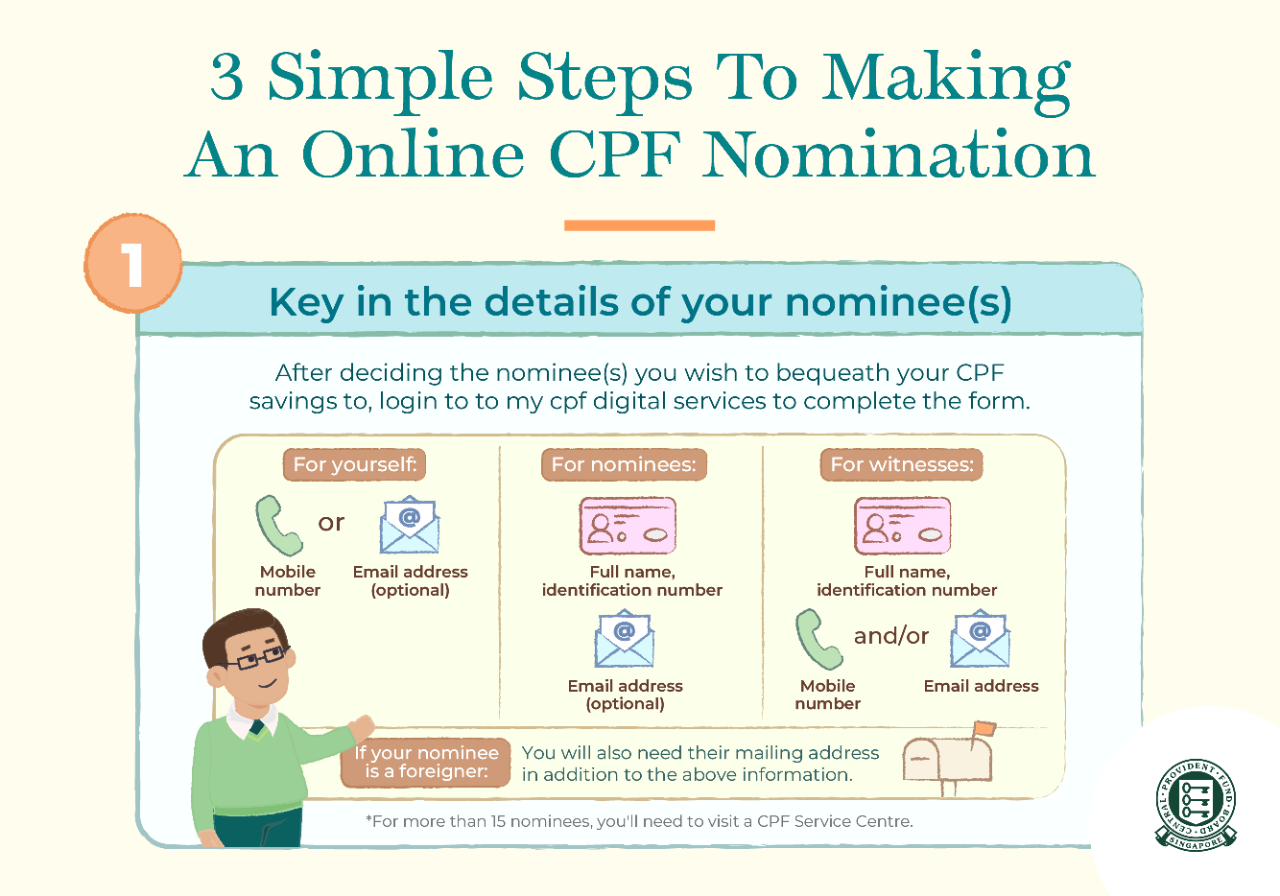
- CPF Nomination (5 minutes).
- CPF doesn’t follow your will. Set/update nomination with clear percentages.
- CPF doesn’t follow your will. Set/update nomination with clear percentages.
- Insurance nominations.
- Confirm each policy’s nominee. Decide trust vs revocable nomination deliberately.
- Confirm each policy’s nominee. Decide trust vs revocable nomination deliberately.
- Letter of Wishes
- Kids/guardianship preferences, where documents live, password manager access, funeral notes.
- Store with your will; share with the executor.
7) Small leaks can sink a big ship
An annual budget check sets you up for success in the new year.
Find the zombies (subscriptions, apps, memberships).
- Tag your Top 5 by cost → keep, downgrade, or kill.
- If unsure, use a 30-day snooze: cancel now; re-subscribe only if you truly miss it.
Utilities & telco quick switch.
- Match real usage (kWh/GB) to new-customer promos.
- If the breakeven is < 6 months, switch. Calendar the new contract end date.
Brokerage & banking clean-up.
- Consolidate to keep it simple and maintenance low.
- Close dormant accounts (fees + fraud risk).
- Keep 2–3 cards aligned to your spend; cancel the rest to avoid annual fees and mental clutter.

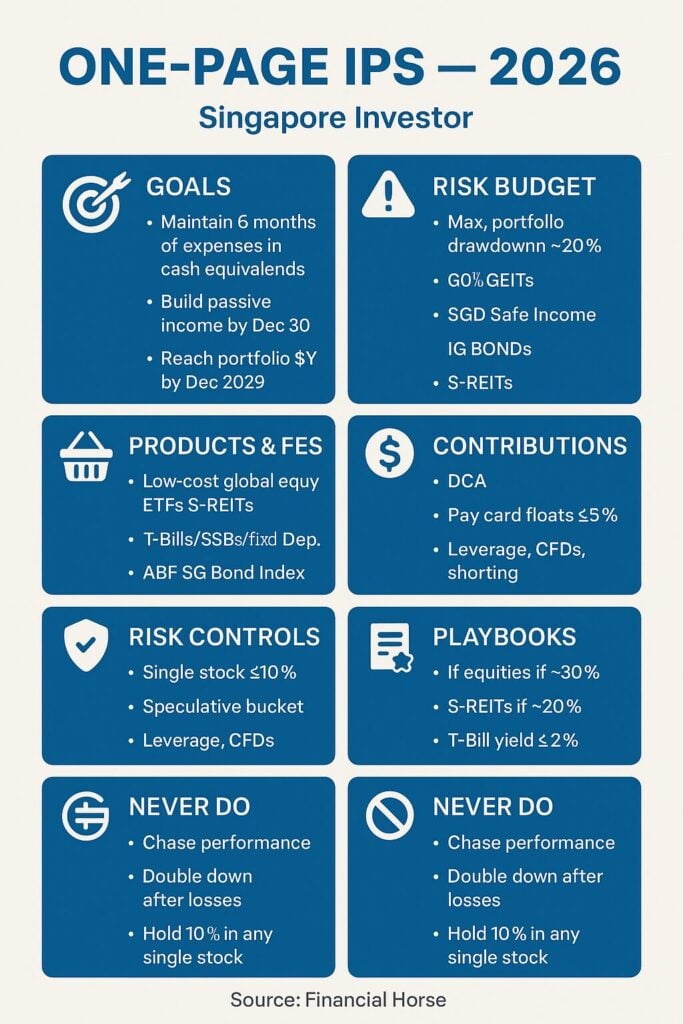
8) A one-page IPS for 2026
Why one page? Because you’ll use it. Long plans live in drawers.
Fill these six boxes:
- Goals (dated, sized): “$X downpayment in 2027,” “$Y passive income by 2032,” “$Z tuition fund by 2035.”
- Risk budget: “Max drawdown I can tolerate without selling: −20%.”
- Target mix: e.g., 60–70% global equities, 15–25% bonds/SSB/T-bills, 5–10% REITs, 0–5% speculative; rebalance triggers = ±5% or ±20% of position weight.
- Allowed products & fee ceiling: list tickers/brokers; “All-in product cost ≤ 0.40% p.a.”
- Playbooks (pre-commitments):
- If S&P −30%: deploy 3 tranches (−10/−20/−30%) using cash/T-bills maturing <6 months.
- If SG REITs −20%: rotate to strongest balance sheets at ≤1.0× P/B.
- If T-bill <2%: move 50% of maturing ladders to short-duration IG bond fund.
- What I’ll never do: no options unless fully collateralised; no >10% in any single stock; no leveraged tokens/CFDs.
Thank you for the useful playbook, very helpful tips condensed into point form.
What IG bonds would you recommend? As the current Tbill rates are quite low.
Btw I think there are some typos in your One Page IPS 2026 diagram.
I would probably just use a SGD hedged bond fund. Something like PIMCO GIS for example.
Provides diversification, and you don’t need to be an AI to access.