I know it’s slightly different from the usual topics we cover on FH Premium.
But I’ve been looking at the GLP-1 industry for a while now.
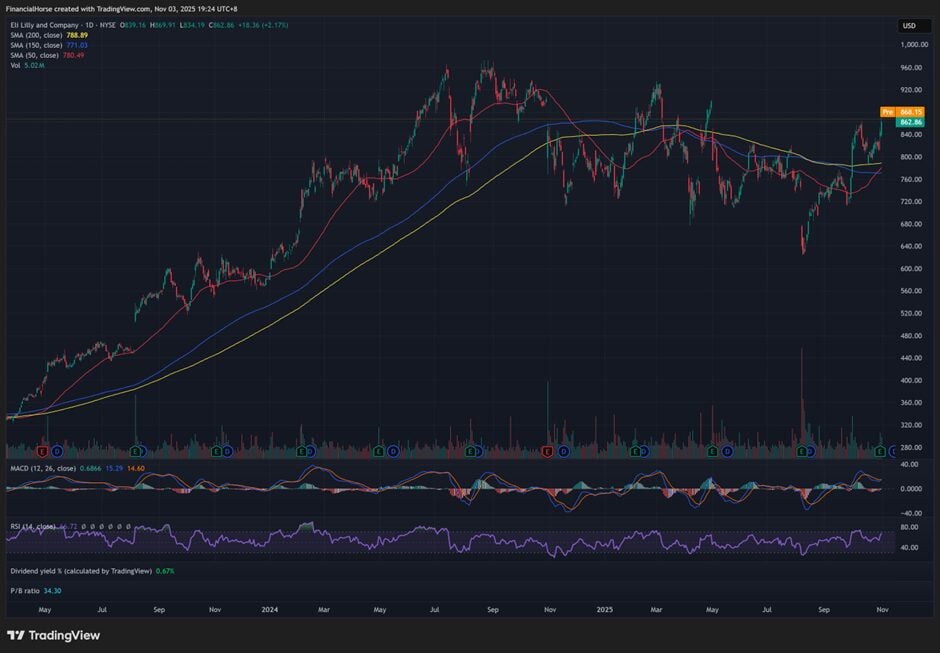
And with the stock of Eli Lilly, one of the 2 GLP-1 titans today, sitting flat for almost 1.5 years.
And with oral GLP-1 drugs on the horizon ready for a 2026 release.
If you ever missed the GLP-1 boat and wanted to get on.
This is probably about as good a time as any.
Understanding the GLP-1 industry
Let’s start big picture by understanding the GLP-1 industry.
What are GLP-1s?
GLP-1 drugs mimic a gut hormone that boosts insulin, slows gastric emptying, and suppresses appetite.
Leading to (1) better blood sugar control, and (2) clinically meaningful weight loss.
(1) is good for diabetes patients, and (2) is good for well, just anyone who is serious about losing weight.
That’s your 2 key target audiences right there, and of course (2) is much much bigger than (1).
This is an FH Premium article I am releasing for all readers. If you enjoy articles like this, do support Financial Horse on FH premium and get access to premium articles like this.
How big is this market?
The working Street narrative is “up to ~US$150bn by late 2020s” for obesity/metabolic incretins.
Some simple numbers:
- assume c.50m global patients (obesity, T2D with obesity, high-risk cardio-metabolic) actually make it onto therapy
- × US$3,000 per pt per year (already discounted from list, post-coverage pressure)
- → ≈ US$150bn Total Addressable Market
This is highly sensitive to three things:
(i) how fast US employers/Medicare open up obesity coverage,
(ii) how much of that demand can be served by cheaper orals vs expensive injectables, and
(iii) how quickly China/local copycats arrive and re-set price.
Any of these moving the wrong way drags the TAM closer to the low end.
But whatever the case, this is potentially a big market.
Why orals are the gamechanger?
GLP-1s today, are mostly injectables.
And as you can imagine, there’s just a certain stigma around having to inject yourself with a drug just to achieve weight loss.
Injecting yourself with a drug to cure yourself from a serious illness, sure.
But considering the biggest market is people trying to lose weight, you can imagine that asking them to inject themselves with a drug is kind of a big sell.
Which is why an oral GLP-1 drug has always been the holy grail for Biotech companies.
Nobody knows for certain how many more people would be willing to try GLP-1s if it comes in oral form.
But a lot of biotech companies are betting a lot of money that this could be really big.
And I’m inclined to agree.

What is the drawback with oral GLP-1s?
There’s a good FT article on this that I’ve attached to this article for those keen to explore more.
The long and short.
Is that the key drawback of oral GLP-1s is that they may not be as effective as an injectable GLP-1.
And less effective, usually means less margins.
In plain English, you cannot charge as much for it.
The advantage of course, is that because it is cheaper, and because a oral drug is just inherently more accessible than an injectible.
You may more than make up for the lower margin with much higher sales volume.
You make less per sale, but you make more overall on much higher volume.
That’s the hope at least.
What is the state of the GLP-1 market today? Who are the key players?
Short answer: the 2 key players today are Novo Nordisk and Eli Lilly. With Pfizer and Amgen a distance behind, but trying to make a catch up play via M&A or pipeline.
Novo Nordisk
Denmark’s Novo Nordisk was the one that built the entire GLP-1 industry as we know it today – with the original Ozempic (T2D) and Wegovy (obesity).
However due to problems with their US rollout, they have now allowed the American Biotech Eli Lilly to become a full competitor in GLP-1s.
The defensive move is the oral Wegovy-like pill (filing 2025, approval expected end-2025) that could add US$5bn+ annually at maturity and keep patients in the Novo ecosystem.
But, and there is more of this in the FT article.
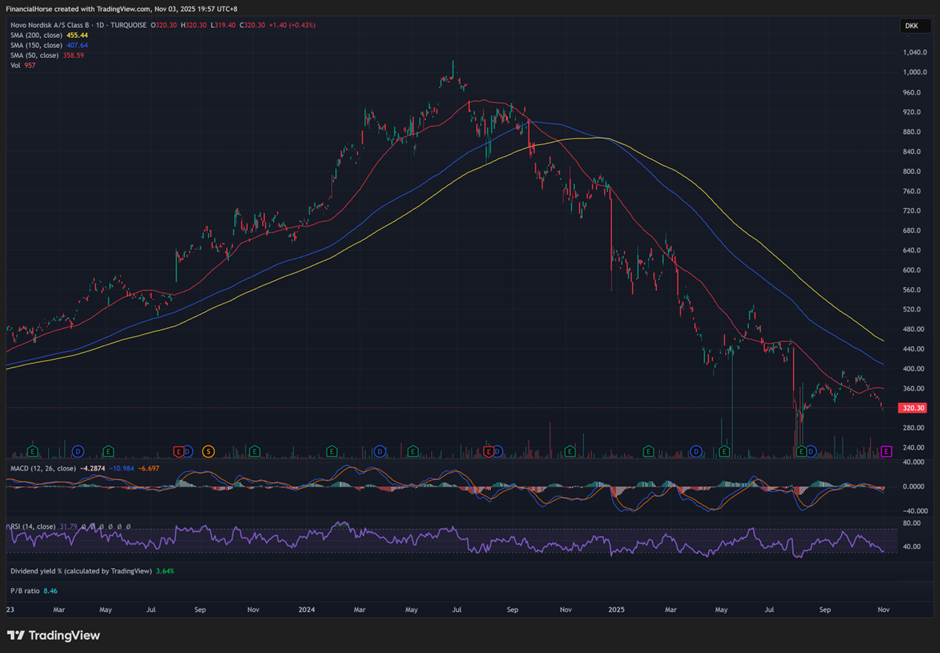
Early reports suggests that Novo Nordisk’s oral GLP-1 may be more complex to manufacture and not as effective as Eli Lilly’s version.
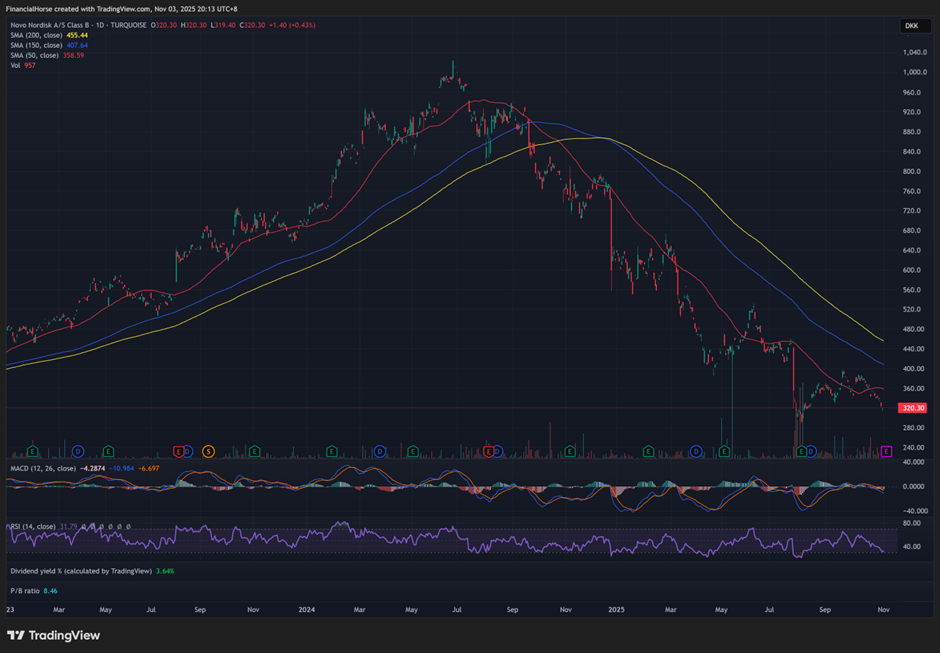
Hence Novo’s share price looks like this:
Eli Lilly:
Why did Eli Lilly manage to overtake Novo Nordisk despite being the second to market?
In one sentence – it had a better product:
Clinically, Lilly’s tirzepatide (Mounjaro/Zepbound) has shown greater weight-loss efficacy than Novo’s semaglutide (Ozempic/Wegovy) in a head-to-head 72-week RCT, and it already carries an extra FDA label for obstructive sleep apnea (OSA).
Mounjaro/Zepbound are perceived as better on weight loss than Wegovy, which if you’re trying to lose weight, is a pretty big point in favour of Eli Lilly.
On top of that, it’s oral GLP-1 is supposedly simpler to scale and manufacture.
On top of that, Lilly runs a broader bench — retatrutide (triple) and long-acting antibodies — so if the market shifts beyond plain GLP-1, Lilly is better hedged vs Novo.
Contrast Lilly’s share price below vs Novo:

Others:
Pfizer
Pfizer’s repeated failures with danuglipron (oral GLP-1 drug) shows that oral GLP-1 chemistry isn’t trivial.
To solve this problem?
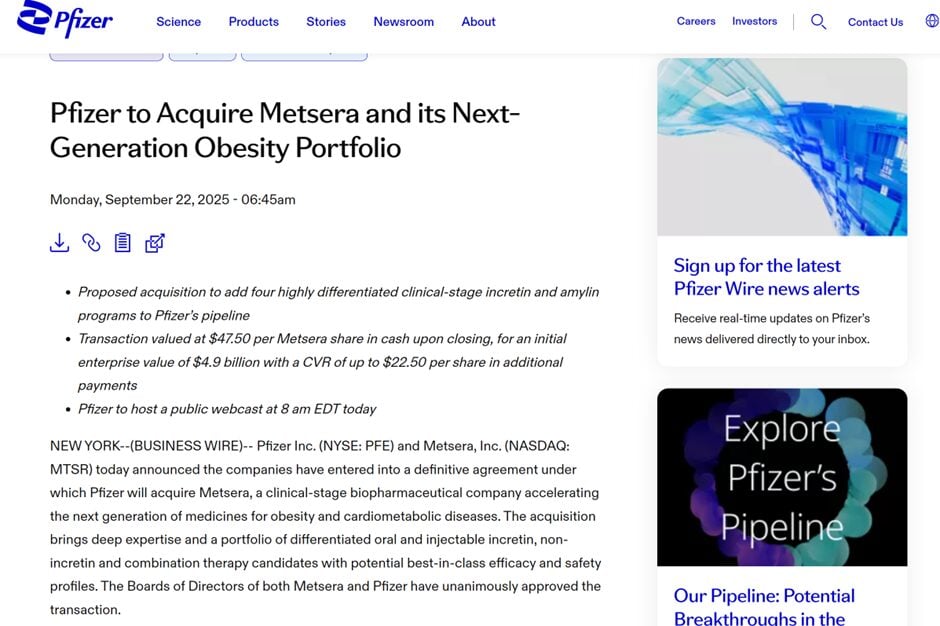
They decided to buy Metsera, which has a strong pipeline of oral GLP-1 drugs.
If successful, this could actually catapult Pfizer into a third GLP-1 player.
The complication?
Novo Nordisk, trying to boost their position relative to Eli Lilly in oral GLP-1s.
Decided to also submit a bid for Metsera.
Which of course has the dual advantage of (1) preventing Pfizer (a potential competitor) from getting Metsera’s pipeline, and (2) giving itself more chances at having an effective oral GLP-1.
Pfizer of course, is not taking this lying down, and is suing to prevent the deal from happening:

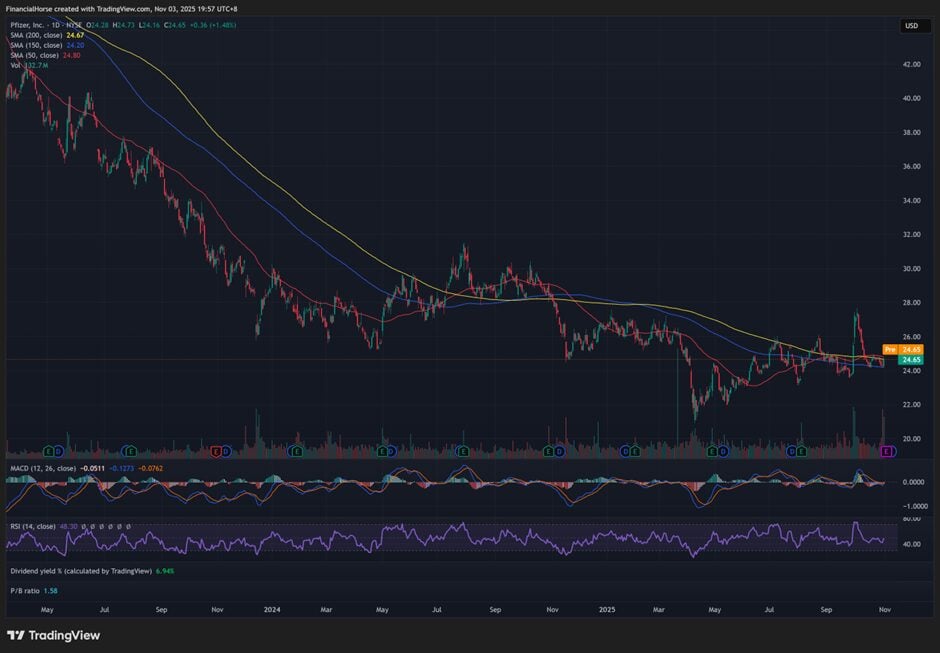
Given this is what Pfizer’s share price looks like today.
There could be meaningful upside if Pfizer manages to somehow pull this off.
Never miss a post! Follow Financial Horse by subscribing or following us on your favorite platform:
Subscribe to our mailing list for exclusive content straight to your inbox:
Amgen
Amgen’s GLP-1 MariTide is credible but on a 2025–27 timeline.
That’s a bit too far away.
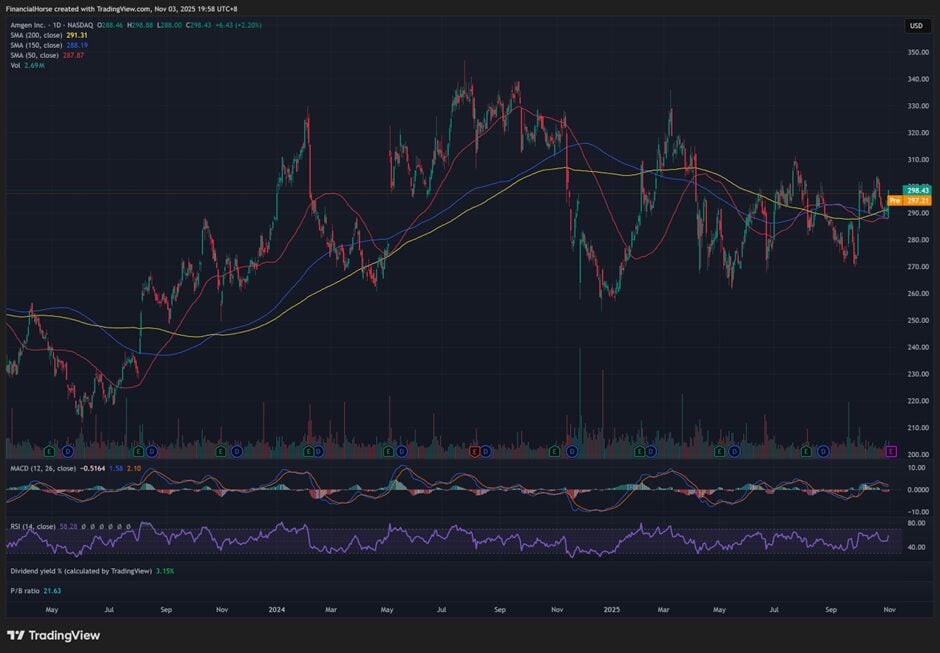
Which for now, makes Novo/Lilly the only near-term “all of (i) validated GLP-1, (ii) visible oral, (iii) commercial muscle” names.
Potentially Pfizer if they complete the Metsera transaction and the drugs are viable, but those are 2 big ifs.
Who is likely to “win” Oral GLP-1s?
The FT piece is a good read on this.
In short – Novo is repurposing a molecule payers/doctors already trust and putting it in a pill — lowest-regret. But the complexity is in difficulty to manufacture, and results are not as effective as the injectable version.
Lilly has the more scalable, small-molecule route — potentially better for payer/formulary breadth — but still has to match efficacy/tolerability to convert that into share.
So both companies have their own challenges.
Novo trying to buy assets like Metsera complicates this. If successful – block a rival (Pfizer), protect share vs Lilly, and buy time/capacity in the part of the pipeline (orals/combos/non-incretins) where it is most exposed — hence it is willing to overpay.
But of course, that is why there is regulatory scrutiny, and in this climate I highly doubt Novo will be allowed to complete the acquisition of Metsera from an anti-trust perspective.
From an investor perspective – what is the risk reward?
I used AI to crunch the hard numbers for me.
Summary below:
On today’s price US$862.86, if Lilly’s orals succeed, I see ~+16% base-case upside (to ~US$1,005) on an unchanged multiple, with ~+32% bull (~US$1,141) and ~+5% bear (~US$908). Sensitivity to P/E dominates: if the market re-rates down to 35×, base-case upside trims to ~+10%; at 40× it lifts to ~+26%. Assumes 2025 EPS midpoint US$23.35 and oral-driven EPS add of +$3.8 (base) / +$7.5 (bull) / +$1.2 (bear) by ~2030.

But the more I thought about it, the more I realized this was just garbage in garbage out.
To model what is the upside.
You need to know how effective the oral GLP-1 will be, how many people choose to buy it, whether insurance covers it, what is the pricing strategy and so on.
Trying to get all of that correct is just nuts.
So what I’m going to say is this.
If Oral GLP-1s do succeed, I think there will be meaningful upside for the player who pulls it off – whether that is Novo or Lilly.
If they don’t succeed, then oof there will be downside no doubt.
But is the upside attractive relative to the downside?
I personally think so.
Diversification benefits of Biotechs
Those of you with access to my portfolio know that I have been adding to Biotechs of late.
For the simple reason that they are not so correlated to the business cycle.
If Oral GLP-1s succeed and earnings grow, these stocks could still do well even if the AI bubble bursts.
So there are benefits from a diversification and portfolio perspective – beyond simply buying the same MAG7 stocks or Semiconductors.
Financial Horse take?
I like investing in industries where there is inflecting growth, and GLP-1s with oral drugs coming in 2026, might just be at that point.
The 2 incumbents are Lilly and Novo.
Between Lilly and Novo.
I’m no Biotech PhD but if you ask me based on what is publicly available today, Lilly looks to be better positioned.
But if you want to hedge and gain broad industry exposure, then buying both Lilly and Novo could make sense.
But charts wise, Lilly charts looks something that I would buy into:

While Novo is just in a solid downtrend at the moment, and even if you wanted to buy you probably have to give it some time for the stock to bottom.
That being said though, this is not a risk-free play, because if the drugs don’t deliver the market will punish the stock.
So standard risk management practices apply, and you want to size positions appropriately relative to your overall portfolio.
But high level that’s how I’m seeing GLP-1s today, and how I may play this in the months ahead.
Love to hear what you think though!
And let me know if you would like more industry specific coverage like this!
This is an FH Premium article I am releasing for all readers. If you enjoy articles like this, do support Financial Horse on FH premium and get access to premium articles like this.
Obesity is a lifestyle illness. Our society matrix and the global love of rich foods will spur developed nations to more… Including myself 😅😅. I see going into both western and Eastern biotechs as the way forward…..