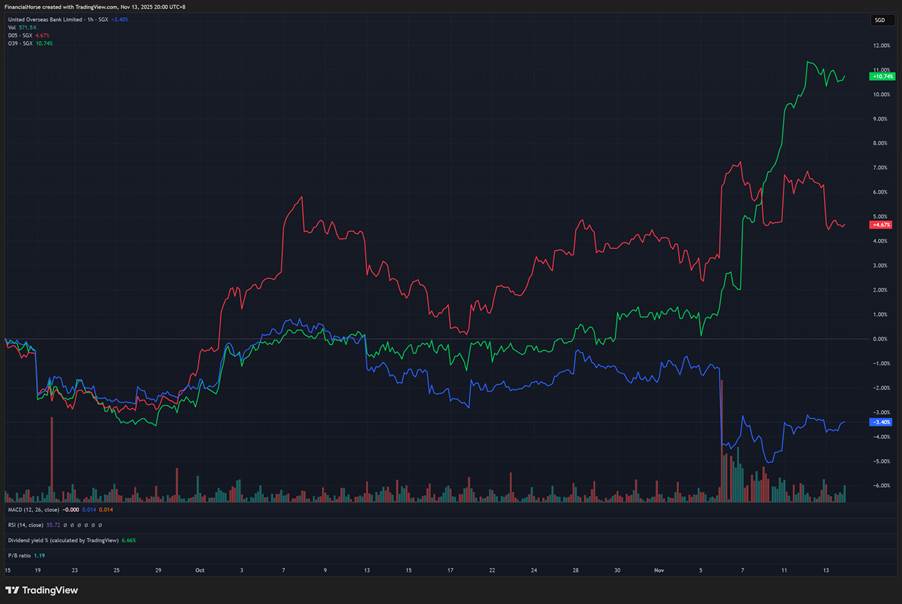
Share price performance for the 3 local banks has been very interesting of late.
After reporting the recent Q3 financial results.
OCBC has soared to all time highs.
DBS remains near all time highs.
While UOB has plunged.
Which raises an interesting question – at 6.6% trailing dividend yield, is UOB Bank a good buy today?
UOB shares plunge while OCBC and DBS bank soar
You can see this charted below.
In the past 2 months:
- OCBC: +10.7% (green)
- DBS: +4.6% (red)
- UOB: -3.4% (blue)
Here’s the daily chart of UOB.
You can see after topping at $39 in April 2025.
UOB has dropped about 13% since then.
And the stock looks to be trending down, and is below all 3 key moving averages.

The charts for DBS and OCBC could not be more different.
DBS is in a strong uptrend and is at all time highs:

Meanwhile OCBC has been flat for a while.
But with the recent Q3 earnings beat, OCBC has soared to all time highs:

Why were UOB Bank’s recent financial results so terrible?
Now what was it in the UOB Q3 financial results that sparked the recent drop?
In one line:
Net Profit after tax: – 67% QoQ – 72% YoY
That’s just a massive, massive drop in profit.
The reason why?
UOB bank decided to set aside $0.6 billion for pre-emptive general allowance, which is fancy bank speak for “potential bad debt”.
There’s nothing more scary as a bank investor than “bad debt”, so you can kind of understand why the stock sold off.

Especially when you look at DBS and OCBC, and there is no hint of similar such bad debt.
DBS reported a 2% drop in YoY profits, and OCBC reporting flat YoY profits – which makes UOB’s 72% drop in profits look extra terrible.
This also suggests the problem is not a macro problem (as neither DBS nor OCBC saw fit to make such a similar allowance), and specific to UOB.
Which again, is troubling.


Why did UOB Bank record a $615 million pre-emptive general provision?
The official reasons UOB gave for doing this is as follows:
- Proactive move to boost provision coverage to reinforce resilience and flexibility to navigate headwinds
- Total credit costs to normalise
- Capital position remains healthy
- Stand ready to support customers and seize strategic growth opportunities.
- Committed to share buyback programme
- No change to our dividend policy; pre-emptive general provisions has no impact on 2025 final dividend


Which frankly, doesn’t say all that much.
If you look under the surface though.
The bulk of the non-performing loans for UOB today comes from ASEAN.
While the greatest increase in Q3 has come from Greater China.

You can see the breakdown of UOB’s loan book below.
ASEAN and Greater China do not make up a big portion of the loan book, yet the account disproportionately for the non-performing loans.
With this big $0.6 billion allowance for bad loans, is UOB seeing something that we don’t?

UOB Bank’s CET1 ratio remains healthy
Big picture wise – CET 1 ratio (which is the amount of safe assets the bank holds relative to its loan book, higher is better) for UOB is 14.6%.
This is not as strong as DBS (16.9) or OCBC (16.9), but generally speaking it is still very solid.

Never miss a post! Follow Financial Horse by subscribing or following us on your favorite platform:
Subscribe to our mailing list for exclusive content straight to your inbox:
UOB’s acquisition of Citigroup’s consumer banking businesses in ASEAN
It’s also worth talking about UOB’s acquisition of Citigroup’s ASEAN consumer banking business in 2022:
UOB has agreed to acquire Citigroup’s consumer banking franchise in Indonesia, Malaysia, Thailand and Vietnam for about $4.915 billion.
The move will enable Singapore’s third-largest bank to “scale up its business in four key regional markets at one go” and accelerate its growth targets by five years, UOB deputy chairman and chief executive officer Wee Ee Cheong said in a briefing on Friday (Jan 14).
The franchise across the four markets comprises the US bank’s unsecured and secured lending portfolios, wealth management and retail deposit businesses.
UOB will pay cash for the acquisition equal to the business’ net asset value (NAV) as at deal completion plus a premium of $915 million – fully funded by the bank’s excess capital. The target business had an aggregate net asset value of about $4 billion as at June 30 last year.
UOB will also bring on board Citibank’s 5,000 employees in the four countries, including senior leadership, after the deal closes.
UOB Paid $4.915 billion, and a $915 million premium to NAV, so it is not a cheap acquisition.
How successful is the integration / synergy?
And you guys know my view on big sexy M&A like that.
I find that 9 times out of 10, the buyer overpays, and most of the promised “synergies” seldom materialize for shareholders.
2 – 3 years on, how successful is the acquisition for UOB?
Frankly – not easy to say, because there is no specific reporting on this.
I could be wrong, but looking purely at the numbers, it’s hard to say that this was a massive success (but I would not go as far as to say it was a disaster too).

UOB Bank pays a dividend yield of 6.6% (including special dividend)
If you include the special dividend, UOB bank trades at a 6.6% trailing dividend yield.
Strip out the special dividend and it works out to a 5.1% dividend yield.
That’s okay-ish.
But nothing fantastic.

Valuations of UOB Bank vs DBS and OCBC Bank
I’ve summarized the valuations of UOB vs DBS and OCBC below.
If you look simplistically at price to book, then UOB is by far the cheapest.
| Metric | DBS | OCBC | UOB |
| Share price (S$) | 53.23 | 18.66 | 34.65 |
| Market cap (S$bn) | 150.0 | 84.0 | 58.5 |
| P/E (TTM) | 13.4x | 11.5x | 10.1x |
| Forward P/E | 13.2x | 11.2x | 9.7x |
| P/B | 2.19x | 1.40x | 1.16x |
| TTM dividend / share (S$) | 2.64 | 0.82 | 1.77 |
| TTM dividend yield (excluding special dividend) | 4.96% | 4.4% | 5.11% |
Profitability of UOB Bank vs DBS and OCBC Bank
But yes, I know many of you always point out that Price/Book is too simplistic a way to analyse banks.
So to complete the picture, I’ve also summarised profitability metrics below.
And here you can see how UOB’s return on equity is also the lowest of the 3 banks.
While the non-performing loan ratio is the highest.
In other words, UOB is cheap, but there is a reason why it is cheap.
The business is simply not doing as well as either UOB or OCBC.
| Metric | DBS | OCBC | UOB |
| ROE (1H 2025) | 17.0% | 12.6% | 12.3% |
| ROE (2024 full-year) | ~18.8% | ~14–15% | ~13.7% |
| NIM (1H 2025) | 2.08% | 1.98% | 1.96% |
| NIM (2024 full-year) | 2.14% | 2.20% | 2.03% |
| NPL ratio (1H 2025) | 1.0% | 0.9% | 1.6% |
| CET1 ratio (1Q 2025) | 17.4% | 17.6% | 15.5% |
UOB shares plunge while OCBC and DBS soar – Will I buy UOB Bank at 6.6% dividend yield?
You know what?
Before I wrote this article I was actually quite keen to open a position in UOB bank with the recent share price weakness.
But after doing the research, I have mixed thoughts.
Looking at the numbers above, I really struggle to say that UOB bank is “cheap” even after the sell-off.
Yes share price is down 13% from highs when OCBC and DBS are at all time highs.
But frankly the business performance is just not as good as OCBC and DBS, and this looks to be a structural issue as it has been the case for years (UOB underperforming OCBC and DBS).
And the recent $0.6 billion allowance could be nothing, but it could also be a warning that UOB knows something we don’t.
If you look at the chart, the share price is trending down and below key moving averages, and it doesn’t look pretty.
The only saving grace is that you could argue there is support at $33, which could be a point to add for long term investors.

For what it’s worth, I haven’t made up my mind on UOB bank.
I see 2 potential ways this plays out.
UOB is a buy
First is that the share price holds the $33 support and the downtrend stops.
The $0.6 billion allowance turns out to be UOB being extra cautious.
And the share price recovers over time.
UOB is a falling knife
Second is that the share price continues its downtrend.
The $0.6 billion allowance turns out to be symptoms of a deeper underlying problem.
And the share price continues to drop.
Which scenario will we see play out for UOB bank?
Time will tell.
There is a decent chance that we see the first scenario play out, in which case UOB would be a buy for me.
Whatever the case, check out the latest market commentary on FH Premium.
Exclusive premium articles on FH Premium.
As Buffett says, “When you find bad news, I say get it right, get it fast, get it out, get it over.”
Haha, fair enough!
It should also be noted that the CEO/ Dep. Chairman purchased 150k shares after the Q3 results. Strong insider buy signal.
Interesting – thanks for the share.