So I was talking to a friend about investments generally.
And he told me that he thinks it is time to start buying China stocks again.
And how he bought a basket of China stocks, including Hang Seng Tech.
And now this really got me thinking.
This friend isn’t the most sophisticated investor around, yet he also isn’t the kind of investor who buys the top (he has reasonably good senses).
If he thinks this is the time to go big on China – is he right?
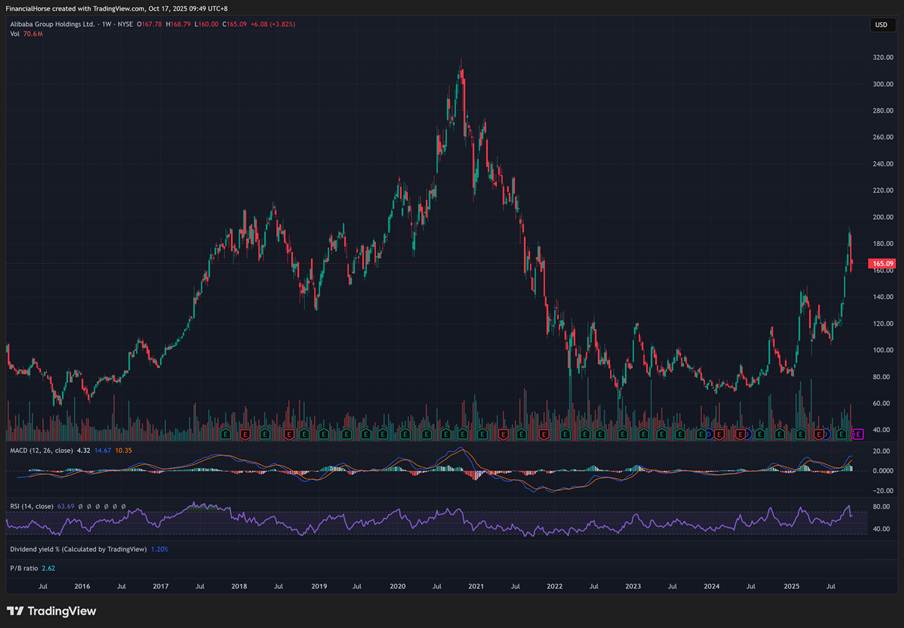
For reference, this is the chart of probably the most quintessential China stock – Alibaba.
Looked at it this way, Alibaba looks to have bottomed some time in 2024, and has recovered to 2021 levels.
Are more gains in store for Alibaba, and China stocks generally?
Have China stocks bottomed? What do the charts tell us?
With China there’s just so much noise and so much polarised opinion around China politics, China Macro, and Xi.
That I thought it would be better to start with something cleaner – charts.
(Although I will still share macro views below.)
China indexes suggest a potential bottom?
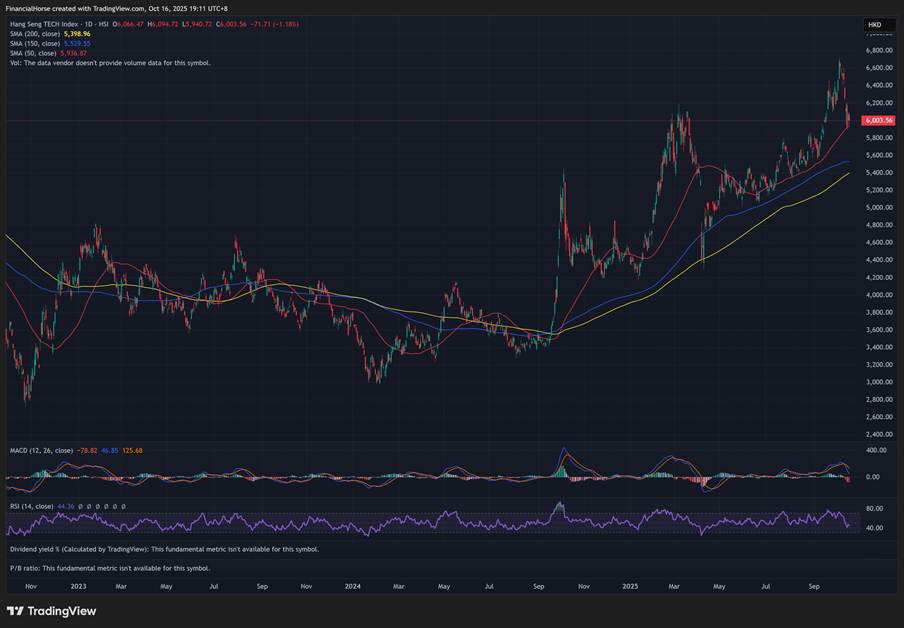
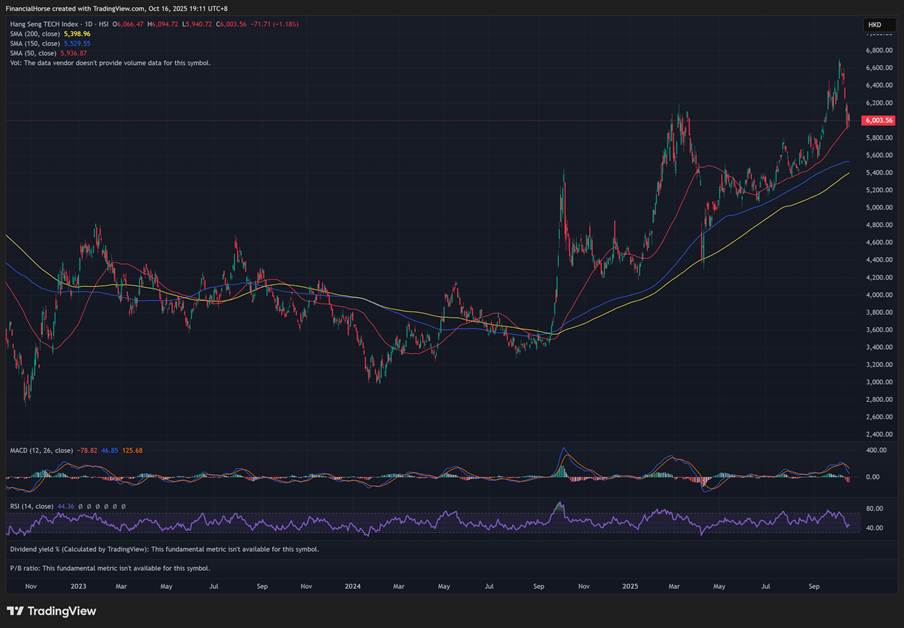
Here’s the chart for Hang Seng tech.
Looks to have put in a bottom in September 2024.
And as shared with FH Premium subscribers for a while now, Hang Seng tech has been trending up ever since the April Liberation Day tariffs.
Viewed this way, I kind of get why my friend added to Hang Seng tech, as the charts look good.
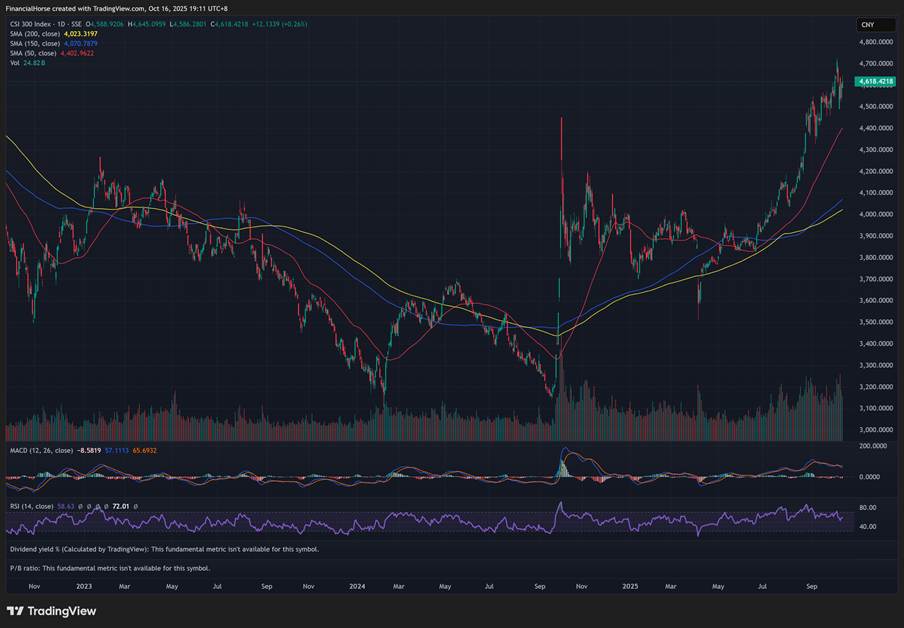
Here’s the CSI300 (basically an index of large China A-shares).
Generally tells the same story, a potential bottom in Sep 2024.
And a strong uptrend since the liberation day tariffs.
What happened in September 2024?
Which kind of begs the question.
What exactly happened in September 2024 to spark such a big rally?
As it turns out, in late-September 2024 Beijing unveiled a surprise, multi-pronged stimulus: a PBoC liquidity backstop for stock buying, explicit support for “national team” purchases, and property/household relief (incl. mortgage-rate cuts).
The policy shift triggered a violent short-covering + positioning squeeze: CSI 300 logged its biggest weekly gain since 2008 and finished September up ~21%.
Confidence was reinforced by high-level fiscal signals (Politburo) to stabilize housing and consumption.
Which together, looks to have marked the bottom (for now).
What about other Chinese stocks? Banks, real estate etc?
That said, those are China indexes generally.
If you look under the surface, there’s a lot of dispersion across industries.
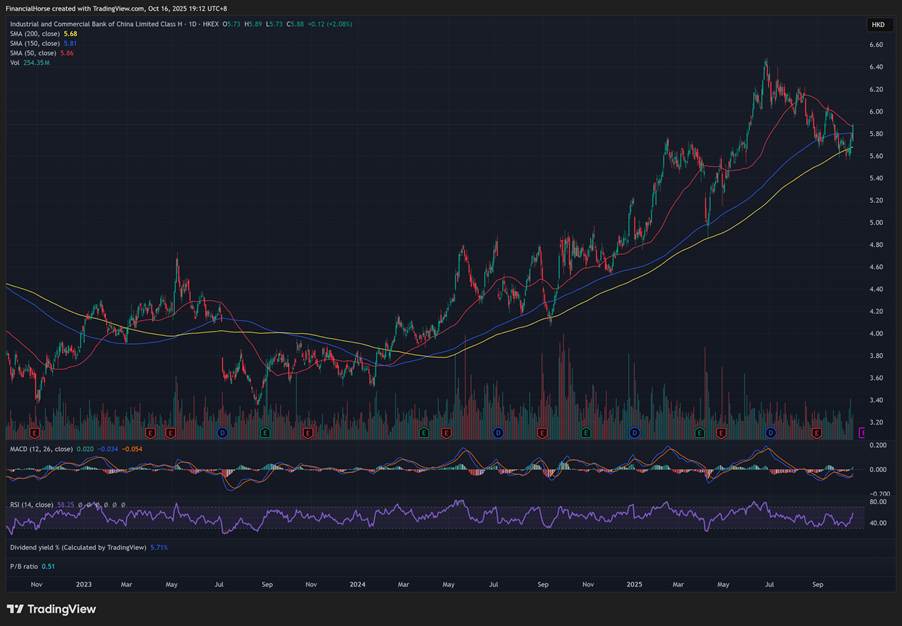
For example, ICBC (one of the China big 4 banks), looks to have bottomed much earlier in early 2024.
And it seems to have peaked around mid 2025 – and has been trending down since:
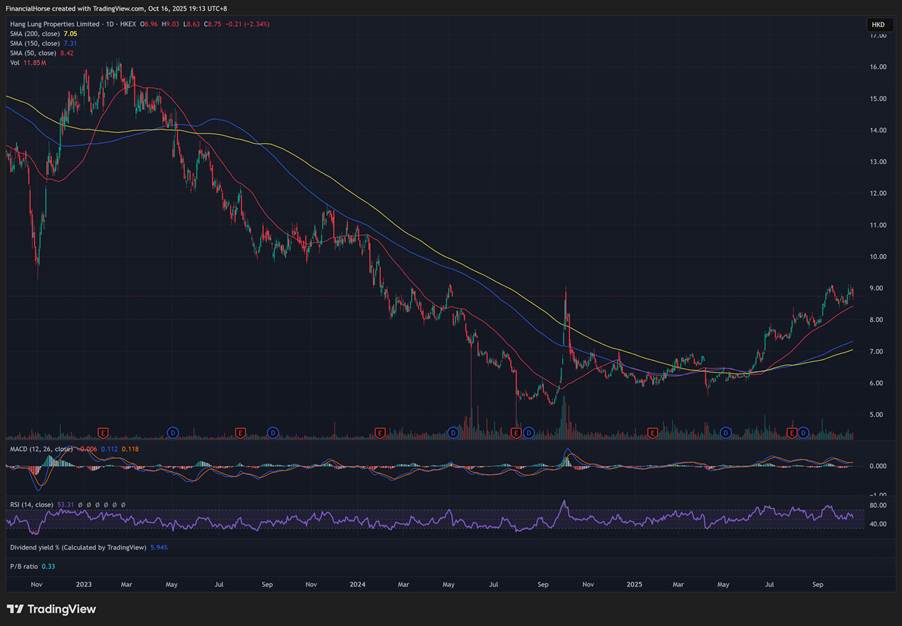
Okay I know Hang Lung has a mix of Hong Kong real estate thrown in there, but I like to use it as a proxy for China real estate strength.
Very interesting chart – showing a potential bottom around the Trump liberation day tariffs, and actually trending up ever since:
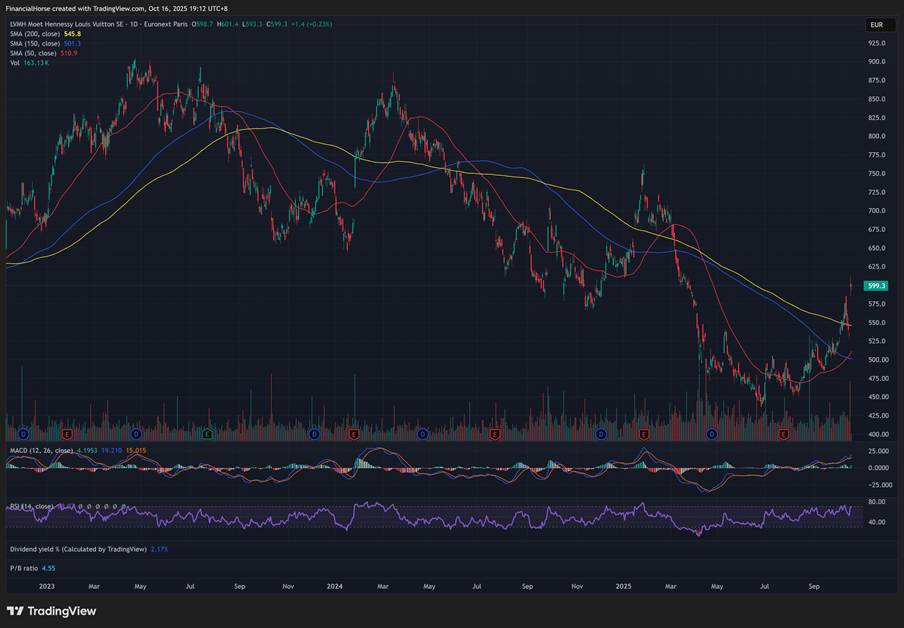
Luxury though tells a very different story.
LVMH has been trending down for a while now, but it looks to have put in a bottom around mid 2025:
Not so clear, but arguable that the same is true for Richemont (owns Cartier, Van Cleef etc):
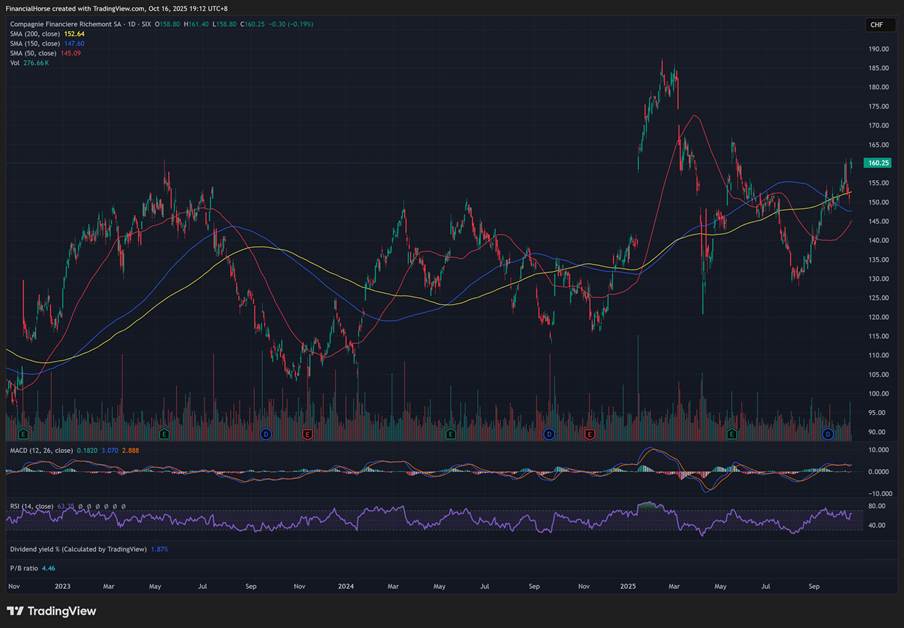
The reason why I look at luxury stocks is because a good chunk of their demand (and growth) is tied to China consumer sentiment these days.
Yes you can argue that consumer sentiment is a lagging indicator and why Hang Seng Tech or CSI300 bottomed before LVMH or Richemont.
But point is that I personally find there is value in using luxury as a proxy play on China.
Long story short – the charts do suggest China stocks may have bottomed, but like I said there is a lot of dispersion across industries.
What about the latest Trump tariffs?
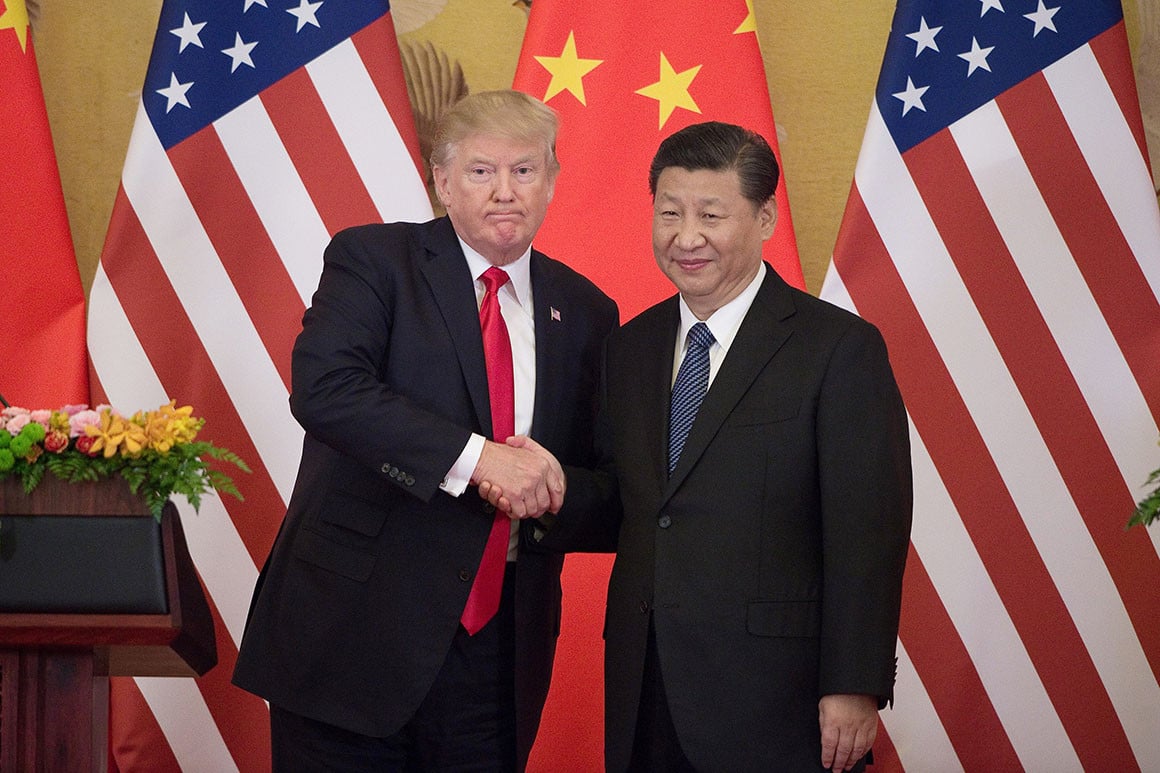
And then of course, we have Trump.
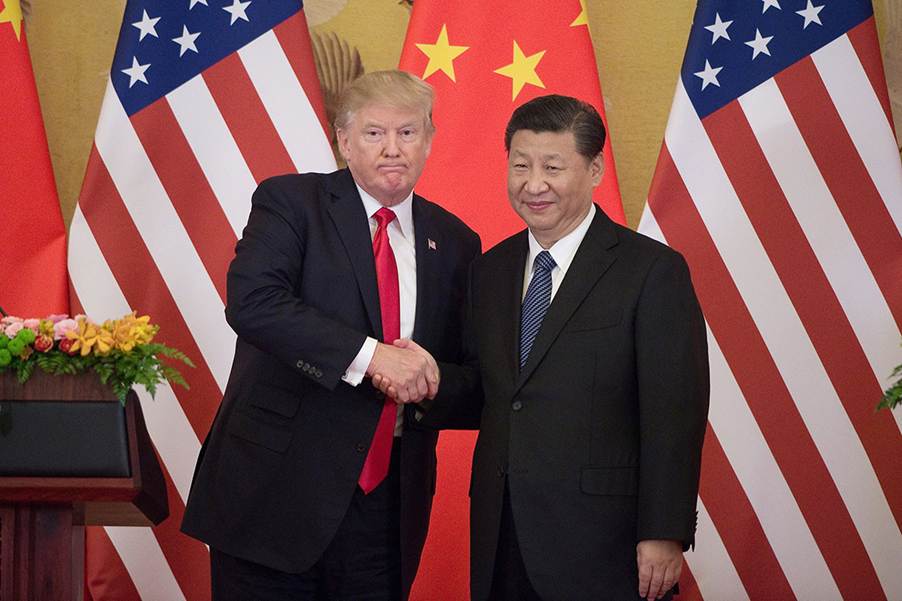
Here’s the sequence of what happened last week:
- Thu 9 Oct: China expanded export controls (license requirements) on selected rare-earth elements, magnet-making tech, and certain downstream uses—explicitly sensitive/military applications. Takes effect 1 Dec. This is framed by Beijing as targeted controls, not an outright export ban.
- Fri 10 Oct: China announced “special port service fees” on U.S.-linked vessels calling at Chinese ports: CNY 400/NT from 14 Oct, rising to CNY 640 (17 Apr 2026), CNY 880 (17 Apr 2027), CNY 1,120 (17 Apr 2028); capped at five voyages per ship per year. Beijing said this mirrors planned U.S. fees on China-linked ships.
- Fri 10 Oct (U.S. evening): Trump announced 100% tariffs on Chinese imports effective 1 Nov and flagged new U.S. export controls on “critical software.” China criticized the move but reiterated rare-earth curbs were legitimate security measures.
Trump announced the tariffs after the market close, so stocks were spared the worst of the move.
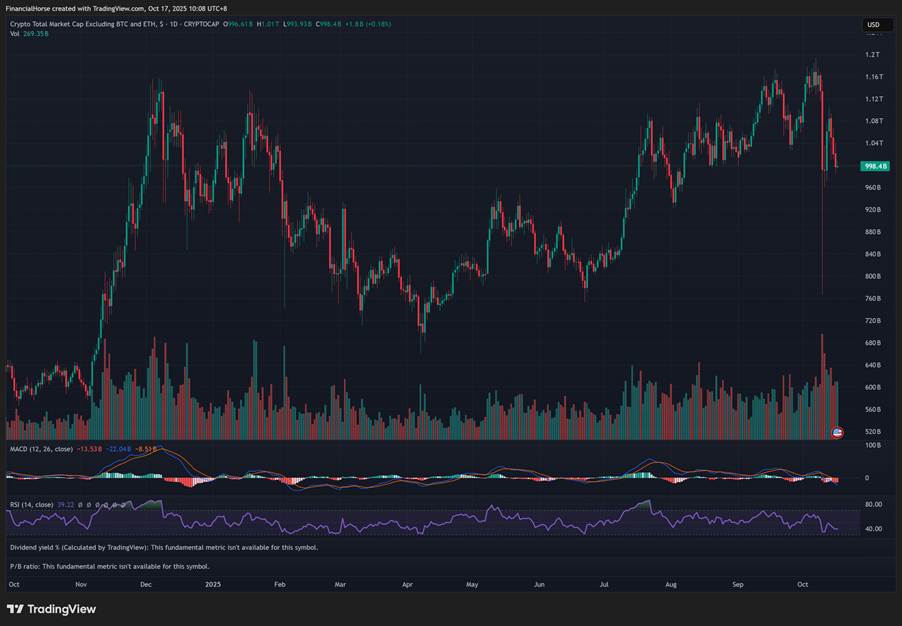
But crypto trades 24/7 – and just look at that massive intraday plunge for crypto.
If you’re in the crypto space you’ll know that many altcoins flash crashed up to 80% during that 1 hour, and anyone who was using leverage would have been liquidated.
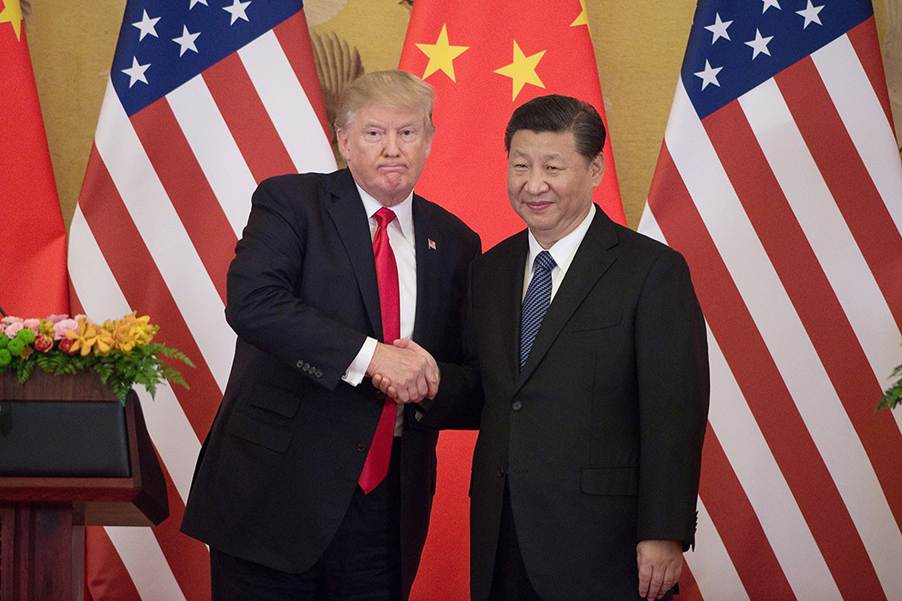
Trump being trump, then posted this on Sunday night:
“Don’t worry about China, it will all be fine! Highly respected President Xi just had a bad moment,” Trump said Sunday on his Truth Social platform, adding “The U.S.A. wants to help China, not hurt it!!!”
Which led to speculation that this was another TACO (Trump always chickens out) trade, and hence we see a big market recovery this week.
My take on the tariffs?
Xi and Trump are scheduled to meet at the end of the month.
So if you think all of this is just posturing before that big meeting?
You know what I think you might just be right.
That said I hesitate to say definitively that the worst is over, as you never really know what Trump would do.
I wouldn’t rule out more volatility heading up to the Xi-Trump meeting.
Although I do anticipate both Xi and Trump are doing this so they can then agree to a big beautiful deal when they meet at the end of the month.
What about the macro picture for China?
But that’s just short term noise in my view.
What about the longer term, big picture macro view for China?
And there things get much less straightforward, and it seems today almost every investor has a view on China – ranging from (a) uninvestible to (b) how can you afford to not be invested in China.
My view is a bit more nuanced, and I wanted to break it down into a few key points.
Locals want to move money out of China
Talk to most locals.
And they still paint a pretty pessimistic picture of China.
They think there are structural problems with China, and they don’t see a pick up in the domestic economy any time soon.
In fact most of the wealthy entrepreneurs who can, mostly still want to move their money out of China, and continue their life overseas.
Of course, the big caveat is assuming they can.
And to be fair if roles were reversed.
And I were a Chinese entrepreneur who already made >100 million and can afford to cash out and retire comfortably anywhere in the world.
I would probably do the same.
If you’re in a situation like that, moving funds out of China is just the lower risk play.
With China there is always that tail risk that one day you do something wrong and the China government comes after you.
That’s not to say you don’t have the same risk outside of China, but the nature of the risk is different.
So this I completely get, but whether it is an accurate barometer of Chinese stock market strength, that I’m not so sure.
But definitely a data point to consider.
China stocks don’t capture value the same way US stock markets do
I was recently asked what is the S&P500 equivalent in China.
And my short answer is that while you have things like MSCI China, Heng Seng tech etc.
There is no real S&P500 equivalent in China.
The US is a bottom-up economy.
The entire political system is set up to protect individual and corporate interests first (although that is changing recently to focus on national security).
Whereas in China, as the 2022 tech crackdown shows, it’s always going to be state interests first (or party depending on how cynical you are), and private interests second.
If the stock market needs to be thrown under a bus for national security reasons, it will be done without a second thought.
Whereas in the US, you have a sitting US president who will actively do and say whatever it takes to make sure stocks go higher.
Fundamentally this is a different setup, and if you invest in China you need to accept that risk.
On top of that, US capital markets are way more sophisticated, with much deeper liquidity than China capital markets.
Long story short.
If you want to invest in the US, buy the S&P500.
If you want to invest in China, the MSCI China / Hang Seng Tech are proxies.
But they don’t give you anywhere close to the same clean and efficient exposure as the S&P500.

But… can you afford to not be invested in China?
This one is probably controversial.
But I mean it as a question, and not a statement.
As a Singapore investor, can you afford to have zero exposure to China?
I think it goes back to risk appetite.
If you tell me you just want Singapore focus, you don’t want to take on idiosyncratic China risk, then I would say hey just skip the China market.
But if you are a global investor, you want to build a diversified global portfolio, then China being the size of China, I’m just not sure how you can ignore this massive market entirely.
Valuations of China stocks are no longer dirt cheap
What I would add though.
Is that after the rally, China stocks are no longer dirt cheap.
Here’s the P/E for Tencent.
There was a time Tencent was trading at single digit P/E, which was just unbelievable dirt cheap value.
Today, Tencent sits at 26 times P/E.
That’s no longer dirt cheap, and I would say the easy money coming out of depression level valuations has been made.

BUT – China stocks are still cheap compared to US stocks
But objectively speaking, I think China stocks are still cheap when you compare to US stocks.
Tencent trades at 18x forward P/E.
Meta (which I suppose is the closest equivalent) trades at 25x forward P/E.
So yes China stocks are no longer cheap, but I think compared to US they are still cheap.
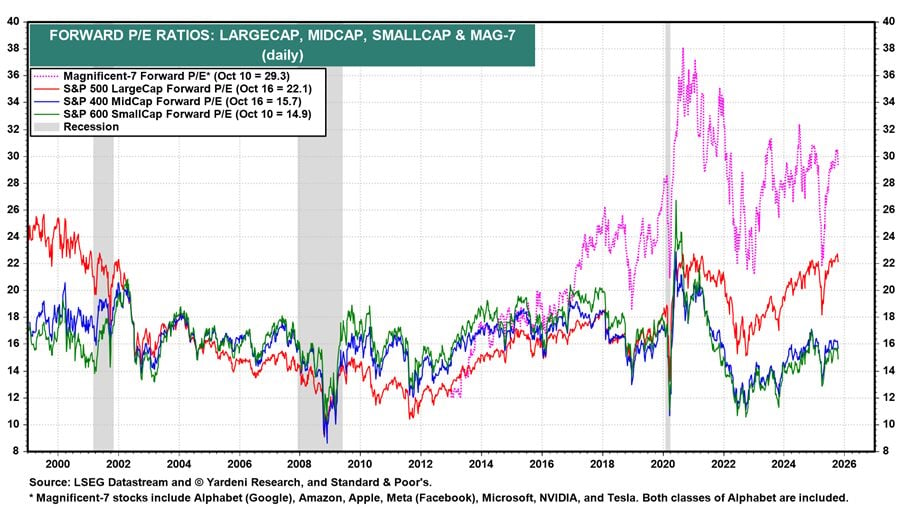
Although you could argue that this is because US stocks are very richly valued right now:
My views – Is it time to buy China stocks? Have China stocks bottomed?
For the record I do hold a basket of China tech and dividend stocks (see full portfolio on FH Premium).
I added in 2023 and 2024, and in hindsight I do regret not adding in bigger size.
But you know how the best investments always make you a bit (or very) nervous when you make them, and I suppose this was one of those where at the time I was also wary of sizing the position too big from a risk exposure point of view.
If you look purely at the charts.
I think it does paint a picture of a potential Sep 2024 bottom.
As long as the uptrend holds, I would see any pullbacks to the 50 day moving average (which we are seeing right now) as potential buying opportunities.
That said from a macro point of view, I do have mixed thoughts.
I have no doubt that if push comes to shove, the CCP will sacrifice the stock market to prioritise national interests.
This is not the US where the level of the S&P500 is itself a matter of national security, and you have a sitting US president who will do whatever it takes for stock prices to go higher.
So that risk is always at the back of my mind.
But that being said, from a diversification perspective, and given the relatively cheap valuations of China stocks.
I do hold a basket of China tech and dividend stocks.
And with the current pullback to the 50 DMA, I may just look to add to positions.
Closing Thoughts: Position sizing is key
That said, ultimately it’s all about risk management.
When I started in investing, I was told to “protect the downside, the upside takes care of itself”.
The more I invest, the more I realise the truth in that.
It’s basically Warren Buffett’s “Rule No. 1, don’t lose money. Rule No. 2, don’t forget rule no. 1”.
In investing, you always want to watch your downside first.
Assuming you protect capital, as long as are exposed to the right places, the upside almost always takes care of itself.
The biggest losses come not from returning 8% in a year the market did 10%.
It’s from losing 30% in a year the market is flat.
So whatever your views on China, ultimately you do need to make a call on how much exposure you want to China, and position size accordingly.
Check out more content on FH Premium.
hi all, please add fb, whatsapp, we chat etc function to share all your posts thanks all