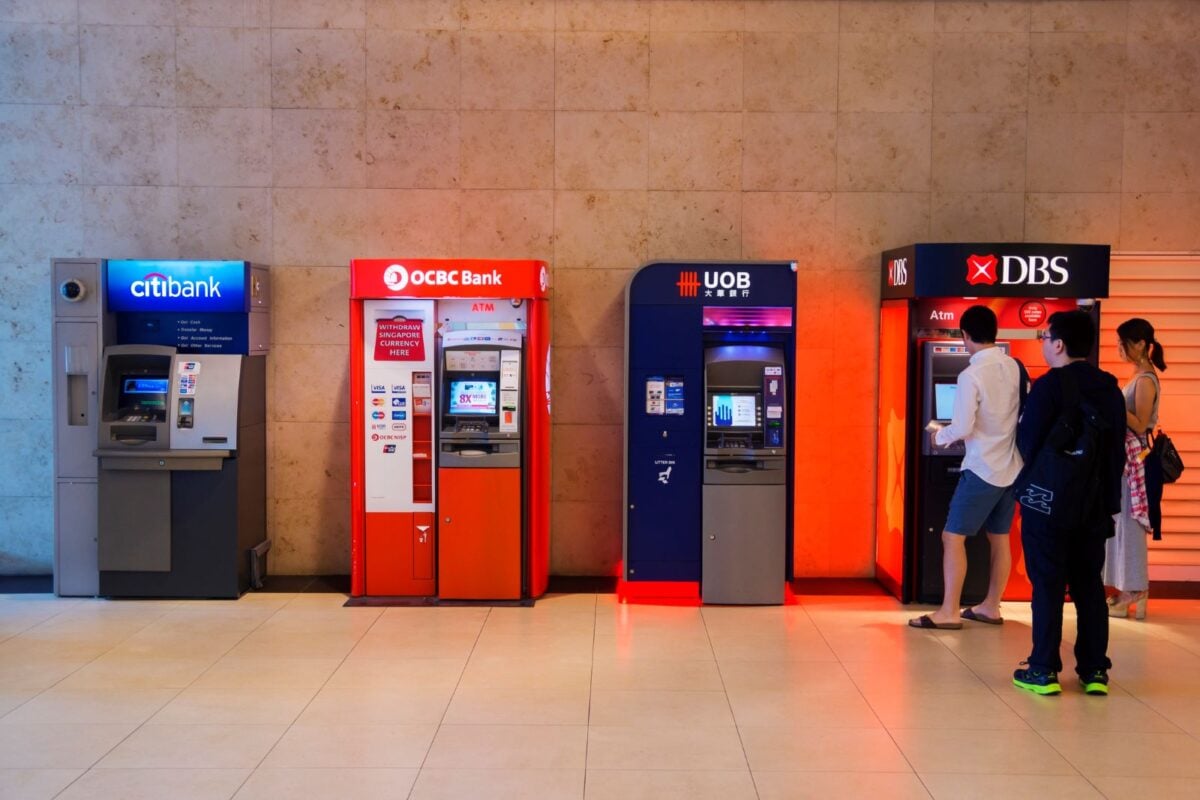
How quickly things change!
A couple of weeks ago, 6-month T-Bills yields were as high as 3.04%.
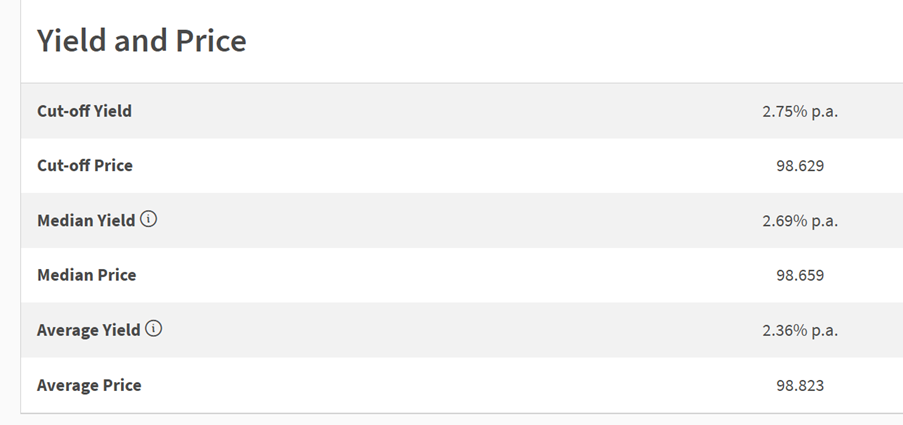
As of this week’s auction – T-Bills yields fell to 2.75%.
At 2.75%, suddenly fixed deposits become an attractive alternative to T-Bills.
As do quite a few of the other options in this article.
4 things I wanted to discuss today:
- What are the Top Fixed Deposit Rates in Singapore today (Mar 2025)?
- Why are interest rates dropping?
- What are the alternatives to T-Bills and Fixed Deposit?
- Where would I put my cash today?
Top Fixed Deposit Rates in Singapore offer 2.85% yield (Mar 2025)
The full table is further below in the article, but I’ve summarised the best interest rates for the 3-, 6- and 12-month tenures below.
Interestingly you can see how the 6 months tenure is the most attractive today.
As it falls down to 2.75% for the 3 month tenure, and 2.70% for the 12 month tenure.
| Tenure | Best fixed deposit interest rate (Mar 2025) | Bank |
| 3 months | 2.75% | Bank of China |
| 6 months | 2.85% | State Bank of India |
| 12 months | 2.70% | Bank of China |
Best Fixed Deposit Rates yield 2.85% if you deposit with Syfe Cash+ (to access institutional fixed deposit rates)
The rates above are assuming that you deposit with the bank directly as a retail customer.
Another way to do it is to use Syfe Cash+ Guaranteed.
The way this works is that you park the cash with Syfe, who will then deposit the cash into an institutional fixed deposit account.
This allows you access to institutional fixed deposit rates.
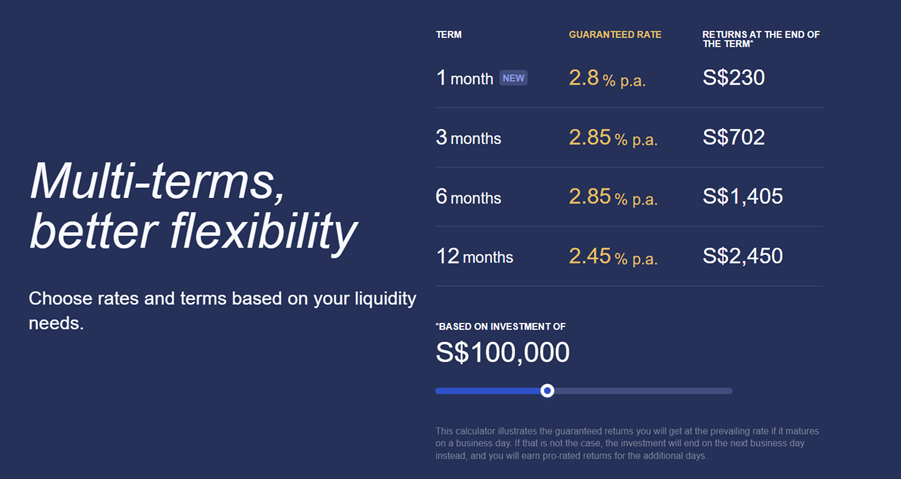
These are the latest interest rates from Syfe Cash+ below:
- 3 months – 2.85%
- 6 months – 2.85%
- 12 months – 2.45%
Frankly, it’s pretty much in line with the best retail fixed deposit rates we saw above.
Note that Syfe Cash+ is not SDIC insured, but given that the underlying is fixed deposits risk should be on the low side (but not risk free).
6-month T-Bills yields drop to 2.75% at this week’s auction
At the most recent T-Bills auction, the 6 month T-Bills closed at 2.75% yield.
That’s quite a big drop in yields vs the 3.04% we saw just a few weeks back.
And at these yields, I don’t think T-Bills are all that attractive as you need to lock up your funds for 6 months, and there are many options on this list that can match 2.75% yield.
Comparing interest rates for T-Bills vs Fixed Deposits vs Syfe Cash+ Guaranteed across all tenures (Mar 2025)
I’ve tabulated the interest rates for the 3 cash options below, as well as with money market funds.
You can see how with the recent drop in T-Bills yields – they’re no longer that attractive anymore.
| 3 months | 6 months | 12 months | Risk Free | |
| T-Bills yields | NA | 2.75% | 2.76% | Yes |
| Fixed Deposit (direct to bank) | 2.75% | 2.85% | 2.70% | Yes (if below $100,000 SDIC limit) |
| Syfe Cash+ Guaranteed (Institutional Fixed Deposit Rates) | 2.85% | 2.85% | 2.45% | No |
| Money Market Funds | ~3.0% | No | ||
Best Fixed Deposit Rates yield 2.85% – if you deposit directly with the bank (as of Mar 2025)
The full list of Fixed Deposit rates is set out below (bold being the most attractive for each tenure).
After the table I’ll share my views on:
- Why are interest rates dropping?
- What are the alternatives to T-Bills and Fixed Deposit?
- Where would I put my cash today?
| Bank | Interest rate per annum | Tenure | Minimum amount |
| SBI | 2.85% | 6 months | S$50,000 |
| 2.75% | 12 months | S$50,000 | |
| Bank of China | 2.75% | 3 months | S$500 |
| 2.70% | 6 months | S$500 | |
| 2.70% | 9 months | S$500 | |
| 2.70% | 12 months | S$500 | |
| RHB | 2.70% | 3 months | S$20,000 |
| 2.70% | 6 months | S$20,000 | |
| 2.60% | 12 months | S$20,000 | |
| CIMB | 2.70% | 3 months | S$10,000 |
| 2.55% | 6 months | S$10,000 | |
| 2.40% | 9/12 months | S$10,000 | |
| ICBC | 2.65% | 3 months | S$500 |
| 2.45% | 6 months | S$500 | |
| Hong Leong Finance | 2.60% | 6 months | S$5,000 |
| 2.50% | 9 months | S$5,000 | |
| 2.50% | 12 months | S$5,000 | |
| Citibank | 2.50% | 3/6 months | S$50,000 |
| OCBC | 2.45% | 6 months | S$30,000 |
| Maybank | 2.45% | 6 months | S$20,000 |
| 2.40% | 9 months | S$20,000 | |
| DBS/POSB | 2.45% | 12 months | S$1,000 (max S$19,999) |
| 2.35% | 9 months | S$1,000 (max S$19,999) | |
| HSBC | 2.40% | 6 months | S$30,000 |
| 2.10% | 3 months | S$30,000 | |
| UOB | 2.40% | 6 months | S$10,000 (fresh funds) |
| 2.20% | 10 months | S$10,000 (fresh funds) | |
| Standard Chartered | 2.40% | 6 months | S$25,000 |
Why are interest rates dropping?
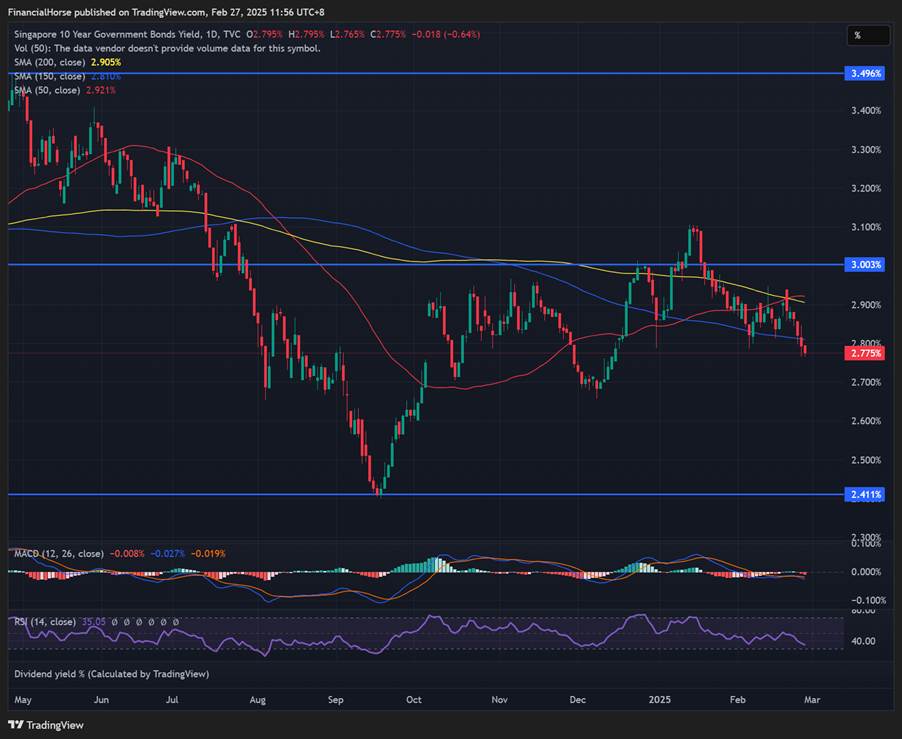
If you recall, the market was pricing in only 2 rate cuts in 2025 just a few weeks ago.
With recent data suggesting slower economic growth – the market is now pricing in 3 interest rate cuts in 2025.
So on that note I suppose it does make sense to see some downward pressure on T-Bills yields (this coupled with the huge demand).
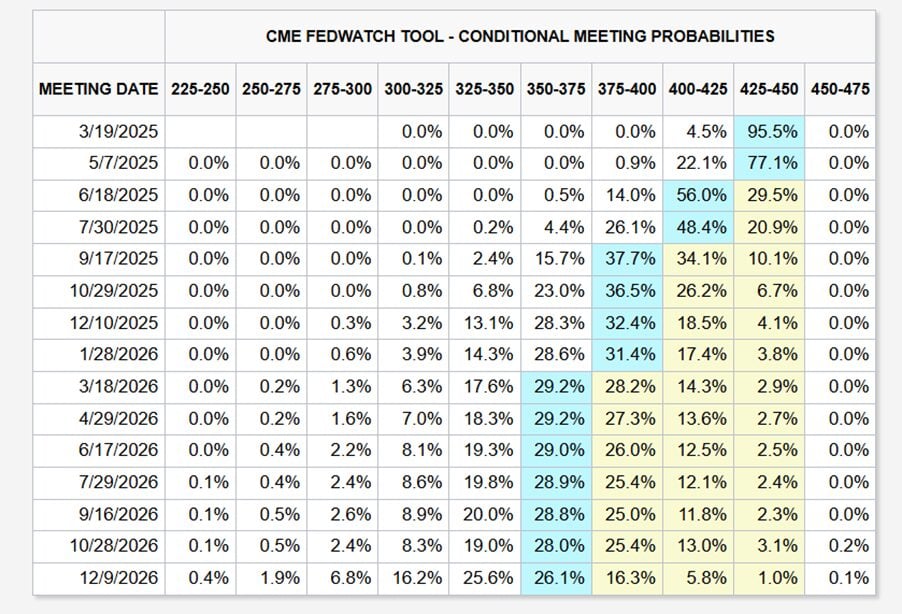
You can see this charted below.
The 6-month T-Bills have been trending down of late.

As have longer term 10 year yields.
What are the alternatives to T-Bills and Fixed Deposit?
Let me outline the key alternatives to T-Bills and Fixed Deposits below.
Follow Financial Horse to avoid missing any post!
High Yield Savings Accounts – UOB One, DBS Multiplier, OCBC 360 etc
This one is self-explanatory, so I won’t dwell on it.
A high yield savings account like UOB One pays 4.0% blended yield on $150,000, that is fully liquid and can be withdrawn any time.
If it works for you, high yield savings accounts like these are probably the best option for yield and flexibility.
If they don’t work (whether you can’t meet the requirements or don’t have enough spare cash), then just use the other options on this list.

Money market fund instruments (like MariInvest) or fintech plays (like Chocolate Finance/GXS/FD) on the short end
Alternatively there is MariInvest which is a money market fund that pays about 3.0% over the past 30 days for me.
For something that is pretty low risk and with good liquidity (first $10,000 can be withdrawn instantly, rest is T+1 liquidity), it’s a decent option in my view. Yields are higher than T-Bills too, but of course with rate cuts the yields are likely to drop going forward.
Alternatively, there’s stuff like Chocolate Finance that even after the drop in rates, will pay about 3.3% on the first $20,000 (fully liquid, but note not SDIC insured).

While GXS is paying 2.98% for 3 months:

There is some investor discretion required here as unlike T-Bills, not all the instruments above (eg. Chocolate Finance / money market funds) are risk free.
But generally speaking I think all of the above are decent enough alternatives to T-Bills and Fixed Deposits.
PIMCO GIS Income Fund via Maribank
For more duration, you can consider buying a bond fund.
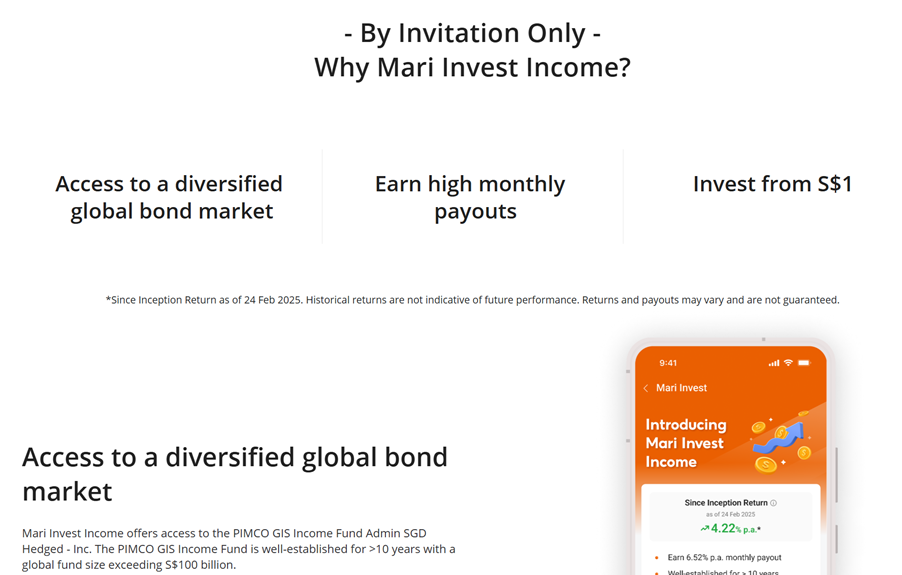
One example is the PIMCO GIS Income Fund, that you can access via Maribank.
It’s known as Mari Invest Income, and is by invitation only for now.
I’ve written on PIMCO GIS Income Fund in the past (article here).
But let me know if you guys want an updated take, and I can do an updated review on Mari Invest Income.
Bottom line is that these bond funds are quite a complex instrument, and not for everyone.
Because if interest rates go up, you can suffer mark to market capital losses.
And there is no way to hold to maturity as the bond fund will automatically reinvest proceeds.
So effectively there is some timing element involved here, in that you want to buy the fund when yields are high, and sell when yields are low, and if you do it the other way around you could see mark to market capital losses.
Best used only if you have a mid to longer term investment horizon.
Where would I put my cash today?
With the drop in T-Bills yields, I don’t think they’re a must buy any more.
Personally, for my fresh funds coming in, I’ve generally been parking them in money market funds such as MariInvest of late, and that’s been working out well enough for me.
I also have funds parked in a mixture of:
- T-Bills
- Singapore Savings Bonds
- Bond funds like PIMCO GIS Income Fund
- UOB One
Most of these were deployed over a period of time, which gives me a nice blend of tenure and yields, with decent liquidity as well.
But that’s just me – and I would love to hear what you guys think!
This post is written on 28 Feb 2025 and will not be updated going forward. My latest views on markets, my Stock watchlist and full Personal Portfolio, are shared on FH Premium.