DINKs — dual income, no kids — are often discussed in financial terms.
Two incomes. No child-related expenses. More disposable income.
From the outside, it can look like a purely financial advantage.
But that is probably too simplistic.
For most couples, being DINK is rarely just a financial decision. It may be a personal choice, a life-stage issue, a health or fertility matter, a timing question, or simply how life has turned out.
So the starting point should not be that DINKs have chosen a financially efficient lifestyle.
The better starting point is that DINKs are part of a newer household model — one with more freedom, but fewer default structures.
DINKs may have lower expenses and stronger cash flow. But the risks do not disappear. They simply appear in different places.
What financial blind spots can come with this lifestyle model?

This article was written by a Financial Horse Contributor.
DINKs are not one type of household
The term “DINK” sounds neat, but real life is not neat.
A couple in their early 30s with no children yet is different from a couple in their 50s who have decided not to have children.
A couple with ageing parents to support is different from a couple whose parents are financially independent.
A high-income couple with modest expenses is different from a couple earning the same income but servicing a large mortgage and supporting both sides of the family.
So the financial plan should not be based on the label.
It should be based on the life behind the label.
Some DINKs have huge savings potential.
Some have heavy caregiving obligations.
Some have more freedom than their peers.
Some feel uncertain because the usual family roadmap does not apply.
Some may be financially comfortable today, but less sure what support will look like in old age.
That complexity matters.
The advantage is real — but it depends on what happens to the surplus
The biggest financial advantage DINKs have is usually surplus cash flow.
Without child-related expenses, a couple may be able to invest earlier, compound faster, pay down debt sooner, build buffers, travel more, or take career risks with less pressure.
That is a real advantage.
But the key question is what happens to the surplus.
If the extra cash flow is converted into investments, buffers, insurance, career flexibility, retirement planning or meaningful life experiences, it can become very powerful.
If it is slowly absorbed into lifestyle, the advantage may be less durable than it looks.
It happens gradually.
More frequent travel.
Better restaurants.
More convenience spending.
More expensive hobbies.
More “we deserve this” spending after a stressful week.
None of this is wrong.
One of the benefits of being DINK may be the ability to enjoy life with fewer constraints.
However, a DINK household can look very financially strong, while still being more dependent on dual income than it realises.
Comfort can reduce urgency
There is another subtle point.
DINK couples may not always feel the need to stretch themselves financially.
This sounds odd, because having no children is usually seen as a financial advantage. And in many ways, it is.
But comfort can reduce urgency.
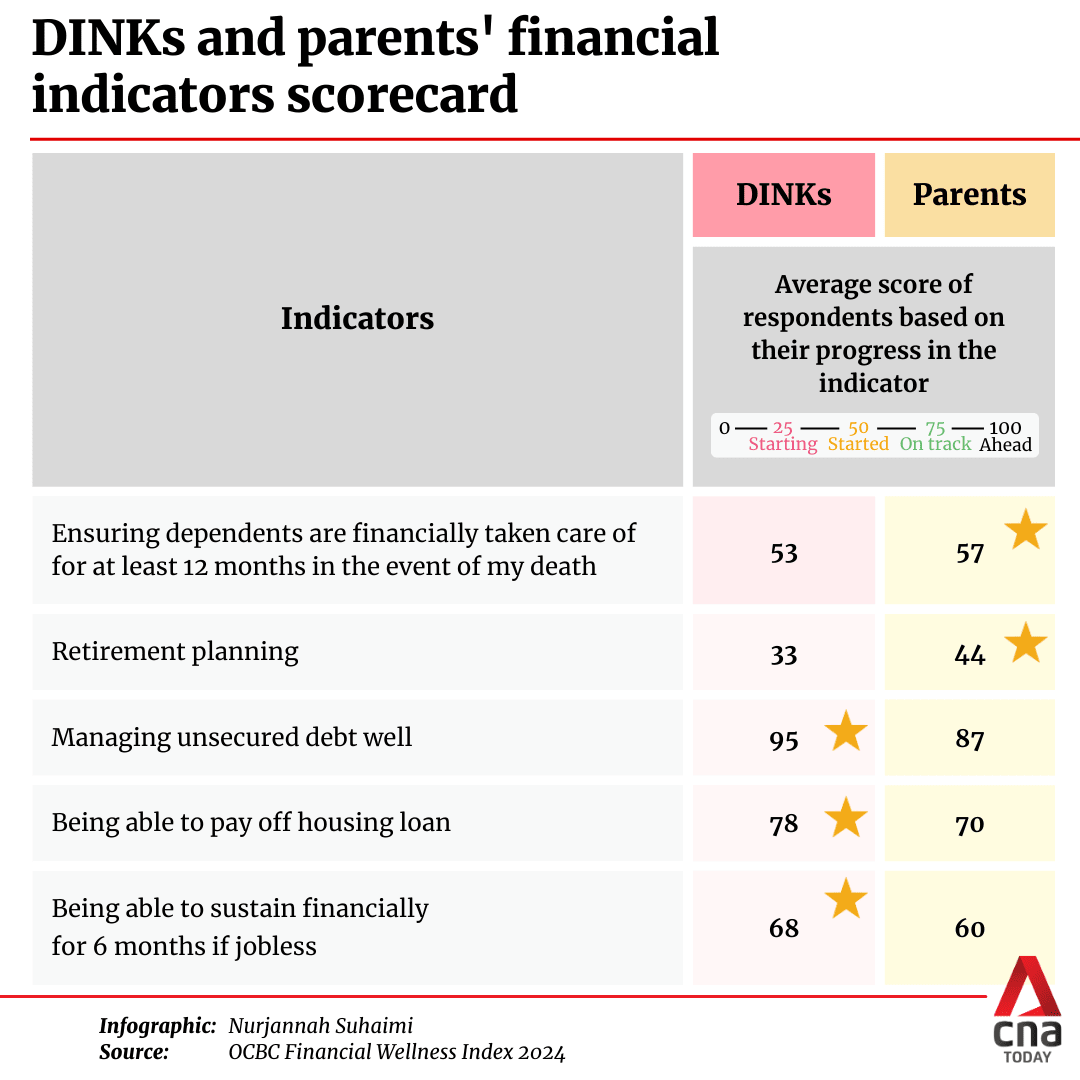
A couple with children may look much more stressed from the outside. There may be childcare costs, school fees, a larger mortgage, a helper, insurance needs and constant family expenses.
That stress is real.
But pressure can also create structure.
Parents may feel they have no choice but to grow income, save more seriously, buy insurance, invest earlier, plan for education, and build a larger safety net.
The same applies to property.
Parents may buy a larger home because they need space for children. They may buy earlier because they want stability. They may consider school distance because of primary school registration. These decisions can be stressful and expensive.
But they can also become forced asset-building.
A family that stretches to buy a larger home, or a better-located property near schools, may feel financially tight for years. But over time, that property may become a major part of household wealth.
This is not to say parents are automatically better off.
They may also be overleveraged, exhausted, or locked into a lifestyle they cannot easily change.
But it does show an important nuance.
Obligations can force financial discipline.
DINKs may have more flexibility. But flexibility does not automatically become wealth.
A DINK couple may choose a smaller home, a more lifestyle-driven location, or delay buying property altogether. That can be perfectly rational. It may preserve liquidity and freedom.
But if the difference is not invested elsewhere, the household may not end up wealthier simply because it had fewer obligations.
Lower expenses create the opportunity for wealth.
They do not guarantee it.
Dual income can hide dependency

Two incomes feel safer than one.
In many ways, they are.
If one person loses a job, the other may still have income. If one career slows down, the other may continue progressing. If both earn well, wealth can compound quickly.
But dual income can also create a blind spot.
Many couples build their lives around the assumption that both incomes will continue.
The travel budget is based on two incomes.
The lifestyle is based on two incomes.
The investment plan feels comfortable because both salaries keep arriving.
But life rarely moves in a straight line.
One person may burn out. One may want to change careers. One may need to care for ageing parents.
One may face health issues. One may be retrenched. One may want to start a business. One may simply decide that the high-stress job is no longer worth it.
The value of dual income is not just higher spending.
It is optionality.
The risk is losing that optionality because the household has quietly built a life that requires both people to keep earning at full speed.
“No kids” may mean “not yet”
Some DINKs are not permanently child-free.
They are DINKs for now.
They may be delaying children because of career timing, housing plans, health issues, fertility treatment, uncertainty, or simply because they are not ready.
This creates a different financial situation.
A couple with no plans for children can optimise around one path.
A couple that may have children later needs room for either outcome.
That means being careful about decisions that assume child-related expenses will never appear.
Changing one’s mind is normal.
For younger DINKs, the more useful question may not be:
“Are we having children or not?”
It may be:
“Have we left enough flexibility for either outcome?”
No children does not mean no dependants
One common misconception is that DINKs have no dependants.
Legally, that may be true.
Practically, it may not be.
Many couples without children still support ageing parents. Some help siblings, nieces, nephews, in-laws or extended family. Some become the default financial backstop because they are seen as having more spare capacity.
This can be especially relevant in Singapore and Asia more broadly.
Family obligations rarely appear neatly in a spreadsheet.
They appear when a parent falls ill. When eldercare costs rise. When a sibling needs help.
When one side of the family assumes the childless couple can contribute more.
These situations are emotionally difficult because the answer is rarely just financial.
Many people want to help.
Some feel a deep responsibility to give back to parents who sacrificed for them.
Others may feel guilty saying no because they do not have children.
A DINK couple may not need to plan for children’s university fees. But they may still need to plan for parental healthcare, eldercare, housing support or family emergencies.
The absence of children does not remove family responsibility.
It simply changes the form it takes.
Ageing without children needs more deliberate support
Children are not a retirement plan.
No one should assume children will automatically provide money, caregiving or emotional support in old age.
But in practice, children can still form part of an informal support network.
They may notice health changes.
They may accompany parents to medical appointments.
They may help with paperwork.
They may respond in emergencies.
They may coordinate care.
They may help make decisions if mental capacity declines.
DINKs may not have that same built-in layer.
That does not mean the future is bleak.
Many child-free couples have strong friendships, siblings, nieces, nephews, community ties, professional advisers and independent lives.
But the support system may need to be more deliberate.
Who will be contacted in an emergency?
Who knows where the documents are?
Who can help if one spouse loses mental capacity?
What happens if both spouses are elderly and one becomes the caregiver for the other?
These questions are uncomfortable, but practical.
For DINKs, planning for old age is not only about portfolio size.
It is also about people, access and decision-making.
The spouse becomes even more important
For many DINK couples, the spouse becomes the central support system.
The spouse may be the main emotional support, financial partner, emergency contact, travel companion, caregiver, decision-maker and retirement companion.
That can be a beautiful thing.
But it is also concentration risk.
If one spouse becomes seriously ill, the other may suddenly carry everything: caregiving, household management, medical decisions, finances and emotional stress.
If one spouse dies early, the surviving spouse may face not only grief, but a complete reshaping of daily life.
This is not unique to DINKs.
But it can be sharper when there are no children or close family members involved in daily support.
A strong marriage matters. But a resilient setup usually needs backup support too: trusted contacts, simple documents, clear asset records, insurance, emergency instructions and a wider social network.
The point is not to reduce the importance of the spouse.
It is to avoid placing the entire burden on one person.
Healthcare and long-term care are major swing factors
Without children, DINKs may have more room to save and invest.
But healthcare remains the great unknown.
The issue is not only hospital bills.
In Singapore, MediSave, MediShield Life, Integrated Shield Plans and CareShield Life are important parts of the picture.
But long-term care can involve much more than medical bills.
There may be helper costs, nursing care, home modifications, mobility equipment, rehabilitation, private specialists, transport and daily support.
If one spouse becomes ill, the other may reduce work or stop work completely.
That creates a double hit: higher expenses and lower income.
This matters because many DINK households are built around two working adults.
If one person becomes a patient and the other becomes a caregiver, the household structure changes quickly.
The risk is not just the cost of care.
It is the loss of flexibility.
This is why healthcare planning is not a side issue for DINKs. It is one of the main swing factors.
Early retirement may be possible — but not simple
One major advantage of being DINK is the possibility of earlier financial independence.
Without child-related expenses, the savings rate can be higher. Investments can compound faster. CPF balances may build steadily. The household may reach its retirement number earlier.
But earlier retirement is not automatically easier.
In some ways, it is harder.
Someone who retires at 55 may need to fund 30 to 40 years of retirement.
Inflation has more time to erode purchasing power.
Markets have more time to disappoint.
Healthcare needs may rise later.
The portfolio needs to last longer.
So DINKs should be careful about confusing lower expenses today with lower risk forever.
Not having children may reduce certain expenses.
It does not remove longevity risk, inflation risk, healthcare risk or market risk.
For many DINKs, the real advantage may not be early retirement itself.
It may be the ability to design a more flexible life before then.
Part-time work.
A sabbatical.
A lower-stress role.
The DINK advantage may be having more choices along the way.
Relationship risk is financial risk
For DINKs, the couple is often the core financial unit.
There may be no children, but there may be joint property, joint investments, joint expenses, shared family obligations and shared retirement plans.
If the relationship breaks down, the financial impact can be significant.
This does not mean couples should approach marriage cynically.
It simply means clarity matters.
How are expenses split?
Who owns which assets?
What happens if one person earns much more?
What happens if one person takes time off work?
What happens if one person supports parents more heavily?
What happens if property contributions are unequal?
These conversations can feel unromantic.
But handled well, they can reduce resentment.
DINKs may need less life insurance — but not less protection
Some DINKs may assume they need less insurance because they do not have children.
That may be true for certain types of coverage.
If there are no dependants, the need for a very large life insurance payout may be lower.
But protection still matters.
The key risk may shift from death to disability, critical illness and long-term care.
If one spouse dies, the surviving spouse may still need to service the mortgage, fund retirement, support ageing parents, or manage shared commitments.
If one spouse becomes seriously ill, the burden may be even more complex.
Medical costs rise.
Income may fall.
The healthy spouse may become caregiver.
Retirement plans may change.
So the insurance question is not only:
“Do we have children who depend on us?”
It is also:
“Would one spouse be financially secure if the other dies, becomes disabled, or needs long-term care?”
That often leads to a more balanced insurance plan.
Not necessarily the biggest life insurance policy.
But enough protection against the risks that would genuinely disrupt the household.
Estate planning matters even without children
Estate planning is sometimes neglected by DINKs because there are no children.
But that can make planning more important, not less.
If there is no will, assets may be distributed according to default legal rules, which may not match what the couple intended.
CPF nominations, insurance nominations, joint accounts, property ownership structures and investment accounts all need to be reviewed.
This is especially relevant where there are ageing parents, siblings, nieces, nephews, charities, blended families or unequal asset ownership.
For child-free couples, estate planning is not just about who receives the money.
It is about reducing confusion, delay and disputes.
It is also about protecting the surviving spouse.
A will, CPF nomination, insurance nomination and Lasting Power of Attorney can make a big difference.
Social capital matters more than it looks
For DINKs, friends, neighbours, siblings, nieces, nephews, community groups and trusted professionals can become part of the long-term support system.
In younger years, this may not feel like financial planning.
It may just feel like life.
But in older age, social capital matters.
Who checks in when someone is unwell?
Who can help interpret a medical bill?
Who notices if something is wrong?
Who can help prevent scams?
Who can accompany the surviving spouse to difficult appointments?
Who can be trusted with sensitive information?
This is not about turning friendships into transactions.
It is simply recognising that a good life is not built only on portfolio value.
It is also built on people.
The softer risk: over-optimising money and under-living life
There is one more risk worth mentioning.
Some DINK couples are excellent savers.
They invest diligently. They avoid lifestyle creep. They optimise CPF, mortgage rates, insurance and portfolio allocation.
That is admirable.
But there is a softer risk: becoming so focused on financial independence that life becomes too narrow.
DINKs often have a rare advantage — more freedom over time, money and life design.
If every spare dollar goes into the portfolio, the household may become financially stronger but emotionally poorer.
Travel postponed too long.
Hobbies delayed.
Friendships neglected.
Health ignored.
Family time missed.
The purpose of financial planning is not to win a spreadsheet.
It is to support a good life.
For DINKs, the challenge is not only to save enough.
It is to use flexibility wisely.
That may mean investing aggressively in the early years.
It may also mean taking meaningful trips, spending time with parents while they are still healthy, building friendships, supporting causes, or designing work that feels sustainable.
The best DINK financial plan is not necessarily the one with the highest net worth.
It is the one that gives the couple security, freedom and a life they actually want to live.
So what are the hidden financial risks?
The biggest risk may not be any single expense.
It may be assuming that strong cash flow automatically equals financial security.
Strong income helps.
No children can reduce expenses.
Dual income can accelerate wealth-building.
But none of these remove the need for planning.
The risks are simply different.
Ageing without children requires a more deliberate support system.
Early retirement creates a longer drawdown period.
Relationship dynamics can affect financial outcomes.
Estate planning still matters.
DINKs often have one of the strongest starting points for financial independence.
But the strength of that position depends on what happens to the surplus.
If the surplus is absorbed entirely into lifestyle, the advantage may fade.
If it is converted into investments, buffers, flexibility, relationships and good planning, the advantage can become very powerful.
Final thoughts
DINKs can be in a very fortunate financial position.
Two incomes and no child-related expenses can create strong cash flow and real flexibility.
But DINK is usually not a financial strategy.
It is a life structure.
The financial benefit, if it exists, is usually secondary.
Lower expenses do not automatically mean higher wealth.
Strong income does not automatically mean low risk.
A high net worth does not always mean strong cash flow.
And early retirement does not remove the need to think about healthcare, longevity, inflation and support in old age.
Parents may look more financially stretched because they face more obligations. But those obligations can sometimes force structure, ambition and asset-building.
DINKs may have more freedom.
The main question is what that freedom becomes.
It can become lifestyle.
It can become wealth.
It can become flexibility.
It can become support for family.
It can become a better retirement.
That is the real opportunity.
Not just having more money today.
But having more choice over how life is built over time.
look like an AI article with little value, ur arguement can apply in any context or scenario.