Okay so when I wrote about which pot to drain first in retirement, I said that deferring CPF LIFE deserved its own article — and quite a few of you took me up on it.
So here it is.
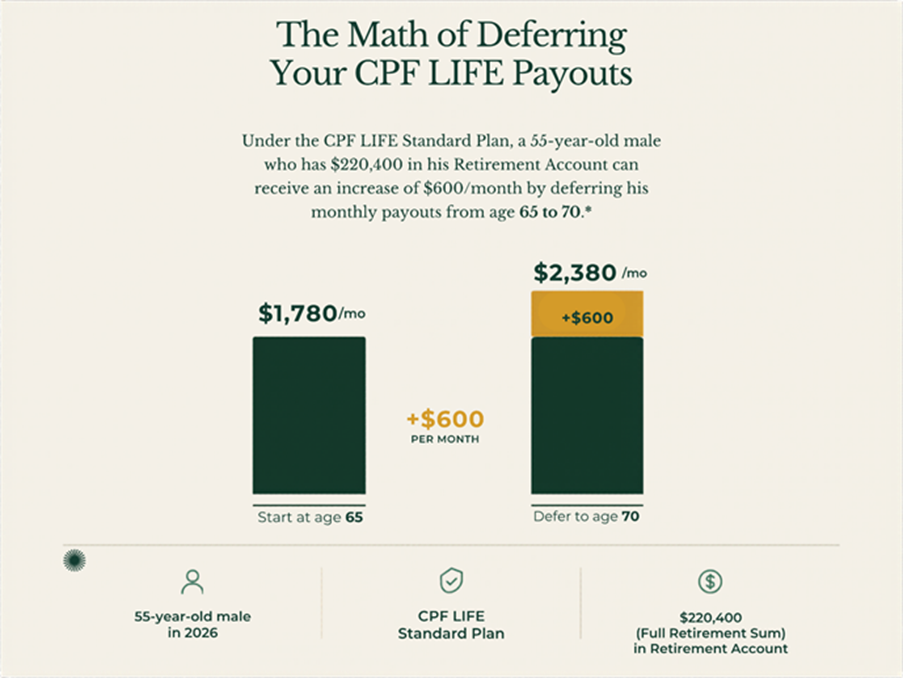
CPF’s own example is a member with S$220,400 in his Retirement Account on the Standard Plan: S$1,780 a month if he starts at 65, or S$2,380 a month if he waits until 70.
S$600 a month more, for life, for waiting 5 years.
The catch is that those 5 years cost you 60 payouts of S$1,780 — about S$107,000 that has to come out of your own pocket instead.
So 3 questions:
- At what age do you break even?
- What do the 5 years of waiting actually cost — and does it matter where the money comes from?
- Who should not defer?
What deferring actually does to your Retirement Account
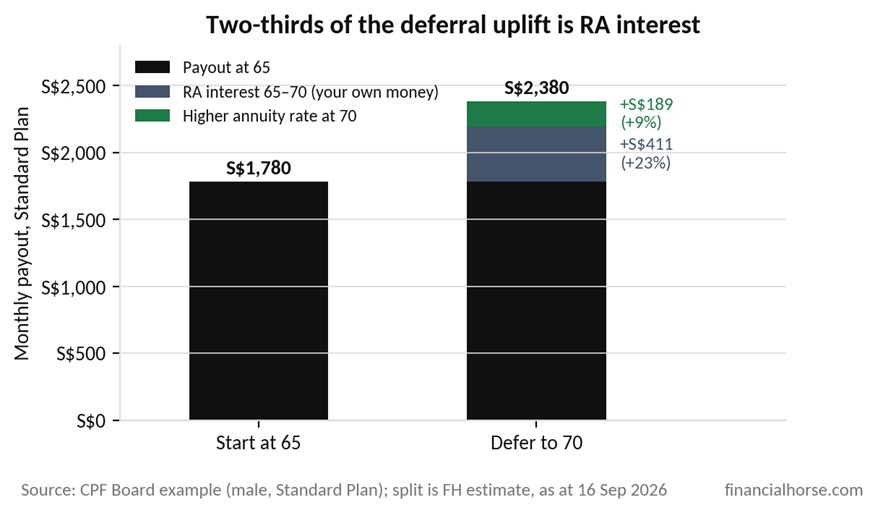
Your CPF LIFE premium is only deducted from your RA one week before your payouts start — not on your 65th birthday.
So if you defer, the whole RA keeps earning 4% a year, plus the extra 1–2% on the first S$60,000, for another 5 years.
Run the numbers on CPF’s example — S$220,400 at 55 grows to roughly S$337,000 by 65 (at 4% plus extra interest).
Leave it alone until 70 and it is roughly S$415,000.
You can see the split below.
For what it’s worth, over 1 in 2 members already defer — mostly by a year or two, while they are still working.
The break-even age — and why it lands exactly on life expectancy
The simple sums first.
You give up S$1,780 × 60 months = S$106,800 between 65 and 70, and you get S$600 a month more from 70.
S$106,800 ÷ S$600 = 178 months, or 14.8 years.
So on payouts alone, you break even at 84.8 — call it 85.
That is the number you will see quoted everywhere, and it is the most straightforward one.
That being said this does assume the S$107,000 would have earned nothing in the meantime.
Which makes sense if you spend it all, but if you invest it then the numbers do change per table below:
| If the bridge money would have earned… | Break-even age |
| 0% (the naive sum) | 85 |
| 2% (roughly today’s inflation — i.e. break-even in today’s dollars) | 89 |
| 2.5% (the CPF OA rate) | 90 |
| 4% (the RA rate) | 96 |
Note that this ignores the bequest – and we’ll run the numbers with the bequest further below.
But again I suppose the main reason you would pick the 65 option is if you plan to actually spend the money, which would make this a moot point.
Also put that against how long a typical Singaporean will live.
Per the latest SingStat life tables, a 65-year-old man in Singapore is expected to live to 84.9, a woman to 88.1.
Here’s the chart for reference.
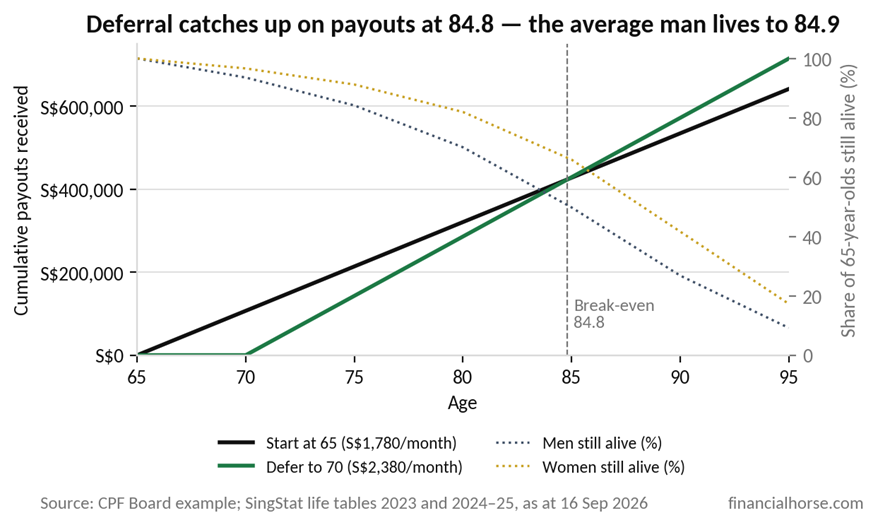
I suppose one way to see it, is that:
If you are a man and you defer, and for every day you live beyond the average lifespan of 84.9, then you 赚到。
And I guess for the “average” woman – they confirm 赚到?
Okay… just my layman simple thinking lah… feel free to disagree.
The number everyone leaves out — the bequest
Now here is where it gets more complex.
On the Standard Plan, if you die before the premium is used up, CPF refunds the unused premium — premium paid less payouts received — to your nominees.
So the question is not just “how much do I receive” — it is “how much does my household receive”, payouts to me plus whatever goes to my family.
Add the bequest back and the picture changes completely:
| Age at death | Start at 65 (payouts + bequest) | Defer to 70 (payouts + bequest) | Difference |
| 68 | S$337,000 | S$382,000 | +S$45,000 |
| 75 | S$337,000 | S$415,000 | +S$78,000 |
| 80 | S$337,000 | S$415,000 | +S$78,000 |
| 82 | S$363,000 | S$415,000 | +S$52,000 |
| 85 | S$427,000 | S$428,000 | +S$1,000 |
| 90 | S$534,000 | S$571,000 | +S$37,000 |
| 95 | S$641,000 | S$714,000 | +S$73,000 |
Read the 85 row again.
The break-even age that everyone quotes is the one age at which deferring does nothing for you.
At every other age — earlier or later — the household comes out ahead.
Die at 68, and the deferrer’s family gets the whole RA, interest included, because the premium was never paid.
Die at 75, and they get an unused premium that is S$78,000 bigger.
Die at 95, and you collected S$73,000 more in payouts.
You can see the two paths below.
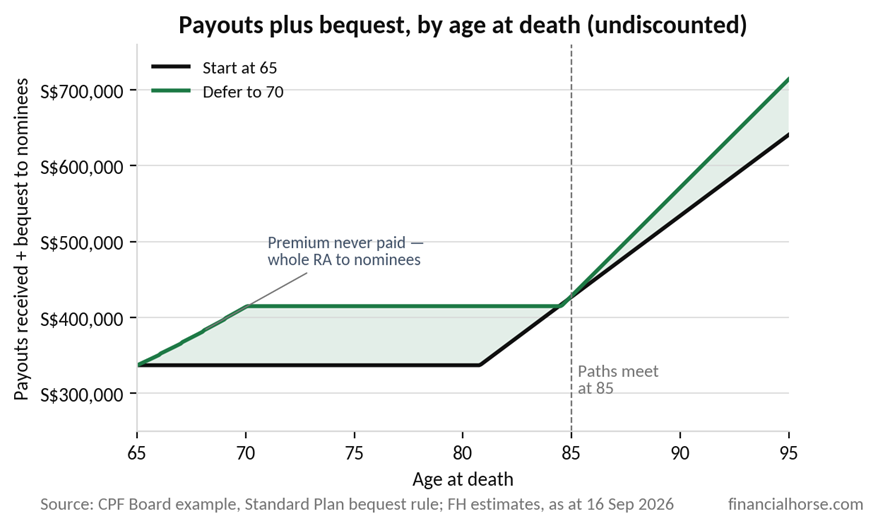
Look at it this way and actually the Defer to 70 option looks very good.
Think of it as longevity insurance — it costs you little if you die on schedule, and pays you well if you die early (via the bequest) or late (via the payouts).
Never miss a post! Follow Financial Horse on WhatsApp or Telegram — one tap, and every new article reaches you the moment it’s published.
What the 5 bridging years actually cost — it depends where the money comes from
There is some nuance as I alluded to above.
How much does this deferment cost – the opportunity cost of the $106,800 that you give up from 65 to 70.
S$106,800 out of pocket is the sticker price.
But this is S$106,800 you’re not getting from 65 to 70, so you do need to think about how you would meet spending needs during this period, or what you would do with the money if you had it.
The real cost depends on how you fund it, because the whole point is “give up a return on S$107,000 for 5 years, to get a bigger 4%-backed annuity”.
From your OA. Once the FRS is set aside, the OA is withdrawable and earns 2.5% — so fund the bridge from there and you are swapping 2.5% money for a 4%-backed annuity.
The S$107,000 would have been worth about S$115,000 at 70, and that is the entire cost, with no market risk anywhere in the trade.
From a T-bill or SSB ladder. Same story, slightly cheaper — the 6-month T-bill cut off at 1.70% on 10 Sep 2026 and the October SSB pays 2.32% over 10 years.
That’s “cheaper” than OA above, as of today.
From your stock portfolio. This is where the sequence-of-returns question comes in — so I ran it.
Take a S$800,000 portfolio and sell S$21,360 a year for 5 years to cover the bridge, under 3 different markets:
| 65–70 returns | Portfolio at 70, no bridge | Portfolio at 70, after bridge | Cost of the bridge |
| Flat 5% a year | S$1,021,000 | S$897,000 | S$124,000 |
| 2000–2004 (S&P 500, dot-com bust) | S$712,000 | S$594,000 | S$118,000 |
| 2007–2011 (S&P 500, GFC) | S$790,000 | S$670,000 | S$120,000 |
The result surprised me a little.
The bridge itself costs about S$120,000 whichever market you get, because the money you withdrew early in a bad sequence also missed the crash.
What a bad sequence does is shrink everything else — the S$594,000 you are left with in the dot-com case has to fund the next 25 years, and at that point the extra S$600 a month from CPF LIFE is doing a lot more work.
In plain English — sequence risk is not a reason to skip deferral, it is a reason to fund the bridge from OA or a cash ladder and leave the stocks alone.
You need to set aside safe funds in bonds or cash that you can draw on in a market sell-off.
Who should not defer — and my personal thoughts
Four situations where I would not defer, or would defer less than the full 5 years:
You need the income at 65. If S$1,780 a month is spending money rather than a planning question, take it — the bridge only works if there is something to bridge with.
Your only bridge is your stock portfolio. Per the table above, the problem is not the S$107,000 — it is what a bad 5 years does to the rest, so build the cash ladder first and then decide.
Poor health, and no one to leave it to. With nominees, the bequest protects you in the early-death case — without them, deferral is purely a bet on your own longevity, and if that bet looks poor, start at 65.
You are on the Basic Plan. The bequest and payout mechanics are different, and the maths above does not carry over.
The one thing that would change my mind on the whole trade is the RA interest rate.
The 4% floor is extended only to 31 December 2026, and without it the RA pays the 10-year SGS yield plus 1%.
If that floor ever goes, or if the floor is raised, the analysis changes completely — and since you can start payouts in any year before 70, this is a decision to revisit every year, not make once.
Which brings us to the million dollar question — should you defer?
Long story short — if the bridge comes from your OA or a cash ladder, yes, in my view it’s worth thinking about.
If you think you will be gone before 83, deferral protects your family’s bequest.
If you think you will pass at 90, deferral pays you S$37,000–73,000 more.
If the bridge would come out of stocks, or out of money you need to live on, then it’s a lot more tricky.
And in that scenario I would say the better option may be to just start at 65.
So that’s how I’m thinking about CPF LIFE deferral today.
Love to hear what you think! If you’re turning 65 in the next 5 years — which pot would your bridge come from, and does that change your answer?
This article was written on 16 Sep 2026. It will not be updated going forward.
How my own portfolio is actually positioned — with weekly updates on what I buy and sell — is shared on FH Premium, alongside my full stock watchlist and the prices at which I would buy.
Join the FH mailing list and new articles land straight in your inbox:
Also on WhatsApp, Telegram and Facebook.
Thank you for your analysis n clarification. Friend m a layman pointing view. Am age 75 n opted for age 70 payout. Now i realized that I should get my payouts earlier cos i can enjoy my my money earlier although lesser. At my age 75 i reflect that I should be living & enjoying my payouts sooner rather than later. Delaying it for the future may not co inside with living today than a better tomorrow! Money is not everything n leaving more/ getting more money or return is not good enough from bc a lay person aspect when opted for payout at 70 with higher payout n return as u have clearly workout. This is just my opinion from my hind sight looking from 70 to 75. May update you if I live to breakeven point at 93. Cheers!
Interesting analysis though i would argue that policy risk remains one of the highest unknowns.. Given how the world is progressing as well, huge IFs all around..
Fair point
At age 65, myriad of health problem. Besides, as we age, body activities slow down thus we eat and drink less. mobility is another problem.
I am 73 now and I deferred until 70 to have my payout. I started topping up my RA to the maximum allowed when I was about 65. Although I am currently receiving my payout amounting to $4600 a month, I have not stopped topping my RA. I am not on CPF Life but chose not to do so as my benefits are greater remaining on the retirement sum scheme. CPF informed me that I will be receiving $4600 per month and this amount will increase if I were to top it up every year. I reckon this payout will cease when I reach 90 or so.
I top up my RA, MA and OA to the maximum allowed every year as I am of the view that this is the best scheme available in the market. RA and MA pay 4% and OA pay 2.5%. Nothing I know can beat this rate in the market risk free.
CPF is a solid scheme that enforces disciplined saving while allowing members to benefit from compound interest. Personally, I value the certainty of receiving payouts at age 65 to cover daily living expenses. Extending the start to 70 introduces too many unknowns, as health conditions can change unexpectedly.
Dear FH,
As usual. Great article.
Can you illustrate more on the point you made if the person decide to choose Basic plan and defer to 70 year old then start the payout.
I think at 70 year old, when CPF deduct the CPF premium, only 10-20% of the RA account will be deduct and the remainder will remain inside RA account which will continue to collect 4% interest (Assuming no change to interest % policy). CPF payment will only start to drop when the RA balance is lesser then $60K.
Will this work best for someone who like to leave more behind for their love ones?
Of cos all the above is on the assumption that no change to the CPF Life policy, I feel that there is no point speculating on potential policy change as it will make thing more complicate with little value.
Thanks
hello! please could you consider writing an article exploring pros and cons of standard and escalating cpf life plan? thank you muchly!