Okay so this one comes from a reader comment on the last article.
“Part 1: Cannot siam US estate tax easily.
Part 2: Where your spouse can find your money.
We need a Part 3 — how your spouse should set up a fuss-free portfolio when they are less financially savvy.”
Fair point.
Part 1 covered how long your family waits before they see a cent. Part 2 covered the one-page plan so they can actually find the money.
Neither answered the obvious next question — what do they do with it once they have it?
And the honest starting point is this: the goal is not to turn your spouse into a hardcore investor picking 30 different stocks globally and managing stop losses.
The goal is to build a portfolio that doesn’t need them to be one.
In this article, I’ll cover:
- What the portfolio has to do when you’re not there
- The 3 holdings (plus cash) I would consider using — and the robo alternative
- A hypothetical S$1 million example and how to think about it
What the portfolio has to do when you’re not there
Reasoning from first principles — a portfolio run by someone who doesn’t want to run it has 4 jobs.
It has to pay the bills every month, without anyone pressing “sell”.
It has to sit in their name, so nothing freezes (the whole problem in Part 1, in reverse).
It has to survive 10 years of doing nothing — no rights issues, no rollovers, no FX, no re-applying for anything.
And it has to survive being approached — by a relationship manager, an agent, a relative, or a scammer.
In 2025, Singaporeans lost S$913 million to scams, and investment scams were the biggest category by dollars lost.
Seniors aged 65 and above were the only age group whose share of victims went up — with the highest average loss of any group, at about S$37,000 per victim.
In plain English — for a surviving spouse, the biggest risk is not a 30% drawdown. It’s a scam call.
A 2019 study in the Journal of Consumer Research found that when couples split money duties, the managing partner gets more financially literate over time — and the other partner gets less.
The gap isn’t a character flaw. It’s designed in, and it widens every year.
So a portfolio your spouse half-understands and can be talked out of is worse than one they don’t understand at all and can’t be.
That’s actually pretty important.
The 3 holdings I would consider using
Three things, all of which pay or grow on their own, none of which ever ask for a decision.
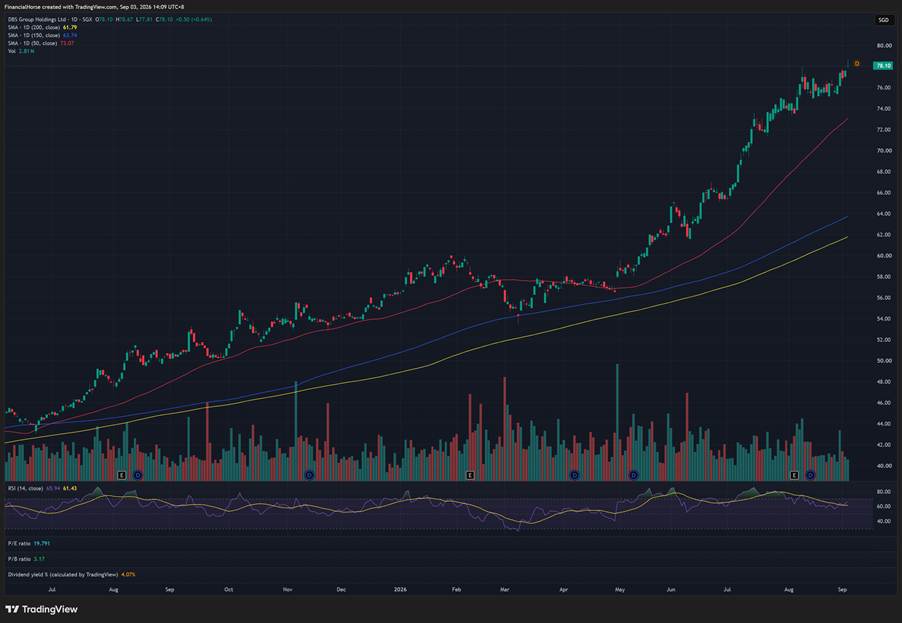
Bank shares — DBS, OCBC, UOB, held in CDP with Direct Crediting
This one is pretty straightforward – the 3 local bank stocks, held in CDP.
Dividends land in the bank account every quarter with nothing to click.
At today’s prices the 3 banks yield roughly 3% at OCBC to a shade over 4% at DBS and UOB (the split is in the table below).
Why banks rather than “dividend stocks” generally? Well because almost half of the STI is Singapore banks, and banks are about as close a proxy to the Singapore economy as it gets (leaving aside real estate).
And it saves a lot of time stock picking.
One honest caveat — 3 banks in one country is not diversification.
And at current valuations the banks are not cheap, so if you buy a lot of them at current prices, and the economy heads south, there is risk of capital loss.
An S-REIT ETF, not individual REITs
Individual REITs demand decisions — rights issues, preferential offerings, the Keppel-type equity raises I wrote about last week.
A spouse who ignores a rights issue gets diluted.
An ETF absorbs all of that.
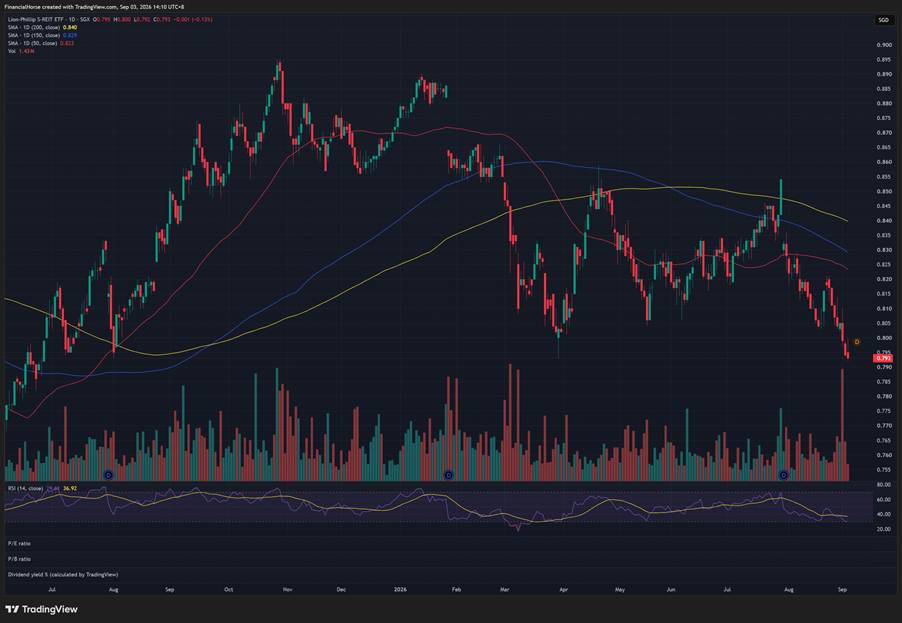
The 2 candidates on SGX are the Lion-Phillip S-REIT ETF (CLR) and the CSOP iEdge S-REIT Leaders ETF (SRT), both paying roughly 5.5% to 6% at today’s prices, twice a year.
Lion-Phillip S-REIT ETF is the larger of the two, at about S$880 million against roughly S$135 million for CSOP. And with ETFs usually the bigger one is better – if anything for higher liquidity when you buy / sell.
Is that yield guaranteed? No — distributions fell through the 2022 to 2024 rate cycle, and REITs remain interest rate-sensitive.
But the money still arrived twice a year, and nobody had to do anything.
As a yield play they work, but as you can see from the chart that when interest rates go up – you can and will suffer capita losses.
The S&P 500 — the growth engine that is never sold
Warren Buffett’s instruction for the money he leaves his wife is famous: “Put 10% of the cash in short-term government bonds and 90% in a very low-cost S&P 500 index fund.”
So in this portfolio, the S&P 500 is the sleeve your spouse never touches — the 30-year money, for longevity and for the kids, with the standing instruction from Part 2 attached: sell nothing.
The clean answer is an Irish-domiciled ETF like CSPX or VUAA, both at a 0.07% expense ratio — no US estate tax, 15% rather than 30% dividend withholding, and accumulating, so there are no distributions to manage.
The catch is that it lives on the London Stock Exchange, which means a broker login and an FX conversion.
The alternative is S27 on SGX — held in CDP, bought in Singapore dollars, nothing foreign about it — except that the fund is US-domiciled, so above US$60,000 the 40% estate tax problem from Part 1 is right back.
In plain English — for the S&P 500 sleeve, you are choosing between a login your spouse has to keep alive, and a tax bill your spouse has to pay.
My answer: Irish-domiciled via a broker, if there is any adult in the family who will log in once a year. If not, this sleeve goes through a robo (more below).
Never miss a post! Follow Financial Horse on WhatsApp or Telegram — one tap, and every new article reaches you the moment it’s published.
The cash sleeve — SSB, T-bills, or FD?
The rule is simple: 12 months of spending in cash equivalents, so that no bad market month ever forces a sale.
The options are compared below:
| Instrument | Yield (Sep 2026) | What your spouse has to do | Fuss verdict |
| Singapore Savings Bonds (Oct 2026 issue) | 1.65% year 1, 2.32% average over 10 years | Nothing for 10 years; redeem any month, no penalty | Built for this |
| 6-month T-bill | 1.60% cut-off (27 Aug 2026) | Re-apply every 6 months — no auto-roll | Fails, unless they will act |
| 12-month fixed deposit | 1.00% board rate at DBS and UOB; up to ~1.45% on promotional “fresh funds” tranches | Nothing, if set to auto-renew | Zero effort, lowest yield |
Two years ago the T-bill would have won this table on yield alone.
Today it doesn’t even do that — 1.60% against 1.65% in year one on the SSB, rising to a 2.32% average if it is simply left alone for ten years.
And even if the T-bill were paying more, it would be the wrong answer here, because someone has to re-apply every 6 months and the whole point is that nobody will.
The SSB, by contrast, was practically designed for a person who does nothing: 10 years, government-backed, redeemable any month, and the interest just turns up.
The only limit is the S$200,000 cap per person — which is exactly why it goes in your spouse’s name, not yours.
So the sleeve is SSBs up to the cap, and fixed deposits on auto-renew for the rest.
One caveat on the fixed deposit leg: the headline 1.40% to 1.45% rates are promotional, and an auto-renewal rolls into the prevailing board rate, which today is 1.00%. Convenience has a price, and that is what it costs.
And switch on Money Lock (DBS calls it digiVault, UOB calls it LockAway, OCBC just calls it Money Lock) on whatever isn’t needed this quarter.
Unlocking takes a branch visit. That friction is the entire point to protect from scammers – you can never be too careful with money like that.
The robo alternative — and the risk nobody removes
Everything above can be bought in one app instead.
Most “Roboadvisors” like Endowus, Syfe, DBS, OCBC etc offer a joint-alternate account — either holder acts alone, and if one of you dies the other keeps full access without waiting for probate — takes a monthly GIRO in, pays a monthly distribution out, rebalances automatically, and holds Irish-domiciled funds without any foreign broker.
These are not free though, and there are fees.
Endowus for example costs 0.35% to 0.65% a year on top of the fund fees — roughly S$3,500 to S$6,500 a year on S$1 million (excluding the fund fees), against close to nothing for the same holdings in CDP.
But if you ask me — worrying about the fee is missing the forest for the trees.
The real issue I would focus on is what you think you are buying with it.
A robo doesn’t remove the asset allocation decision. It makes it for you, once, from a questionnaire — and then nobody in the household thinks about it again.
In plain English — outsourcing the allocation to someone else doesn’t remove the risk. It removes you from thinking about it, but the risk is still there.
In a year where the S&P500 fell 18% – some robo advisors outperformed some didn’t.
| Portfolio | 2022 return |
| Singapore robos — “balanced” (~50–60% equity) | −15% to −19% |
| Singapore robos — all-equity | −17% to −19% |
| S&P 500 (total return) | −18.1% |
| S-REIT index | roughly −10% to −12% |
| DBS / OCBC / UOB | all up for the year, all raised dividends |
| Singapore Savings Bonds | interest paid, no capital loss |
“Balanced” lost within about 2 percentage points of all-equity, because in 2022 bonds fell alongside stocks.
At certain platforms, the balanced portfolio actually lost more than the all-equity one.
The risk you know about vs the risk you don’t
To be fair — the DIY portfolio in this article has exactly the same risk. It’s just visible.
The difference is that with DIY, at least someone in the family knew what the bet was.
So whichever route you take, the allocation — and the why — goes on the one-page plan from Part 2, in 3 lines.
Long story short — the robo is right for the spouse who will never hold a CDP or broker account, and a perfectly sensible home for the S&P 500 sleeve alone if the broker step is the blocker.
Pay the fee for the account structure and the payout plumbing. Never for the idea that someone else is watching the risk.
When it comes to money – you have to own the risk.
Putting it together — the S$1 million example
So let’s run the numbers on S$1 million, outside of CPF and property.
Note that this is a purely hypothetical portfolio, and you should adjust accordingly based on your own risk appetite.
| Holding | Amount | Yield (Sep 2026) | Monthly income |
| DBS / OCBC / UOB, in CDP with Direct Crediting | S$350,000 | ~3.8% | ~S$1,110 |
| S-REIT ETF, in CDP | S$200,000 | ~5.7% | ~S$950 |
| S&P 500 Irish-domiciled ETF, never sold | S$300,000 | 0% by design | S$0 |
| SSB (to the cap) + FD on auto-renew | S$150,000 | ~2.0% | ~S$250 |
| Total | S$1,000,000 | ~S$2,310 |
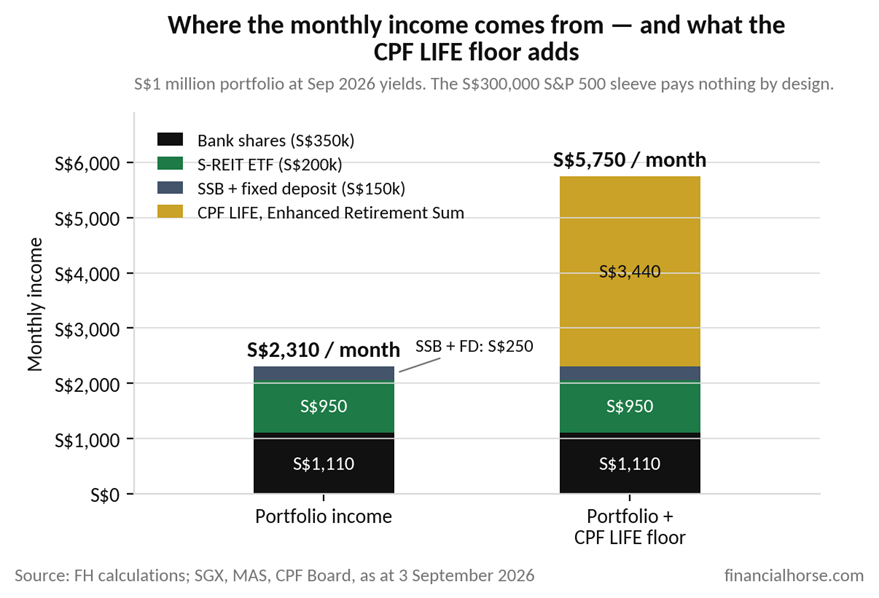
Call it S$2,300 a month, arriving with zero sell orders — about 2.8% of the portfolio, comfortably under the 3.9% that Morningstar currently calls a safe starting withdrawal rate, with the S&P 500 sleeve compounding untouched on top.
Is that enough?
Without the CPF floor, it probably isn’t — because dividends are not guaranteed, and we have seen when something like COVID comes around, dividends can and will be cut.
With the CPF LIFE floor at the Enhanced Retirement Sum thrown in, the household is closer to S$5,700 a month.
So CPF LIFE does provided an important floor in providing cash flow that will never get cut – allowing you to tide through the tough periods without having to sell the S&P 500 sleeve.
Closing Thoughts
Long story short — the hard part was never picking the holdings.
It was accepting that the portfolio I would build for myself is not the portfolio I should leave behind.
I love investing, and I’m happy to spend all my waking hours looking at stocks and investments.
But hey – I have to accept that not everyone is like me.
And when I go, I don’t want to pass the burden on, I want them to have a portfolio they can run even without me.
Love to hear what you think though!
What would your spouse struggle with more — the first monthly bill, or the first phone call from someone offering to help?
This article was written on 3 Sep 2026. It will not be updated going forward.
How my own portfolio is actually positioned — with weekly updates on what I buy and sell — is shared on FH Premium, alongside my full stock watchlist and the prices at which I would buy.
Join the FH mailing list and new articles land straight in your inbox:
Also on WhatsApp, Telegram and Facebook.
Hi FH,
I disagree with you that local bank stocks “don’t ask anything of you”. Remember DBS did a 1 for 2 rights issue during the height of global financial crisis in late 2008? Then what about all 3 local banks doing scrip dividend during the recent COVID-19 pandemic?
Good point – I updated the article to correct this. Frankly there is no stock that doesn’t ask anything of you, it’s about trying find something that is “more” fuss free.
Hi FH,
As for your point about ETFs, it is not designed to run “forever” like companies. Some ETFs might be delisted, merged or closed down. It all depends on the manager of those ETFs. Those decisions are sometimes commercial rather than anything else. Managers can also change due to mergers of fund management companies. It is not foolproof that the ETF will run forever.
Again, fair point. Maybe a big ETF like SPY will have lower risk, but this is absolutely right.
Hi FH,
Thank you for creating this article; it is a helpful read on the assumtion portfolio. Can i know what happens to the S&P 500 portfolio since it is a accumulating instead of dividends paying and you are also not selling any. So how do we benefits from keeping this for life but there is no actual withdrawals/ monthly income from here.
Hi Darren. This calls for a part 4, how to spend the money 🙂
Some thoughts:
-the portfolio does not need to live forever. I think I should be drawn down.
-the goal should instead be to buy as much time as possible for our dependents to be self sufficient.
-work out the annual expenses of the spouse / family.
-at the start of each year. Use the dividends + sg stock sales + us stock sales to replenish the cash buffer
-keep at least two years worth of spending as cash buffer, that way you don’t have to force sell during crash years
-the portfolio can last quite a long time depending on the sequence of returns for the stocks held
Some variable factors apart from markets that affect portfolio longevity:
-spouse might choose to continue / go back to work. In that case expenses go down, portfolio lasts longer
-cpf life payouts could kick in to help, reducing portfolio drawdown requirements
-payouts from insurance if I pass on plus my cpf getting transferred over to spouse would increase size of overall starting portfolio
-mortgage insurance (I think this applies only to hdb?) could take over spouse share and reduce expense burden.
On the softer aspects…
-the aim here is to give your spouse and the family a financial safety net so that they have one less thing to worry about as they rebuild their lives without me.
-it also gives some optionality to your spouse on whether / when he/she feels ready to start working again.
-I am off the view that we shouldn’t leave too much to our children, else they won’t be hungry enough and it might actually be a dis-service to them in future… 🙂