Okay so after the inflation article last week, quite a few of you have asked me for my views on S-REITs and interest rates.
Especially after the article on the local banks, where I said I was holding the banks but not adding at these valuations.
The S-REIT index has fallen all the way back to the lows we saw during the Iran war in March and April.
Singapore REITs are down about 7% in 2026, while the STI is up more than 20% and the local banks sit near their highs.
At today’s prices, the sector yields about 6.4% on forward distributions.
So… are REITs a good buy?
And what would I do with the REITs I still own, given I’ve been selling REITs all year?
S-REITs have round-tripped to the Iran-war lows
Here’s the chart for reference.
You can see that the S-REIT index sold off sharply in March when the war started, bounced with the April ceasefire, and has now given all of it back.
The sector is down about 7% year to date, against an STI that is up around 22%.
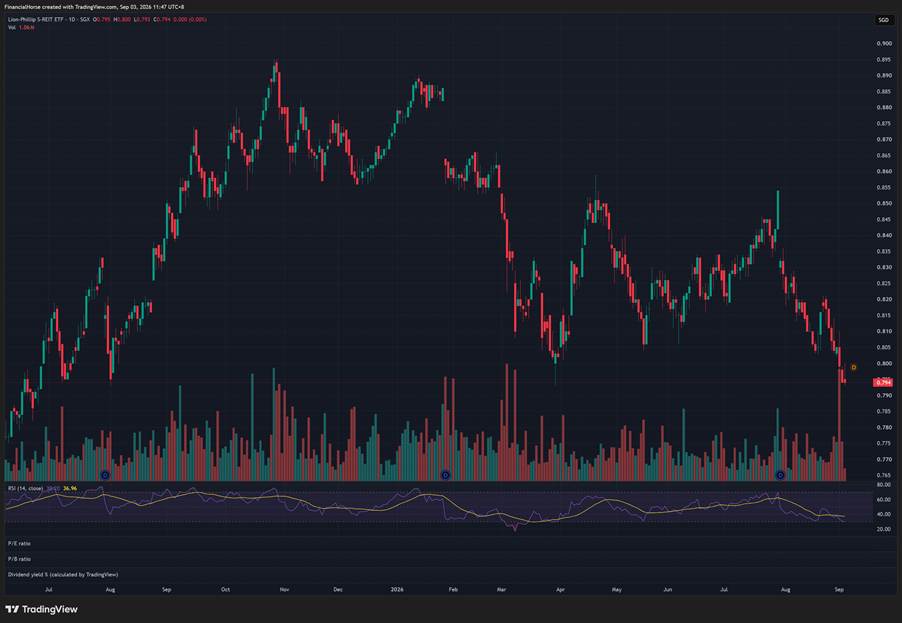
But what is interesting is why it is back at the lows.
In March, the sell-off was oil, inflation and plain risk-off — everything fell together.
This time, stocks are at record highs and it is only REITs falling.
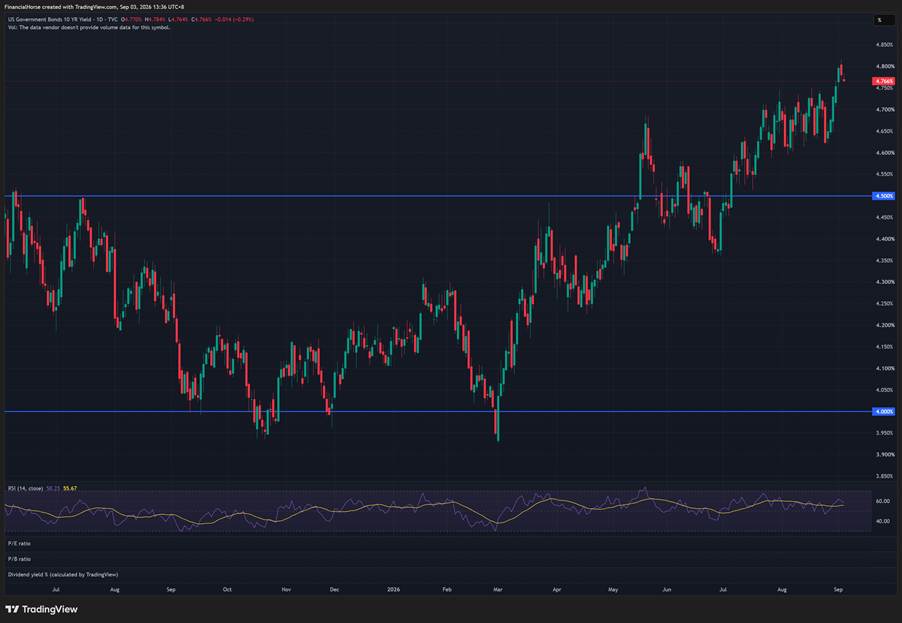
The reason is simple — long-term bond yields.
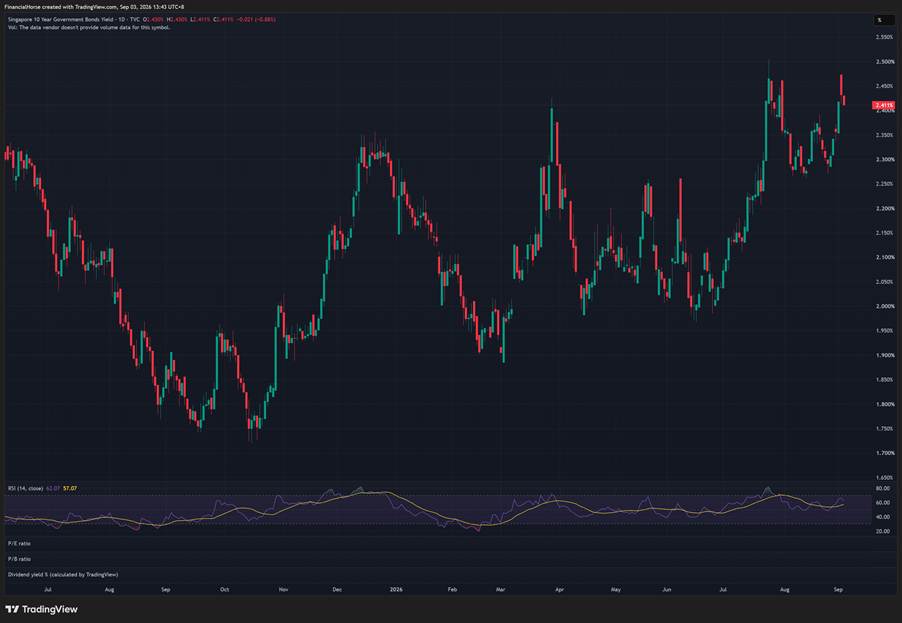
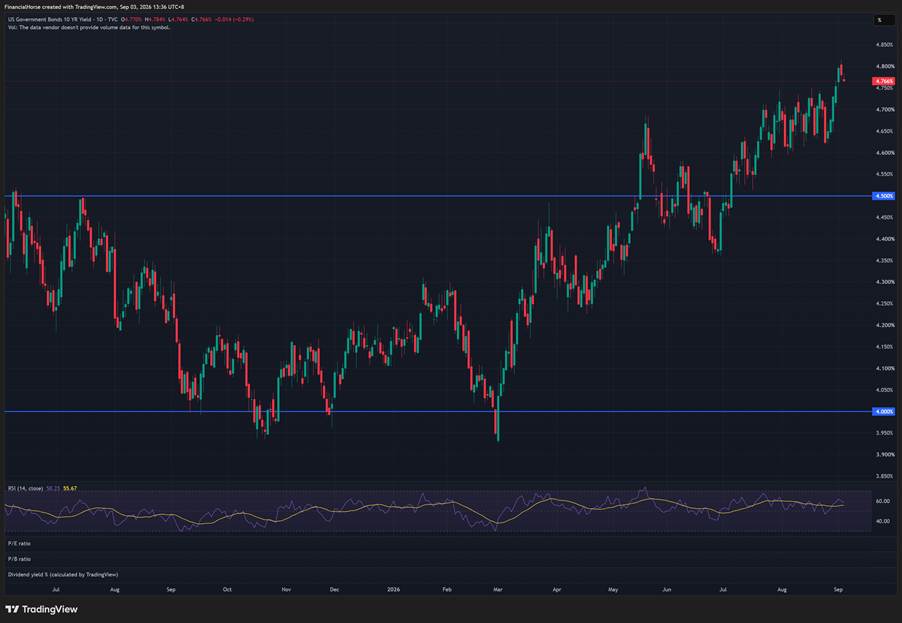
The US 10-year Treasury yield hit 4.78% this week, its highest level since November 2023, and the Singapore 10-year government bond yield has climbed to 2.42% from 1.74% last October.
In plain English — the March sell-off was a war sell-off, while the August sell-off is a bond sell-off, and bond sell-offs hurt REITs more than almost anything else.
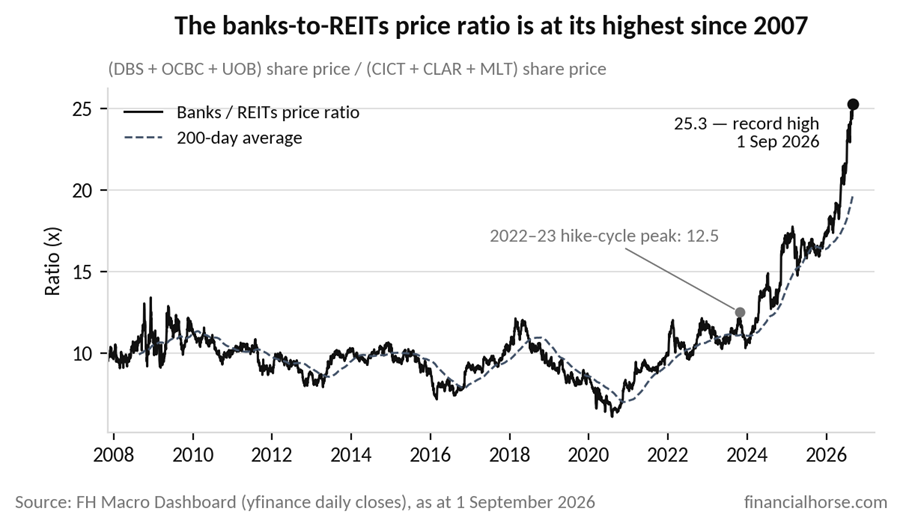
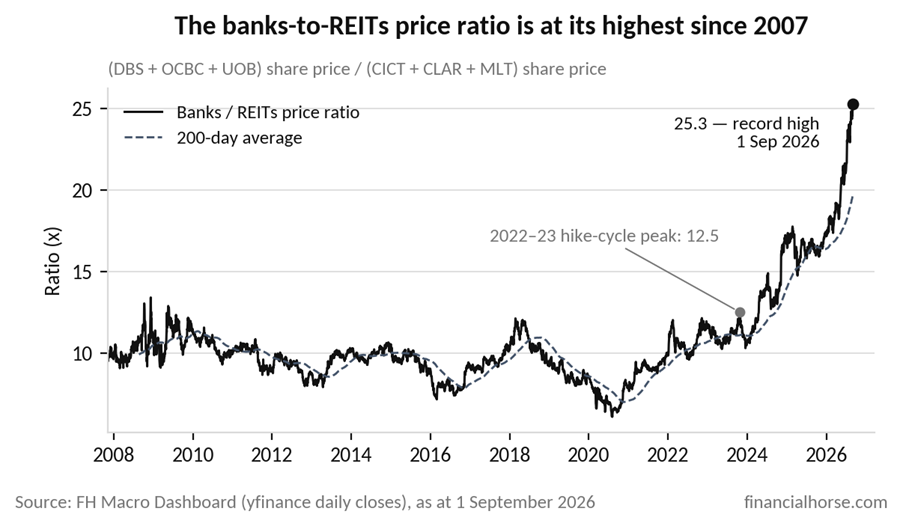
Here is another way to see the same thing — the price of the 3 local banks divided by the price of 3 blue-chip REITs, going back to 2007.
That ratio is at the highest level in the entire series.
In plain English — the market has never favoured Singapore banks over Singapore REITs by this much, not even at the peak of the 2022–2023 rate-hike cycle.
REIT cash flows went up. REIT prices went down.
This is the part that I think a lot of investors are missing.
If REITs were at the lows because rents were falling or debt costs were spiking, the sell-off would be easy to explain — but that is not what the 1H 2026 results showed.
The latest numbers for the big S-REITs are summarised below:
| REIT | DPU (latest half / quarter, y/y) | Cost of debt (trend) | Gearing | Yield |
| CapitaLand Integrated Commercial Trust | +7.1% | 2.9% (stable) | 37.4% | 5.0% |
| Keppel DC REIT | +11.3% | 2.6% (down from ~3.0%) | 34.0% | 4.6% |
| Frasers Centrepoint Trust | +1.4% | 3.0% (down from 3.5%) | 40.4% | 5.6% |
| CapitaLand Ascendas REIT | flat | 3.5% (stable) | 39.7% | 6.1% |
| Starhill Global REIT | +0.8% | not disclosed | 35.5% | 6.9% |
| Mapletree Logistics Trust | +0.2% | 2.6% (down from 2.7%) | 40.5% | 6.2% |
| Mapletree Pan Asia Commercial Trust | −2.5% | 2.94% (down from 3.16%) | 37.7% | 6.2% |
| Mapletree Industrial Trust | −4.9% | 3.2% (flat, hedges rolling off) | 37.5% | 6.7% |
6 of the 8 REIT grew or held DPU flat, and the cost of debt fell or held steady at every one that discloses it.
Occupancy is high, rental reversions are positive, and core CBD Grade A office vacancy is at a record low of 3.3%.
In plain English — REIT dividends are actually holding steady, and up in many cases.
To be fair — the weakness is real where the REITs own overseas assets.
MPACT is still struggling in China and Japan, Mapletree Industrial Trust has US occupancy sliding and swaps rolling off, and Mapletree Logistics Trust is only just turning the corner in China.
But if you stick to Singapore suburban retail and Singapore office, the operating story is about as good as it has been in years.
So this is not an earnings problem.
It is a discount-rate problem — which is exactly why the interest rate question decides everything.
Which interest rate actually matters for S-REITs?
“Interest rates are going up, so REITs go down” is the standard line.
But for a Singapore REIT there are 3 different interest rates in play, and right now they are pointing in different directions.
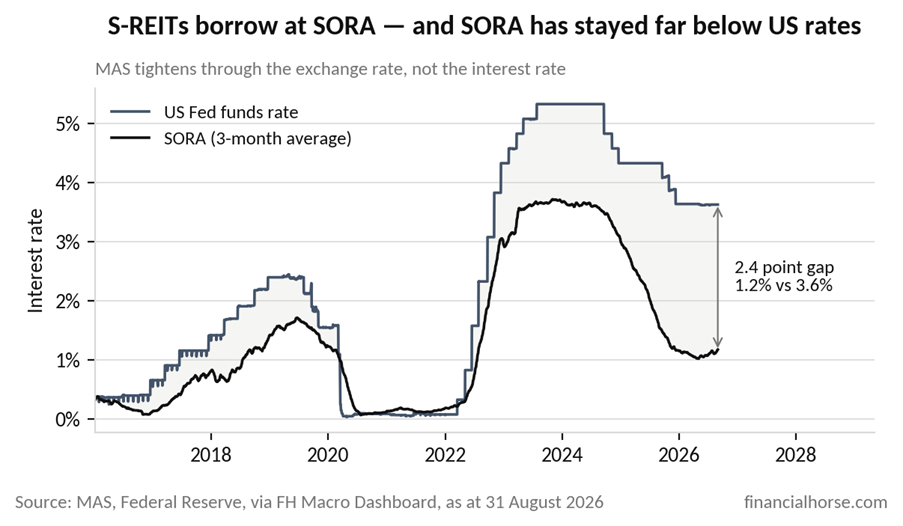
Rate 1 — SORA. This is what REITs actually borrow at.
3-month SORA is around 1.2% today, down from a peak of about 3.7% in late 2023, and it sits roughly 2.4 percentage points below the US Fed funds rate — a gap that has only been wider in short bursts over the past decade.
And here is the part most readers get wrong.
MAS “tightened” monetary policy in April and again in July, but MAS does not tighten by raising interest rates — it tightens by letting the Singapore dollar appreciate faster.
A currency that is expected to keep strengthening means Singapore dollar interest rates can stay well below US rates.
So MAS tightening did not raise S-REIT borrowing costs this year. If anything, it kept them low.
That is why every REIT in the table above is refinancing cheaper.
Rate 2 — the Singapore 10-year government bond. This is what REITs are valued against.
Every REIT is priced as a yield above the risk-free rate.
When the 10-year SGS goes from 1.74% to 2.42%, a REIT has to yield more to compete — and the only way a REIT yields more is for its price to fall.
The 10-year auction cut-offs tell the story: 1.99% last October, 2.09% in April, 2.30% at the 27 August auction.
Singapore 10 year yields are going up – and this is what is pressuring the REIT prices.
Rate 3 — the US Fed. This is what sets the ceiling on everything else.
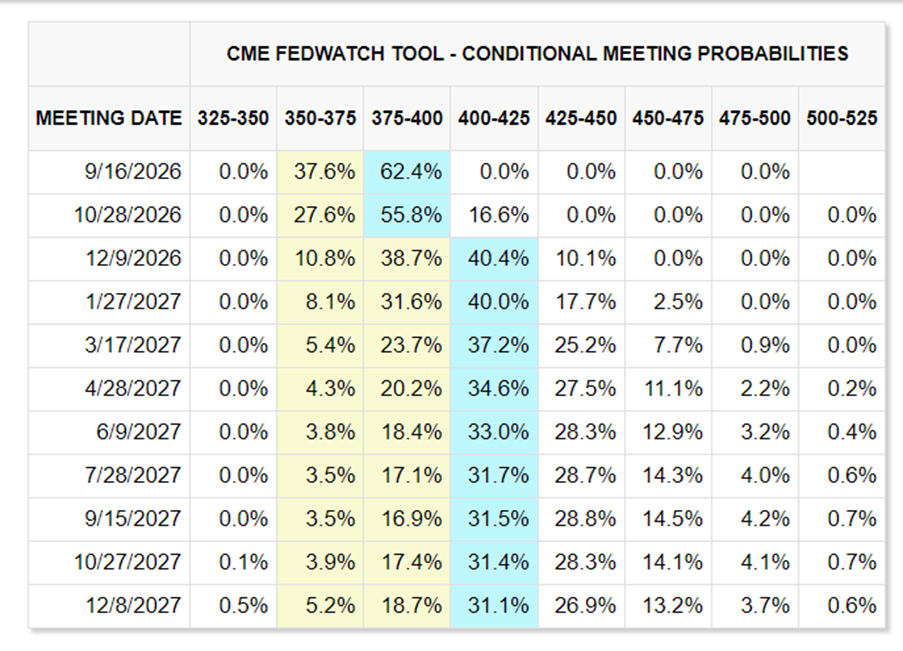
The Fed held rates at 3.50%–3.75% in July, but 3 members dissented in favour of a hike.
After Chair Warsh’s speech at Jackson Hole, futures markets are pricing roughly 60% chance of a 25 basis point hike at the 16 September meeting.
Meanwhile, US CPI is running at 3.4%, core PCE at 3.3%, and the 10-year Treasury at 4.78% — the highest since 2023.
If US yields keep rising, Singapore yields follow, and the SGD-funding advantage in Rate 1 only cushions the blow.
Long story short — funding costs (SORA) say buy REITs, valuation says wait, and the Fed (and long term yields) says not yet.
And on the domestic side, Singapore inflation just picked up to 2.2% with MAS guiding for it to stay elevated into early 2027 — so there is no rate relief coming from home either.
Never miss a post! Follow Financial Horse on WhatsApp or Telegram — one tap, and every new article reaches you the moment it’s published.
What’s priced in at a 6.4% yield for the REITs? Compared vs banks and T-Bills
The yield against the alternatives, as of early September 2026:
| Instrument | Yield |
| S-REIT sector (forward) | ~6.4% |
| Singapore banks (average) | ~4.0% |
| 10-year SGS | 2.42% |
| Singapore Savings Bond (Oct 2026, 10-year average) | 2.32% |
| 6-month T-bill | 1.60% |
Against cash, it is not even close — almost 5 percentage points over a T-bill.
Against the banks, the gap is more than 2 percentage points, the widest of this cycle.
Against bonds, the spread is roughly 4 percentage points over the 10-year SGS — up only slightly from about 3.7 percentage points at the April lows.
REIT prices are back where they were in April, but the 10-year yield is 40 basis points higher, so most of what you have gained on price you have given back on the risk-free rate.
On price to book, the sector trades at 0.87x forward book, against a 10-year average of 0.96x.
In plain English — REITs are cheap against cash, cheap against banks, and fairly priced against bonds. This is not 2022 depression pricing.
What the 2022–2023 rate-hike cycle taught me
The Fed started hiking in March 2022, and S-REITs fell close to 20% by that October.
The Fed’s last hike was July 2023 — but REITs did not bottom in July 2023.
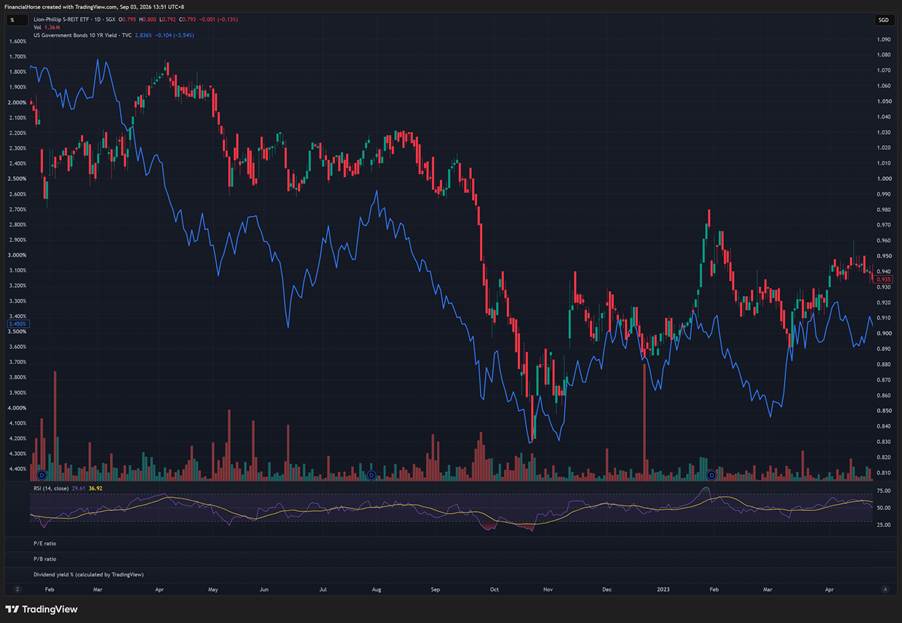
They kept falling until late October 2023 — the week the US 10-year yield peaked at 5% — and then rallied strongly into year-end once the Fed signalled cuts (see chart of REIT (candles) vs 10 year yield inverted (blue)).
The lesson, if you ask me, is that REITs bottom when long-term bond yields peak, not when the Fed stops hiking.
And for the year and a half in between, you clipped a 6% yield and went nowhere on price.
Yes it is a sample size of one cycle, but that is exactly the set-up I think we are in today.
Risk-reward — bull, base and bear
Which brings us to the million dollar question.
Keeping this simple — at today’s prices, I see 3 ways the next 12 months or so could play out:
Bull — the Fed hikes once and is done, long yields roll over, and the record gap between banks and REITs starts to close. Something like the November 2023 rally: total return maybe around +15 – 25%, including distributions. That said, this needs the 10-year yield to peak first, and for now it’s not clear if it has.
Base — the Fed hikes once or twice, long yields plateau at these levels, and REIT prices go sideways. You collect the distributions and not much else: total return maybe around +5 – 8%, including distributions — which is essentially the yield. This is the 2022–2023 template, and it is my base case.
Bear — inflation stays sticky, the Fed keeps hiking into 2027, the US 10-year pushes through 5% and the Singapore 10-year heads towards 2.7%. The index breaks the Iran-war lows and sector yields head to 7%: total return probably flat to −10%, including distributions.
What I am watching to tell which one is winning:
- The US 10-year yield after the 16 September Fed meeting — if it fails to make a new high on a hike, the long end may be done.
- The 10-year SGS auction cut-offs — 1.99%, then 2.09%, then 2.30%; the first lower one matters.
- The Fed’s language shifting from “hike” to “hold” — the November 2023 rally started with words, not cuts.
- The banks-to-REITs ratio rolling over from its record.
- Oil and the Strait of Hormuz — with Brent at US$96, a real reopening takes the pressure off everything above.
On the fundamental side, the one thing to keep an eye out for is hedges rolling off at REITs like Mapletree Industrial Trust — fine while SORA sits at 1.2%, less fine if SORA ever normalises towards US rates.
In any case, my most updated macro views on REITs and stocks are always shared on FH Premium.
What I am doing with my money
My REIT selling this year was an allocation decision, not a reaction to the August sell-off.
At the start of 2026, I said that with the bulk of the rate-cut cycle behind us, I no longer saw the same tailwind for REITs in 2026, and that I intended to roughly halve my REIT exposure.
So I trimmed REITs in the first half, and then again in recent months.
What is left is a smaller set of Singapore-focused REITs that I am holding for the income.
For what is left I will probably hold for the yield, but I may sell or add opportunistically based on how things play out.
So to answer the question in the title — no, I am not buying back the REITs I sold. Not yet.
The verdict is hold, not add: I keep the reduced REIT allocation for the 6% yield, I put no new money into REITs at today’s rate set-up, and the trigger for adding back is the long end of the curve turning — tripwires 1 to 3 above.
I know my own bias is to average into losers because they got cheaper, and this is one of those moments where it is tempting – but I am actively countering my bias.
I would rather buy REITs 5% higher with the 10-year yield clearly past its peak, than 5% lower into rising yields.
Closing Thoughts: Buy Banks or REITs?
Banks give you a 4% yield plus growth while rates stay high; REITs give you a 6.4% yield and not much else until rates turn.
The record banks-to-REITs ratio tells you the switch trade will pay eventually.
But “eventually” needs a peak in long-term yields, and I would rather be late to that trade than early.
So for now I hold both, and I am adding to neither.
In plain English:
If you think the Fed is done after September and long-term yields have peaked, then today’s 6.4% is your entry, and the spread will do the work for you.
If you think inflation at 3.4% keeps the Fed hiking into 2027, then there is probably one more leg down before REIT yields are truly compelling — and you can afford to wait.
For those of you holding S-REITs through 2026 — are you adding at these levels, or, like me, waiting for the long end to turn? Love to hear what you think!
The views above are as at 3 Sep 2026, and markets move quickly.
My latest macro views, what I’m doing with my own money this week, and what would change my mind, are shared on FH Premium.
Join the FH mailing list and new articles land straight in your inbox:
Also on WhatsApp, Telegram and Facebook.
Great analysis. With the recent worsening of the situation in middle east (Houthi attacks) and sticky inflation, I personally will not be adding to S-REITS any time soon.