Okay so quite a few of you have asked me about Grab.
And I understand why – Grab closed at US$2.81 this week.
The lowest since mid 2023.
And it is now down 59% since its high of 6.60 just late last year.
Yet all 26 analysts covering Grab rate it a Buy, with an average target price of US$5.86 – double today’s price.
I wrote about Grab in April at US$3.50–3.90, and my conclusion then was that “even if I am right, I don’t make a lot of money”.
And personally, I hold grab shares with an average price of $3 – $4, so I am definitely down on this position.
In this article, I wanted to discuss:
- Why does Grab keep falling when profits are growing 50%?
- What is priced in at US$2.81?
- Will I buy, hold or cut my Grab position?
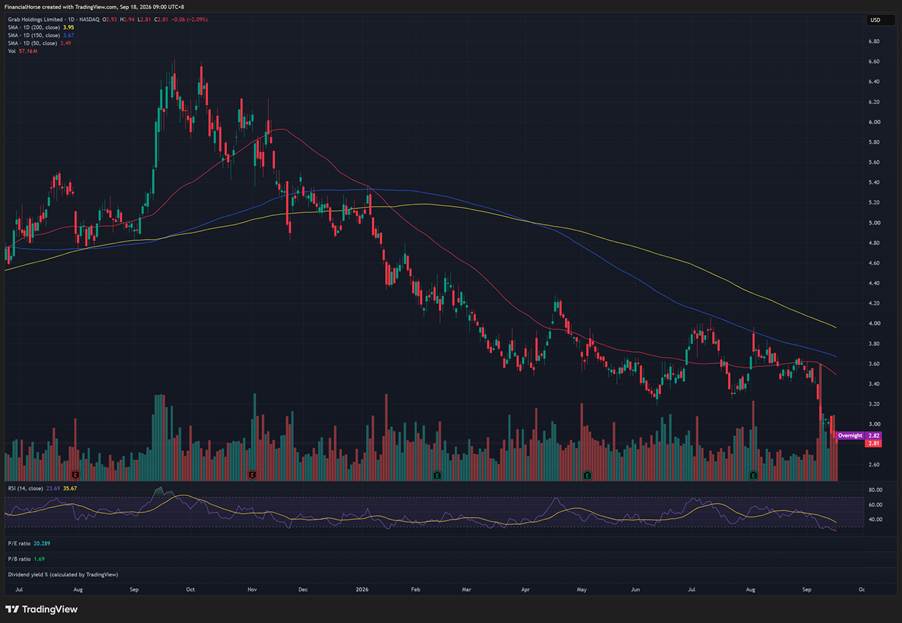
Price action of Grab shares – multi year low on heavy volume
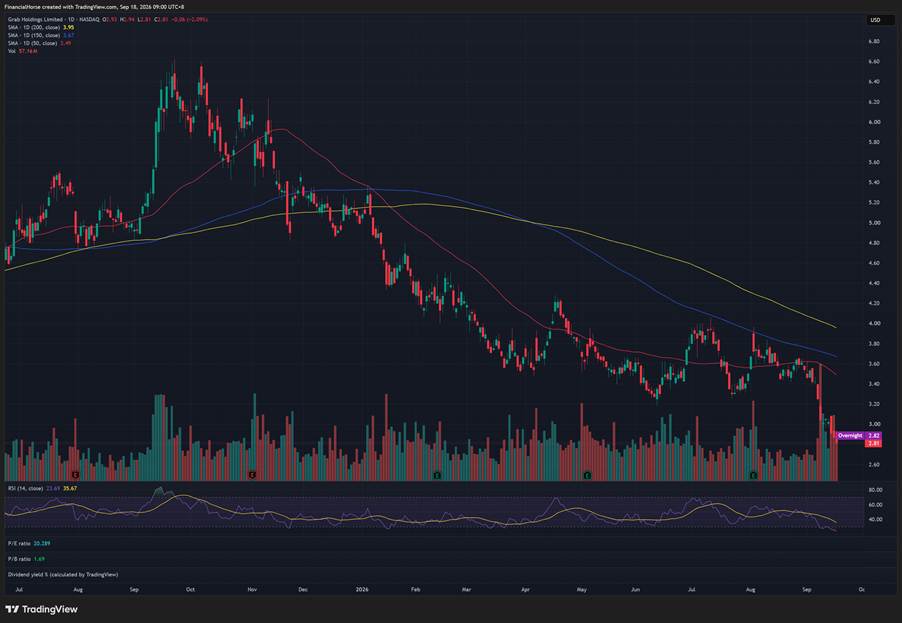
Here’s the chart for reference.
It’s just an absolute horror show.
On 8 and 9 September, Grab broke its June low of US$3.27 on 148 million shares traded, more than 3 times normal volume.
And the stock underperformed the S&P 500 by about 35 percentage points over 6 months.
In plain English – this is a stock in a downtrend, and the downtrend accelerated this month.
What actually happened to Grab this month?
There was no single piece of bad news – there were 4, in one week:
1. On 8 September, it was announced CEO Anthony Tan sold 400,000 shares for about US$1.45 million – small in dollar terms, but not a great look when the top guy is selling stock.
2. The same day, Vietnam’s competition regulator asked Grab to explain how it sets fares and commissions, after drivers called a 2-day app boycott for 12–13 September over falling take-home pay.
3. Grab announced that they are buying a controlling stake in Atome, a Singapore buy-now-pay-later firm valued at more than US$2 billion.
4. Oil went back above US$100 and the US 10-year yield went back to 5% – which hits South East Asia in particular (more on this below).
Grab fell 10.8% that week. The S&P 500 fell 2%.
So this was not the market. This was Grab.
And it comes on top of 2 bigger overhangs from July.
Uber – still a 13% shareholder in Grab – agreed to buy Delivery Hero for US$14.8 billion, which brings foodpanda, Grab’s biggest delivery rival in Singapore and Malaysia, under Uber’s roof.
And Indonesia capped ride-hailing commissions at 8% from 1 July – with a broader presidential regulation covering food and goods delivery still sitting unsigned in Jakarta as I write this.
In plain English – the market is not reacting to one headline, but to a pattern where every few weeks something chips away at the thesis.
The financial results say nothing is wrong – but this is backward looking
For what it’s worth – Grab’s Q2 2026 results, released end July, were the best the company has ever printed.
Revenue was up 22% year on year to US$997 million, and adjusted EBITDA was up 54% to US$168 million – a 16.9% margin, and the 18th straight quarter of sequential EBITDA growth.
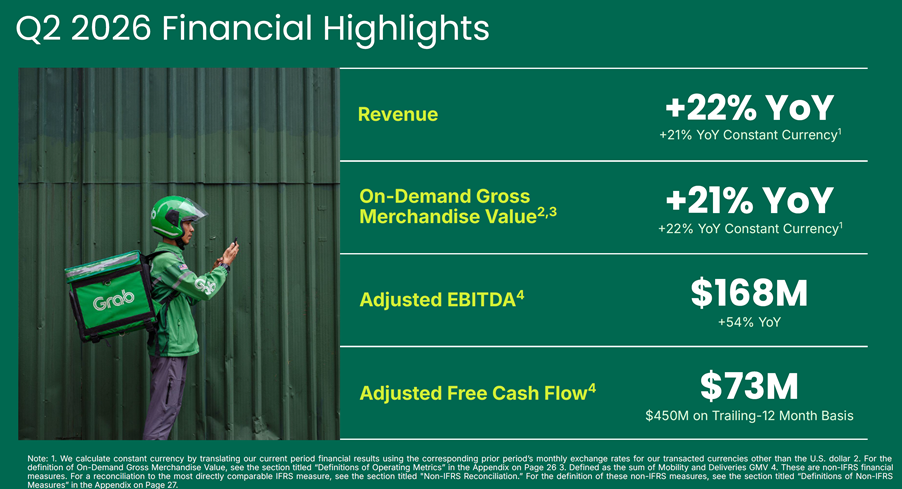
Management raised full-year guidance for the second time this year, to US$4.10–4.15 billion of revenue and US$720–740 million of adjusted EBITDA, and announced a new US$750 million buyback on top of US$5.4 billion of net cash liquidity.
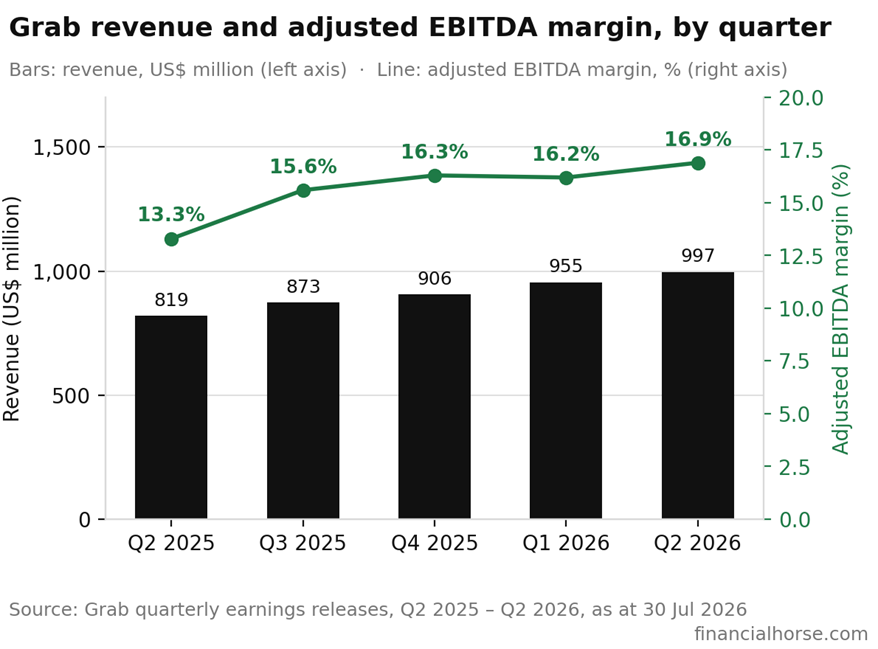
You can see the trajectory above – revenue growth in the low 20s every quarter, and the margin climbing from 13.3% to 16.9% in a year.
That said, one caveat – net profit of US$235 million included a US$307 million one-off accounting gain from consolidating Superbank, its Indonesian digital bank, so without it there is no net profit to speak of.
Grab’s own reconciliation shows it: operating profit for the quarter was US$19 million, and the US$235 million of net profit gets there via US$171 million of net finance income (where the Superbank gain sits) and a US$43 million tax credit.
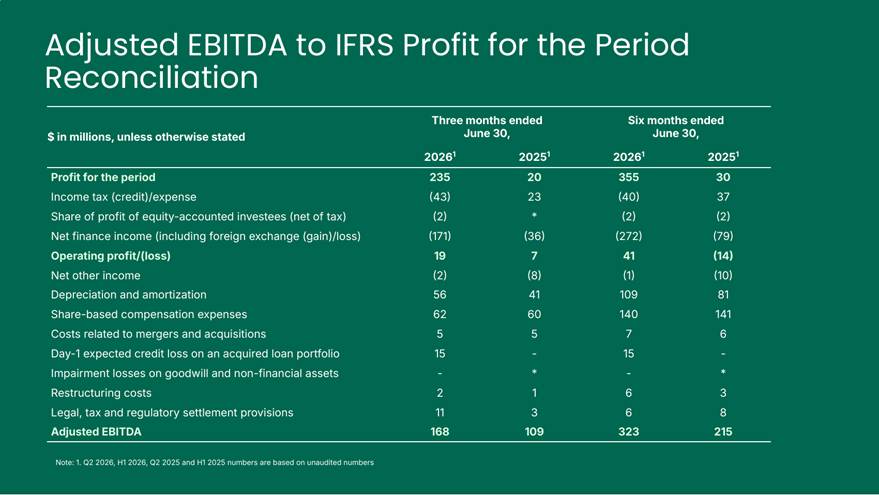
In plain English – the operating business is growing 20%+ and getting more profitable every quarter (although loss making if you strip out the one-off), but the stock is at a multi year low.
What gives?
So why does Grab keep falling? 3 things the market doesn’t believe
Here’s the thing – consensus EPS for 2026 has gone up from US$0.09 in March to US$0.12–0.14 today (depending on whose numbers you use), while the stock has fallen more than 20%.
That is a de-rating, not an earnings cut – the market is paying less and less for the same earnings.
Why?
If you ask me, it comes down to 3 reasons.
One – Margin Pressure
Revenue growth is already in the numbers – what the bulls need is for the current 16.9% EBITDA margin to hit the mid 20s.
Which is what Grab’s own EBITDA target for 2028 implies.
The problem is incentives.
Grab spent US$706 million on driver and consumer incentives in Q2 – 71% of its revenue, and 10.9% of GMV against 10.1% a year ago.
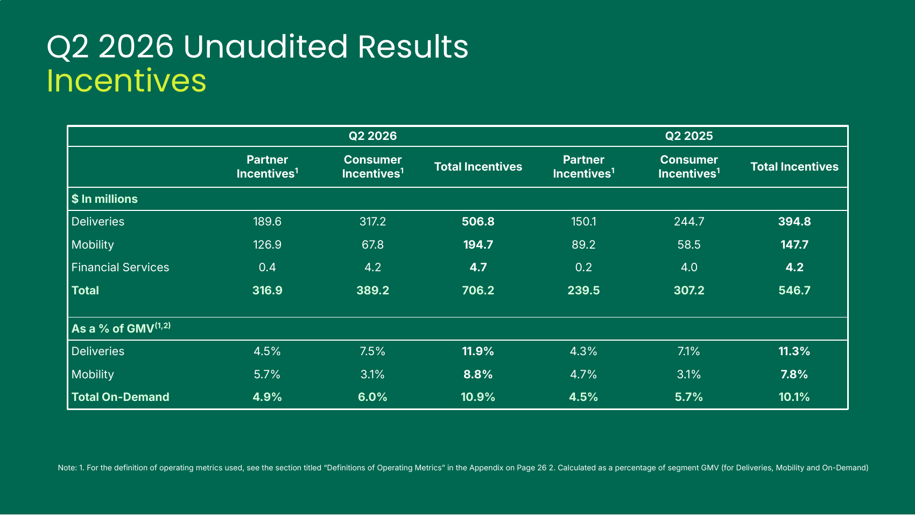
Incentives rose as a share of GMV in both marketplaces – Deliveries from 11.3% to 11.9%, Mobility from 7.8% to 8.8% – and partner incentives, the money paid to drivers, grew fastest at 32%.
In plain English – Grab is paying more, not less, to keep drivers and customers on the platform, and that is exactly the line that has to fall for the margin story to work.
This was the exact same problem that Shopee had a quarter or two back, and why the market sold the stock.
You can also look at the recent earnings reaction for SATS Ltd, after analysts sniffed out margin pressure.
This market is brutal about margins.
It’s no longer about how much you can grow revenue, it’s about how much money you can make off that revenue.
If the market sniffs out margin pressure, the stock will sell off.
And for now, the market is not convinced by Grab.
Two – regulation is spreading, and oil at US$110 is a double whammy.
To make point 1 worse, is factors beyond Grab’s control.
Political regulation, and oil price.
Indonesia capped 2-wheel ride-hailing commissions at 8% in July, and Vietnam’s regulator is now reviewing Grab’s commissions after drivers said they cannot make a living at 20–25% rates with fuel prices where they are.
And this is where oil comes in – because for a Grab driver, fuel is the single biggest cost.
Brent crude started 2026 at about US$61, spiked above US$120 in April when the Iran war closed the Strait of Hormuz, fell back to US$70 after the April ceasefire, and is back testing US$110 this month after attacks on Gulf shipping and the Saudi East-West pipeline.
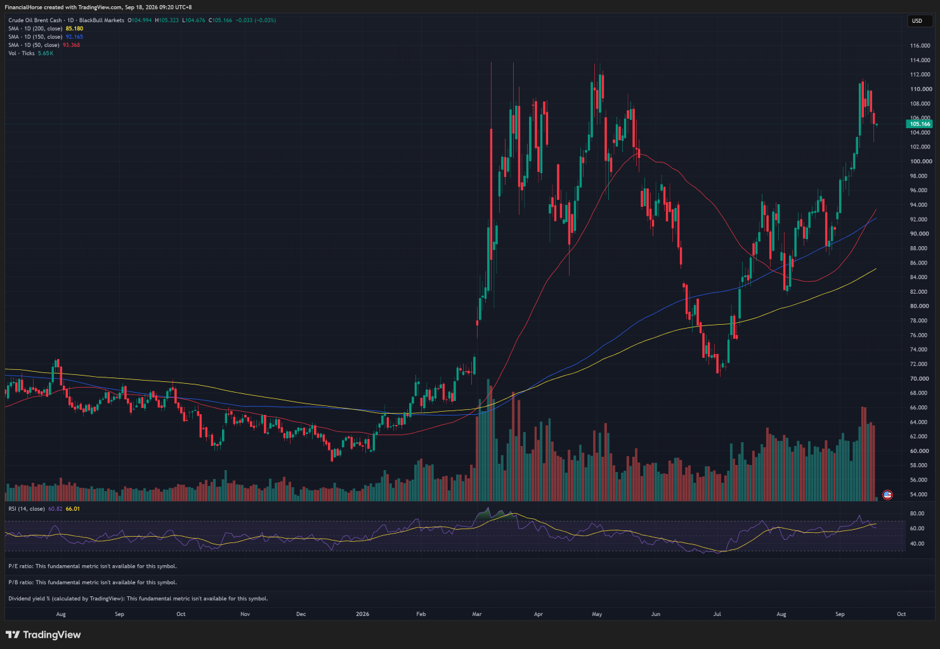
Now higher oil, means drivers need more per trip to make the same money.
Grab can either raise fares – and lose demand – or raise incentives – and lose margin.
In Singapore it raised its fuel surcharge to S$0.90 per trip in April, in the Philippines it put ₱350 million into driver fuel support, and in Vietnam the drivers are boycotting.
Grab’s own Q2 slides label the first half of this year a “fuel crisis” – driver incentives per active driver were up 12% year on year “amid elevated fuel costs”.
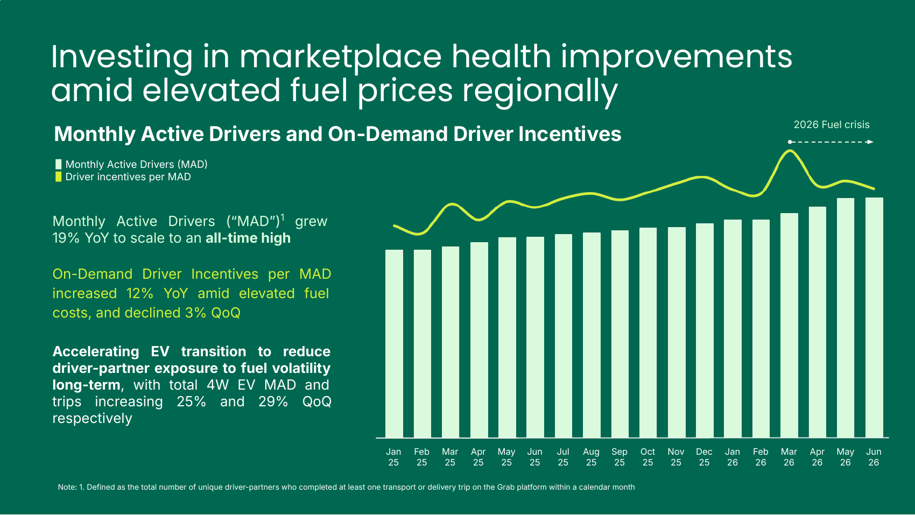
The yellow line is driver incentives per active driver – it spiked in March 2026 as the fuel crisis hits, and by June is still running above last year’s level even as active drivers hit an all-time high.
It doesn’t stop at the driver – here’s what oil has done to the FX of Grab’s 2 biggest markets outside Singapore this year:
| Fuel | Currency | Central bank | |
| Indonesia | Petrol held at Rp10,000/litre on a budget that assumed US$70 oil | Rupiah record low in July | Hiked to 5.75% to defend the rupiah |
| Philippines | National energy emergency declared in March | Peso at record lows | 3 hikes in a row, to 5.0% |
Grab reports in US dollars, but earns in rupiah, pesos, ringgit and baht – so weaker currencies, squeezed consumers and higher fuel costs is about the worst macro combination you could design for a South East Asian ride-hailing and delivery business.
Grab is basically getting squeezed on all fronts here, and you could argue that it’s al the same problem.
Higher oil prices means Grab needs to give higher incentives to subsidize drivers.
While higher oil prices pressure the South East Asian economy and currencies, hitting Grab in a double whammy.
Three – Despite all that, Grab continues to spend heavily to acquire
With all that is going on, you would have thought that Grab would batten down the hatches.
All hands on deck kind of stuff.
Well – Grab just literally announced that they will be buying a 60% stake in Atome Financial.
Paying $1.49 billion in cash.
Really, given all that is happening above?

To be fair – with US$5.4 billion of net cash liquidity, none of this is a solvency question.
But when a company goes from “we are finally profitable” to “we are redeploying the cash into consumer credit in South East Asia”, investors have to reevaluate the business, at a time when South East Asia is looking very vulnerable to higher oil prices.
I mean… you can’t really fault the market here can you.
Never miss a post! Follow Financial Horse on WhatsApp or Telegram — one tap, and every new article reaches you the moment it’s published.
What is priced in at US$2.91?
Which brings us to the million dollar question.
All of the above is known – so is it already in the price?
Here’s how Grab compares with its peers, as at 15 September 2026:
| Share price | Forward P/E | EV/Sales | P/B | |
| Grab | US$2.91 | 16.7x | 2.0x | 1.8x |
| Uber | US$71.43 | 17.3x | 2.7x | 5.3x |
| Sea | US$102.65 | 24.1x | 2.1x | 5.1x |
| DoorDash | US$198.26 | 30.9x | 5.3x | 8.7x |
| MercadoLibre | US$1,828.94 | 43.4x | 2.9x | 11.8x |
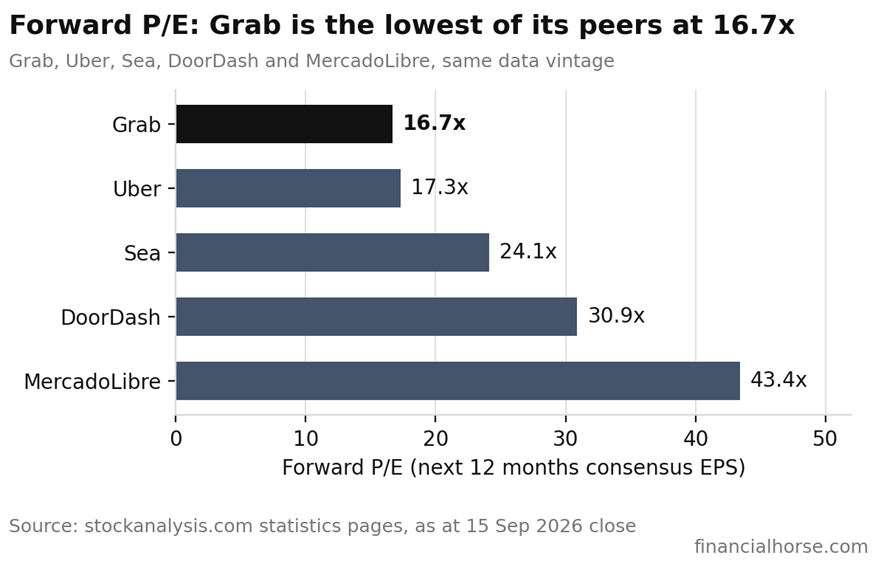
Grab is the cheapest of the lot on forward P/E, at about 17x – the same as Uber, and well below Sea, DoorDash and MercadoLibre.
And that understates it, because Grab has about US$1.10 a share of net cash – 38% of the share price.
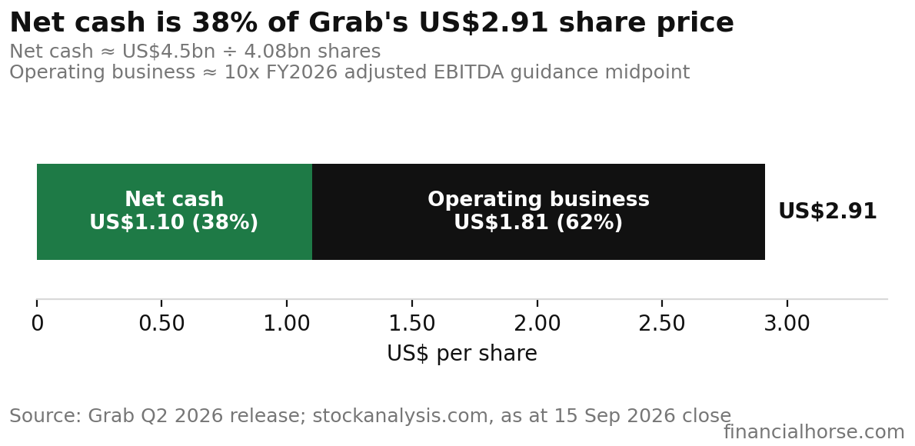
In plain English – at US$2.91, you are paying about US$1.80 a share for the operating business, roughly 10 times this year’s EBITDA guidance, for a platform growing revenue at 22%.
On EV/Sales, that is about 2 times – the cheapest Grab has been since listing (the previous low was 3.9 times in 2023).
Which I suppose is just a fancy way of saying that Grab stock is very cheap at this price – if you assume that the Iran war will eventually end, oil price will come down, and all this will blow over eventually.
Risk-reward – bull, base and bear for Grab at US$2.91
Keeping this simple – at US$2.91, I see 3 ways the next 3 years could play out:
Bull – incentives peak this year and fall below 10% of GMV as oil normalises, Deliveries margins climb towards 4% of GMV, and the digital banks turn profitable.
EBITDA reaches US$2 billion and the market pays a growth multiple again. Total return around +150–180% – but this needs everything to go right, including oil.
Base – Grab hits the street’s numbers: revenue compounds in the high teens and the margin grinds up to the mid-20s by 2029.
Total return around +50–60% over 3 years, largely via earnings growth at today’s multiple.
Bear – Indonesia extends the commission cap to food delivery, Uber re-funds foodpanda, oil stays above US$100 and incentives stay above 11% of GMV.
Margins stall in the high teens, the buyback stops, and the stock trades down to around US$2.
Total return around –30 to –35%.
Is that attractive risk reward?
On paper, yes – for every US$1 of downside in the bear case there is about US$1.70 of upside in the base case, with 38% of the price backed by cash.
If you think incentives are cyclical – a 2026 land grab against foodpanda, made worse by an oil shock that will pass – then US$2.91 is the cheapest Grab has ever been, and the analysts are right.
If you think 11% incentives are simply the structural cost of holding market share in South East Asia, then Grab is cheap for a reason, and the “value” is a cash pile being redeployed into Indonesian consumer credit.
The chart says don’t catch a falling knife (yet)
I can run all the valuation analysis I want, but the stock keeps making new lows on volume. So a more practical view is required.
This is the exact set-up where my bias to average into losers costs me money – the stock looks cheaper at every step down, and it keeps going down.
So for now at least, my own trading rules prohibit me from buying into Grab at least until the price stabilises and it stops being a falling knife.
What I’m doing with my money
As shared above, I hold Grab, with an average price of $3 – $4, so I am definitely down on this position.
That said this is not a big position, and way smaller than my Sea or OCBC positions, so the loss in dollar terms is not big.
I made 2 big mistakes with this stock.
The first is that after the first ceasefire by Trump earlier this year, I averaged into the stock.
In hindsight that was probably a mistake, and even if it was not a mistake after Trump / Iran broke the ceasefire I probably should have realised what was coming and sold the stock.
The other mistake I made, is that after Grab broke key support levels on high volume, I should have cut the loss and sold the stock.
But I didn’t, and the only saving grace for me is that as shared above this position is not that big.
But it still doesn’t change the fact that I kind of got sloppy on this one.
So now at $2.81 I’ve got a problem.
A lot of Grab’s problems you could argue are temporary, and will go away once oil price goes down.
And if it does, Grab’s current price looks very cheap.
On the other hand, if oil price stays high for a while, it could get messy.
And I don’t like that management is doing a big deal to buy Atome in this climate.
Sure if things blow over they could look like a genius.
But what if it doesn’t.
And even if the macro improves, is the whole consumer lending business in South East Asia a great business to be in?
Sea Ltd is also aggressively growing in this space, and based on what I’ve seen I’m not convinced.
Whatever the case, I’ve not made up my mind on this stock yet.
I will share updated views on FH Premium as and when I make up my mind.
Are you buying Grab at US$2.91, or does the cash pile going into a loan book worry you as much as it worries me? Love to hear what you think!
This article was written on 16 Sep 2026. It will not be updated going forward.
My live views on Grab — including the price at which I would buy — are updated weekly on FH Premium, alongside my full watchlist and personal portfolio.
Join the FH mailing list and new articles land straight in your inbox:
Also on WhatsApp, Telegram and Facebook.
Hi FH,
Thanks for the analysis, and interesting that you mention 26 analysts rate it a Buy now and at a high price.
I don’t have Grab, but I do have SEA (good to see you do too), and am contemplating dumping it now eventhough I would realise over US$100K in losses (bought at the ATH 5 years ago). Would love to hear your thoughts.
BTW and FYI – the phrase is “batten down the hatches”, not “button down”.
Hi Beverly, appreciate the great comment.
Let me see if I can do a fuller article on SEA. It’s one of my bigger positions, although my average price is low 100 so at current price I am break even.
Short answer is that for now I am still holding, although the fact that Grab is going to be competing with SEA heavily in the consumer lending space, and rumours about PDD/Meituan coming to SEA will not be good if true.
Thanks for the correction! Will update the article – batten.
Too hard pile for me
Thanks for the article
Fair enough!