Most people think retirement planning is about one question:
“How much money is enough to retire?”
But that is only half the issue.
An important question to ask yourself is:
“What can go wrong after retirement — and what’s the plan?”
During the working years, mistakes can often be repaired. If markets crash, income is still coming in. If inflation rises, salary may eventually adjust. If a portfolio underperforms, there may still be time to rebuild.
In retirement, the margin for error is smaller.
That is why retirement planning should not be framed only as a “magic number” exercise.
It is about whether the retirement plan is resilient enough to survive the things that can go wrong.
And for Singaporeans, the issue is more nuanced than simply saying: “Singaporeans have not saved enough.”
This article was written by a Financial Horse Contributor.
Singaporeans are retirement-aware — but execution is the hard part
Recent survey findings reported by CNA show that many Singaporeans are already thinking seriously about financial independence.
A CIMB Singapore survey found that about two in three Singapore residents aim to be financially independent between ages 40 and 60. More than half believed they needed more than S$1 million to achieve financial independence.
This is encouraging.
It suggests that many Singaporeans are not ignoring retirement. Many understand that retirement requires a meaningful sum. They know CPF matters. They know healthcare costs can rise. They know housing is a major part of household wealth.
But the same survey also found that the top barriers were high cost of living, family responsibilities and low income.
That is where the real tension lies.
It is not always that people do not want to plan.
It is that life gets in the way.
The gap between retirement confidence and retirement readiness
The gap becomes clearer when looking at older Singaporeans.
Research by SMU’s Centre for Research on Successful Ageing found that only about one-third of Singaporeans aged 53 to 78 rated their retirement preparedness as good. A meaningful share did not have a retirement plan at all.
This matters because this group is already near retirement, or already in retirement.
Yet many still do not have a robust plan.
Why the S$1 million retirement number can be misleading
The S$1 million figure is psychologically powerful.
It sounds big. It sounds safe. It sounds like the number that should solve retirement.
But in Singapore, S$1 million can mean very different things depending on the household.
A retiree with a fully paid HDB flat, no dependants, CPF LIFE payouts, modest expenses and good health may find S$1 million very comfortable.
A couple living in private property, helping adult children, supporting elderly parents, paying for healthcare, travelling regularly, and maintaining a higher lifestyle may find S$1 million less comfortable than expected.
Risk 1: Longevity risk — living longer than expected
Longevity risk is one of the most obvious retirement risks, but also one of the most underestimated.
Many people plan as though retirement will last until age 80 or 85.
But what if it lasts until 90, 95, or even 100?
That is a blessing. But financially, it creates a planning problem.
A retirement plan that looks comfortable for 20 years may not work for 35 years.
This is especially relevant in Singapore. The country is ageing rapidly, and by 2030 about one in four Singaporeans will be aged 65 or above.
Retirement planning is no longer a niche issue. It is becoming one of the biggest financial questions for Singapore households.
A retirement plan should not be built only around average life expectancy. It should also account for the possibility of living longer than expected.
The downside of underestimating lifespan is painful. A person may run out of money at exactly the stage of life when earning it back is hardest.
How this can be managed
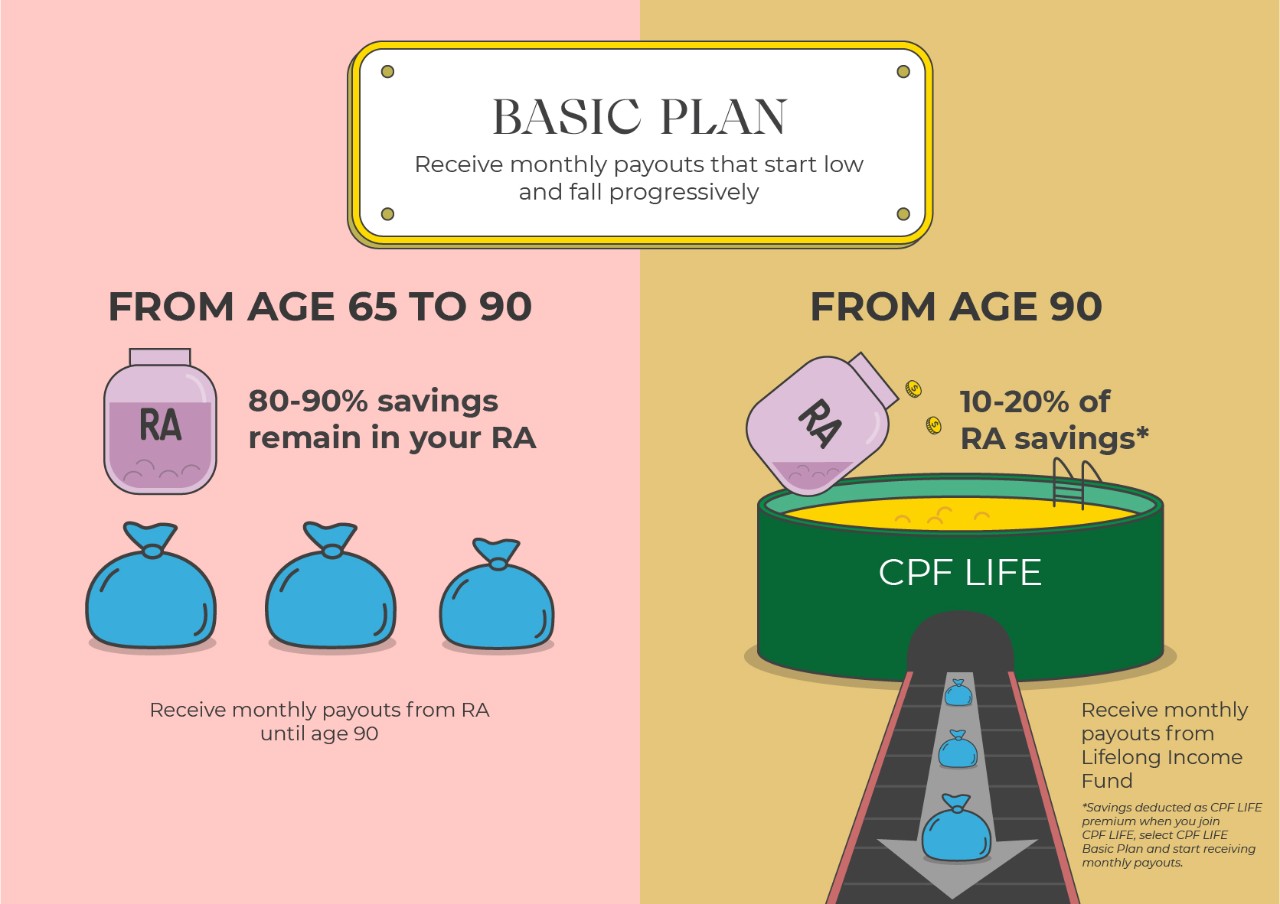
One possible approach is to build a base layer of lifetime income.
For Singaporeans, CPF LIFE plays this role. It may not fund every lifestyle aspiration, but it provides something valuable: income that continues for life.
That income floor can then be supplemented by investment income, rental income, annuities, bond ladders, or drawdowns from a diversified portfolio.
The key is to avoid drawing down too aggressively in the early years.
The goal is not just to retire.
The goal is to stay retired.
Risk 2: Inflation risk — the silent retirement killer
A retirement budget that feels comfortable today may feel tight 10 or 20 years later. Food, utilities, transport, insurance, healthcare, home maintenance, helper costs and daily expenses can all rise over time.
This matters because many retirees naturally become more conservative with age. They may hold more cash, fixed deposits, T-bills, Singapore Savings Bonds, bonds or annuity-like products.
There is nothing wrong with that.
But if too much of the portfolio sits in low-return assets, inflation can quietly erode purchasing power.
The retiree may still have the same number of dollars.
But each dollar buys less.
Retirement planning therefore cannot focus only on capital preservation. It also needs to preserve purchasing power.
How this can be managed
Retirement money can be separated by time horizon.
Money needed in the next few years can be kept conservative.
Money needed much later can still have some exposure to growth assets, such as equities, REITs or other assets that may grow faster than inflation over time.
The right allocation depends on age, risk appetite, health, family support, spending needs and total wealth.
The broader principle is that safety is not only about avoiding volatility.
Safety is also about preserving purchasing power.
Even in retirement, not all money has the same time horizon.
Some money is for next month.
Some money is for age 80.
Some money is for age 90.
They do not necessarily need to be invested the same way.
Risk 3: Sequence of returns risk — a market crash early in retirement
Sequence of returns risk is one of the most important retirement risks.
Two retirees can have the same starting portfolio, same average long-term return and same annual spending.
But the retiree who suffers a major market crash in the first few years may end up much worse off.
The reason is simple.
If money is being withdrawn while markets are down, assets may need to be sold at depressed prices. That leaves less capital to recover when markets rebound.
This risk is especially dangerous in the first 5 to 10 years of retirement.
During the working years, market crashes can be opportunities. The worker can keep earning, keep investing and buy assets at lower prices.
In retirement, the retiree may be selling, not buying.
How this can be managed
One possible framework is to divide the retirement portfolio into layers.
The first layer is near-term spending money. This can include cash, fixed deposits, T-bills, Singapore Savings Bonds or other low-risk instruments. This layer covers several years of expenses.
The second layer is income-producing assets, such as bonds, dividend stocks, REITs or other assets that generate cash flow.
The third layer is long-term growth assets, such as equities or other assets that can compound over time.
This structure reduces the need to sell long-term assets during a market downturn.
A cash buffer may feel inefficient in a bull market.
But in retirement, it is not just about returns.
It is about resilience.
Risk 4: Healthcare and long-term care risk
Healthcare costs are hard to plan for.
The issue is not only normal medical bills. The larger risk is serious illness, long-term care, mobility issues, dementia, or needing help with daily living.
This can be emotionally and financially draining.
It can also affect the whole family.
In Singapore, many people assume that MediSave, MediShield Life, Integrated Shield Plans, CareShield Life and family support will be enough.
For many households, they may be.
But actual care needs can be messier than a spreadsheet.
There may be helper costs, nursing care, home modifications, private specialists, mobility equipment, transport, physiotherapy, rehabilitation, or family members reducing work to provide care.
Healthcare risk should not be treated as a small footnote.
It can be one of the biggest swing factors in retirement.
How this can be managed
Healthcare coverage can be reviewed before retirement, not only after health issues appear.
Once medical conditions arise, it may be harder or more expensive to upgrade insurance.
A separate healthcare reserve may also help. This money does not need to be invested aggressively. Its role is to reduce the chance of being forced to sell investments during a medical emergency.
Practical care planning also matters.
Who makes decisions if something happens?
Which doctor or hospital will be used?
Where are the key documents stored?
Are the will, CPF nomination, insurance nomination and Lasting Power of Attorney in place?
These topics are not pleasant.
But they are easier to handle before a crisis.
Risk 5: Being asset-rich but cash-flow-poor
This is one of the most Singapore-specific retirement risks.
Many households have much of their wealth tied up in property and CPF.
Both are valuable.
But they are not always flexible.
A home may be worth a lot of money. But unless it is rented out, right-sized, sold, or monetised, it may not help with monthly cash flow.
CPF balances may also be meaningful. But CPF LIFE is designed to provide a lifetime income floor. It may not fund every lifestyle need, especially for retirees with higher expenses.
This creates a very Singaporean problem.
A household can look wealthy on paper but still feel tight on monthly cash flow.
That is why retirement planning should focus not only on net worth, but also on cash flow.
How much predictable income comes in every month?
How much must go out?
How much flexibility exists if costs rise?
How much wealth can actually be accessed without disrupting daily life?
A retiree living in a fully paid private property may look wealthy. But if most of that wealth is locked inside the property, the retirement plan may still feel tight.
How this can be managed
Property wealth should be treated differently from liquid financial assets.
A home is valuable. But unless there is a clear monetisation plan, it may not directly fund monthly expenses.
For retirees who are property-rich but cash-flow-poor, possible options include right-sizing, renting out rooms, moving to a lower-cost home, or using available property monetisation schemes.
These decisions are usually better considered early, rather than forced during a cash-flow crisis.
The worst time to decide whether to sell a home is often when cash is urgently needed.
Risk 6: Family responsibilities — the hidden retirement cost
For Singaporeans, family responsibilities are not a side issue.
They are central to retirement planning.
The CNA-reported CIMB survey found that family responsibilities were one of the top barriers to financial independence.
Many Singaporeans are part of the sandwich generation. They may be supporting children and ageing parents at the same time.
Even in retirement, this may not fully stop.
Some retirees may still help adult children with housing, childcare, education costs, weddings or business ventures. Others may support siblings, spouses or elderly parents.
This is emotionally understandable.
But financially, it can be dangerous without boundaries.
A retirement plan that works for one couple may break down if they also need to support two adult children and one elderly parent.
One practical retirement question is therefore not only:
“Can retirement expenses be covered?”
It is also:
“Who else may need support?”
And:
“How much support can be given without weakening the retirement plan?”
How this can be managed
Family support can be planned with clear limits.
Large gifts, loans, property guarantees, business support or repeated financial assistance should be assessed against the retirement plan.
Helping family is personal.
But it should be sustainable.
Housing can be financed.
Education can be financed.
Retirement is much harder to finance once active income has stopped.
Risk 7: Overspending in the first few years
Many retirees spend more in the early years of retirement.
After decades of working, there is finally time for travel, hobbies, restaurants, family holidays, gifts to children, home renovation and lifestyle upgrades.
There is nothing wrong with enjoying retirement.
The danger is treating the first few years as a reward phase without recognising that the money may need to last for decades.
A portfolio that looks large at age 60 can shrink quickly if spending is not controlled.
How this can be managed
A clear annual withdrawal budget can help.
This does not mean retirement must be restrictive. It means separating spending into categories.
Essential spending covers basic living needs.
Lifestyle spending covers comfort and enjoyment.
One-off discretionary spending covers large holidays, major gifts, renovations or big-ticket purchases.
Essential spending should ideally be supported by reliable income sources.
Lifestyle spending can be more flexible.
Large one-off spending can be reviewed each year based on market performance, health, family needs and portfolio size.
This creates freedom, but with guardrails.
The goal is not to make retirement miserable.
The goal is to avoid spending too much too early.
Risk 8: Being too conservative
Being too conservative can also be a risk.
Many retirees become very afraid of losing money. So they put everything into cash, fixed deposits, T-bills or other low-risk products.
That feels safe.
But over a 20 to 30 year retirement, the portfolio may not grow enough to keep up with inflation and rising expenses.
The retiree avoids short-term volatility but takes on long-term purchasing power risk.
This is especially important for someone retiring in their 50s or early 60s.
If retirement starts at 55 and lasts until 90, that is a 35-year retirement.
A 35-year retirement is not a short-term problem.
It is a long-term investment problem.
How this can be managed
Asset allocation can be matched to time horizon.
Money needed in the next 3 to 5 years can be kept conservative.
Money needed much later can still be invested for growth.
The mistake is treating all retirement money as short-term money.
Risk 9: Being too aggressive
The opposite risk is also dangerous.
Some retirees continue investing as though they are still in their 30s or 40s.
They chase hot stocks, speculative themes, crypto, leverage, private deals, or high-yield products they do not fully understand.
This can be disastrous.
In retirement, the ability to recover from a big loss is much lower.
A 40-year-old who loses 30% of a portfolio can work longer, save more and rebuild.
A 70-year-old may not have that option.
How this can be managed
One approach is to separate core retirement money from higher-risk capital.
Core retirement money should be diversified and built around resilience.
Higher-risk investments should be limited to amounts that will not affect the retirement plan if they perform badly.
Essential retirement capital should not be placed into speculative investments.
The first rule of retirement investing is not necessarily to maximise returns.
It is to avoid permanent damage.
Risk 10: Ageing alone and weaker social support

Retirement risk is not only financial.
It is also social.
Singapore is ageing rapidly, and the number of seniors living alone has been rising.
A retiree who lives alone may face different risks from a retiree with a spouse, children nearby, strong community ties and regular support.
Living alone can affect healthcare access, daily care, emergency response, mental wellbeing and financial decision-making.
At the same time, the picture is nuanced.
Some seniors live alone by choice and value their independence. Others live alone because of widowhood, lifelong singlehood or family circumstances.
So the point is not to assume that living alone is always negative.
The point is that retirement planning should account for the possibility that social support may be thinner than expected.
That makes community care, trusted contacts, simple investment structures, Lasting Power of Attorney arrangements and clear estate planning more important.
Retirement planning is not only about money.
It is also about building a support system before it is needed.
Risk 11: Cognitive decline, scams and poor decisions
This is a risk people do not like to discuss.
As people age, decision-making may become harder.
Scams, fraud, poor investment advice, aggressive sales tactics and pressure from relatives or acquaintances can become more dangerous.
A retiree may spend decades building wealth, only to lose a large amount through one bad decision.
The damage can happen quickly.
A bad investment.
A scam transfer.
A loan to the wrong person.
A complex product that was not properly understood.
Any of these can undo years of careful planning.
How this can be managed
Safeguards are best put in place before they are urgently needed.
Investments can be kept simple.
Complicated products can be avoided unless properly understood.
Large financial decisions can be reviewed with a trusted family member or adviser.
Internal limits can be set for large transfers.
A will, CPF nominations, insurance nominations and Lasting Power of Attorney can be prepared in advance.
Clear records of bank accounts, CPF, insurance, investments and property can also help family members if something happens.
The key is timing.
By the time decision-making problems appear, it may already be too late to build safeguards calmly.
Risk 12: Policy, tax and rule-change risk
Retirement rules can change over time.
CPF rules, tax rules, healthcare subsidies, property rules, estate planning rules and investment regulations may evolve.
This is not something retirees can fully control.
But it is still a risk.
A plan that relies too heavily on one rule, one product or one assumption may become fragile if rules change.
How this can be managed
Flexibility matters.
A retirement plan can be built around multiple income sources, asset classes and liquidity layers.
This may include CPF LIFE, cash buffers, bonds, equities, REITs, annuities, rental income, insurance and property planning.
Not every household needs every tool.
But the principle is useful.
A retirement plan is stronger when it does not depend on a single assumption turning out exactly right.
So what is the biggest retirement risk?
The biggest risk may not be any single factor.
It may be fragility.
A fragile retirement plan breaks when one thing goes wrong.
A resilient retirement plan survives even when several things go wrong at the same time.
For example:
Markets crash.
Inflation stays high.
Healthcare costs rise.
A family member needs help.
Interest rates fall.
Rental income drops.
A retiree lives longer than expected.
Any one of these may be manageable.
But if several happen together, the retirement plan can come under serious pressure.
That is why retirement planning should not be built only around optimistic assumptions.
It should also be stress-tested.
A practical retirement framework for Singapore households
A more resilient retirement plan usually has several layers.
First, a reliable income floor.
This can come from CPF LIFE, annuities, bond ladders, rental income, dividends or other stable income sources.
Second, a cash buffer.
This gives the retiree time and emotional comfort during market downturns.
Third, a diversified investment portfolio.
The portfolio should include enough growth assets to fight inflation, but not so much risk that the retiree cannot stay invested during bad markets.
Fourth, healthcare planning.
MediSave, MediShield Life, Integrated Shield Plans, CareShield Life, emergency funds and long-term care planning should be reviewed before retirement.
Fifth, a property plan.
If most wealth is tied up in the home, there should be clarity on whether the household is willing to right-size, rent out rooms, sell, or otherwise monetise the property if needed.
Sixth, family boundaries.
It is natural to help family. But the help should be sustainable. Retirement capital should not be used without understanding the long-term consequences.
Seventh, estate and decision-making safeguards.
A will, CPF nominations, insurance nominations, LPA arrangements and clear asset records can make life much easier for the family.
Finally, flexibility.
Retirement planning should not be a one-time exercise. It should be reviewed regularly as markets, health, family needs and personal spending change.
Final thoughts
Retirement is not about finding the perfect number.
It is about building a system that can survive uncertainty.
The biggest mistake is to assume that the future will look exactly like the spreadsheet.
It rarely does.
Markets can crash. Inflation can surprise. Healthcare needs may rise. Family needs may change. Rules may evolve. People may live longer than expected.
Because the goal is not just to retire.
The goal is to stay retired — with dignity, flexibility and peace of mind.