Okay so quite a few of you have asked me about the 4 Xtrackers ETFs listing on SGX on 13 October.
S&P 500, Nasdaq 100, MSCI World, and S&P 500 Equal Weight.
All 4 are Irish-domiciled, trade in SGD, and can be bought with SRS money.
Why does Irish-domiciled matter?
Because if you hold US-listed ETFs like VOO or SPY, you are paying 2 taxes to the IRS.
30% of every dividend, and up to 40% of the portfolio when you die.
An Irish-domiciled ETF fixes both.
So in this article I’ll cover:
1. What the 2 taxes actually cost
2. The 4 ETFs – which to buy, which to skip
3. Whether to buy them on SGX, or stick with CSPX and VUAA in London
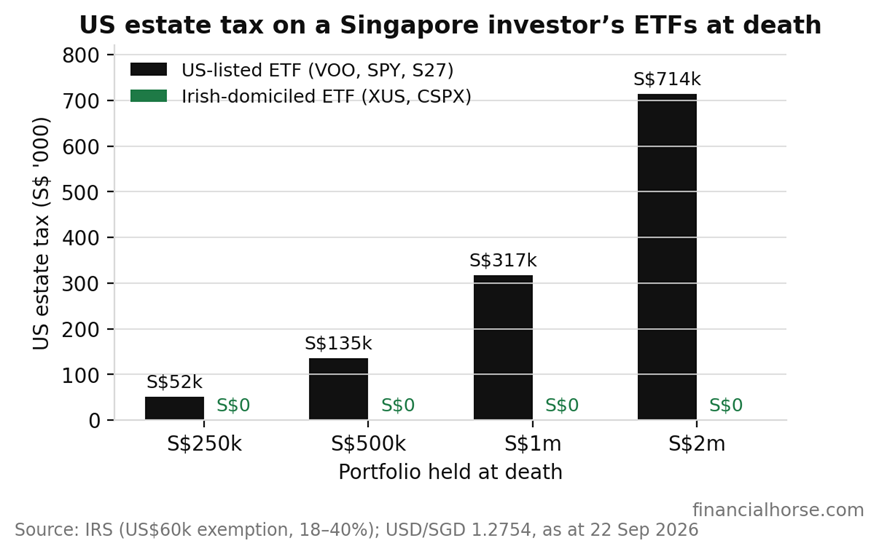
Tax 1 – the US estate tax: S$317,000 on a S$1 million portfolio
Singapore has no estate duty.
The US does – and it applies to foreigners holding US assets.
US stocks. US-listed ETFs. Even the SPDR S&P 500 ETF (S27) on SGX, because the fund itself is American.
The exemption is US$60,000.
Above that, the rate runs from 18% to 40%.
Here’s the chart for reference.
What this means in plain English.
Is that if you die holding S$1 million worth of US S&P500 ETFs, the bill is about S$317,000.
On S$500,000, about S$135,000.
And a joint account with your spouse does not help – the US gives no marital deduction to a non-citizen spouse.
As long as you hold more than about S$77,000 of US-listed ETFs or US stocks, your family pays this tax when you go, and the broker may freeze the account until the IRS paperwork is done.
I wrote about the estate tax and the account freeze in 2 earlier pieces, so check those out if you haven’t.
The same S$1 million in an Irish-domiciled ETF tracking the same S&P 500?
Zero.
An Irish fund is not a US asset, and Ireland does not tax non-Irish heirs on fund units either.
Tax 2 – 30% of every dividend
The US also withholds 30% of every dividend paid to a foreign investor.
Singapore has no tax treaty with the US, so there is no way to bring that down.
Ireland does have a treaty – so an Irish-domiciled fund pays 15% instead.
Ireland takes nothing further, and IRAS does not tax foreign dividends.
At today’s S&P 500 yield of about 1.05%, the difference is 0.16% a year.
Sounds like nothing.
Here’s what it does to S$1 million over 30 years at a 7% return.
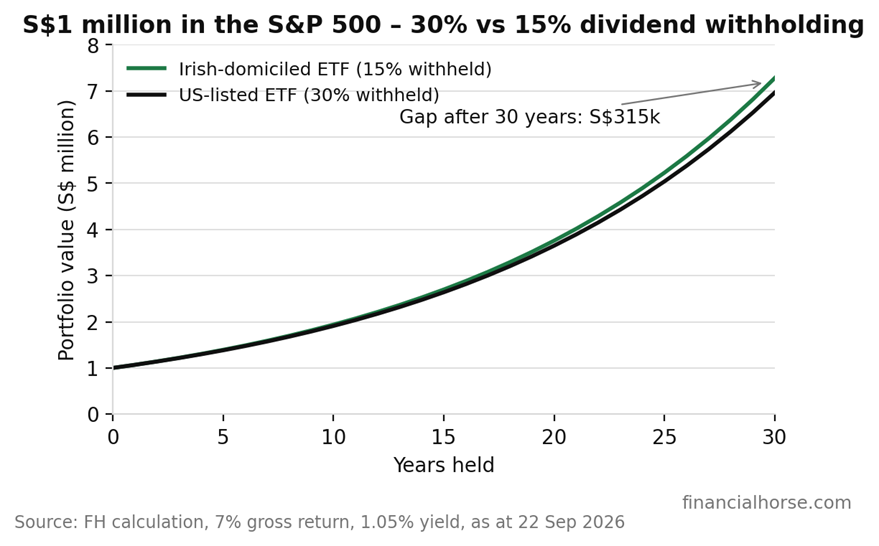
Chart 2 — S$1 million in the S&P 500 over 30 years at a 7% gross return, 30% versus 15% dividend withholding (FH calculation, 1.05% yield).
The Irish fund finishes about S$315,000 ahead.
In plain English – the dividend tax is a 0.16% a year fee for buying the US version of the fund instead of the Irish version.
To be fair – the Irish fund still loses 15%.
But it’s half the leak, not zero.
Why these 4 ETFs matter
None of this is new.
Singapore investors have been buying CSPX and VUAA in London for years for exactly this reason.
What is new is that from 13 October you can do it on SGX, in Singapore dollars, with SRS money.
And these are not small new funds – they are SGD trading lines of Xtrackers funds already listed in London and Frankfurt, with billions in them.
The 4 funds are summarised below:
| SGX ticker | Index | TER | Fund size | Same fund in London |
| XUS | S&P 500 | 0.03% | €2.3bn | XDPU |
| XND | Nasdaq 100 | 0.20% | €2.3bn | XNAQ |
| XWR | MSCI World | 0.12% | €21.2bn | XDWD |
| EUS | S&P 500 Equal Weight | 0.15% | €11.4bn | XDEW |
Fund sizes as at 29 July 2026. All 4 are Irish-domiciled, physically replicated, accumulating.
Let’s go through each.
Never miss a post! Follow Financial Horse on WhatsApp or Telegram — one tap, and every new article reaches you the moment it’s published.
1. Xtrackers S&P 500 (XUS) – 0.03%
This is the one that matters.
At 0.03%, it is the cheapest S&P 500 fund a Singapore investor can buy, on any exchange.
CSPX and VUAA in London charge 0.07%.
VOO charges 0.03% too – but then you pay double the dividend tax, and the estate tax on top.
Here’s what the all-in cost looks like, fee plus dividend tax.
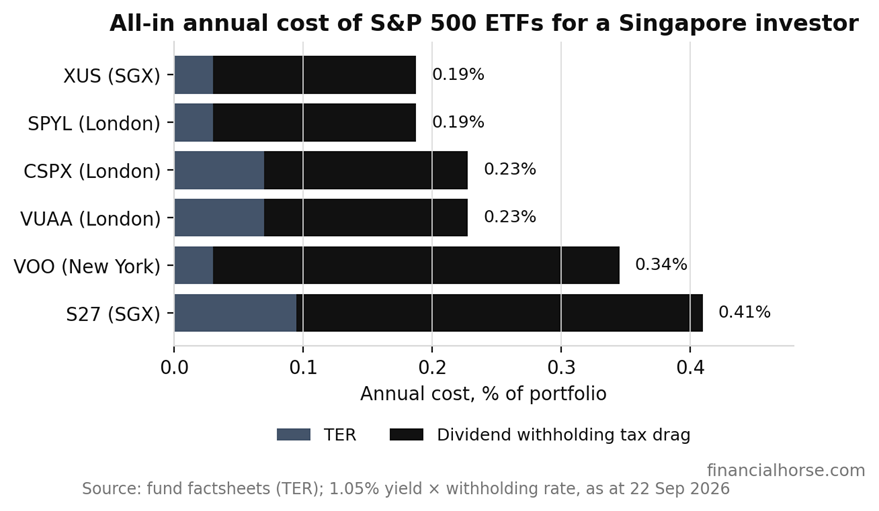
Chart 3 — TER plus dividend withholding drag, S&P 500 ETFs available to a Singapore investor, as at 22 September 2026.
XUS at 0.19% a year all-in, against 0.34% for VOO and 0.41% for S27.
In plain English – S27 on SGX, which a lot of SRS money has gone into over the years, is the most expensive way to own the S&P 500.
One caveat – CSPX has beaten its own index net of fees for years, because iShares earns securities-lending income that more than covers its 0.07%. The Xtrackers line has only existed since 2022, so it does not have that track record yet.
Verdict – this one looks pretty good. Perhaps the one question mark is that you don’t know what liquidity will be like on the SGX, and if its like any other SGX listed ETF it could be quite poor. But other than that, everything else looks pretty good.
2. Xtrackers MSCI World (XWR) – 0.12%
This is basically the all world index.
23 developed markets, about 1,450 stocks, one fund.
But 69.5% of it is the US.
So you are paying 0.12% instead of 0.03% for a 30% sleeve of Japan, the UK, Canada and Europe.
That’s fine if you want one fund and never want to think about it again.
Verdict – if you want to buy one fund and forget about it, this is probably it. Personally I would prefer going with the S&P500 though, but that’s just me.
3. Xtrackers Nasdaq 100 (XND) – 0.20%
This is the NASDAQ100, which is a tech heavy index.
The top 10 names are about 66% of the index.
This is a concentrated bet on Nvidia, Apple, Microsoft and friends – not a broad index.
Cheaper than CNDX in London at 0.30%, if you want it.
Verdict – again I probably would go with the S&P500. But if you want to make an overweight bet on the MAG7, this is probably the ETF.
4. Xtrackers S&P 500 Equal Weight (EUS) – 0.15%
The same 500 companies, each at 0.2% – so equal weighted.
This is the anti-Mag-7 fund – and it has lagged badly, up 41% over 3 years against 67% for the cap-weighted index.
You buy this only if you think the concentration in the S&P 500 unwinds.
Verdict – watchlist. The only one of the 4 that pays you if the Mag-7 trade breaks. Use as a tactical trade, not as a multi decade holding.
Buy these ETFs on SGX or London?
Which brings us to the million dollar question.
If you already buy CSPX or VUAA in London – should you switch to SGX?
High level comparison below:
| SGX (XUS) | London (CSPX, VUAA) | |
| Currency | SGD | USD or GBP – you convert |
| Commission | Local rates | IBKR from GBP 2; DBS Vickers from ~GBP 27 |
| SRS | Yes | No |
| Bid-ask spread | Unknown until 13 October | ~0.02–0.10% |
The one thing nobody knows yet is the spread, or the liquidity as I discussed above.
Xtrackers’ existing SGX counters are thinly traded with wide spreads, and SGX trades while New York is closed, so the market maker prices off futures and adds a cushion.
Why it matters – XUS saves you 0.04% a year over CSPX.
If the SGX spread costs you 0.30% on the round trip, that is 7.5 years of fee savings gone on day one.
So here’s how I see it:
- SRS money – SGX, no question. It is the only option, and if your SRS has been sitting in S27, this is the switch to make.
- Large lump sums on IBKR – arguably London, until SGX spreads prove tight.
- Already in CSPX or VUAA – no reason to switch. Same tax, same index.
One more thing – “SGD-denominated” is not SGD-hedged.
XUS trades in SGD, but you own 500 US companies in US dollars, and if the SGD strengthens you feel it exactly as you would with CSPX.
There is no hedging here.
What I’m doing with my money
If you hold more than US$60,000 in US-listed ETFs – it’s probably worth the switch.
Singapore has no capital gains tax, so the switch costs you a spread and a commission, not a tax bill.
That is a very cheap price for taking S$317,000 off the table in terms of tax risk, assuming you are holding US ETFs today.
And whatever your view on the Mag-7, the estate tax and the dividend tax do not care – the Irish domicile is the right answer either way.
What would change my mind on SGX over London is mainly the spread / liquidity.
If the SGX liquidity is poor (like other SGX listed ETFs), you may still be better off buying the London listed ETFs.
So here’s how I see it:
- SRS money – SGX, no question since this is the only option
- Large lump sums on IBKR – arguably London, until SGX spreads prove tight.
- Already in CSPX or VUAA – no reason to switch. Same tax, same index.
Long story short – the Irish-domiciled ETF has been the right answer for Singapore investors for years, and from 13 October it is finally the convenient one too.
Are you moving your SRS into XUS on 13 October, or waiting to see the spreads first? Love to hear what you think!
This article was written on 24 Sep 2026. It will not be updated going forward.
How my own portfolio is actually positioned — with weekly updates on what I buy and sell — is shared on FH Premium, alongside my full stock watchlist and the prices at which I would buy.
Join the FH mailing list and new articles land straight in your inbox:
Also on WhatsApp, Telegram and Facebook.
Hi
Thank you for your article. Is it possible to share your computations on the first chart, ie US estate tax on Singapore investor?
Kind regards
Amaryllis
Why not pick SPYL over CSPX since TER is lower? Which brokerage would you recommend for DCA of these S&P and World index ETFS?
Dear FH,
Does these ETF pay regular dividend? For retire that want to receive regular dividend pay out, are these ETF poor choice?
In another words, are these ETF good for folks who are young and have many many years ahead of them so that they can buy and keep for years until the price rises significantly and sell to take profit?
Thanks
Read carefully again. It says the 4 ETFs are accumulating, which means no dividends.
Hi FH, great article. Have been thinking on the the Irish-domiciled ETF recently, especially with the launch of Vanguard all world ETF, VALU/VALL, with an expense ratio of 0.07%, vs the old guards IWDA / VWRA.
But you points of SRS money also an interesting one. Would you be able to come up with an article for choosing and managing bank SRS account + brokerage accounts (cost, fee, etc)?
Thanks for sharing. Curious on your thoughts about comparing Amundi Index MSCI World A12S versus XWR for SRS? While Amundi is Unit Trust and 0.1% TER compared to XWR being ETF and 0.12%. Is there a case to make the switch? Why or why not?
Why not buy these on SGX and using IBKR.