In case you missed it, Keppel DC REIT announced last week that it is buying two data centres in Inzai, Greater Tokyo, for S$1.37 billion.
To pay for it, the REIT raised S$625 million in a private placement at S$2.10 a unit — about a 4.5% discount to the S$2.20 it last traded at before the trading halt.
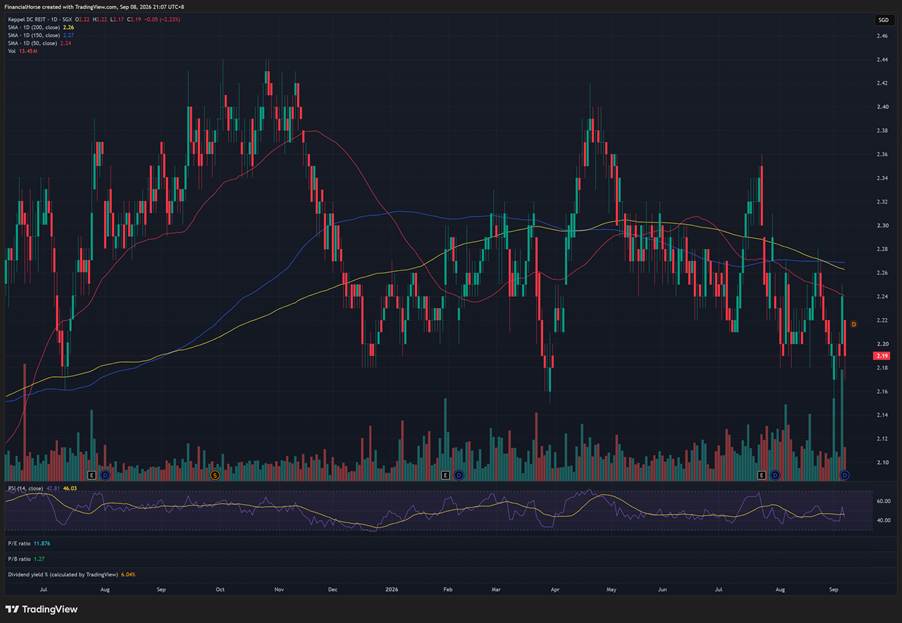
The units closed at S$2.24 on 7 September, which works out to a pro forma yield of roughly 4.7%.
Quite a few of you have asked me what I make of it, so in this article I wanted to discuss:
- Is this Tokyo acquisition a good deal for existing unitholders?
- What does the Japanese yen have to do with it?
- Would I buy Keppel DC REIT at S$2.24?
For the record, I sold out of Keppel DC REIT a while back at around S$2.30, so I don’t hold it today.
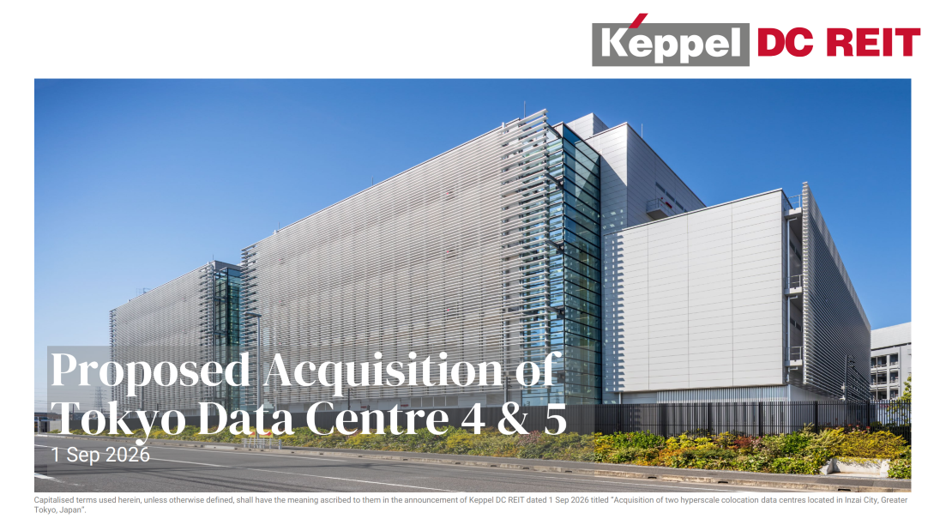
What Keppel DC REIT actually bought in Tokyo
The two assets are Tokyo Data Centre 4 and 5, both freehold, both in Inzai City in Chiba — which is where much of Greater Tokyo’s hyperscale capacity sits.
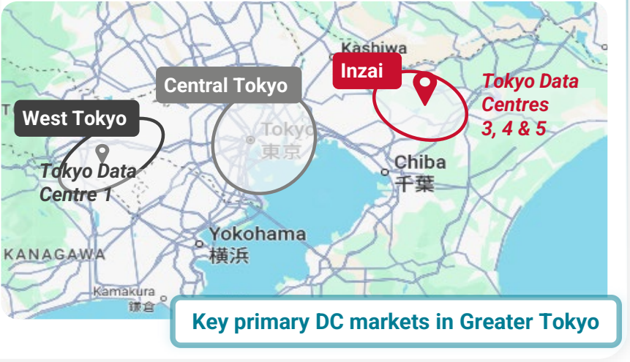
The sellers are GIC and Equinix, so this is not a sponsor asset being recycled into the REIT (although I know what you guys will say about “zeng hu” la).
GIC exits its 80%, Equinix cuts its stake from 20% to 10% and stays on as the operator.
The key terms are summarised below:
| Item | Figure |
| Stake acquired by Keppel DC REIT | 88.62% (Keppel Ltd co-invests 1.38%; Equinix keeps 10%) |
| Price for the REIT’s stake | S$1,372 million (JPY168.4 billion) |
| Price vs independent valuation | 2.1% discount (JPY190 billion vs JPY194 billion on a 100% basis) |
| Occupancy / tenants | 100% let to 4 investment-grade clients, 3 new to the REIT |
| WALE | TDC4 ~4.5 years, TDC5 ~10.6 years, blended ~8.3 years |
| Rent escalation | ~2.8% a year, contracted |
| In-place rents vs market | More than 30% below market |
| Funding | ~43% equity (placement at S$2.10), ~57% yen debt; pro forma average cost of debt 2.7% |
| Aggregate leverage | 34% before, ~38% after (39% including a temporary consumption-tax loan) |
| Japan’s share of rental income | 9% before, 23% after |
| Top client’s share of rental income | 43.5% before, 38.2% after |
| DPU accretion (pro forma FY2025) | +2.6%, 10.381 cents to 10.649 cents |
| Expected completion | 4Q 2026 |
Source: Keppel DC REIT acquisition presentation, 1 September 2026.
On the asset itself, I don’t have much to complain about.
The REIT paid roughly valuation, the buildings are fully leased out, the tenants are investment grade, and the leases carry 2.8% annual escalators in a market where the norm is closer to 0–1%.
The one thing I would note is that TDC4 has a WALE of only 4.5 years — which is where both the reversion upside and the re-leasing risk sit.
So nothing wrong with what they bought. The question is how they paid for it.
This is an FH Premium article that I am releasing to all readers. For more articles like this, my full personal portfolio and stock watch, do check out FH Premium!
Where does the 2.6% DPU accretion actually come from?
Keppel DC REIT is issuing about 12% more units to buy an asset that adds about 15% to distributable income — hence the 2.6% accretion.
But the interesting question is how an asset yielding around 5% ends up accretive to a REIT whose units cost 5.1% in DPU yield at the placement price.
Here’s the chart for reference.
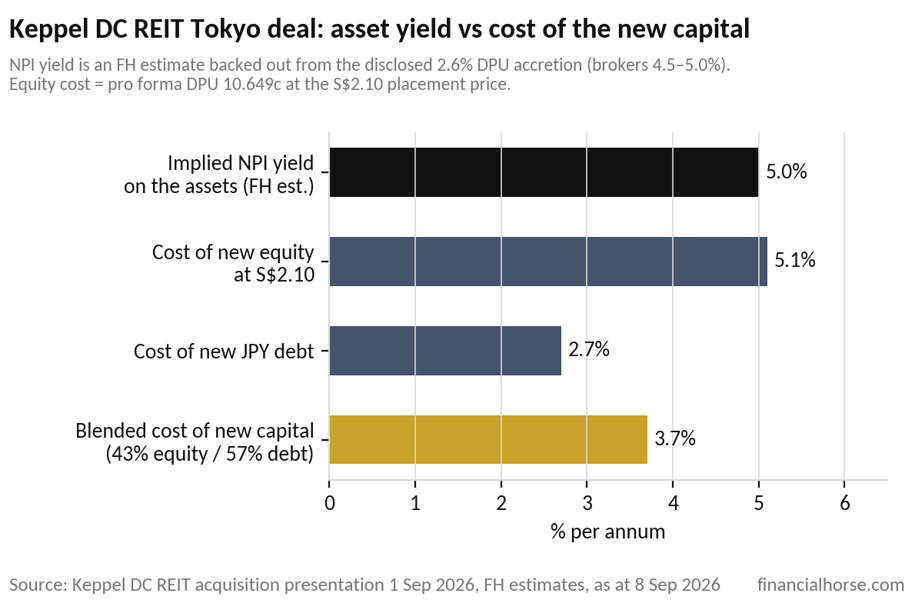
Chart 1 — The Tokyo deal’s implied asset yield against the cost of the new equity, the new yen debt and the blended cost of capital.
The company did not disclose the NPI yield, so the 5.0% is my own estimate backed out from the disclosed accretion — the brokers are somewhere between 4.5% and 5.0%, which is close enough for this purpose.
Look at the first two bars.
The yield on the assets and the cost of the new equity are basically the same number.
In plain English — if Keppel DC REIT had funded this deal with equity alone, the DPU accretion would have been roughly zero.
The entire 2.6% comes from the third bar: 57% of the purchase is funded with yen debt at around 2.7%, which pulls the blended cost of capital down to about 3.7%.
That is not a criticism — borrowing cheap yen against a Tokyo asset is exactly what a sensible REIT manager should do.
But it does mean the accretion is created by the loan, and by leverage going up – not by the data centres.
The yen loan is the bet
So if the accretion comes from the loan, the obvious next question is what happens to the loan.
The Bank of Japan is at 1.00% today, its highest policy rate since 1995, and the market expects another hike to 1.25% at the meeting that ends on 18 September.
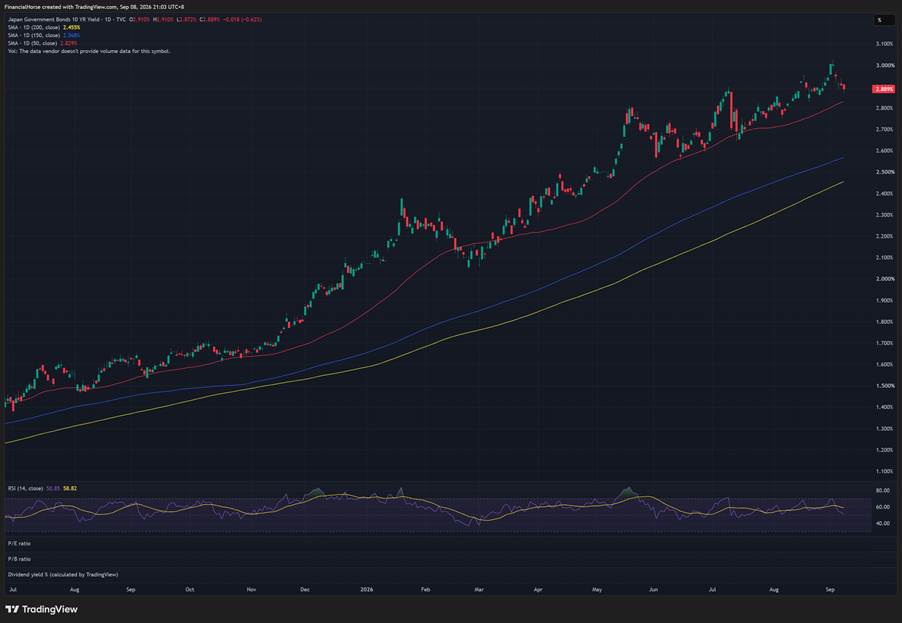
The Japanese 10-year yield hit a 30-year high of 2.93% in August and sits at 2.89% today, and the 5-year — roughly the tenor Keppel DC REIT is borrowing at — is about 2.24%.
The REIT’s average cost of debt stays at 2.7% after the deal, on a 3.4-year average tenor with the new loans hedged for 3.3 years — so the yen debt effectively refinances around 2030.
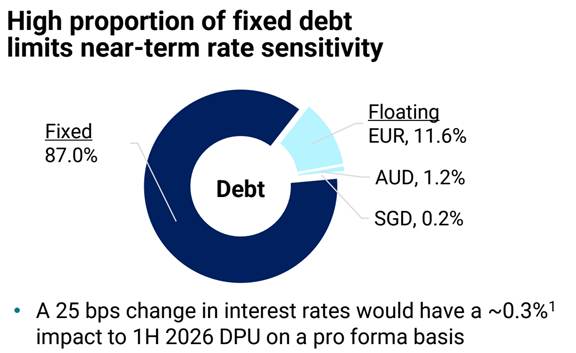
So yen debt is no longer the free money it was in 2021–2023, and a 2.7% loan today is a bet that Japanese rates stop going up.
I ran the sensitivities on the pro forma DPU of 10.649 cents:
| What changes | Effect on DPU |
| Yen debt refinanced 50bp higher | −1.3% |
| Yen debt refinanced 100bp higher | −2.7% |
| Yen debt refinanced 150bp higher | −4.0% |
| Yen weakens 10% against SGD (on the 23% of income now in yen, before hedges) | −2.3% |
| 30% of the Tokyo rents mark to market (+30%) | +2.2% |
| 50% of the Tokyo rents mark to market (+30%) | +3.6% |
| All of the Tokyo rents mark to market (+30%) | +7.3% |
Source: FH estimates from the acquisition presentation figures, 8 September 2026.
The line that matters is the second one.
A 100bp rise in the yen funding cost wipes out the entire accretion — and with the 5-year JGB already at 2.24% and the BOJ still hiking, a 2030 refinancing at 3.5–4% is not a stretch.
And that’s before the currency.
Borrowing in yen is a natural hedge on the asset value — if the yen falls, the building and the loan fall together in SGD terms, so NAV is protected.
But it is not a hedge on the income beyond the 1–2 years that REITs typically hedge forward, and Japan now makes up 23% of rental income.
So Yen FX is something the REIT has to watch out for too.
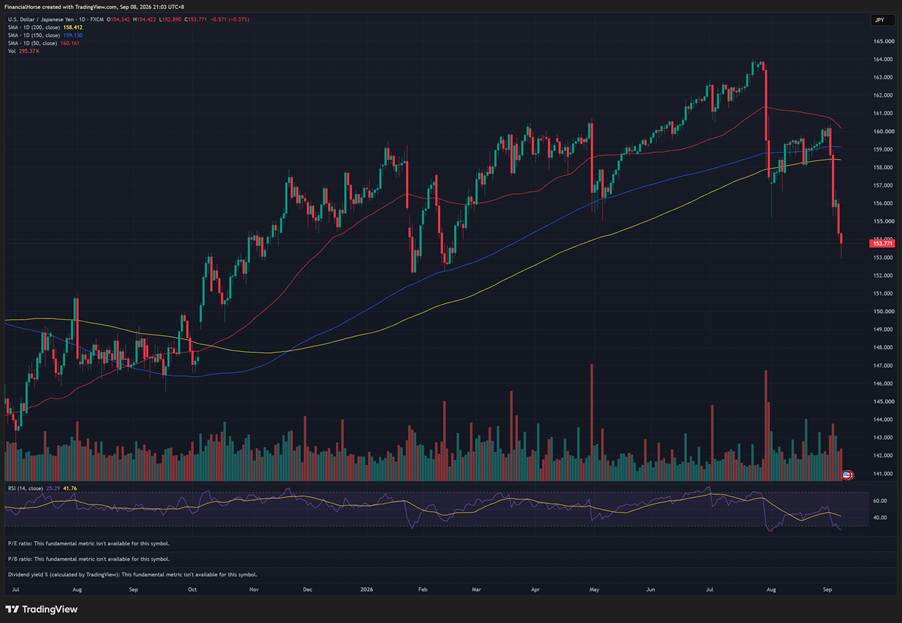
In my view, this is a rates-and-currency trade wearing a data-centre badge — and I would see it for what it is.
The real value lever — the 2028–29 rent reviews
Now for the one part of the deal that I find interesting.
Management says in-place rents at the two assets are more than 30% below market, and that more than 5% of income comes up for renewal by 2029 — TDC4 first, given its 4.5-year WALE.
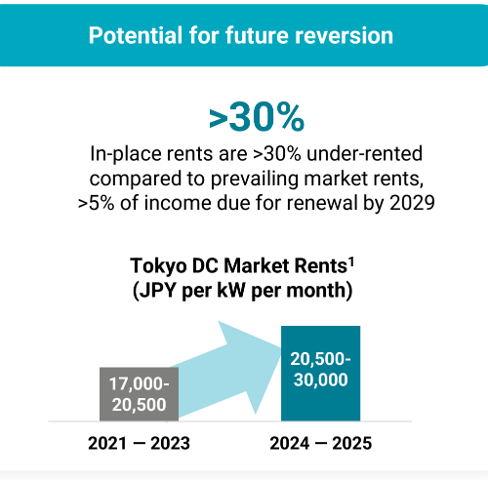
To be fair, the case for Tokyo rents holding up is a decent one.
Grid connections in Inzai take anywhere from 4 to 10 years depending on who you ask, Tokyo colocation vacancy is under 6%, rents have risen 20–45% since 2021, and AWS, Oracle and NTT have all committed tens of billions to Japan capacity through 2027 and beyond.
| What changes | Effect on DPU |
| Yen debt refinanced 50bp higher | −1.3% |
| Yen debt refinanced 100bp higher | −2.7% |
| Yen debt refinanced 150bp higher | −4.0% |
| Yen weakens 10% against SGD (on the 23% of income now in yen, before hedges) | −2.3% |
| 30% of the Tokyo rents mark to market (+30%) | +2.2% |
| 50% of the Tokyo rents mark to market (+30%) | +3.6% |
| All of the Tokyo rents mark to market (+30%) | +7.3% |
So the reversion is real, and the sensitivity table above shows what it is worth — if half the Tokyo rents mark to market, the deal’s true accretion is mid-single digits, not 2.6%.
The other side is that Tokyo’s construction pipeline is 3,368MW against 1,473MW live today, a 2.3x build-out.
Today’s scarcity is a grid constraint, not a shortage of people who want to build — and the 2025 hyperscaler lease pauses, short as they were, are a reminder that colocation renews at market in both directions.
In plain English — you are paying for the reversion today, and collecting it in 2028 if it turns up.
Does the acquisition machine actually work for unitholders?
Now let me be fair to Keppel DC REIT, because the pushback I expect from a lot of you is: the REIT has raised equity 5 times since 2019, and DPU has still gone up — so who cares about the funding mix?
You can see the record below – despite all the fundraising the DPU has been steadily going up, so you can’t fault the REIT for this.
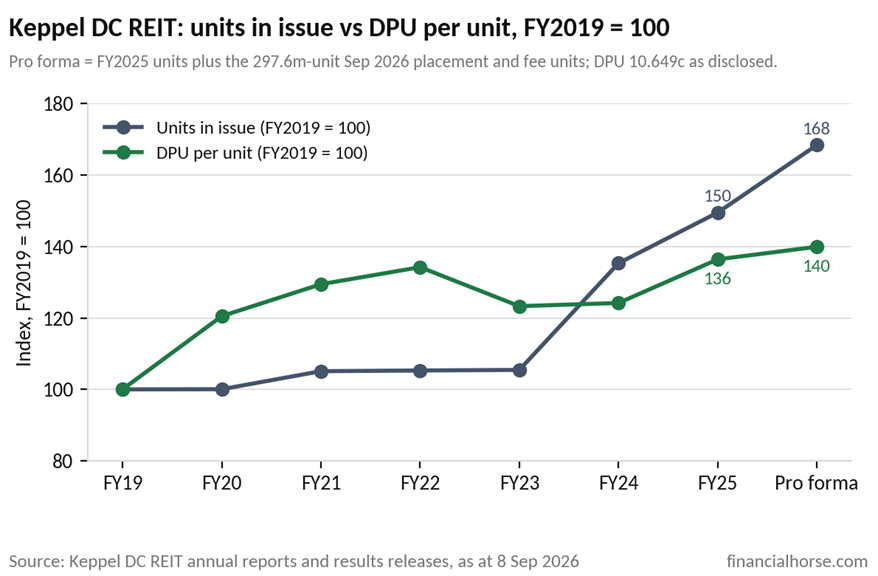
Chart 2 — Keppel DC REIT units in issue and DPU, FY2019 = 100, with the pro forma post-placement position.
Units in issue are up 50% from FY2019 to FY2025, and DPU is up 36% over the same period — about 5% a year.
So to give credit where credit is due, the machine has worked on a per-unit basis, which is more than you can say for a lot of S-REITs that grew AUM and diluted their way to a lower DPU.
But the chart also shows the cost of the machine.
FY2023 DPU fell 8.1% when the Guangdong tenant stopped paying rent, and by my count the loss allowances since FY2023 have cost unitholders roughly 1.5 cents of cumulative DPU — the best part of three years of growth — and that dispute is still not confirmed closed.
And at 38–39% gearing after this deal, another equity raise within the next year or two is a possibility, not a prediction.
In plain English — what a Keppel DC REIT unitholder is really underwriting is that the units keep trading above book, so that the next placement is accretive too.
What’s priced in at S$2.24?
Here’s how Keppel DC REIT compares with the alternatives as at early September 2026:
| Instrument | P/B | Distribution yield |
| Keppel DC REIT | 1.31x | 4.6% on FY2025 DPU / ~4.7% pro forma |
| Mapletree Industrial Trust | 1.12x | ~6.5% |
| Digital Core REIT | ~0.65x | ~7% |
| S-REIT sector average | ~0.9–1.0x | 6.0–6.5% |
| 10-year SGS | — | 2.35% |
Source: company filings and market data, 7–8 September 2026; Mapletree Industrial Trust and Digital Core REIT figures from secondary sources.
Keppel DC REIT is the most expensive REIT in the set, by some distance.
The market is paying 1.3x book for a portfolio that is 60% Singapore data centres by rental income and has grown DPU about 5% a year.
Yes I know Singapore data centres are a very scarce and therefore prized asset class because the government controls supply tightly, but at this price, I still think it is largely priced in.
What the market is not pricing yet, in my view, is the Japan side: the fact that nearly a quarter of the income now sits in a currency and a rate cycle that are both moving against the REIT.
And the trend tells you the crowd is not bothered — the units held S$2.19–2.24 through a 12% placement, which for a REIT is a pretty strong signal that the premium is intact.
In plain English — the good asset, the growth record and the Singapore anchor are all in the price. The yen is not.
Never miss a post! Follow Financial Horse on WhatsApp or Telegram — one tap, and every new article reaches you the moment it’s published.
So is it a good deal, and will I buy?
Long story short — I would call the Tokyo acquisition a fair deal, not a great one.
The REIT bought a good asset at a fair price, and the 2.6% accretion is real — but it is created by cheap yen debt rather than by the asset, and it is only as durable as the BOJ allows.
Which brings us to the million dollar question — would I buy at S$2.24?
Full disclosure, I sold out of Keppel DC REIT a while back at around S$2.30 a while back, and I don’t see a reason to buy back for now.
If you ask me, it comes down to 2 reasons.
The first is that I think the REIT is fairly valued at the current price — at 1.3x book and a 4.7% yield, you are paying for the growth machine, and the accretion from this deal is thin and rate-dependent.
The second is that higher interest rates remain a key headwind for REITs, which is the same view I set out in the S-REITs article last week — I am not adding to REITs until the long end of the curve turns.
And for Keppel DC REIT specifically, the long end that now matters is Japan’s, and it is still going up.
What would change my mind?
I still think it goes back to interest rates.
If I see long term interest rates start to peak and turn lower, or if the price of Keppel DC REIT starts to come down, those would be me interested again.
So that’s how I’m thinking about Keppel DC REIT today.
Love to hear what you think though!
This is an FH Premium article that I am releasing to all readers. For more articles like this, my full personal portfolio and stock watch, do check out FH Premium!
Hi,
Mathematically speaking,
the natural hedge does not protect the nav in sgd terms, it will still drop if yen drops.
Only the gearing is protected since both the yen debt and asset value will drop together.
Also the pro forma ave cost of debt is 2.7%, higher than the reported 2.6%. This means the new yen debt has to be quite higher than 2.7% in order to bring up the ave.
One analyst mentioned 2.9%
https://www.businesstimes.com.sg/opinion-features/keppel-dc-reits-tokyo-drift-easy-yen-trade-over