Okay so quite a few of you have asked me which dividend stocks are still worth buying in this market.
The STI is up 22% this year and DBS and OCBC are sitting near all-time highs.
All while S-REITs, the traditional dividend play in Singapore, are down about 13% in 2026.
For what it’s worth, I did this exact exercise in October last year, and the 5 names were OCBC, Sembcorp, Singtel, CICT and UOB.
A year on – OCBC is up 89%, UOB is up 20%, Singtel is flat, CICT is down 5% and Sembcorp is down 9% (price only, before dividends).
So… one year on – which 5 dividend stocks would make my list today?
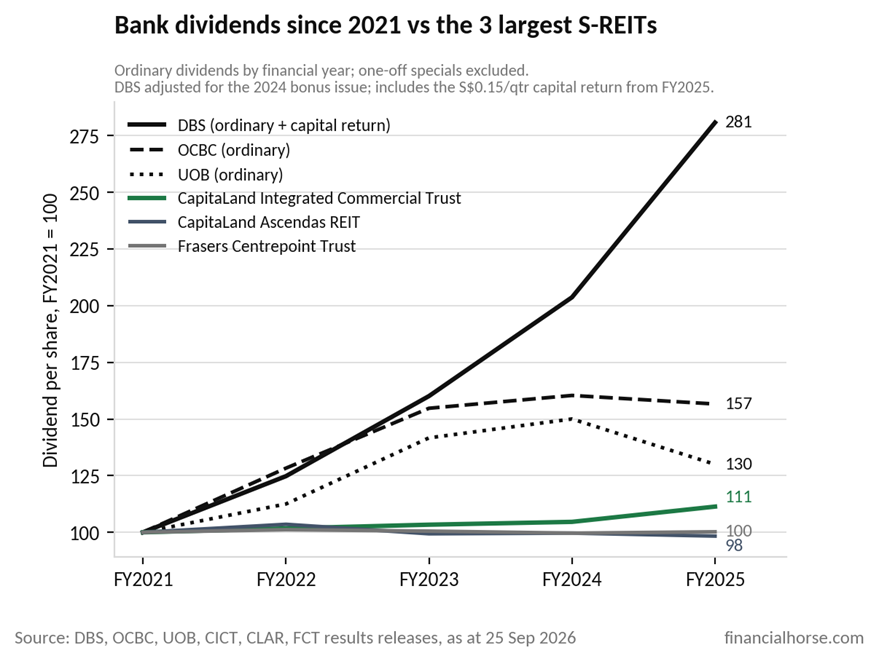
Why 5% dividend yield no longer works in this market
Three criteria, stated up front.
One – the yield has to be at least 4% today, which is 2 points over the latest 6-month T-bill.
Two – the dividend per share has to be higher than it was 5 years ago – grown, not just held.
Three – the payout has to be covered: earnings for the stocks, and distributable income and gearing for the REITs.
Here’s how the usual suspects screen as at 25 September 2026:
| Name | Yield today | Dividend vs 5 years ago | Passes the screen? |
| Keppel Infrastructure Trust | 7.7% | Up, but 1H2026 payout exceeded distributable income | No – payout not covered |
| Mapletree Pan Asia Commercial Trust | 6.6% | Down 4 years in a row since the 2022 merger | No – cut |
| CapitaLand Ascendas REIT | 6.6% | Flat to down (15.26c → 15.01c) | No – cut |
| Frasers Centrepoint Trust | 6.0% | Flat (12.09c → 12.11c) | No – 6 years of no growth |
| NetLink NBN Trust | 5.7% | Up 7% (5.08c → 5.42c) | Yes |
| Keppel REIT | 5.5% | 1H2026 DPU down 4% while income rose 25% | No – cut |
| CapitaLand Integrated Commercial Trust | 5.4% | Up 11% (10.40c → 11.58c), 5 straight years | Yes |
| Keppel DC REIT | 5.2% | Up 5% (9.85c → 10.38c), one down year in 2023 | Yes |
| Sembcorp Industries | 4.6% | Up 5x (5c → 25c) | Yes |
| Singtel | 4.3% | Up 2.5x (7.5c → 18.5c, of which 5.1c is a special) | Yes |
| DBS | 4.2% | Up 2.8x (S$1.09 → S$3.06, incl. capital return) | Yes |
| UOB | 3.7% | Cut 13% in FY2025 (S$1.80 → S$1.56) | No – below 4%, and cut |
| OCBC | 3.3% | Up 57% (53c → 83c) | No – below 4% |
You can see the problem with the 5% minimum dividend yield I used last year.
If you apply the same filter today, the only ones that would make the list is REITs in downtrends, plus a business trust.
For the simple reason that SGX stocks have rallied across the board, such that dividend yields today are much less attractive.
If you drop your minimum level to 5$ yield however, then DBS comes back in, with Sembcorp and Singtel.
Here’s what each name pays you over the latest 6-month T-Bill at 1.92%:
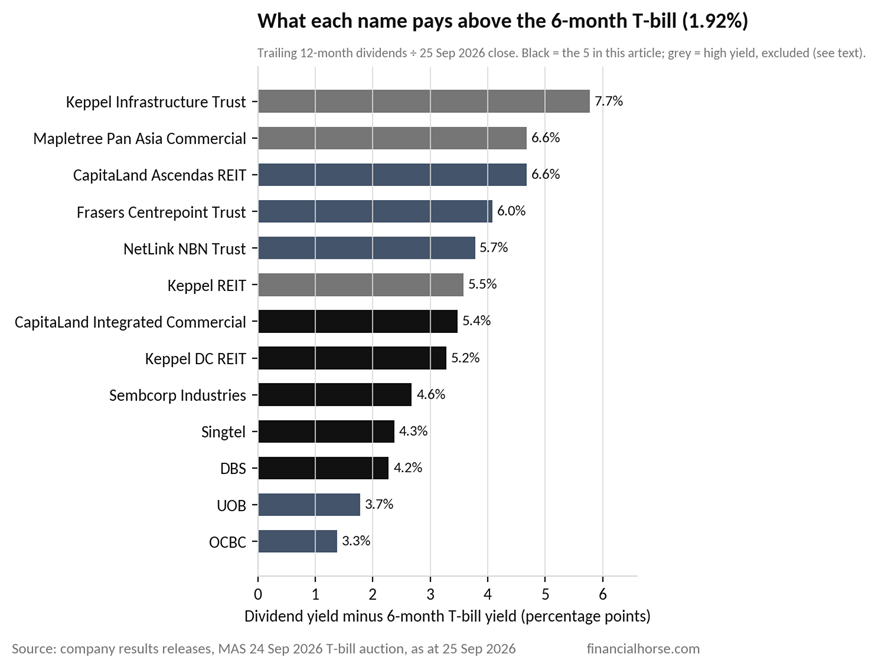
The grey bars are the ones I want to flag – because high yield is not the same as safe income.
Keppel Infrastructure Trust pays 7.7%, but in 1H2026 it paid out S$121 million against S$101 million of distributable income, and gearing jumped to 44.2%.
Keppel REIT pays 5.5%, but its 1H2026 DPU fell 4% while distributable income rose 25% – the income is going up, and each unit is getting less of it.
MPACT pays 6.6%, and the DPU has fallen every year since the 2022 merger.
In other words – it pays to look beyond just the headline dividend yield, and into the sustainability of the underlying yield.
With that in mind, which are the 5 dividend stocks I would consider today.
1. DBS – 4.2% dividend yield at a record multiple
I suppose this list would not be complete without a bank stock, so let’s just get that out of the way.
DBS pays S$0.81 a quarter today – S$0.66 ordinary plus a S$0.15 capital return dividend that management has said runs through FY2027.
Here’s DBS’s own dividend slide:
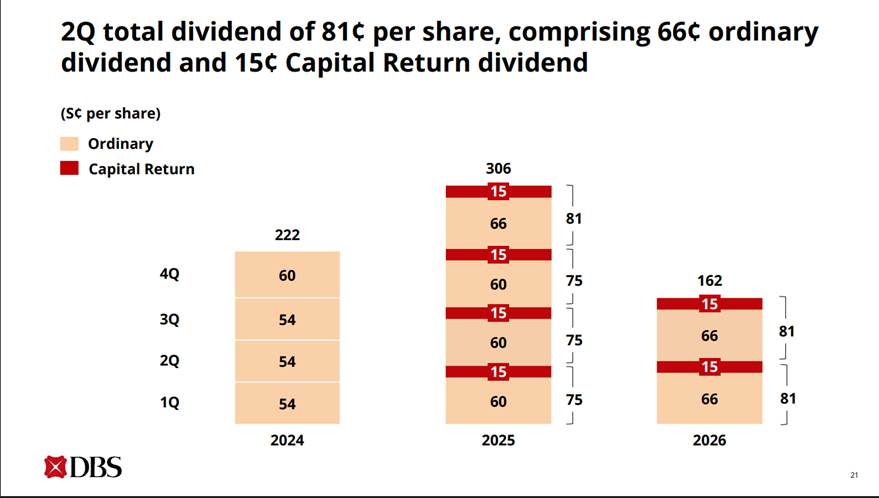
That’s 4.2% dividend yield at S$78, or 3.4% on the ordinary dividend alone.
The 2Q2026 results were a record: net profit S$3.08 billion, up 9%, with wealth fees up 42% and a fully phased CET1 ratio of 14.6%.
The dividend is covered and growing – DBS has raised the ordinary dividend every year since 2021, and did not cut in FY2025, when UOB cut and OCBC trimmed.
The problem is the price.
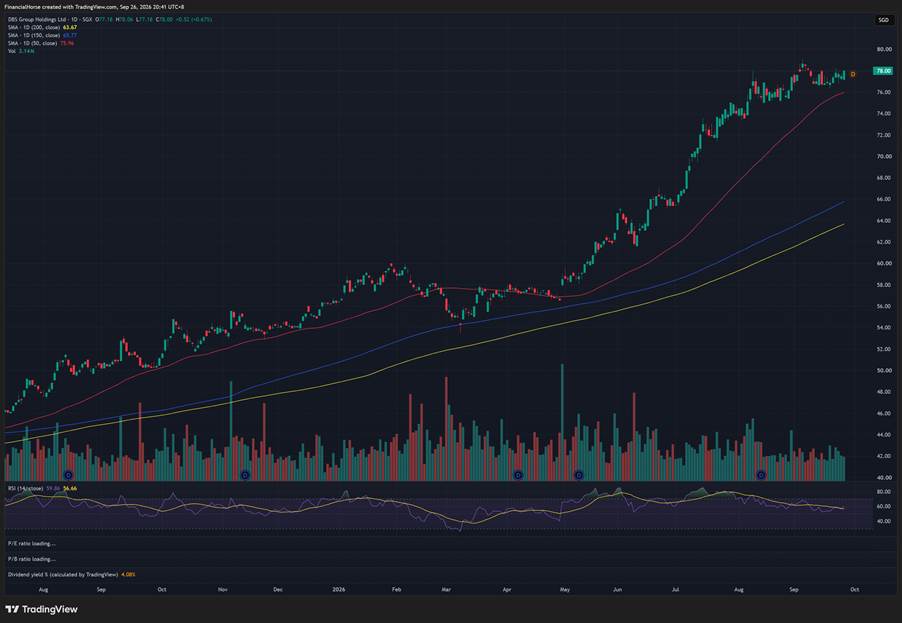
At S$78, DBS trades at 3.4x tangible book and about 17x forward earnings – above every year-end multiple in its history, against OCBC at 2.5x and UOB at 1.5x.
In plain English – you are paying a record price for the best bank in the region, and the return from here depends on that multiple holding, not just on DBS growing earnings.
2. CICT – arguably the best REIT in Singapore, in a downtrend
CapitaLand Integrated Commercial Trust is the one large S-REIT with distributions per unit up 5 years in a row.
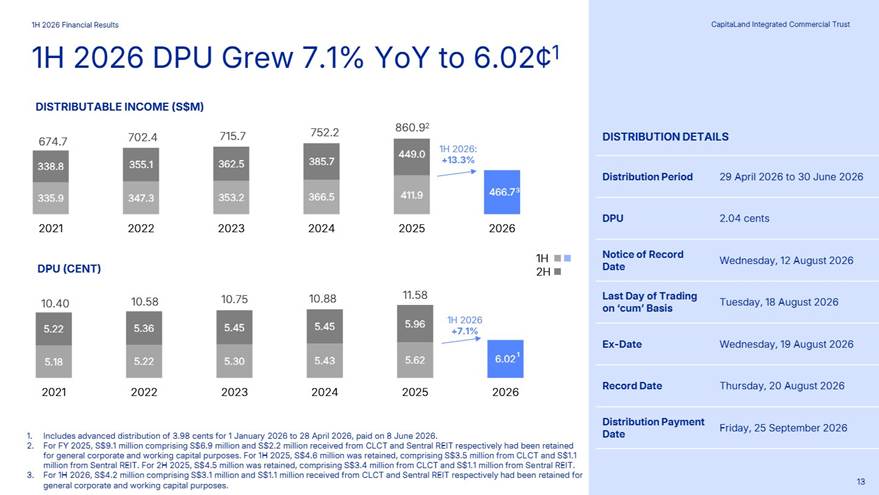
1H2026 DPU was 6.02 cents, up 7.1%, on distributable income up 13% – and that’s after an April placement that grew the unit base by almost 6%.
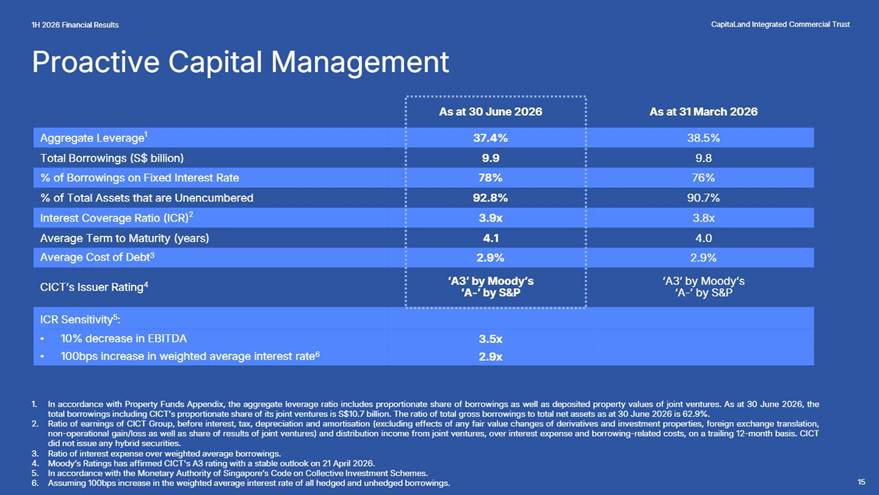
Gearing came down to 37.4%, cost of debt to 2.9%, Paragon was completed on 1 July, and Asia Square Tower 2 is being sold for about S$2.45 billion.
Here’s the 5-year record against the other 2 big REITs.
For a REIT, CICT is about as good as it gets:
You can see the point – CICT’s DPU is up 11% since 2021, Ascendas REIT’s is down 2%, and Frasers Centrepoint’s is flat.
The banks are on a different chart altogether.
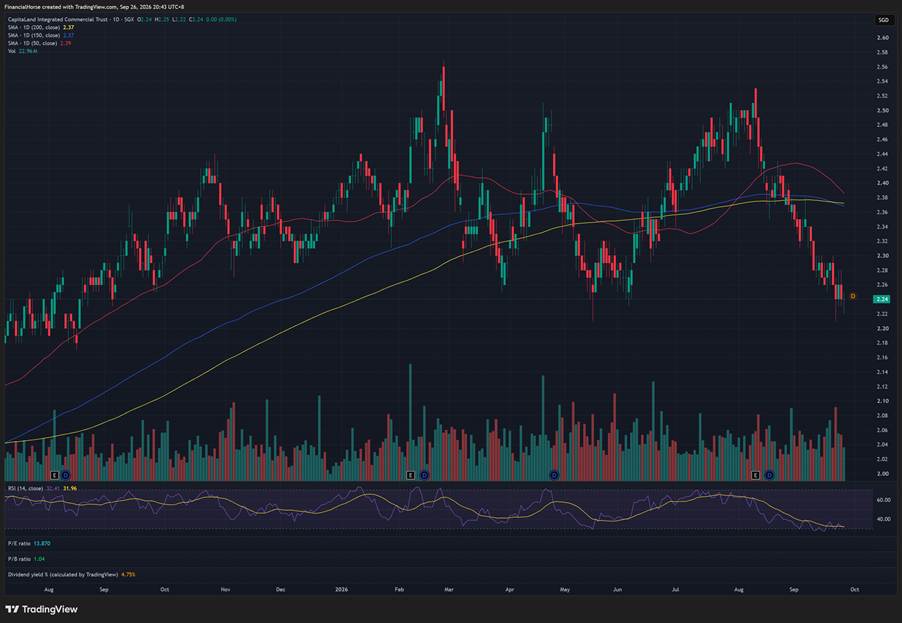
At S$2.24 the yield is 5.4%, at roughly 19x forward distributions – mid-range against its own 10-year history.
So current prices are fair, not cheap.
And I can run all the valuation analysis I want, but the unit is below its 200-day average and 18 points behind the STI over 6 months.
REITs as a while look like a falling knife at the moment, and as shared in last week’s article, I don’t see a meaningful bottom until long term interest rates top out – which depends very much on the Iran war.
And boy… good luck predicting how the war plays out.
Never miss a post! Follow Financial Horse on WhatsApp or Telegram — one tap, and every new article reaches you the moment it’s published.
3. Sembcorp – the dividend grew 5x, and then it bought Alinta
Sembcorp’s dividend went from 5 cents in FY2021 to 25 cents in FY2025, and the 1H2026 interim was raised another 22% to 11 cents.
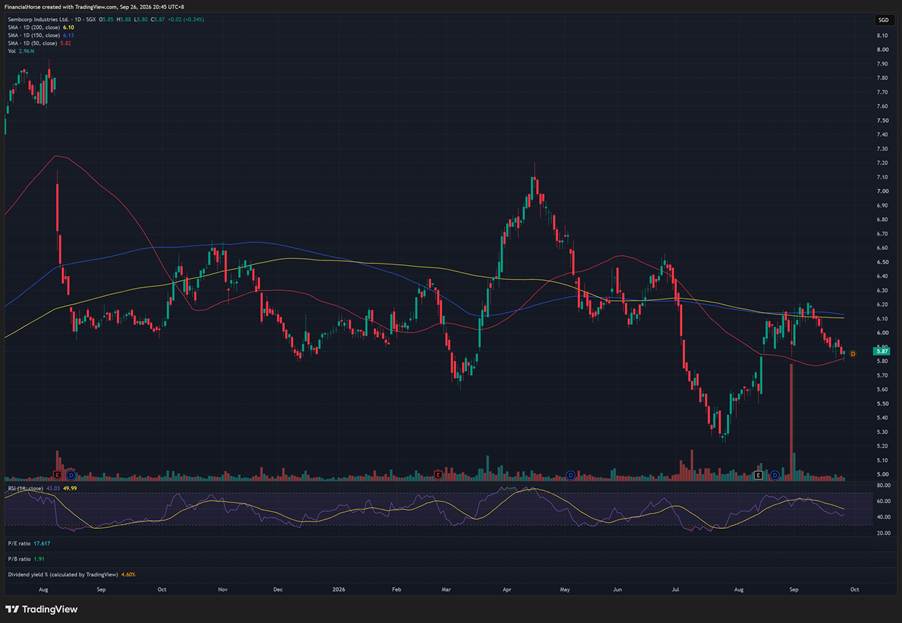
That’s 4.6% dividend yield at S$5.87, on a payout ratio that was around 40% last year – so the dividend has plenty of room.
Last August I skipped the stock after it fell 20% in 4 days, and in October I said it could be an interesting add at S$6.43.
It’s S$5.87 today – so the skip was right.
But Sembcorp in 2026 is a different company from Sembcorp in 2025.
In June it completed the A$4.5 billion purchase of Alinta Energy in Australia, and 1H2026 underlying profit fell 25% to S$369 million.
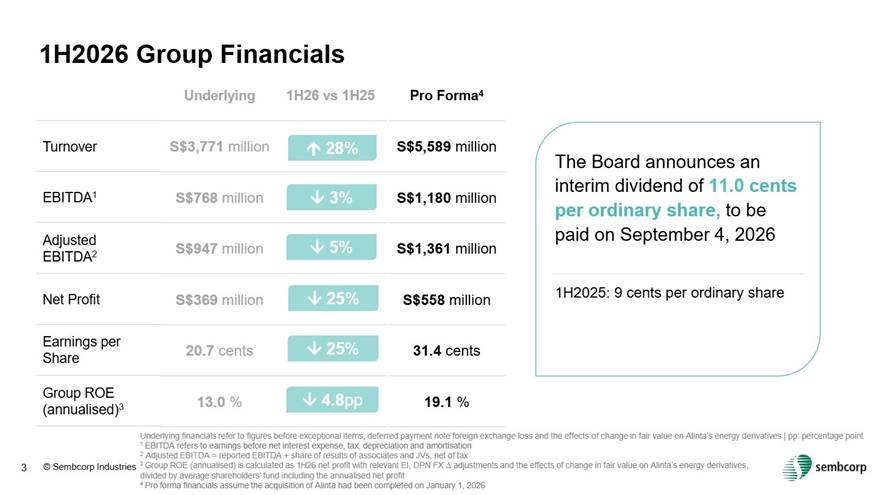
In fairness – Alinta adds 3.4GW of capacity and a million customers, and a dividend raised 22% into a 25% profit fall is management telling you the dip is temporary.
That said – the share price has fallen from a S$7.20 high to S$5.87 over the past year, and the stock is sitting roughly on its 200-day average.
While the story of renewable energy is interesting, the chart does look like a falling knife at the moment.
4. Singtel – 4.3% dividend yield, but a third of it is a special dividend
Singtel’s FY2026 dividend was a record 18.5 cents – a 13.4 cent core dividend, plus a 5.1 cent “value realisation” dividend funded by selling down stakes like Airtel.
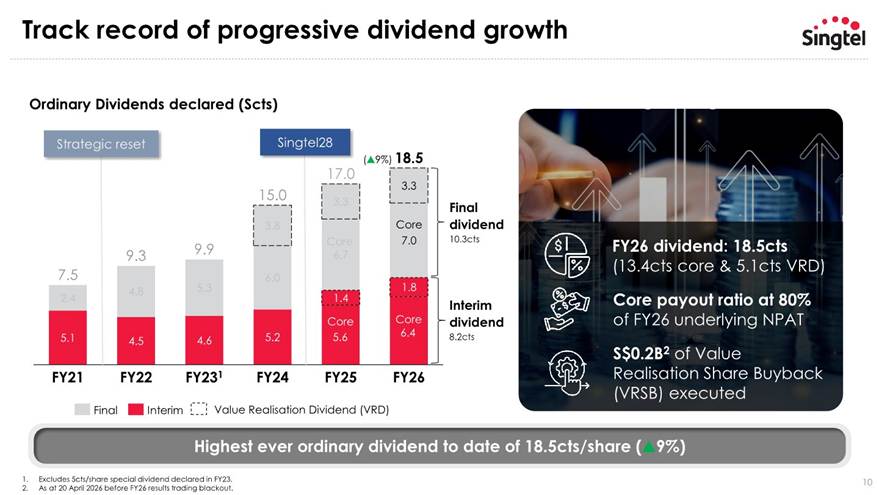
At S$4.28 that’s 4.3% – but 3.1% on the core dividend alone, and the rest is special dividend which is funded largely by divestments.
That said, the core dividend has grown 5 years in a row, the payout policy is now 70–90% of underlying profit, and 1Q FY2027 net profit was up 21%.
I passed on Singtel in June last year at S$3.95, and said I regretted not buying lower.
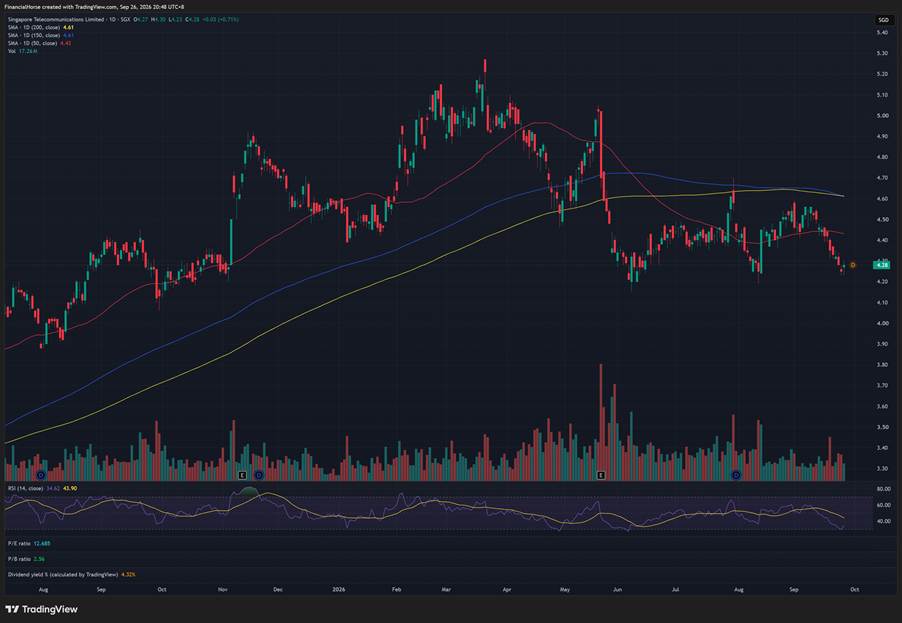
Here’s the strange part – since then the stock went to S$5.27, then fell back to S$4.28, near its 52-week low, while the dividend kept rising.
So despite all the improvements in the core business, the share price has largely gone nowhere for a year.
That’s what I mean when I say the growth is priced into a stock – this is a perfect example.
Unless management outperforms vs expectations, the stock can continue to go sideways because the growth is already priced in.
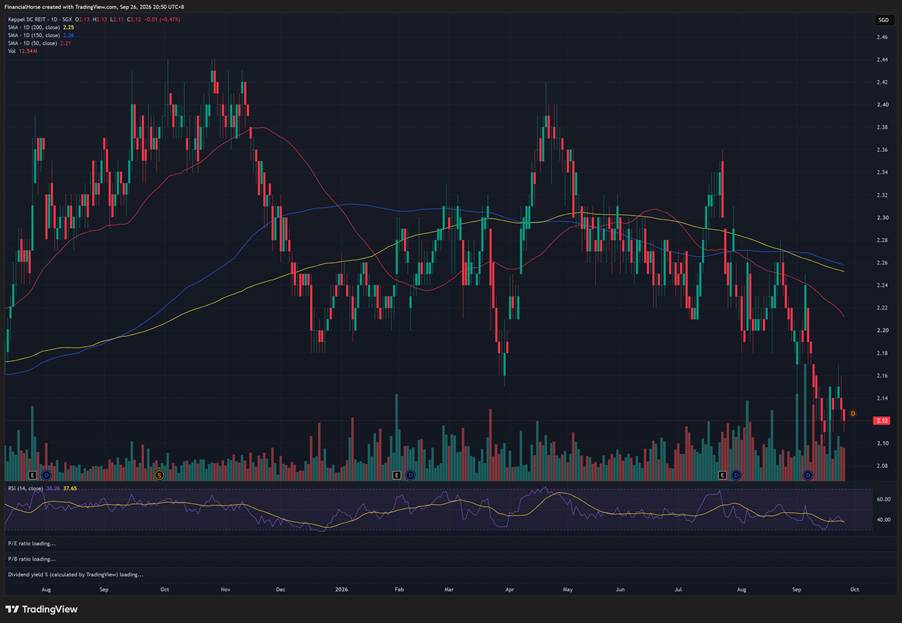
5. Keppel DC REIT – the one REIT with a growth story
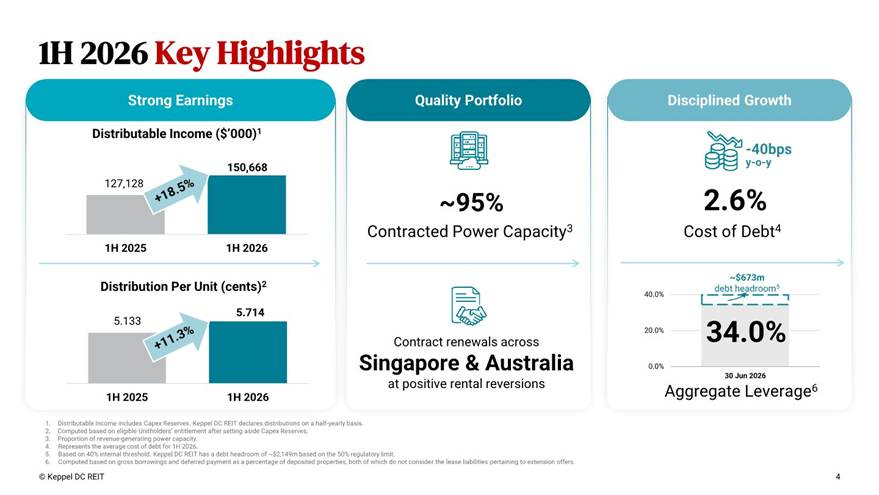
Keppel DC REIT pays 5.2% at S$2.12, and 1H2026 DPU was up 11.3% year on year – among the fastest DPU growth in the REIT sector this year.
Gearing is 34.0%, the lowest on this list, and the demand growth is as sexy as it gets – AI data centre capex that investors are dying to get exposure to.
That said, there is some nuance, because a big chunk of Keppel DC REIT are legacy data centres.
And it’s not so straight forward to transition from a legacy data centre to an AI data centre, because the power requirements, and the cooling requirements – are on a whole different level.
AI data centres just consume much more power, and require much more cooling.
It’s the same problem Mapletree Industrial Trust had with their US data centres – they just couldn’t convert them into AI data centres cost effectively.
So the transition for Keppel DC REIT may not be as straightforward as you expect.
I listed Keppel DC REIT in my May 2024 list at 5.3%, and the DPU is about 10% higher since.
But big picture wise, it’s a REIT, and 2026 has not been kind to REITs.
The unit is down 9% over the past year, near its 52-week low, and below the 200-day like most other REITs out there.
Banks or REITs – what has the market already decided?
Which brings us to the million dollar question.
Look at the table above and the pattern is obvious – the bank dividends are growing and price is near all time highs, while REIT distributions are flat, and prices are at multi year lows.
In fact if you divide the price of banks vs S-REITs – the ratio sits at 26x today, the most extreme it has eve been since 2008:
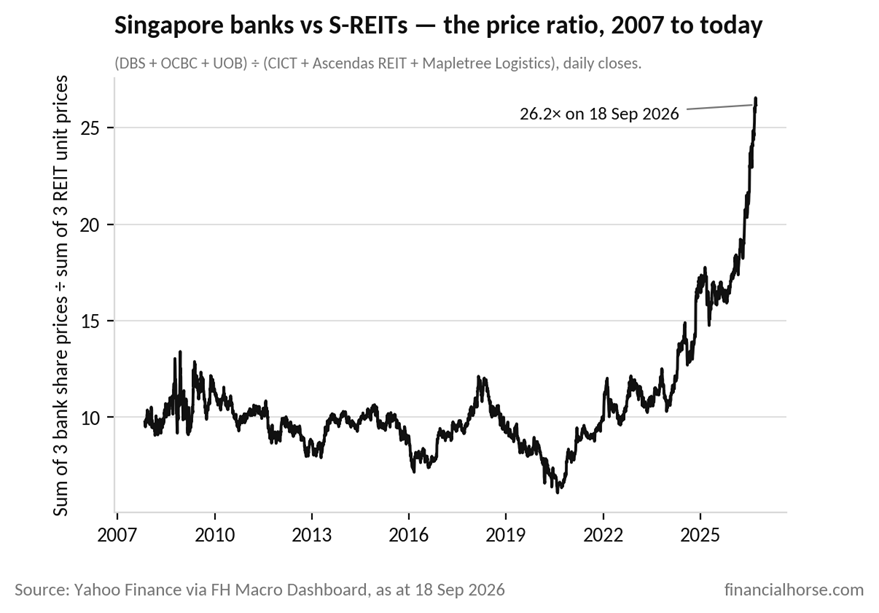
There’s 2 ways of seeing this.
Either the market is right and only the banks are going to grow going forward.
Or the market is wrong, and REITs are in for one hell of a recovery.
If you ask me, I think the crowd may be right about the direction here.
The challenge with REITs is that if you look at what Trump is doing in the US, it looks like this is going to be a decade of higher structural inflation.
Sure interest rates may come down here and there like we say the past 2 years.
But longer term, with the US fiscal deficit, and the need to finance a structural conflict vs China, I think the longer term trend for long term interest rates is up.
What I’m doing with my money
I know my own bias is to average into losers, and every REIT on this list is at or near a 52-week low.
So I’m deliberately not adding REITs until the sector turns – because that is exactly my bias to buy falling knives.
That’s boring, but Ascendas REIT looked cheap at S$2.49 in May too, and it is S$2.28 today.
The problem with the banks though, is that they really are just not cheap at today’s price.
I hold meaningful exposure to OCBC and UOB, so while I am not selling, I am also not adding here as well.
With the non-bank non-REIT dividend stocks though, it’s also clear that they have gone nowhere for a year.
And until we have a meaningful resolution to the Iran war, it’s also hard to see that changing.
So for now at least, while I am maintaining my existing exposure to dividend stocks and REITs, I also hesitate to add in a big way here.
That being said, markets move quickly, and if the facts change, I’ll change my mind and buy / sell positions based on how market conditions change.
You can see my full personal portfolio on FH Premium, together with weekly updates on what I buy / sell.
Love to hear what you think though!
This article was written on 26 Sep 2026. It will not be updated going forward.
How my own portfolio is actually positioned — with weekly updates on what I buy and sell — is shared on FH Premium, alongside my full stock watchlist and the prices at which I would buy.
Join the FH mailing list and new articles land straight in your inbox:
Also on WhatsApp, Telegram and Facebook.
Hi FH,
https://sgwealthbuilder.com/2026/09/22/cict-sgx-c38u-the-unstoppable-fortress/
Just to recap, CICT (SGX: C38U) completed the acquisition of Paragon for a whopping $3.919 billion in July while divesting Asia Square Tower 2 for $2.45 billion. An EGM was convened in which an overwhelming 99.96% of voters were in favour of the acquisition. And for good reasons too as the capital would be redeployed to acquire a freehold asset at a higher yield. In my view, the acquisition is really a no-brainer. This explains the bullish form of CICT unit price, which surge to a 5-year high of $2.50 in August.
Apart from the rising CICT unit price, this S-REIT stands out for its increasing annual DPU for the past 6 years – 8.69 cents (FY2020), 10.4 cents (FY2021), 10.58 cents (FY2022), 10.75 cents (FY2023), 10.88 cents (FY2024) and 11.58 cents (FY2025). The consistent performance is impressive given that many S-REITs have been struggling to overcome the high interest rates in recent years. On this basis, I am quite confident that FY2026 will see CICT dishing out a better annual DPU than FY2025.
One of the key reasons that I invested in CICT in 2026 was because it is largely Singapore-centric. Following my dismal investment in Mapletree Logistics Trust, I am really wary of S-REITs with significant exposure in overseas markets. CICT stood out for being a blue-chip S-REIT that focuses mainly in the Singapore market, cemented by its acquisition of CapitaSpring in August 2025 and the recent acquisition of Paragon.