Okay so quite a few of you have asked me about Nike, after the stock got dropped from the S&P 100.
And a few more have asked about Lululemon, after it fell 17% in a single day on its results earlier this month.
Both are down approximately 80% from all time highs.
For transparency – I do not hold either name today. I used to hold a small position in LULU but I closed it after realising the stock was in a downtrend.
In this article I want to relook both stocks and discuss:
- What actually broke at Nike, and at Lululemon?
- Which is cheaper, once you ask what is priced in?
- Will I buy either one?
It’s a fairly lengthy analysis, so if you want to skip the analysis you can go straight to the conclusion on what I would do at the end.
This is an FH Premium article that I am releasing to all readers, in the hopes that it helps your thought process. If you enjoy articles like this, do support FH on FH Premium and get access to my full personal portfolio, stock watch, and premium analysis.
The price action for Nike and Lululemon
Let’s start with the charts.
Here’s Nike for reference.
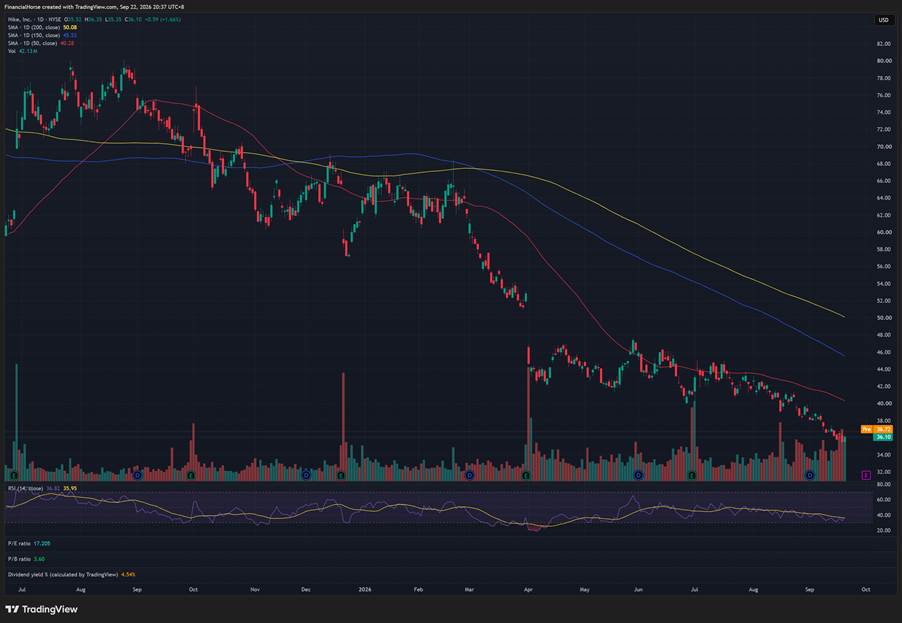
It’s about as ugly as it gets.
The stock is below all 3 moving averages, all 3 are trending down, and every bounce this year has been sold – including the one after the July results.
And this week you had the S&P 100 deletion on top of that – index funds forced to sell.
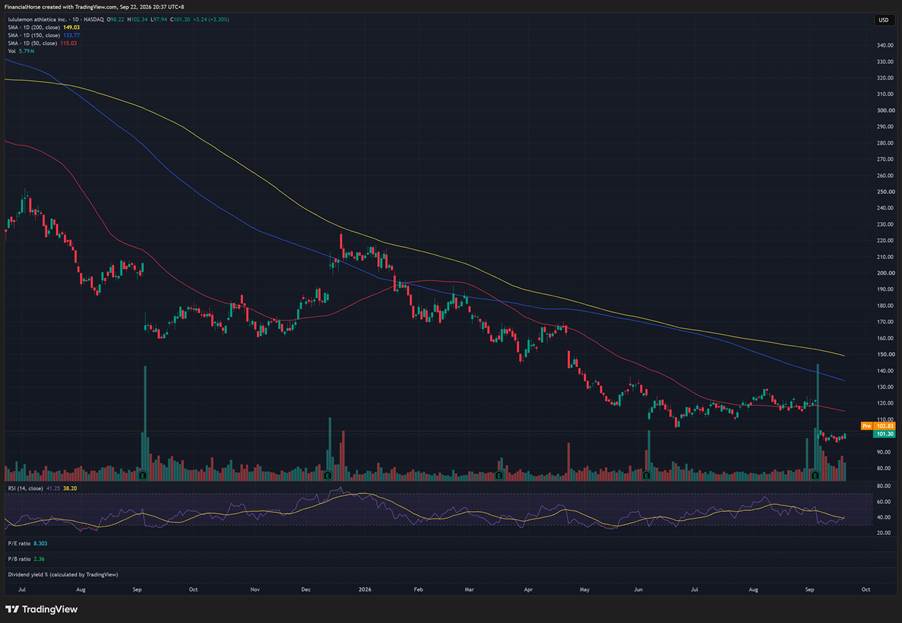
Lululemon is not much better.
A series of lower highs since December, and the 17% drop on results in early September still hasn’t bounced.
Here’s the two of them against the S&P 500 (blue is Nike and green is LULU).
Both have massively underperformed – though between the two LULU is worse.
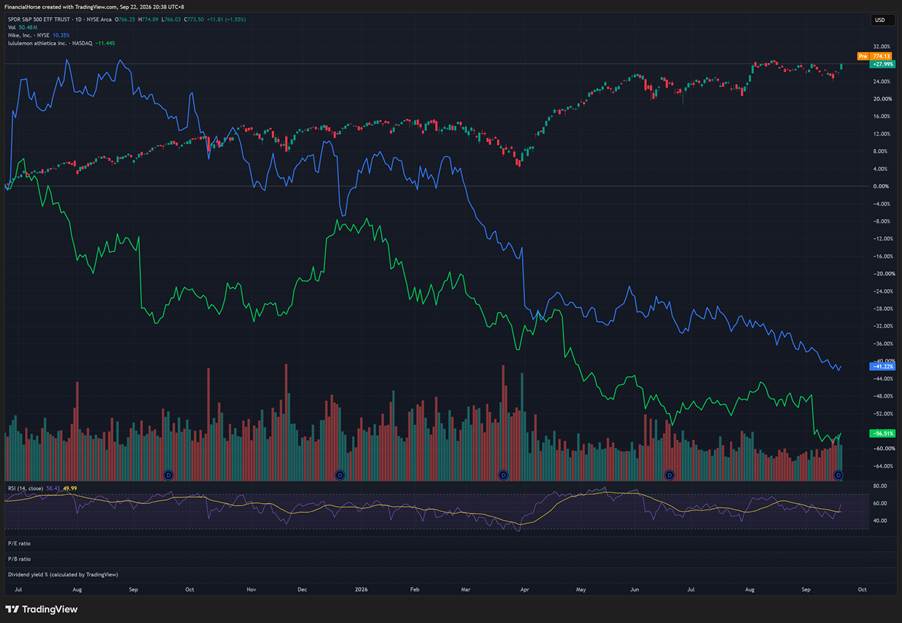
Since the middle of last year, the S&P 500 is up close to 30% – while Nike is down about 40%, and Lululemon more than 55%.
To be fair, this is a sector thing – On and Deckers are down 30–40% over the past year as well – but Nike is the biggest brand in the category, and it has led the whole sector down.
What broke at Nike – a reset that is taking longer than expected
Now here’s the thing with Nike – a good part of the decline was deliberate.
When Elliott Hill took over as CEO in October 2024, Nike had spent 4 years cutting its wholesale partners loose, and printing Dunks, Air Force 1s and Jordans until you could find them everywhere at a discount.
This affected the scarcity and consumer desirability.
His fix was to pull supply – in his own words on the June call, Nike has “taken $2 billion out of the market in FY26 of our classic franchises”.
You can see what that did to the top line.
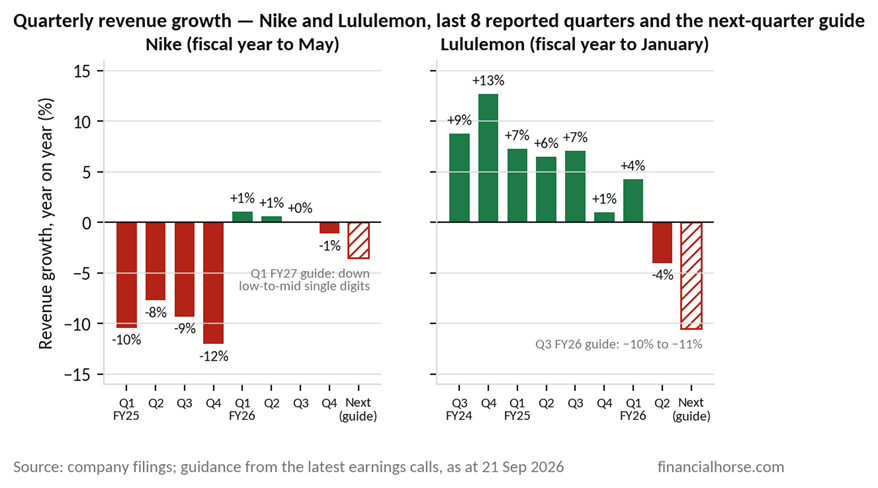
Revenue for the year to May 2026 came in at US$46.4 billion, about 10% below where it was 2 years ago (Greater China alone was down 17% last quarter), and the next 2 quarters are guided down again.
But the bit that really hurts is the margin.
Strip out the one-off US$986 million tariff refund, and the operating margin is roughly 6–7% – about half of what Nike earned in FY2022.
In plain English – Nike still has a cost base built for US$51 billion of sales, but is now sitting on US$46 billion of sales.
Now to give credit where credit is due, the business is improving.
Running has grown double digits for 5 straight quarters, wholesale is growing again, Nike is back on Amazon, and Foot Locker just posted its first positive comp in 4 years.
The problem is that the lifestyle business Nike deliberately shrank is 2 to 3 times the size of running – Sportswear fell double digits last quarter, and management’s own word for Jordan streetwear is “eroding”.
And there is a list of known problems still to come – a Greater China online reset from January 2027 that takes out about US$1 billion of revenue (a fifth of the region), and the tariff on Vietnam-made footwear going from 10% to 15%.
Then there’s the dividend.
Nike pays a 4.5% yield at today’s price, and has raised the dividend for 24 years running – but last year it paid US$2.4 billion in dividends against free cash flow of about US$2.2 billion, and US$0.3 billion of that was the tariff refund coming in as cash.
So Nike is basically paying you to wait, with money it is not currently making.
If they do cut the dividend, expect more downside. If they don’t cut the dividend, they need to borrow to finance it.
What broke at Lululemon – the product cycle, not the supply
Lululemon’s problem is the opposite kind.
Nobody pulled supply here – customers just stopped buying.
The second quarter results on 3 September showed revenue down 4%, Americas comparable sales down 12%, and leggings – about a third of the business – down roughly 20%.
Leggings. Down 20%. At Lululemon.
China Mainland, which had been the growth story, swung from +13% to −8% in a single quarter – and the Americas have now got worse 4 quarters in a row: −5%, −1%, −6%, −12%.
That just screams of a core business in decline.
So where did the sales go?
In plain English – to the competition.
BMO’s August numbers had Lululemon losing 10 points of share, with Alo picking up about 6 points and Vuori about 2.
Alo and Vuori own the silhouettes that people want right now, and Lululemon’s own fix (cutting in-store SKUs by 15%, chasing 20% more volume into whatever is selling) is an admission that the assortment was wrong.
The other problem with a pure retail model is that the costs are fixed.
Lululemon runs 825 stores itself, with US$2.1 billion of leases, so when sales fell 12%, operating expenses jumped from 37.7% of sales to 41.7% in a single year.
Capital allocation hasn’t helped either.
Lululemon spent about US$3.5 billion buying back stock over the past 2 and a half years, at an average of roughly 2.5 times today’s price, and kept opening stores into falling sales.
And then there’s the governance – founder Chip Wilson won 2 board seats in a proxy fight in May, the company ran 7 months with interim co-CEOs, and Heidi O’Neill from Nike only started on 8 September, with no plan due before March 2027.
Which is the irony of this whole story.
Lululemon has hired someone from Nike to fix Lululemon – while Nike themselves can’t even fix Nike.
Viewed this way, actually Nike’s looks much better – at least Nike’s core business is improving, at Lululemon the core business is terrible.
Nike vs Lululemon
So putting the two side by side:
| Nike | Lululemon | |
| What broke | Supply pulled on purpose, margin halved | Demand lost to Alo / Vuori, Americas comps −12% |
| Next-year estimates | Cut 33% in 9 months | Cut 25% in 90 days |
| Balance sheet | US$9.0bn cash vs US$7.9bn bonds | No debt, US$1.4bn cash |
| Capital return | 4.5% dividend, not covered by cash | Buybacks, running ahead of cash flow |
| CEO | Hill – 2 years in | O’Neill – 2 weeks in |
| Next results | 1 October | 3 December |
Probably the biggest one is the estimates.
Both companies beat estimates and cut guidance at each of their last 2 results – the beats were against numbers that had already been cut going in.
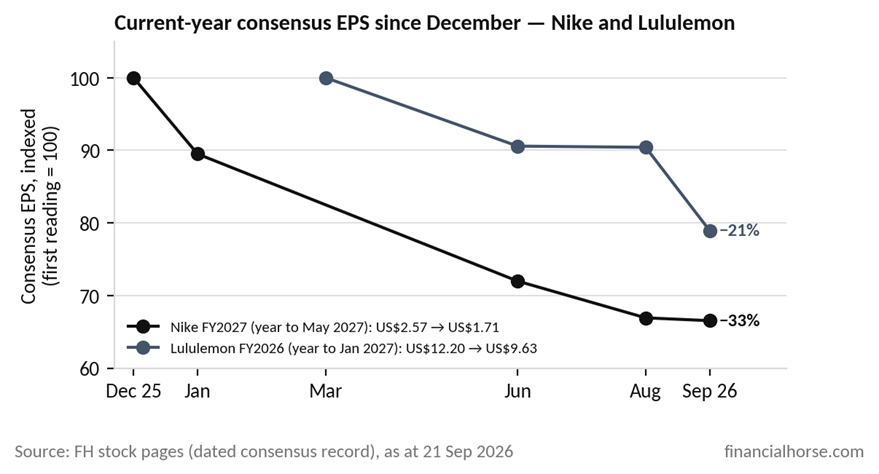
You can see the numbers are still going one way.
So that’s the backdrop here – two brands, both at multi-year lows, both with estimates still being cut.
Which brings us to what is actually in the price.
What is priced in?
Here’s the chart for reference.
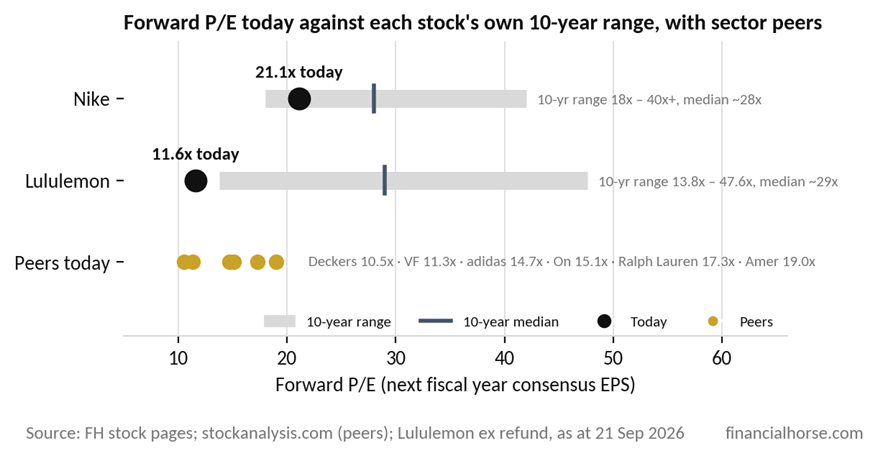
Nike trades at about 21 times next year’s earnings – the bottom of its own 10 year range, but above every peer in the sector.
Lululemon trades at 11.6 times (stripping out the refund) – the lowest multiple in its listed history, roughly where VF and Deckers trade.
So on first glance Lululemon is the obvious value, and Nike looks expensive.
But it’s rarely that straightforward, because you need to look at what earnings growth is priced in vs what the street expects.
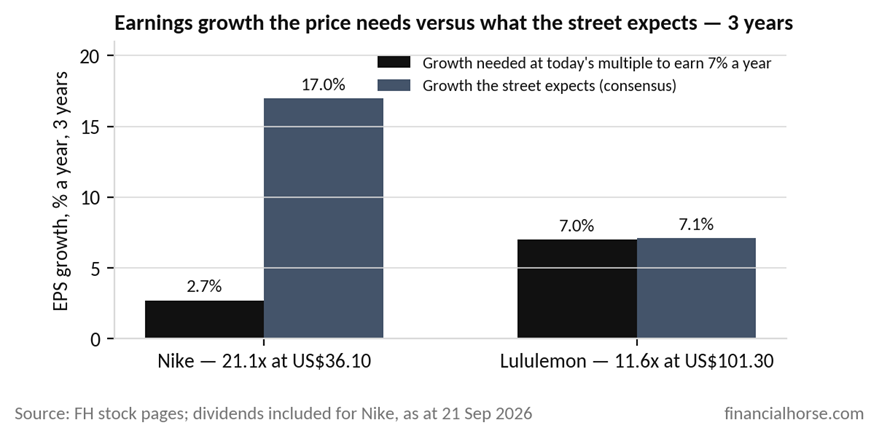
For Nike, a buyer at US$36 needs earnings to grow about 3% a year for 3 years to make 7% a year at today’s multiple.
And the street has 17% a year pencilled in.
On paper that’s an easy beat.
The catch – analysts have been wrong on Nike for 8 quarters straight, and the FY2028 recovery it shows today is the same recovery it showed for FY2027 a year ago, just pushed out a year.
For Lululemon, a buyer at US$101 needs about 7% a year – and the street has 7.1%.
Now the interesting thing is how this played out with other brands that fell out of favour.
adidas bottomed in late 2022 around the time a new CEO was named, and roughly doubled over the next 2 years – but the stock moved when the numbers turned, not when it got cheap.
Lululemon itself fell 55% in 2013–14 after the Luon recall, then more than doubled to new highs within 4 years – again, once the numbers turned.
And Under Armour got “cheap” in 2016, and is 87% lower today – the numbers never turned.
Yes it’s a sample size of 3, but if you ask me the lesson is pretty universal – with these turnarounds, the multiple tells you nothing.
What tells you something is the first quarter where earnings start to improve.
The right time to buy – is to wait until earnings pick up.
What needs to go right – bull and bear, from first principles
I’m not going to give you a grid of price targets and probabilities here, because I don’t think anyone can put odds on this with any accuracy before the next set of results – so let me lay it out from first principles instead.
For Nike, 3 things need to go right at the same time.
One – revenue has to stop falling, which means running and football have to outgrow the US$2 billion of classics Nike pulled, while China loses a fifth of its sales.
Two – the margin has to climb from 7% back to 10%, with tariffs just up and EMEA sitting on elevated inventory.
Three – the cost base has to stay flat while Nike rebuilds the wholesale relationships it spent 4 years dismantling.
If all 3 happen, the street is right, and you’re looking at something like 20% a year from here including the dividend, without the multiple even needing to re-rate.
If none of them happen – the classics never come back at full price, the margin stays stuck at 6%, and the dividend probably gets cut – then the stock is not cheap at 21 times.
And if some of them happen, it depends – which is probably the most likely outcome, and why the stock keeps beating estimates and falling at the same time.
The asymmetry to note is that the bear case only needs 1 thing to go wrong (the lifestyle cycle stays with the smaller brands), while the bull case needs all 3 to go right.
For Lululemon, it’s really just 1 thing – product.
If the new CEO fixes the assortment and the Americas comps turn positive by late 2027, then everything else follows – the fixed store base works in reverse, margins recover into the mid-teens, and a stock at 11 times earnings with no debt re-rates hard. That’s the kind of set-up where you can double your money.
If she doesn’t – if the leggings share is gone for good to Alo and Vuori – then that same fixed store base keeps crushing margins, the buyback stops, and the stock is not cheap at 11 times either.
Notice the difference though.
Nike’s problems are mostly things Nike did to itself, which means Nike can undo them – slowly.
Lululemon’s problem is what the customer wants, which a new CEO can influence but cannot control.
That’s why Lululemon’s bull case is bigger than Nike’s – but also why it’s much harder to execute.
Will I buy either? What I’m doing with my money
Which brings us to the million dollar question.
Will I buy Nike or Lululemon at these prices?
The short answer – not today.
I don’t buy into a falling knife, and neither of these is at a price where it is depression pricing to justify an exception.
Both go on the watchlist though.
Of the two, Nike is the one I would rather own when the trend flips.
The reason is simple – Nike’s problems are mostly self-inflicted and dated: the supply is already pulled, the severance is paid, the China reset is announced, and the guide already assumes the decline. From here the comparisons get easier every quarter.
But that being said, I’m not going to be a hero here.
I’m just going to watch for the earnings to improve, and the stock to go back into an uptrend, before I buy.
Consumer discretionary is a very hard space to play in, where consumer tastes can change very quickly, and this is an idea I don’t profess to have any edge in.
If the earnings / trend doesn’t improve, I’m fine to skip both stocks entirely.
Love to hear what you think though!
This is an FH Premium article that I am releasing to all readers, in the hopes that it helps your thought process. If you enjoy articles like this, do support FH on FH Premium and get access to my full personal portfolio, stock watch, and premium analysis.