Singapore’s richest 1% of households hold about 14% of the country’s total household wealth.
The top 5% hold about 33%.
At first glance, those numbers sound striking. They naturally raise questions about fairness, opportunity, and whether Singapore is becoming a society where wealth is increasingly concentrated at the top.
But as with most things involving money, the real story is more nuanced.
Singapore does have wealth inequality. That should not be brushed aside. Wealth tends to accumulate over time, compound through assets, and pass from one generation to the next.
At the same time, Singapore’s numbers are not unusually extreme when compared with other advanced economies. Senior Minister of State for Finance Jeffrey Siow said Singapore’s top 1% wealth share is “broadly comparable” with advanced economies with similar levels of wealth inequality. CNA also reported that the top 1% in major economies such as Australia, Japan and South Korea held at least 20% of national wealth, while the figure for the United States was 35%.
Singapore is not facing US-style wealth concentration. But wealth inequality still matters, because it affects housing, retirement, social mobility, family support, and how confident ordinary households feel about the future.
The better question is not: “Are the rich too rich?”
The better question is: “Can ordinary Singaporeans still build wealth, move up, and give their children a fair shot?”

This article was written by a Financial Horse Contributor.
Wealth inequality is not the same as income inequality
Income is what you earn.
Wealth is what you own.
A person may have a high salary but limited wealth if most of the money goes into lifestyle, children’s expenses, car costs, insurance premiums, or family support.
Another household may have a modest income but meaningful wealth because they bought property early, paid down debt steadily, accumulated CPF savings, or invested over many years.
Income is monthly.
Wealth is cumulative.
That is why wealth gaps usually look wider than income gaps. Assets compound. Property values change. CPF balances grow. Investment portfolios generate returns. Businesses can scale. Families can transfer assets across generations.
This does not make wealth inequality harmless.
But it does mean we should interpret the numbers carefully.
A wealth gap is not automatically proof that the system is broken. But it is a useful signal. It tells us where opportunity is accumulating, where families are building security, and where others may need more help to catch up.
The data is useful, but imperfect
One reason to welcome this data is that it gives Singaporeans a clearer picture of household wealth.
Mr Siow cautioned that the estimates should be interpreted carefully because of sample-size limits and possible under-reporting at both ends of the distribution. Wealth is also hard to measure, especially where assets are overseas, unlisted, or held privately. CNA noted that Singapore’s wealth inequality could be underestimated if wealth at the top is underreported.
For most ordinary households, assets are relatively visible: HDB flats, CPF, bank deposits, insurance, listed investments.
For wealthier households, assets can be harder to capture: private company shares, overseas property, trusts, family office structures, private equity, art, and other less visible holdings.
So the 14% number should be treated as a starting point for discussion, not a perfect measurement.
The Singapore difference: property and CPF
The most important part of Singapore’s wealth story is not just how much the top 1% owns.
It is what ordinary household wealth is made of.
Across all resident households in 2023, property accounted for 56% of household wealth. CPF balances and other financial assets each accounted for 22%. For the bottom 20% of households, property made up 54% of wealth, while CPF made up 39%. Among the top 20%, property was 58%, CPF was 15%, and other financial assets made up 27%.
This tells us something important.
Singapore’s middle-class wealth is deeply tied to home ownership and CPF.
That is a strength.
Broad-based home ownership means many households have an asset base. CPF gives working Singaporeans a structured way to accumulate retirement savings. Together, housing and CPF have helped many families build security over time.
That is one reason Singapore’s wealth concentration is not as high as in some other advanced economies.
But there is also a limitation.
A home is valuable, but it is not always liquid. CPF is valuable, but it is not fully flexible before retirement. A family can have meaningful net worth on paper and still feel cash-flow tight in daily life.
That is not failure.
It is just the structure of Singapore household wealth.
For many families, the next step is not simply to own a home. It is to build financial flexibility around that home.
Why some households feel richer on paper than in real life
This is where the wealth debate becomes personal.
A household may own an HDB flat, have CPF savings, and appear financially stable. But the family may still feel stretched because of mortgage payments, ageing parents, children’s expenses, healthcare concerns, and rising daily costs.
This is why net worth alone does not capture everything.
There are three different types of financial strength.
First, asset wealth.
This is your property, CPF, investments, and other assets.
Second, cash-flow strength.
This is whether your monthly income comfortably covers your expenses.
Third, financial flexibility.
This is whether you can handle shocks, change jobs, help family, retire with dignity, or support children without being forced into bad decisions.
Singapore households may score well on asset wealth because of housing and CPF, but still feel pressure on cash flow and flexibility.
That is why the conversation should not only be about redistribution.
It should also be about helping households turn asset ownership into lasting security.
The real divide may be financial assets
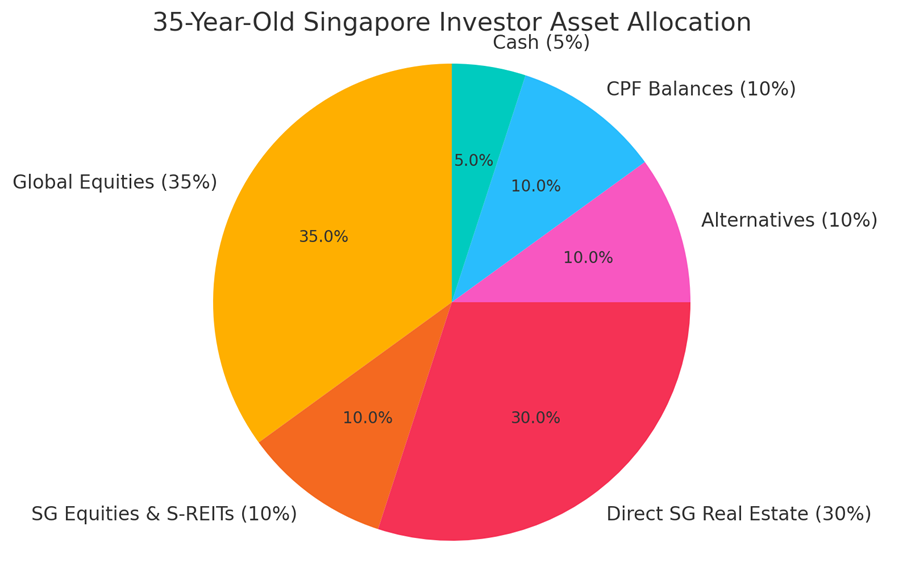
The data also shows a quieter divide.
Lower-wealth households have more of their wealth tied up in property and CPF. Higher-wealth households have a larger share in other financial assets. Among the top 20% of households, other financial assets made up 27% of wealth, compared with CPF’s 15%.
That matters because financial assets are more flexible.
They can be sold in parts.
They can generate dividends or income.
They can be diversified globally.
They can support retirement before CPF payouts begin.
They can help children with education or housing.
They can be passed down more flexibly.
A fully paid home and CPF savings provide a good foundation.
But a home, CPF savings, and a diversified investment portfolio provide more options.
This is why the next phase of financial education in Singapore cannot just be “buy property”.
It also has to be “build liquid, diversified financial assets over time”.
Not everyone will become rich from investing.
But more households can become more resilient.
Should Singapore tax wealth more?
This is a fair question, but it is not an easy one.
Singapore already taxes certain forms of wealth, especially less mobile assets such as property and motor vehicles. Mr Siow said Singapore’s approach is to tax wealth in ways that are less exposed to cross-border movement and tax planning. He also noted the need to balance younger households accumulating assets with higher-value property owners contributing more.
That balance matters.
If taxes are too light, wealth gaps may widen.
If taxes are too heavy or poorly designed, they can hurt competitiveness, discourage investment, or create unintended pressure on households that are asset-rich but cash-flow poor.
There is no perfect answer.
A good wealth tax system needs to raise revenue, preserve fairness, avoid excessive avoidance, and not punish ordinary households trying to build assets for retirement.
That is why the question should not be framed as “tax the rich more”.
A better framing is:
How do we keep Singapore attractive, while making sure wealth accumulation remains broad-based and socially sustainable?
The deeper issue is social mobility
The most important issue is not whether the top 1% owns 14%.
The most important issue is whether the bottom and middle can still move up.
CNA reported that social mobility has shown signs of “gradual moderation” as Singapore’s economy matures. Among children born to fathers in the bottom 20% of earners, the share who remained in the bottom bracket as adults increased across several cohorts. At the same time, three in four children born into the bottom 20% of households in the late 1970s and 1980s still moved to higher income tiers as adults.
That is a balanced picture.
Singapore’s mobility story is still encouraging.
But it cannot be taken for granted.
Wealth affects opportunity in quiet ways.
It affects where a family can live.
How much time parents have.
Whether children need tuition.
Whether a young adult can take career risk.
Whether parents can help with a first home.
Whether a family can survive a retrenchment.
Whether someone can start a business.
Whether education choices are made from aspiration or fear.
This does not mean every wealthy family is unfairly advantaged, or every less wealthy family is trapped.
It simply means wealth gives optionality.
And optionality compounds.
That is why social mobility is the heart of the issue.
What ordinary Singaporeans can take away
The national debate matters.
But for households, the practical lessons are just as important.
1. Do not measure wealth by income alone
A high income is useful, but it is not the same as wealth.
The formula is simple:
Wealth = Income − Spending + Investment Returns over Time
A household can earn a lot and still feel financially fragile if spending rises just as quickly.
The goal is not to look wealthy.
The goal is to build assets that give you freedom, resilience, and choices.
2. Treat CPF as part of your real wealth
CPF may feel less flexible than cash, but it is still a major part of your financial life.
For many households, CPF is not a small side account. It is a major retirement asset, housing tool, and healthcare buffer.
Review your CPF once a year.
Know your OA, SA, MA and RA balances.
Know how much CPF has gone into housing.
Know your accrued interest.
Know your likely retirement payouts.
Make sure you have done your CPF nomination.
Boring does not mean unimportant.
3. Use property as a base, not the whole plan
Home ownership is one of Singapore’s great wealth-building tools.
But property should not be the only plan.
A home gives security.
Financial assets give flexibility.
The ideal household balance is not the same for everyone. But over time, try to build some liquid assets outside your home and CPF.
That could include emergency cash, Singapore Savings Bonds, T-bills, SRS, ETFs, stocks, REITs, or other diversified investments depending on your risk profile.
The point is not to chase returns blindly.
The point is to avoid having all your wealth locked inside one roof.
4. Build financial assets slowly and consistently
Most people do not need heroic investment decisions.
They need consistency.
Save part of every pay raise.
Avoid letting lifestyle rise too quickly.
Keep emergency cash.
Invest regularly.
Avoid high-interest debt.
Avoid panic-selling every downturn.
Do not gamble.
Teach children early about saving and investing.
Compounding is not exciting at the start.
But over decades, it is powerful.
Never miss a post! Follow Financial Horse by subscribing or following us on your favorite platform:
Subscribe to our mailing list for exclusive content straight to your inbox:
5. Help children build capability, not just credentials
Education still matters.
But in a world where wealth compounds, children also need financial capability.
They need to understand budgeting, investing, CPF, debt, insurance, career risk, and property decisions.
Parents do not need to make children obsessed with money.
But they should teach them how money works.
A child who understands assets, risk, and time has a better chance of building security as an adult.
A kinder way to think about the top 1%
It is easy to turn wealth inequality into resentment.
But that is not always useful.
Some wealthy households inherited money.
Some built businesses.
Some took career risks.
Some invested early.
Some bought property at the right time.
Some had luck.
Most had a mix.
Likewise, some less wealthy households made mistakes. But many simply faced harder starting points, lower incomes, family obligations, health problems, bad timing, or fewer opportunities.
A kinder conversation recognises both truths.
We should not demonise wealth.
But we also should not ignore how wealth compounds advantage.
The goal is not to make everyone equal.
The goal is to keep Singapore a place where more people can build a good life.
So is this a problem?
It is not a crisis.
But it is a signal.
Singapore’s wealth concentration is not extreme by advanced-economy standards. The country also has broad-based asset ownership through housing and CPF, which helps moderate inequality and gives many households a real stake in the system.
But Singapore should still watch the trend carefully.
The first release of wealth data is useful because it gives policymakers and households a clearer baseline. The next household expenditure survey cycle is planned for 2028, which should help show whether the gap is stable, improving, or worsening over time.
The real test is not whether rich people exist.
They always will.
The real test is whether ordinary families can still move up, own assets, retire with dignity, and feel that the system remains fair.
Final thoughts
Singapore’s wealth story is more balanced than the headline suggests.
The richest households own a meaningful share of wealth, but Singapore’s concentration is lower than in several other advanced economies. Housing and CPF have helped many ordinary households build assets. At the same time, wealth inequality is real, and important because it affects opportunity across generations.
So the sensible response is not anger nor denial.
It is calm attention.
For Singapore, the challenge is to keep broad-based asset ownership alive — through housing, CPF, education, jobs, and a tax system that remains both fair and competitive.
For households, the lesson is more personal. Income matters, but ownership matters too. A home, CPF savings, emergency cash, and a growing investment portfolio may not sound glamorous, but together they form the quiet foundation of financial security.
Dear Sir/Mdm
This article may not be exhaustive, but it is comprehensive enough for many clear minded individuals to understand.
You have brought a fair and open minded approach in elaborating the subject matter (factually, too)
Thank you for making time to share such enlightened thoughts.