The hardest part of investing is rarely just finding the right stock. It is managing the person making the decision.
After a certain point, the gap between a decent investor and a good one is often not knowledge. It is self-awareness.
Markets have a way of exposing people.
They reveal who is patient and who is restless. Who is calm under pressure and who only looks calm when prices are rising. Who can think independently and who quietly needs the comfort of the crowd. Who can sit still, and who needs constant action just to feel in control.
In that sense, investing is not only about analysing assets. It is also about analysing yourself.
This article was written by a Financial Horse Contributor.
The market is not just a scoreboard. It is a mirror.
People like to think of investing as a rational exercise. Read the numbers, assess the business, estimate value, make a decision.
In reality, investing is emotional from start to finish.
You feel fear when prices fall. You feel greed when something is running. You feel envy when other people seem to be making money faster. You feel regret when you sell too early, and denial when a thesis starts to crack.
That is what makes investing so revealing. It does not just test your ideas. It tests your temperament.
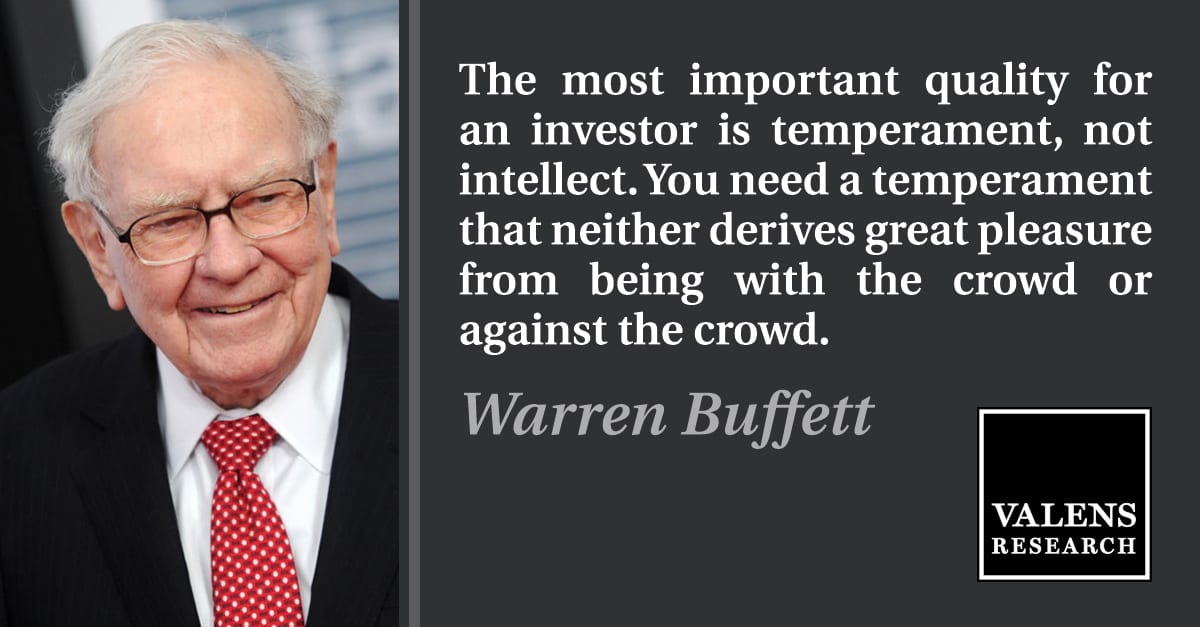
Your biggest investing edge may be behavioural
Many traditional edges fade over time.
A valuation gap closes. A trade gets crowded. A theme becomes consensus. Information spreads quickly. Screens get copied.
But behavioural edges are harder to arbitrage away.
The ability to stay calm when others panic matters. The ability to wait when nothing is happening matters. The ability to admit you are wrong without turning it into a personal crisis matters just as much.
These things sound soft, but they are highly practical. They affect position sizing, entry discipline, holding periods, sell decisions, and risk management. In other words, they affect returns.
An investor who understands their own patterns can build around them. An investor who does not will keep repeating the same mistakes and calling it bad luck.
Know what kind of investor you actually are
One of the most common mistakes in investing is style mismatch.
People copy strategies that look impressive rather than strategies they can actually follow. They admire concentrated investors, but cannot emotionally handle large drawdowns. They like the idea of deep value, but do not have the patience for a slow thesis. They try to trade tactically, but are too reactive to headlines. They want the upside of conviction without the discomfort that conviction requires.
That rarely ends well.
A good investing style is not the one that sounds smartest in conversation. It is the one you can execute consistently over time.
That means being honest about your temperament.
If you are naturally steady and patient, you may do well with concentrated long-term positions. If volatility makes you second-guess every decision, you may be better with broader diversification and a more rules-based process. If you love research but hate fast decision-making, you may be more suited to slow accumulation than active trading.
There is no shame in this. Investing is not a personality contest. Fit matters more than image.
Watch yourself in four situations
If you want to learn a lot about yourself as an investor, pay attention to how you behave in four moments.
a. When prices fall
A drawdown reveals your real risk tolerance.
It is easy to say you can handle volatility when markets are strong. It is harder when your portfolio is down, headlines feel darker by the hour, and every position suddenly looks more fragile.
Do you panic sell? Freeze? Average down too quickly? Obsessively check prices? Start rewriting your thesis just to reduce discomfort?
That behaviour tells you more about your actual risk capacity than any questionnaire ever will.
b. When prices rise fast
Bull markets can be just as dangerous.
Do you become careless after a few wins? Start buying things you do not understand? Mistake a rising market for personal skill?
A lot of investors are hurt less by fear than by easy success. Gains reduce discipline. Confidence turns quietly into complacency. And once that happens, decision quality usually falls long before results do.
c. When nothing is happening
This is an underrated test.
Can you sit still?
Many investors lose money not because they are foolish, but because they are bored. They need movement. They need stimulation. They feel that doing nothing means missing out.
But in investing, inactivity is often a skill. Good results do not always come from constant action. They often come from selective action.
If you cannot tolerate stillness, markets will eventually make you pay for that.
4. When you are wrong
This may be the most important test of all.
How do you react when the facts change? When a thesis weakens? When new evidence cuts against your original view?
Do you update honestly? Rationalise? Double down to defend your ego? Avoid looking because admitting the mistake feels too painful?
Your relationship with being wrong sits at the centre of your investing life. If every mistake feels like a threat to your identity, decision-making becomes much harder than it needs to be.
Good investors are not people who never get things wrong. They are people who can recognise error without losing clarity.
Keep an investor journal
One of the simplest ways to study yourself is to keep a written record of your decisions.
Write down what you bought or sold, why you did it, what would invalidate the thesis, what risks you may be underestimating, and how confident you really are.
This does two useful things.
First, it forces precision. A vague idea in your head can feel compelling. Once written down, it often becomes obvious whether it is actually well thought through.
Second, it helps you spot patterns.
You may notice that your worst buys happen after sharp price moves. Or that you consistently sell good businesses too early. Or that you get too optimistic after reading too much confirming commentary. Or that you become reckless when markets are easy.
That is valuable information. Not because it makes you perfect, but because it makes you harder to fool.
Build a process that protects you from yourself
Self-knowledge is only useful if it changes behaviour.
Once you understand your tendencies, the next step is to design a process around them.
If you are impulsive, create a waiting period before buying. If you are prone to thesis drift, write down the original reason for owning something and review it quarterly. If volatility affects your judgement, reduce position size until you can think clearly. If you tend to chase excitement, tighten your valuation rules. If headlines pull you around, cut down your media intake during stressful periods.
The goal is not to become emotionless. That is unrealistic.
The goal is to make it harder for your weakest instincts to take control at expensive moments.
Never miss a post! Follow Financial Horse by subscribing or following us on your favorite platform:
Subscribe to our mailing list for exclusive content straight to your inbox:
Study your recurring mistakes, not just your returns
Every investor makes mistakes. What matters is whether you know which ones are characteristically yours.
Some people move too early. Others too late. Some sell winners too soon. Others hold losers too long. Some are too stubborn. Others are too easily shaken out. Some overpay for quality because they fear missing out. Others keep buying weak businesses because the valuation looks cheap.
These are not random errors. They are often expressions of temperament.
That is why reviewing returns is not enough. You also need to review your decision patterns.
The aim is not to eliminate every flaw. It is to understand the few that repeatedly cost you the most.
You cannot borrow someone else’s temperament
This is where a lot of investors get stuck.
They try to copy not just other people’s ideas, but other people’s psychology.
But temperament does not transfer neatly.
A strategy that works brilliantly for someone else may still be the wrong one for you. You can admire a concentrated investor and still be better off diversified. You can respect a trader and still be unsuited to fast-moving decisions. You can learn from deep-value investors and still decide that quality compounders fit your psychology better.
The market does not reward imitation as much as people think. It rewards alignment.
Your strategy should fit your time horizon, workload, emotional makeup, and ability to stay consistent.
A strategy that is theoretically superior but behaviourally impossible for you is not superior at all.
Investing maturity often looks quieter than people expect
Many people imagine progress in investing as becoming more complex, more aggressive, or more sophisticated.
Often it looks like the opposite.
It looks like fewer unforced errors. Better filters. Smaller ego. More patience. Less need to react. More willingness to say, “I do not know.” Less confusion between urgency and importance.
That is real maturity.
At some point, becoming a better investor means becoming less impressed by your own feelings in the moment. You stop treating every urge as insight. You stop assuming that intensity equals truth. You stop confusing movement with progress.
That is when your process starts to improve.
Final thoughts
The market will teach you a great deal, whether you want it to or not.
It will show you what you fear, what you chase, what you rationalise, and what you cannot sit through. It will show you whether your process is real or only decorative. It will show you whether you truly want good outcomes, or whether part of you also wants excitement, validation, and the comfort of moving with the crowd.
That is why studying yourself matters.
Because in investing, you are never dealing only with businesses, valuations, and macro views. You are also dealing with the person making the decision.
And that person may be the biggest variable of all.
thank you, great article.
The market has indeed taught me a great deal about me.
Mr Market (often personified as a manic depressive almost comical character) is to be feared and respected in equal measure.
Agreed!