The money lessons children remember are usually not taught in a lecture.
They are learned in the supermarket, at the dining table, through pocket money, through work, and through watching how adults behave when money is tight or tempting.
The strongest examples show the same thing again and again: kids first learn money by watching, then by handling small amounts, and finally by linking money to values.

This article was written by a Financial Horse Contributor.
Before children learn about investing, they learn about atmosphere.
They notice who in the family worries about bills. They notice who says “we can’t afford that” and who explains why.
They notice whether money is spoken about calmly, fought about loudly, or avoided completely.
Reuters, in an interview with personal finance author Beth Kobliner, noted that children start picking up money concepts earlier than many adults think.
Children watch money behavior closely, and adults become the model whether they intend to or not.
That is why the most important money lessons are not really about stocks or interest rates. They are about setting the example you want for your children.
Teach them that money is about choices, not just numbers
One of the best money lessons a child can learn is that every “yes” quietly creates a “no” somewhere else.
Instead of brushing off a child with “we can’t afford that,” parents can explain why they buy the pricier toothpaste for sensitive gums, or we have to eat out less these few months because the family also wants to afford a holiday.
That is a far better lesson than simple denial. It teaches children that money decisions are about priorities, trade-offs and values.
Consistency matters. Whatever system parents choose, it needs to be steady enough that the lesson is clear.
Reuters also raises a useful warning for parents who turn everything into a transaction. Paying a child for making the bed or doing basic household duties can backfire if it teaches that contribution only happens when cash is attached. Not every family will agree, but the underlying principle is sound: children should learn both that money rewards value and that some responsibilities come from belonging to a family, not billing it.
Let them handle small amounts of money while the mistakes are still cheap

Many adults want children to become good with money without ever letting them touch it. That rarely works.
CNA profiled blogger Xie Wanyun, who began teaching her son Travis before Primary 1 with homemade grocery cards showing items and prices.
Later, she moved from pretend play to real budgeting: Travis received S$10 every Sunday and had to decide how much to bring to school each day. Some days he brought S$1. On others, S$3. The point was not the amount. The point was that he had to ration.
In the same piece, nine-year-old Natalie Ang described how her mother taught her to take the balance from her food money and drop it into a piggy bank when she got home.
That is exactly the right scale for learning for young children. A child who overspends S$3 learns something useful and personal responsibility.
One of the most valuable things parents can do is to give their children a small sum to invest when they are young adults, then step back and let them own the process.
The point is not to maximise returns on that first portfolio. It is to let them build judgment, conviction, and emotional discipline with real money at stake.
A young person who makes a few mistakes early, in a controlled way, often learns more than one who is protected from every wrong move.
Parents should guide without controlling, and discuss without shaming. A young adult who makes a few imperfect decisions with S$1,000 today may build far better instincts than one who reaches 30 having never been allowed to think for themselves.
Teach that money comes from work, effort and solving real problems

One of the most dangerous ideas a child can absorb is that money simply appears.
The better lesson is that income usually comes from one of three things: your time, your skill, or the value you create for someone else.
The Straits Times captured this well through young Singaporeans working part-time. Polytechnic student Masdanial Abdullah said his job helped him pay for interests like his guitar setup, contributed to transport, clothing and food, and also helped with family bills. Another student, Lucas Lim, worked at FairPrice on weekends because he had watched his father, the family’s sole breadwinner, work tirelessly for years and wanted to help carry some of that burden. These are not abstract lessons about “work ethic.” They are real examples of young people linking money to labour, sacrifice and responsibility.
And an inspirational story. The Straits Times reported that Zames Chew started a repair business at 16 after seeing his parents struggle to find trustworthy repair and maintenance providers. It reportedly cost him just S$30 to start, and the business later generated over S$1.7 million in revenue in 2024. The deeper lesson for children is powerful: money can also be earned by spotting a problem and solving it well.
Make money a normal conversation, not a guilty or taboo one
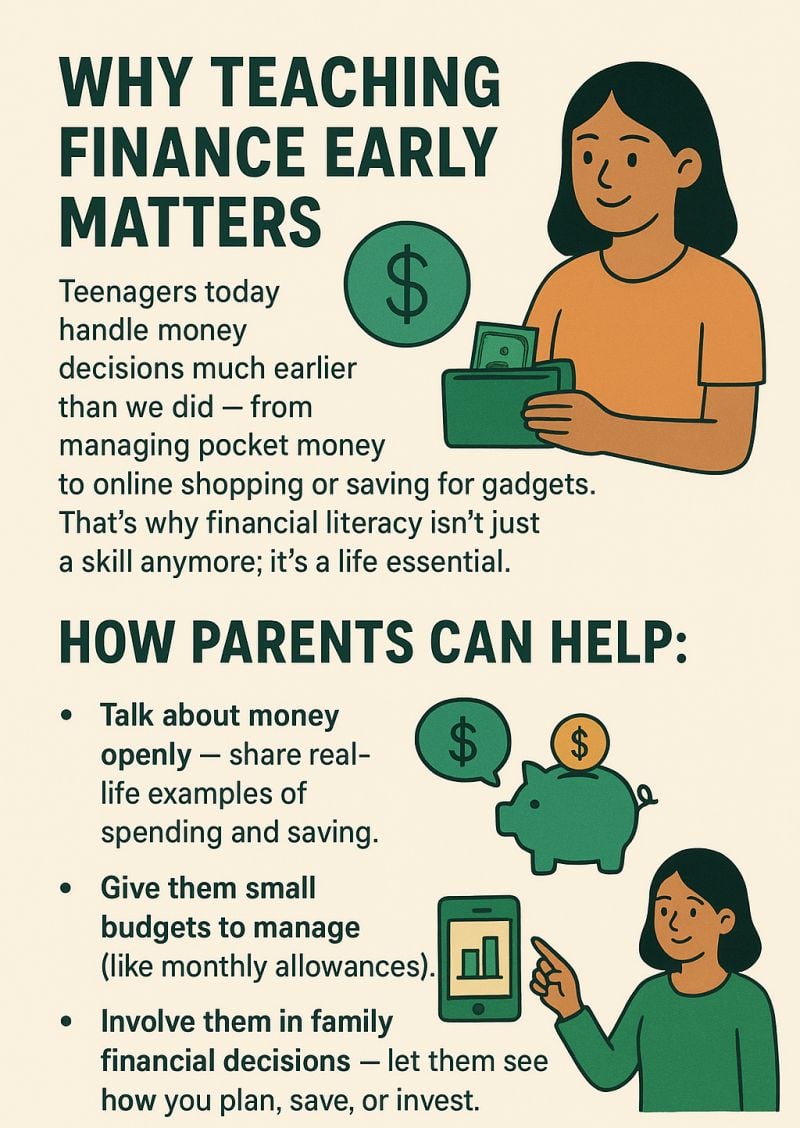
Children learn very quickly what kind of subject money is in a household.
If it only appears in tense moments, hushed conversations, or family arguments, they may grow up seeing money as something frightening or taboo.
But when parents talk about it naturally, in simple and calm ways, children begin to understand that money is just part of life: something to plan for, make choices about, and handle responsibly.
That might mean explaining why the family is choosing a cheaper option, why a holiday has to wait, why saving comes before splurging, or why working hard and spending wisely go together. The point is not to load children with adult anxieties, but to remove the mystery around money.
When money becomes a normal conversation rather than a guilty one, children are more likely to grow into adults who can face financial decisions with clarity instead of avoidance.
Dawn Cher, remembers seeing her mother at the dining table with a stack of bills, carefully working through the household budget. She recalls that most shopping happened during the Great Singapore Sale, and that paying her tuition teacher’s fees sometimes meant no taxi rides for the rest of the month. It is a vivid picture not because it is dramatic, but because it is so familiar: a child seeing, without being formally taught, that money is limited and choices are real.
The goal is not to dump adult anxieties on children. Children usually do not need details like salary comparisons or retirement balances. But they do need age-appropriate openness: where money comes from, why choices are made, and what the family is trying to prioritise.
Teach patience early, because modern life teaches impatience by default
Children are growing up in a world built to collapse waiting time. Tap to pay. One-click checkout. Buy now, pay later.
Everything whispers: have it now.
That is why delayed gratification has to be taught on purpose.
CNA writer Daniel Sim shares an interesting story. At dinner, he posed a puzzle to his children: would they rather take S$1 million now, or one cent that doubles every day for 30 days? One child chose the immediate million. Another chose the cent. Only after they took out calculators did they realise the tiny coin, given enough time, would grow to more than S$10 million. It is the kind of family anecdote that sticks because it teaches two lessons at once: patience matters, and small choices can become very big outcomes over time.
Children do not need a finance textbook first. They need a moment of surprise. They need to feel, almost physically, that waiting can create value.
Never miss a post! Follow Financial Horse by subscribing or following us on your favorite platform:
Subscribe to our mailing list for exclusive content straight to your inbox:
Make generosity one of the first money lessons, not one of the last
One of the best ways to stop children from seeing money purely as something to spend on themselves is to teach generosity early.
Too often, giving is treated as an optional extra to think about only after earning, saving and spending have been sorted out.
But children should learn from the start that money is also a tool for helping others, sharing what they have, and responding to need with action. This does not have to mean large sums. Even small acts of giving can teach powerful lessons about empathy, perspective and responsibility.
A child who learns to set aside a little for others grows up understanding that money is not just about personal gain, but also about what kind of person you choose to be.
CNA told the story of 10-year-old Chng Rui Jie, who wanted to donate her pocket money after hearing that people were going hungry and that even rabbits might be affected. Her father pointed out that half of her S$2 daily pocket money would not go very far on its own, then helped her think bigger: what if she used her voice to get many people to give S$1 each? That seed grew into 18 online campaigns, more than S$250,000 raised overall, and more than S$56,000 for recess money in one campaign alone. This example teaches three things at once: empathy, leverage and initiative.
Another CNA story gives the same lesson. Adrian Ang, founder of Stuff’d, remembered being 16 during the Asian financial crisis, pretending to sleep through recess because he had no money to buy food, and saving two slices of bread from breakfast to get through the day. Years later, after building a successful business, he launched a programme giving one free meal a day to children in need, which CNA reported had expanded to feed more than 140 children.
That is an important lesson for children: money is not only for buying. It is also for helping others.
In a cashless world, make money visible again
For many children now, money is not coins and notes. It is a tap, a beep, a number on a screen.
That makes teaching harder, because pain is harder to feel when spending is invisible.
CNA writer Lara Tung reflected that she only got her first bank account at 16 after working part-time during the school holidays. But she has since become more open to children having their own bank accounts or debit cards in a cashless environment, provided they are ready to understand that money is finite and trade-offs are real. She argues that these tools can help children set savings goals and see spending patterns, rather than treating money as some magical stream that flows out of a parent’s phone.
In the old days, an empty wallet sent a very clear message.
In the cashless age, parents may need to create that clarity deliberately: review spending together, set limits, show where money goes, and make the invisible visible again.
Beyond dollars and cents
In the end, teaching children about money is not mainly about raising little experts in saving, budgeting or investing.
It is about helping them grow into adults who are steady, thoughtful and unafraid in the face of financial decisions.
Adults who understand that money is a tool, not a measure of worth; that work, patience and restraint matter; that freedom often comes from living below one’s means; and that the way we spend, save and give quietly reveals what we value most.
These lessons endure not because they are taught once, but because they are seen at home, practised over time, and carried into life.