Okay so this one is by popular demand.
At the end of the brokerage account article, I asked whether there was interest in a piece on how to leave behind a portfolio your spouse/kids can actually run.
A LOT of you said yes.
So I decided to sit down to answer the question properly — if I died tomorrow, could my family actually take over my portfolio?
And I’ll be honest — when I started this exercise, the answer was no.
Not because they aren’t capable.
But because the entire map — which accounts exist, whaere they are, what happens to each one — lived in exactly one place.
My head.
So In this article, I’ll cover:
- What my family would actually face if I died tomorrow
- The 5 documents that change the timeline from years to weeks
- The one-page plan I’m leaving behind (and how to make yours)
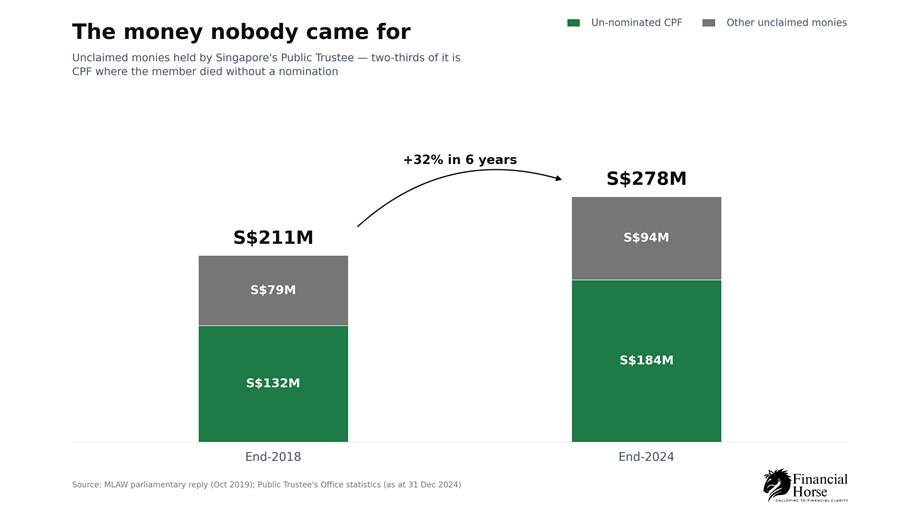
The S$278 million nobody came for
You would think families eventually sort this out on their own.
The data says otherwise.
As at end-2024, the Public Trustee’s Office was holding S$278 million in unclaimed monies — S$184 million of it CPF savings where the member died without making a nomination.
At end-2018, that figure was S$211 million.
So despite years of official outreach — letters, phone calls, even home visits — the pile of money nobody came for grew about 32% in 6 years.
In plain English — this is not money that was lost in some crash.
It is money families either didn’t know existed, or couldn’t complete the paperwork to claim.
And the preparation numbers explain why.
Only 22% of Singapore residents have a will (2024 YouGov survey).
Only around 36% of CPF members aged 16 to 64 have made a CPF nomination.
And in a 2025 UBS study of wealthy American women — households with US$1 million plus to invest — 83% of widows ran into difficulties taking over the household finances, and 1 in 4 didn’t fully know where their late partner’s assets were.
These were families with money, and access to advisers.
The problem isn’t capability. The problem is that one person runs the portfolio, and the other inherits it with no clue where everything lies, and how to access it.
The audit — what my family would actually face
So I did the same thing I did for the brokerage article — I audited my own accounts.
All of them.
Between brokers, banks, CDP, CPF, SRS and insurance policies, even I myself got tired counting after a while.
Each one holding a piece of the family’s net worth.
Each one with its own process when I die.
And as covered in the brokerage article, that process is not quick — every sole-name investment account goes through probate, and the executor notifies each institution separately, on top of compiling a formal Schedule of Assets for the court.
I wrote about those mechanics recently, so check out that article if you haven’t.
But here’s what the audit made obvious.
The enemy isn’t the 40% US estate tax, or even probate itself.
The enemy is that nobody except me knows the full picture.
My family is highly capable.
But if I died tomorrow, they wouldn’t know where to start looking.
They’ll have to go through my mail, my inbox, and guesswork.
So… how do I solve this?
Step one is not a document — it’s fewer accounts
Before any paperwork, the cheapest fix is fewer moving parts.
Every extra platform is one more institution your executor must find, notify, and clear — so consolidation is estate planning.
Two other structural fixes, covered in earlier articles, in one line each.
Irish-domiciled UCITS ETFs sidestep both the 40% US estate tax and the 12-to-18-month IRS paperwork freeze.
And joint accounts (where your platform offers them) let the survivor keep access without a grant — though access is not the same thing as ownership, so back them with clear wording in your will.
But you can’t simplify CPF. And you can’t hold an insurance policy jointly.
For those, Singapore gives you exactly one tool each — which brings us to the documents.
The 5 documents
Here’s the full list, with what each one actually does:
| # | Document | What it unlocks | Cost |
| 1 | Will + named executor | Grant of Probate instead of Letters of Administration — the biggest single lever on the probate timeline | ~S$200–400 at a law firm; online services from ~S$89 |
| 2 | CPF nomination | CPF paid directly to your nominees — CPF Board contacts them within ~10 working days | Free, ~15 min via Singpass |
| 3 | Insurance nomination | Insurer pays nominees directly — straightforward claims paid ~14 days from complete documents | Free |
| 4 | Lasting Power of Attorney (LPA) | Covers the scenario worse than death — incapacity | Free for citizens since 1 Apr 2026, plus a certificate issuer fee (typically ~S$50 at a GP) |
| 5 | The one-page plan | Makes the other 4 findable | Free |
Total cost of the entire stack: a few hundred dollars, most of it the will.
Now — the table looks boring, and that’s the point.
But there are 4 landmines buried in it that most people have never heard of.
Landmine 1 — marriage revokes your will AND your CPF nomination.
Under the Wills Act, marriage automatically revokes any will you made before it (unless the will was made in contemplation of that marriage).
And separately, marriage automatically revokes any CPF nomination you made before it.
Divorce, counterintuitively, revokes neither.
In plain English — if you made your will or CPF nomination before your wedding, you may be holding void paper right now. And if you divorced and never updated them, your ex may still be the beneficiary.
If you’re not sure, just check – better safe than sorry.
Landmine 2 — your CPF doesn’t follow your will.
CPF savings sit outside your estate, so the only document that directs them is a CPF nomination.
Without one, your CPF goes to the Public Trustee, who distributes it under intestacy rules — a process measured in months, not weeks, minus a tiered fee (about S$830 on S$100,000 of CPF).
With one, CPF Board contacts your nominees within about 10 working days, and for most local adult nominees the disbursement is automatic.
One scope note — a nomination covers your CPF balances (and any unused CPF LIFE premium), but not property bought with CPF or investments under CPFIS. Those follow your will.
There’s more to say about CPF nominations than fits here — let me know in the comments if there’s interest and I’ll do a proper piece.
Landmine 3 — there is still no nomination for brokerage or CDP accounts.
As covered in the brokerage article — CPF has a nomination scheme, insurance has a nomination scheme, and your investment accounts have nothing.
Which is exactly why documents 1 and 5 do the heavy lifting for the portfolio itself.
For insurance, one nuance worth 2 lines: a revocable nomination keeps you in control (change it anytime), while a trust nomination is irrevocable and reserved for your spouse and children.
No nomination at all means the payout joins the estate queue behind probate — insurers can pay a proper claimant up to S$150,000 without a grant, but above that, everyone waits.
Landmine 4 — death is not the worst case. Incapacity is.
If I die, at least there’s a process — probate is slow, but it ends.
If I’m in a coma, there is no probate to apply for — and without an LPA, my family would have to apply to court to be appointed my deputy, which is slower and more expensive, while the bills keep arriving.
Since 1 April 2026, making an LPA is permanently free for Singapore citizens.
At that price, “I haven’t gotten around to it” is a hard position to defend.
Never miss a post! Follow Financial Horse by subscribing or following us on your favorite platform:
Subscribe to our mailing list for exclusive content straight to your inbox:
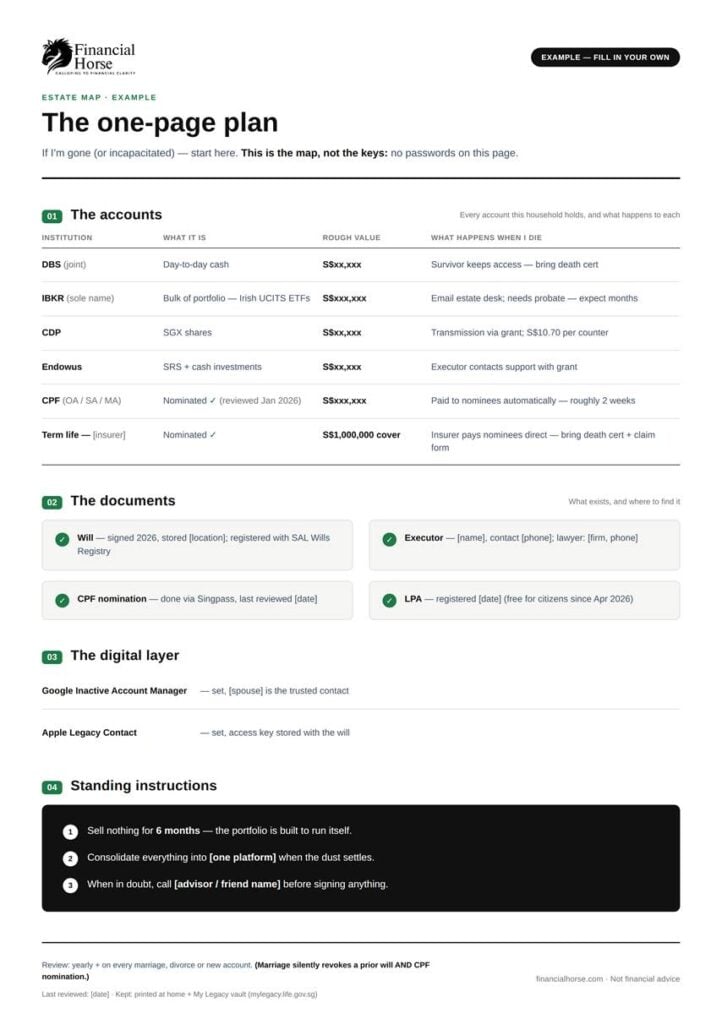
The one-page plan itself
So the 4 documents above handle the legal layer.
The one-page plan handles the human layer — it’s the page my family actually opens in week one.
Mine is literally one page, and it contains:
- Every institution we hold money with — account type and rough value. Not passwords. The map, not the keys.
- What happens to each account when I die, in one line each (“IBKR — email the estate desk, expect months”. “CPF — paid out automatically, roughly 2 weeks”).
- Where the will is, who the executor is, and the lawyer’s contact.
- CPF and insurance nominations — status, and the date I last reviewed them.
- The digital layer — I’ve set up Google’s Inactive Account Manager and Apple’s Legacy Contact, so the photos and email don’t die with the phone.
- A standing instruction — which single platform to consolidate everything into, and one line of investment policy: “sell nothing for 6 months; the portfolio is built to run itself.”
Two notes on that last bullet.
The first 6 months after a death are the worst possible time to be making portfolio decisions — so the plan’s job is to remove the need for any.
And per the brokerage article — passwords are not the plan. An account map is legal and safe to share. A password list is neither.
Where does the page live?
A printed copy at home where my family can find it, and a digital copy in the Government’s My Legacy vault — which is built to store exactly this kind of information and share it with trusted persons ahead of time.
Last thing — the page has a review date.
Once a year, and immediately on any marriage, divorce, or new platform.
Because as we’ve seen, 2 of these documents silently void themselves at the altar.
Reader question — “why not just put the account in their name now?”
A few readers went one step further, and it’s a good question.
If the goal is for my family to keep running the US portfolio, why bother with executors and transfer certificates at all — why not move the account into their name before I die?
And here’s the thing — this actually works, and it works better than most people realise.
Singapore has no gift tax and no capital gains tax, so nothing stops you transferring shares to your spouse today.
But the surprising part is the US side.
The US taxes a non-resident’s estate on US stocks above US$60,000 — but it does not tax a non-resident’s gifts of US stocks at all, because stocks are “intangible property” under the gift tax rules.
In plain English — a large position in Apple that gets taxed at 40% if you die holding it can be given to your family tax-free while you’re alive.
Give with a warm hand, not a cold one — the US tax code agrees.
So why doesn’t this replace everything above?
Three honest reasons.
One — a gift has to be real. Once transferred, it is genuinely your family’s asset and no longer yours: regardless of what happens next – divorce, bankruptcy etc. A transfer “in name only”, where you keep running it as yours, is exactly the arrangement courts unwind — same doctrine as the joint account problem.
Two — it moves the problem, it doesn’t kill it. If you put in your spouse’s name, and your spouse dies first (or when they eventually passes), a sole-name account full of US stocks faces the same US$60,000 line and the same probate queue — just with the roles reversed. The structural fix is still Irish UCITS; the gift just changes whose name the problem sits under.
Alternatively you could transfer to your kids while you are still alive, and sidestep the entire issue.
Three — the joint account version doesn’t get the same deal. For non-US persons, the IRS presumes the entire joint account belongs to the first holder to die, unless the survivor can prove what they contributed — so “just make it joint” fixes access, not the US estate tax.
Same death, 2 very different timelines
So let’s answer the question in the title.
The difference the file makes is summarized below:
| Asset | With the 5 documents | Without |
| CPF | Nominees contacted in ~10 working days, disbursement mostly automatic | Public Trustee route — months, plus tiered fees |
| Insurance | Nominees paid ~14 days from complete documents | Joins the estate, waits behind probate |
| Brokerage / CDP / bank | Probate either way — but will + executor + map keeps it to months | Letters of Administration + no map — the long way |
| The full picture | Executor works through a checklist | Family reconstructs your life from mail and bank statements |
One honest caveat — the documents don’t make probate fast.
Nothing makes probate fast (that was the whole point of the last article).
What they do is shrink everything around it — and make sure nothing joins the S$278 million pile.
So — could my family run the portfolio?
Frankly – I think with the 5 documents, it would make life a heck of a lot easier.
Closing Thoughts
One scale note — if your portfolio is a single CDP account and some CPF, a will and a CPF nomination may genuinely be all you need.
The full file earns its keep as the platforms multiply and the sums grow.
But if the portfolio is substantial — and if you’re reading this site, it probably is — you’re risking a few hundred dollars and one uncomfortable weekend to save your family months, possibly years.
Long story short — the hard part was never the paperwork. It was sitting down and admitting that the map only existed in my head.
This piece exists because readers asked for it — so let me end with the reverse question.
What would your spouse struggle with first — finding the accounts, or running them?
And if you’ve been the one on the other side, who had to piece together a loved one’s finances — I’d love to hear what you wish they’d left behind.
This article was written on 7 August 2026. It will not be updated going forward.
My latest macro views, as well as my full stock watch and personal portfolio, are shared on FH Premium.
Thank you for preparing this article. It was an eye opener for me.
Just in case some of our friends here do not know. I just realised that CPF DPS needs a separate nomination with Great Eastern. The original CPF nomination does not cover DPS.
How about the srs account if the person die before or after 62 or before the payout. Most people will delay so that they dont want to pay tax on it.
Does iFast’s Beneficiary Account solves some of these issues if I trade in the BA? My spouse can produce my death cert & transfer all the assets in my BA account into hers ?
Vincent or others, please enlighten me. I know CPF, but what is CPF DPS you mentioned?
Also, does anyone know if the IRS taxes currency accounts (USD and SGD) parked in a Citibank Singapore a/c when the account holder dies ? Thanks
DPS is Dependants’ Protection Scheme https://www.cpf.gov.sg/service/article/what-is-the-dependants-protection-scheme
This is great. Part 1: Cannot siam US estate tax easily. Part 2: Where your spouse can find your money.
We need a Part 3. How your spouse should set up a fuss free portfolio, he/she is less financially savvy.
Good idea!
Good point haha will do it.