Okay so quite a few of you asked me this after the estate tax article.
The 40% US estate tax is one problem.
But it turns out there is a second problem almost nobody talks about — the mechanics.
Who actually unlocks your brokerage account when you die, what documents do they need, and how long does the money stay frozen?
And… can you save yourself all the hassle and just give your brokerage password to your loved ones, so they can sell your stocks and transfer it out themselves?
So I sat down and worked out what would actually happen to my own accounts if I died tomorrow.
The answer was… not straightforward.
In this article, I’ll cover:
- What actually happens to your brokerage account (IBKR, moomoo, Tiger, the robos, CDP) when you die
- How long your family waits before they can touch the money
- Whether “just give your spouse the password” actually works
Step one: everything freezes
The moment a broker learns of a death, the account is frozen.
No trading, no withdrawals, no transfers — the account sits there until someone proves they have the legal authority to deal with it.
And that proof is not a marriage certificate or an NRIC.
It is a court order.
Big picture wise, the sequence of events is as follows:
- The death is registered, and the account is frozen once the broker is notified.
- The family applies to the Family Justice Courts for a Grant of Probate (if there is a will) or Letters of Administration (if there isn’t).
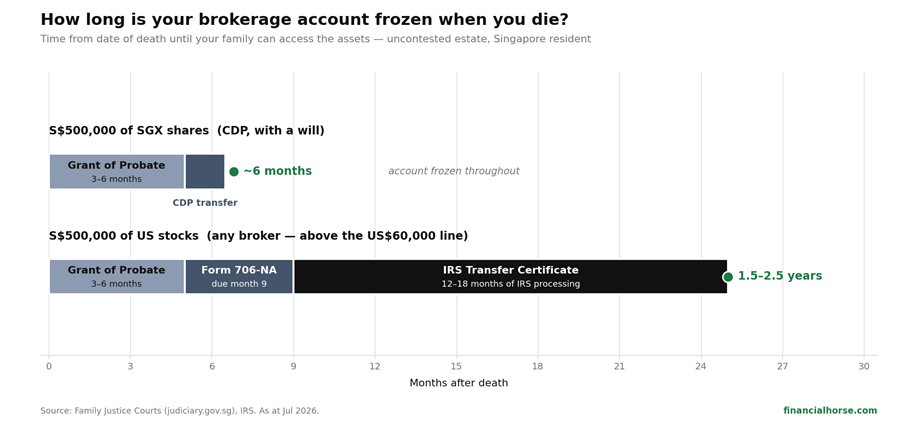
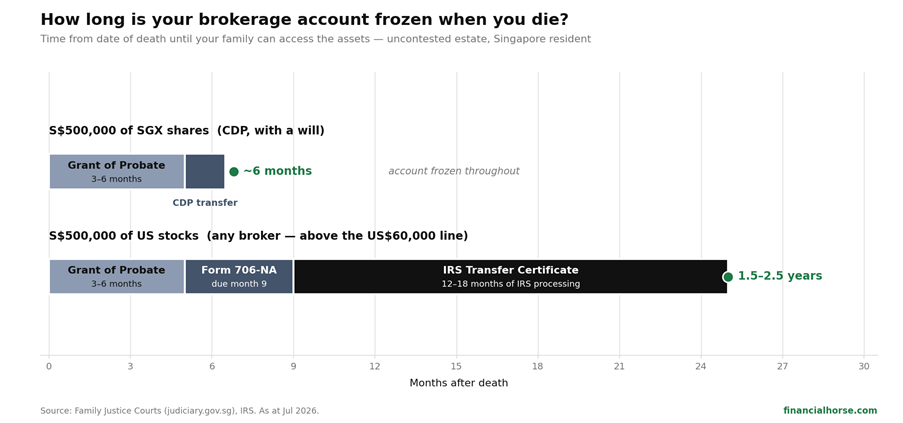
- The grant is extracted — the courts quote approximately 2 to 3 months of processing, and in practice a clean, uncontested application takes around 3 to 6 months from filing to grant.
- The executor then notifies every institution separately — each broker, each bank, CDP — and works through each one’s own process.
- Only then do assets get transferred out or sold.
In plain English — from the day you die, your family is realistically looking at 6 months or more before they can touch a dollar, even in the simplest case.
No will makes it slower (the court has to establish who administers the estate).
A contested will, a missing will, or overseas assets can stretch this into years.
Legal fees for a simple uncontested estate run around S$1,500 to S$5,000, plus a few hundred dollars of court fees.
And during this entire window, nobody can sell anything.
If markets fall 20% while the estate is in probate, your family watches it happen to a frozen portfolio.
There are a few small escape hatches worth knowing:
- Estates worth S$50,000 or less can skip lawyers entirely and use the Public Trustee to administer the estate (for a fee).
- Bank balances under S$5,000 can usually be claimed directly from the bank without probate.
- And since November 2024, CDP holdings worth S$5,000 or less can be claimed directly from CDP without a grant, if there is no will and all beneficiaries consent.
Useful — but if you’re reading this site, your portfolio is probably not S$5,000.
What each broker actually requires
Here’s where it gets interesting.
I went through the published estate process of every major platform Singapore investors use.
The documentation requirements are summarized below:
| Platform | Published process? | Key documents required | What happens to the holdings |
| IBKR | No consolidated page — estate desk handled by email [Based on what I could research from the public website] | Certified death certificate, Grant of Probate / Letters of Administration; additional US tax documents if US assets exceed US$60,000 | Account retitled “Estate of [name]”; assets transfer in-kind, beneficiaries typically need their own IBKR account |
| moomoo SG | None found | — | Contact support |
| Tiger Brokers SG | None found | — | Contact support |
| Endowus | Yes | Death certificate, grant, executor’s ID | Executor takes over / opens estate account; no beneficiary nomination possible under the custody structure |
| Syfe | Yes | Original death certificate, grant, executor’s ID | Released to the estate |
| StashAway | Yes | Grant | Entire account is liquidated — proceeds paid in cash to the estate |
| Saxo | Yes | Death certificate, grant, executor’s ID | Account closed on executor’s instructions |
| POEMS | Yes | Death certificate, grant, Schedule of Assets, ID | Estate account opened via trading representative |
| CDP | Yes | Death certificate, grant, CDP forms | Shares transmitted in-kind, S$10.70 per counter |
Two rows in this table deserve attention.
First — I could not find any published estate process for moomoo or Tiger, two of the most popular brokers in Singapore.
That doesn’t mean there is no process, but it means your family starts from a blank page, emailing customer support with a death certificate and trying to sort out next steps.
Second — StashAway’s published policy is that the account is liquidated, with cash paid to the estate. And that they only recognize the executor or administrator of the estate.
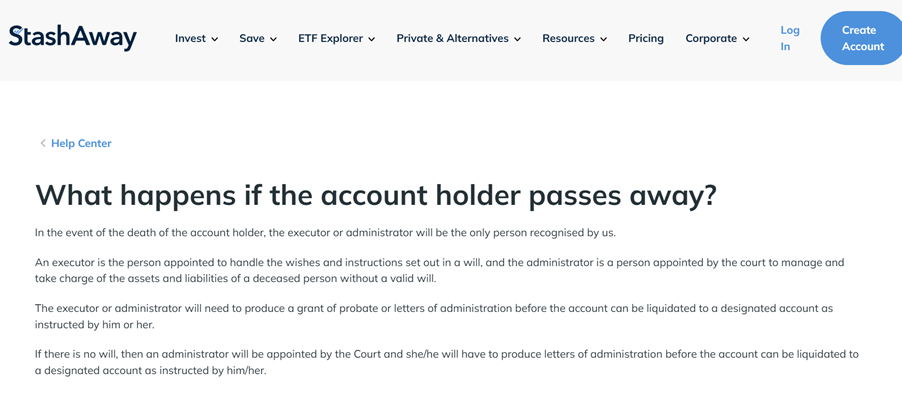
In plain English, your heirs don’t inherit your portfolio — they inherit the cash proceeds, sold at whatever the market price was at time of sale.
CDP, by contrast, transfers shares in-kind for S$10.70 per counter — your family inherits the actual positions.
Same death, very different outcomes, purely based on which platform the money sat in.
The US layer — where 6 months becomes 2 years
Now for the part that ties back to the estate tax article.
If you die holding more than US$60,000 of US-situs assets — US stocks and US-listed ETFs count, regardless of which broker you use — your estate needs to file Form 706-NA with the IRS within 9 months of death.
And here’s the kicker.
Brokers holding US assets will generally not release them until the estate produces an IRS Transfer Certificate — a document confirming the US estate tax has been settled.
The IRS’s own stated processing time for this certificate is 12 to 18 months — and the clock only starts once they have received complete documentation.
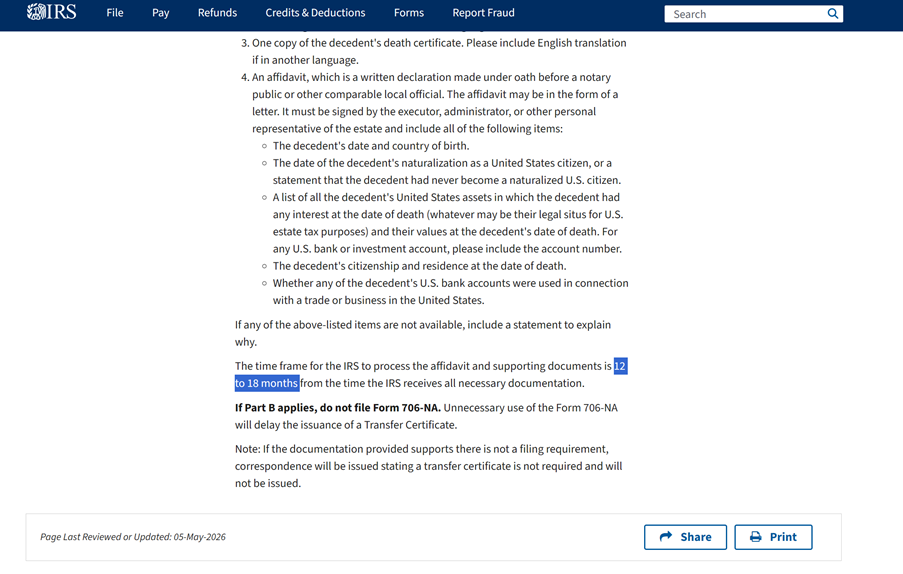
So the full stack for a Singapore investor holding US stocks looks like this: 3 to 6 months for the Singapore grant, 9 months to prepare and file the US estate tax return, then 12 to 18 months of IRS processing — with the account frozen throughout.
There are documented cases of families waiting around 2 years, with a 6-figure US estate tax bill at the end of it.
I wrote about the estate tax itself recently, so check out that article if you haven’t — but the mechanics angle adds something important.
Irish-domiciled UCITS ETFs don’t just sidestep the 40% tax.
They sidestep this entire IRS paperwork layer — no 706-NA, no transfer certificate, no 12-to-18-month freeze.
This makes Irish domiciled ETFs even more attractive for Singapore investors. Not only do you save on the tax, you also save on the tax and admin paperwork.
Never miss a post! Follow Financial Horse by subscribing or following us on your favorite platform:
Subscribe to our mailing list for exclusive content straight to your inbox:
“I’ll just give my spouse my password”
Which brings us to the million dollar question.
Every time this topic comes up, the most common response is some version of: “That’s why my wife has my passwords.”
Or – “my children have my account details, they can just login and well”.
I understand the appeal — it feels like a zero-cost fix that skips all of the above.
So let’s take it seriously: does it actually work?
In the very short term, sometimes yes.
If nobody notifies the broker, the account stays live, and someone with the login could in theory sell positions and move cash out.
But walk through what actually happens, step by step, and there are definitely risks.
Problem 1 — 2FA outlives your memory of the password.
Every major broker now sits behind two-factor authentication tied to your phone and, increasingly, your face.
Phone plans get terminated, devices get locked, SIMs get recycled — and sometimes the login your spouse “has” stops working precisely when it’s needed.
Problem 2 — the money has nowhere clean to go.
Brokers generally only pay withdrawals to a bank account in the deceased’s own name.
And that bank account gets frozen too, once the bank learns of the death.
So even a “successful” login often just moves the money from one soon-to-be-frozen account to another.
Problem 3 — the paper trail catches up.
To settle the estate properly, the executor must eventually file a Schedule of Assets with the court — a formal listing of everything you owned at death.
An account that was quietly emptied after the date of death, before the grant, is exactly the kind of thing that surfaces — to the court, to the other beneficiaries, and to the broker.
And if the will (or intestacy law) says those assets belong partly to your children or your parents, a spouse who sold and pocketed the proceeds has effectively taken someone else’s inheritance.
That is how families end up in litigation with each other.
Problem 4 — it may well be illegal.
Under Singapore’s Computer Misuse Act, accessing a computer system without authority is an offence — up to a S$5,000 fine and/or 2 years’ jail on a first conviction.
Your consent to use your password arguably dies with you, and the broker’s terms never authorised your spouse in the first place.
To be fair, there is no Singapore case I’m aware of where a grieving spouse was prosecuted for logging into a deceased partner’s brokerage account — this is a legal grey area rather than settled law.
But “probably won’t be prosecuted” is a strange foundation for an estate plan.
And one more thing — for US assets, selling everything quickly doesn’t dodge the US estate tax either, because the tax attaches to what you held at the date of death.
So… can or cannot?
Long story short — as a lot of you have shared, the password plan works.
But I just want to be clear that it works because sometimes the broker, or the tax authority, doesn’t know about it.
And doesn’t know about it doesn’t make it legal or proper.
As flagged above, there are a lot of potential risks with this approach.
If the portfolio is substantial, it probably makes sense to have a real plan beyond (oh don’t worry, they have my password).
But hey that’s just my view.
What actually skips probate (and what doesn’t)
So if passwords don’t work, what does?
| Skips probate | Goes through probate |
| CPF (with a valid nomination) | Individual brokerage accounts (IBKR, moomoo, Tiger, etc.) |
| Insurance policies (with nomination) | Robo-advisor accounts (Endowus, Syfe, StashAway) |
| Joint accounts (with caveats — see below) | CDP holdings |
| Sole-name bank accounts |
Notice the pattern.
CPF has a nomination scheme. Insurance has a nomination scheme.
Brokerage and CDP accounts have nothing — there is no beneficiary nomination for investment accounts in Singapore, so every dollar in a sole-name account must pass through the probate machine described above.
The one genuine tool available is the joint account.
On death of one holder, the surviving holder generally keeps access and control — no freeze, no grant, no waiting.
Availability is patchy, though: IBKR offers joint accounts with survivorship, Endowus and Syfe (since 2025) offer joint-alternate accounts, and CDP allows 2-holder joint accounts — while moomoo and Tiger offer none.
And one honest caveat: under Singapore law, surviving-holder access is not automatically surviving-holder ownership.
Where one party funded the account, the courts can still treat the money as belonging to the deceased’s estate — so if you use a joint account, make sure your will says clearly what you intend.
It does get messy sometimes.
So — how long before your family sees a cent?
Back to the S$500,000 question in the title.
- S$500,000 of SGX stocks in CDP, with a will: realistically around 6 months — grant plus transmission.
- Same portfolio, no will: add months — Letters of Administration are slower, and the intestacy rules decide who gets what.
- S$500,000 of US stocks (roughly US$390,000 — well above the US$60,000 line): grant, plus Form 706-NA, plus the IRS Transfer Certificate — realistically 1.5 to 2.5 years, with a US estate tax bill on top.
That’s the answer, and I don’t think most investors have any idea.
The good news is that the fixes are cheap and boring:
- Know your US exposure. If your US-situs holdings are above US$60,000, you’ve chosen the 2-year track — Irish UCITS ETFs take you off it.
- Make a will and name an executor — the single biggest lever on the timeline, and it costs a few hundred dollars.
- Consider joint account structures where your platform offers them and they fit your family situation — and back them with clear wording in the will.
- Write down the account map — every platform, every account, roughly what’s in it, and where the will is. Not the passwords — the map. Your executor can’t notify institutions they don’t know exist.
That last point deserves an article of its own — how to leave behind a portfolio your spouse can actually run — and let me know if there’s interest and I’ll write one.
Have you (or your family) actually been through this with a Singapore broker? I’d love to hear how long it really took.
This article was written on 24 July 2026. It will not be updated going forward.
My latest macro views, as well as my full stock watch and personal portfolio, are shared on FH Premium.
Very helpful article, indeed. My question is: What happens to the deceased’s Singapore T bill holdings?
Oh, it just occurred to me that t bills are in CDP. So, CDP process applies?
Yes I would believe so.
FYI: my mom recently passed away and the doctor only need to enter in the NEHR to generate the death certificate, and NEHR will auto notify all the relevant ministries and public agencies. And CPF transfer her balance to me as the nominee. I no need to do anything. Question is: is any of the brokers connected to NEHR to get the death notice also?
Yes CPF is unique in this way. To my knowledge, the brokers do not work in the same way.
How is USD dollar cash balance with broker/s treated?
TQ for this good article.
For non-US residents and non-US citizens, a USD cash balance held in a brokerage account is generally considered a US-situs asset subject to US estate (inheritance) tax.
Are unit trusts holdings (e.g. with IFAST or Endowus) with US stocks and bonds exposure (assuming >USD60k) subjected to the US transfer rules and the estate tax? Thanks
I would believe so. But you can check with your custodian agent to be sure.
Very good write-up. Did not know most of the issues raised. Yes I would like to know how my spouse can run my portfolio I leave behind.
OK! Will do a follow up!
Great article. But you didn’t mention how the UCITS will be handled. If they sidestep all the US administrative issues, does that mean only the admin from ibkr comes into play?
Per comment above. I think this only works if the entire account is UCITS and non-US stocks. If the account has a US stock it complicated the entire process.
“How to leave behind a portfolio your spouse can actually run”
Yes if u could do a article on this with T-Bills & Bank Deposits pls.
Great article & thanks a bunch!
Will do!
Best article I’ve read on this. However, I am dubious that if you have mostly UCITS in your IBKR that this sidesteps the entire process. Say you have 90% in UCITS and 10% in single stocks, IBKR or the U.S. govt isn’t going to release that 90% to you first. That 10% will likely still tie your estate up for 2 years and still cost you 5-6 figures to settle with some rando US lawyer taking a huge percentage cut of the estate, ignoring that you had it mostly in UCITS
Apologies – my point was more that if the entire IBKR is UCITS and non-US stocks, then it sidesteps the process. If there is 10% in US single stocks then yeah I agree with you.
What happens to non Singapore citizens e.g. Australia, U.K. but has been residing in Singapore and pay tax here and has the tax treaty with US. Is the 706 NA still required?
Need to check on a case by case basis, depending on the individual situation.
Good job on this! I want to point out that there is 1 broker offering a beneficiary account in Singapore: FSMOne’s beneficiary account allows the beneficiary to claim the assets in the account after the account holder’s death.
“The beneficiary account holder (upon 18 years old) is required to bring the original death certificate and his/her original NRIC to our office. We will open a Personal Account for the beneficiary holder and then transfer all the holdings registered under the beneficiary account into this newly created Personal Account. Thereafter, the beneficiary will have rights towards this holdings and he/she will be able to purchase, sell or switch if he/she wishes to.”
Thanks for pointing this out!
Very good article.
How about SCB broker? Is there a process?
I didn’t check SCB specifically for this article, but can definitely do as a follow up.
Thanks for the articles. Would it make sense for brokers/platforms to consider nomination process as with insurance & CPF. That would help things a bit right ?
Yes, definitely would help.
Maybe useful:
– will writing https://mylegacy.life.gov.sg/find-a-service/will-learning-tool
– will registry
https://wills.sal.sg/
Thank you!
Thank you for such a wonderful article.
Please also do an article on different type of trusts that can help in estate matters.
Sure, will look into this.
Amazing article! Ref Problem 2, while the money is withdrawn into a frozen bank account, at least it can avoid the US tax problem? Then the money in the frozen bank account can still be distributed by a will? So while it still takes some time, it is worth a shot you think?
Thanks for the article.
Is US$ cash in bank accounts also subject to US estate tax?
Regards
A
This is like a taboo topic when I brought this up with IBKR/Schwab. Due to this matter, I have used a Joint-Account but it does not solve the problem directly. Thanks for the good write up and now digging up other write up you did