If you had to name the trade of 2026 so far, it wouldn’t be AI.
It would be Singapore.
The STI is sitting at an all-time high of around 5,500, up a whopping 32% over the past 12 months. (Source: Business Times, 15 July 2026).
The Singapore dollar is one of the strongest currencies in the world right now, and money has been flowing into Singapore assets as a safe haven amid everything going on in the Middle East.
So it’s no surprise that Lion Global Investors – the asset management arm of the OCBC group – is offering investors a broader range of funds focused on Singapore assets: the LionGlobal Signature Singapore Suite.
The suite covers everything from money market funds to Singapore equities to physical gold vaulted in Singapore.
Which raises 3 questions:
- What exactly are you investing in across the eight funds and ETFs?
- How do they stack up against doing it yourself?
- And with the STI at record highs – is it still a good time to access the Singapore trade?
Let’s dive in.
This article is produced in collaboration with Lion Global Investors. All views and opinions expressed are from Financial Horse. Please refer to the end of this article for the full disclosures and disclaimers.
What’s in the LionGlobal Signature Singapore Suite?
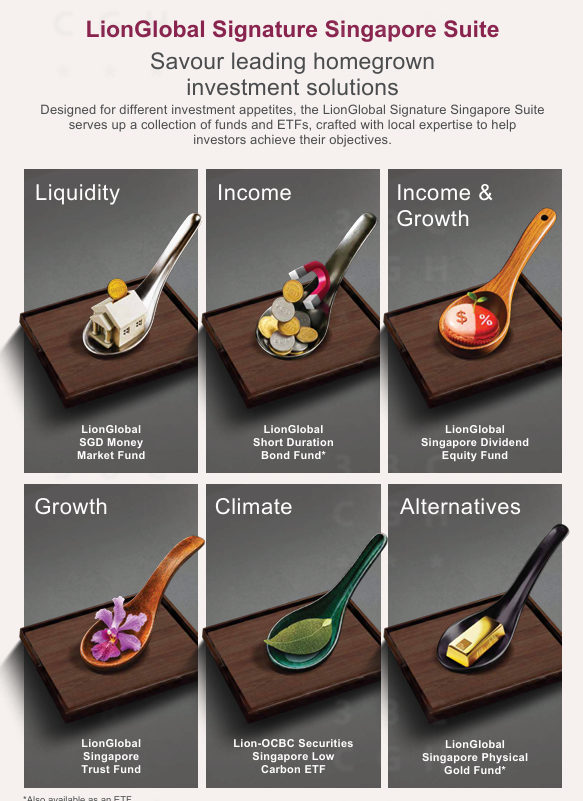
The suite encompasses eight funds and ETFs, each targeting a different investment objective.
Here’s a summary of the key details:
| Fund or ETF | Format | Portfolio role | Investment focus | Relevant date | DIY alternative approach* |
| LionGlobal SGD Money Market Fund — Class A SGD (Acc) | Unit trust | Liquidity | High-quality, short-term money-market instruments and debt securities | 1 Nov 1999 (class inception) | T-bills or fixed deposits |
| LionGlobal Short Duration Bond Fund — Class A SGD (Dist) | Unit trust | Income | Actively managed Singapore and international bonds, generally with a short portfolio duration | 22 Mar 1991 (fund inception) | T-bill and SSB ladder, or a short-duration bond ETF |
| LionGlobal Short Duration Bond Fund — Active ETF SGD Class | Active ETF | Income | SGX-traded access to the Short Duration Bond Fund’s actively managed portfolio | 29 Sep 2025 (listing) | A portfolio of short-term government and investment-grade bonds |
| LionGlobal Singapore Dividend Equity Fund — Class SGD (QDist) | Unit trust | Income and growth | Primarily high- or sustainable-dividend equities domiciled in Singapore, with flexibility to invest outside Singapore | 2 Jun 2015 (class inception) | STI ETF combined with an S-REIT ETF |
| LionGlobal Singapore Trust Fund — Class SGD | Unit trust | Growth | Companies incorporated in, operating from or having significant business exposure to Singapore and listed in Singapore, Hong Kong or USA | 3 Mar 1989 (class inception) | STI ETF combined with selected Singapore small- and mid-cap exposure |
| Lion-OCBC Securities Singapore Low Carbon ETF | Passive ETF | Climate-focused equities | Tracks the iEdge-OCBC Singapore Low Carbon Select 40 Capped Index | 28 Apr 2022 (listing) | Broad Singapore equity ETF without the low-carbon screen |
| LionGlobal Singapore Physical Gold Fund — unlisted classes | Unit trust | Alternatives | Exposure primarily to allocated physical gold; the allocated gold is insured and vaulted in Singapore | 1 Dec 2025 (first dealing and inception) | Physical gold or a global physical-gold ETF |
| LionGlobal Singapore Physical Gold ETF | Passive ETF | Alternatives | SGX-traded access to the same allocated physical-gold portfolio | 26 Mar 2026 (listing) | Global physical-gold ETF |
*For illustrative purposes only. These approaches are not like-for-like substitutes and may differ materially in portfolio construction, diversification, liquidity, accessibility and risk.
Find out more here: LionGlobal Signature Suite Brochure
Why Singapore?
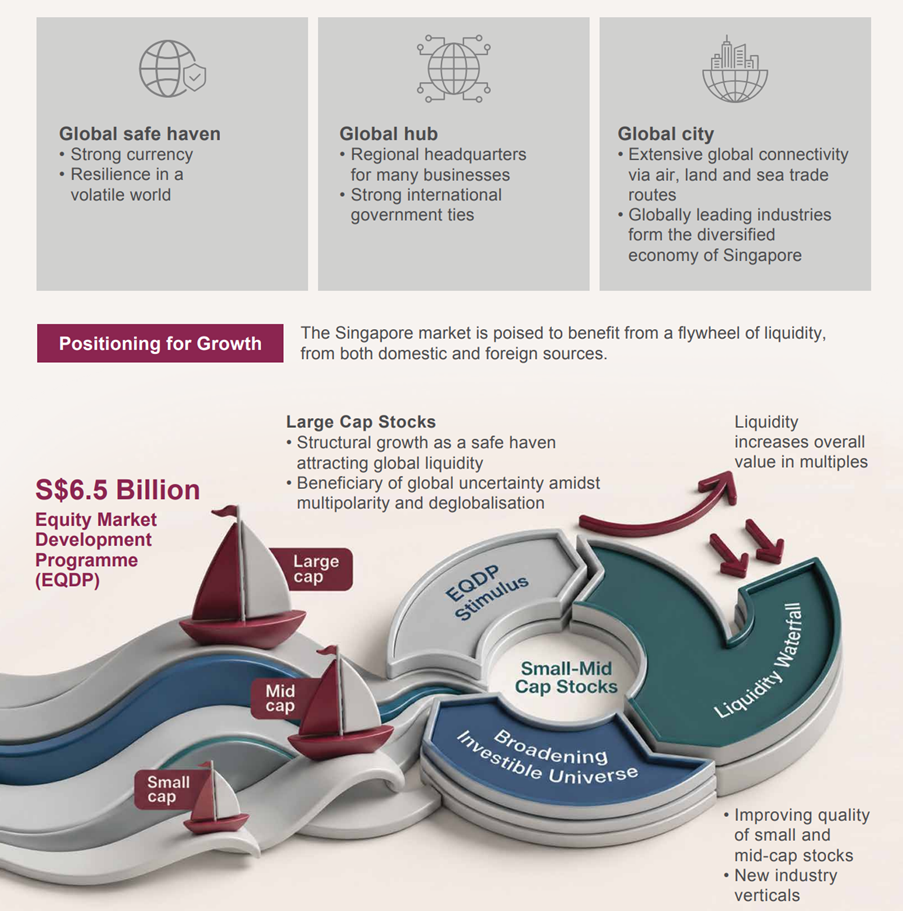
Singapore’s appeal lies less in rapid growth than in resilience. Its AAA sovereign credit rating, strong regulatory environment, and globally connected financial center reinforce its standing as a stable investment hub.
Amid geopolitical uncertainty and shifting capital flows, the country offers vital security and diversification for US-heavy portfolios.
However, it is not risk-free, as its local equity market is relatively small and heavily concentrated in banking and property.
To navigate these specific dynamics, investors can look to Lion Global Investors. As one of Singapore’s leading homegrown asset managers and part of the OCBC Group, they offer a comprehensive range of local solutions—from equities and bonds to money market funds and gold—helping investors effectively build this stability into their portfolios.
What about fees?
The retail Class A SGD funds’ expense ratios range from 0.30% for the LionGlobal SGD Money Market Fund to 0.55% for the LionGlobal Short Duration Bond Fund. In our view, these are reasonable for actively managed retail unit trusts.
Sources: Lion Global Investors, LionGlobal Investment Funds Semi-Annual Report, p. 52; and LionGlobal Short Duration Bond Fund Semi-Annual Report, p. 10. Expense ratios as at 31 December 2025.
The actively managed equity funds charge more, broadly in line with comparable strategies.
Before investing, please check the relevant factsheet and Product Highlights Sheet for the applicable share class, fees, risks and investment terms.
The rate outlook has changed – what it means for the income sleeves
Earlier this year, the story for cash was straightforward.
Interest rates were falling, and the only real question was how quickly they would drop.
All that has changed.
The conflict in the Middle East has pushed oil and inflation higher, and the Fed under Kevin Warsh has shifted from cutting rates to signaling that its next move could be a hike.
For Singapore savers, the consequence is simple: cash yields have stopped falling, and may start rising.
You can see it in the numbers.
The latest 6-month T-bill auction on 2 July closed at 1.50% – the highest cut-off yield this year.
The 10-year SGS yield has climbed to 2.22% as of mid-July, up from around 2.01% in early June.
And the August Singapore Savings Bond offers a 10-year average of 2.06%, with the next issuance projected higher.
What SGD cash and bonds are yielding now
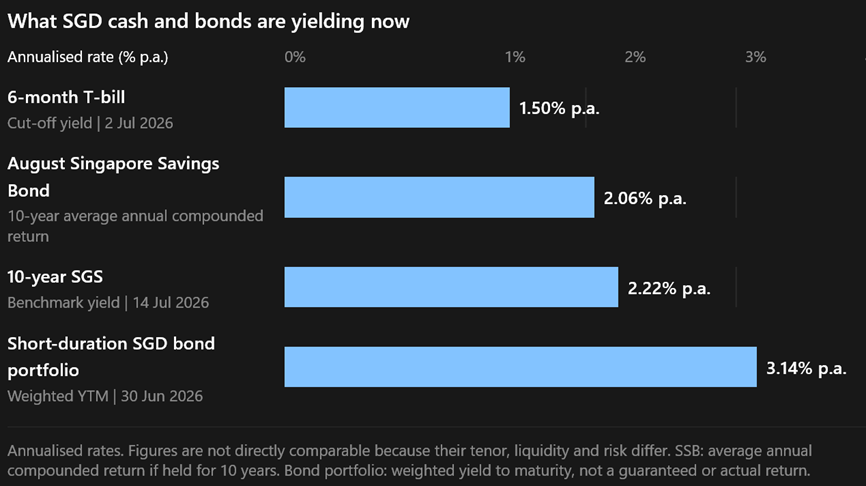
(Source: MAS, 1–14 July 2026; Lion Global Investors, 30 Jun 2026; DividendParadise, 25 July 2026.)
The key point is simple: SGD bond yields are higher than they were a month ago.
That is good for investors putting fresh money to work. But it also means existing bond prices may fall if interest rates continue rising.
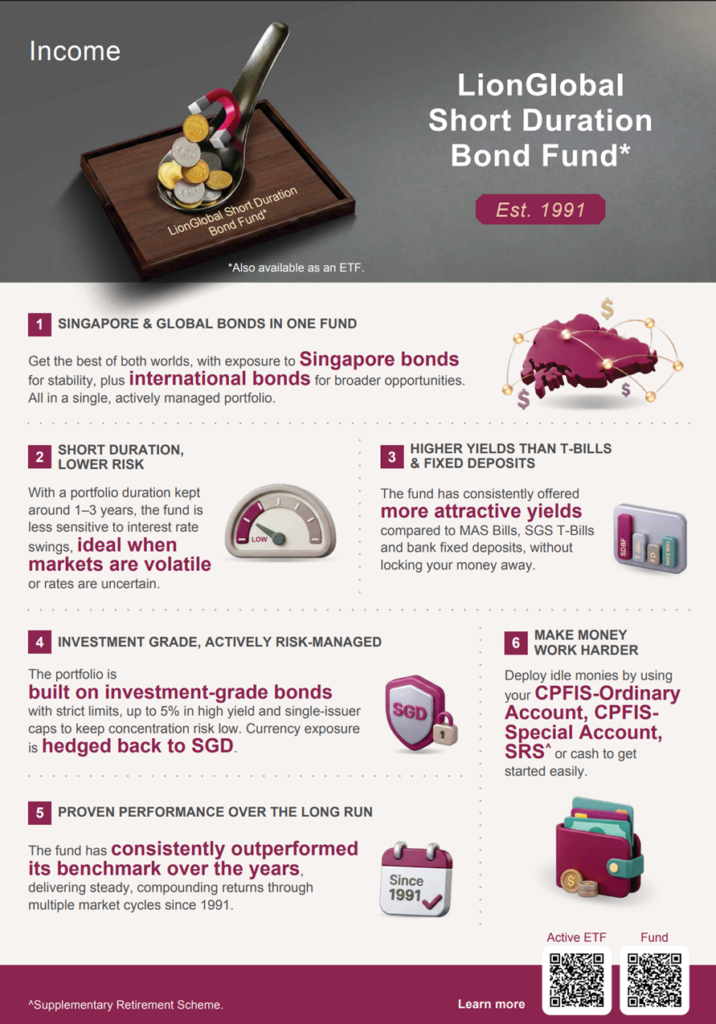
For the LionGlobal Short Duration Bond Fund, that risk should be manageable.
The Class A SGD (Dist) share class has an annualized return of 3.5% since its inception in 1991 and currently has a weighted duration of around 2.6 years. It will therefore be affected by rising rates, but less than a comparable long-duration bond fund.
The fund pays distributions quarterly, currently equivalent to roughly 3.29% a year (Source: Bloomberg as of 17 Jul 2026). Its Class A SGD distributing units can also be bought using CPF-OA, CPF-SA and SRS funds.
That 3.29% distribution rate is higher than the CPF-OA base rate of 2.5% and the latest 1.5% T-bill yield. But the comparison is not like-for-like: CPF interest is guaranteed, while the fund’s price and distributions can rise or fall.
*Distributions are not guaranteed and may fluctuate. Past distributions are not necessarily indicative of future payments. Distribution payouts and its frequency might be changed at the Manager’s discretion and can be made out of income, capital or both. Any payment of distributions by the fund may result in an immediate reduction of the net asset value per share/unit.
Please refer to Lion Global Investors website for more information on the income disclosures.
The fund differs from other forms of investments, including T-bills, in its structure, liquidity, investment flexibility and risk characteristics. Investors should take these differences into consideration.
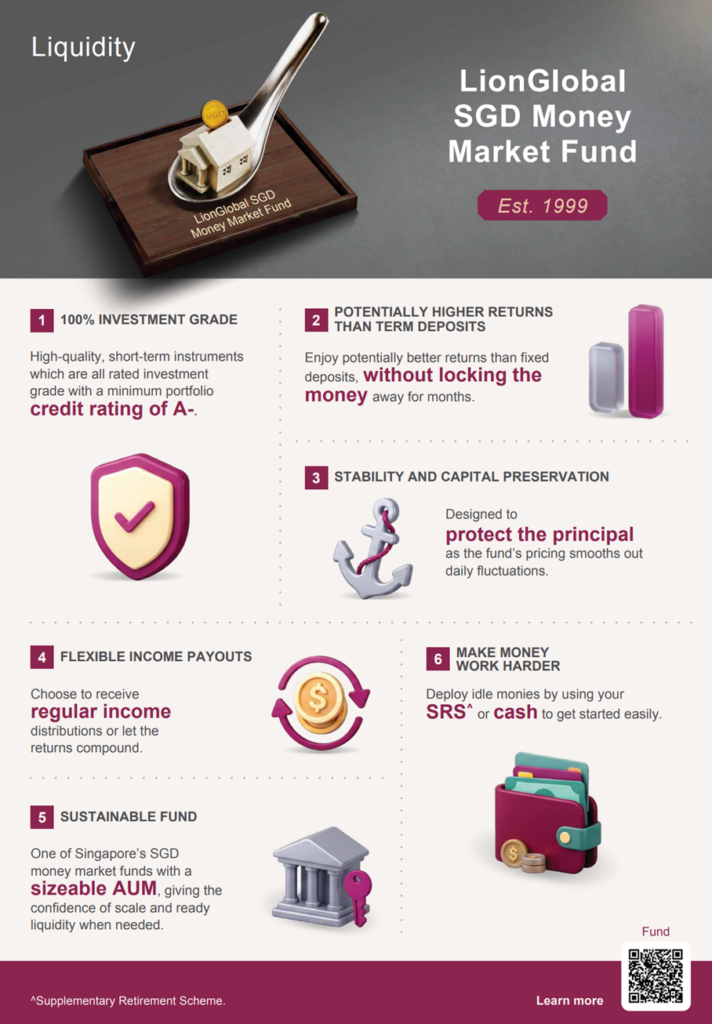
The LionGlobal SGD Money Market Fund is an even more straightforward option for investors.
It is designed as a place to park cash without committing it to a fixed-deposit or T-bill maturity. Investors can transact every dealing day, while its short-term portfolio can adjust relatively quickly when interest rates change.
The fund1 also currently offers a higher yield than the fixed-deposit and T-bill options discussed above, making it attractive for investors seeking both liquidity and a competitive return. However, unlike a fixed deposit or T-bill held to maturity, its yield can fluctuate and its capital is not guaranteed.
Its 0.30% expense ratio is reasonable for a retail money-market fund (Source: Lion Global Investors, 3 July 2026).
1The fund differs from other forms of investments, including T-bills, in its structure, liquidity, investment flexibility and risk characteristics. Investors should take these differences into consideration.
The equity funds – buying the Singapore trade at all-time highs?
Which brings us to the million-dollar question.
Over the 12 months to 30 June 2026, the STI delivered a 36.3% total return in SGD, compared with 22.3% for the S&P 500 in USD. (Source: FTSE Russell and S&P, via Baillie Gifford, 30 June 2026.)
The STI has outperformed the S&P 500 — a sentence I do not get to write very often.
The broader point is clear: Singapore equities have enjoyed a powerful re-rating.
The rally has also been bank-led. DBS, OCBC and UOB—all trading around record highs—together account for approximately 57.0% of the STI. (Source: State Street, 27 July 2026; The Business Times, 9 July 2026.)
Investors buying the suite’s equity sleeves today are therefore entering after a strong run, rather than before it.
Singapore’s re-rating has been strong—and bank-led
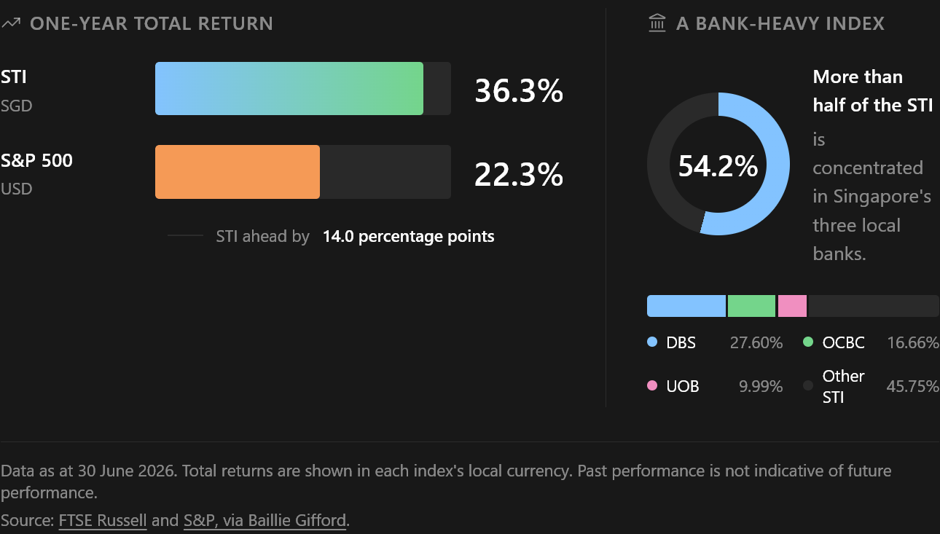
Data as at 30 June 2026. Total returns are shown in each index’s local currency. Past performance is not indicative of future performance. Source: FTSE Russell and S&P, via Baillie Gifford.
That does not mean the structural opportunity is over.
MAS has expanded its Equity Market Development Programme from S$5 billion to S$6.5 billion, with S$3.95 billion allocated across nine managers as of February 2026. The programme is intended to channel more professionally managed capital into Singapore equities and attract additional private investment. (Source: MAS, 12 February 2026.)
SGX reforms—including lower board-lot sizes and a more disclosure-based regulatory framework—should also lower participation barriers and support better price discovery. These measures can broaden and deepen the market, although they cannot substitute for earnings and dividend growth.
With the STI trading near record highs at around 5,600 after a strong 12-month rally (Source: Business Times, 27 July 2026), investors have less protection if earnings or dividends fall short of expectations.
Further gains are likely to depend increasingly on earnings and dividend growth, rather than another sharp rise in valuations.
That still supports the case for long-term Singapore exposure, but argues for sensible position sizing and building the allocation gradually.
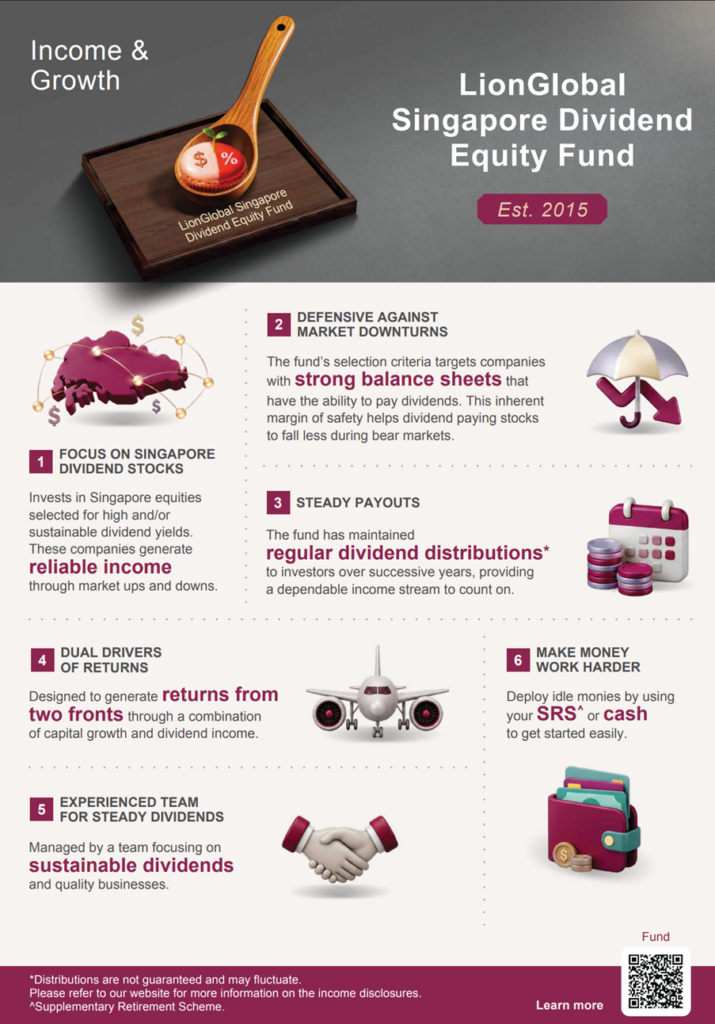
Against this backdrop, the LionGlobal Singapore Dividend Equity Fund is the most straightforward of the equity options.
The Class SGD (QDist) invests primarily in Singapore-listed dividend-paying equities, offers quarterly distributions, and has delivered an annualised NAV return of 7.3% since its inception on 2 June 2015.
But it remains an equity fund: its NAV and distributions can fall, and it should not be treated as a bond substitute.
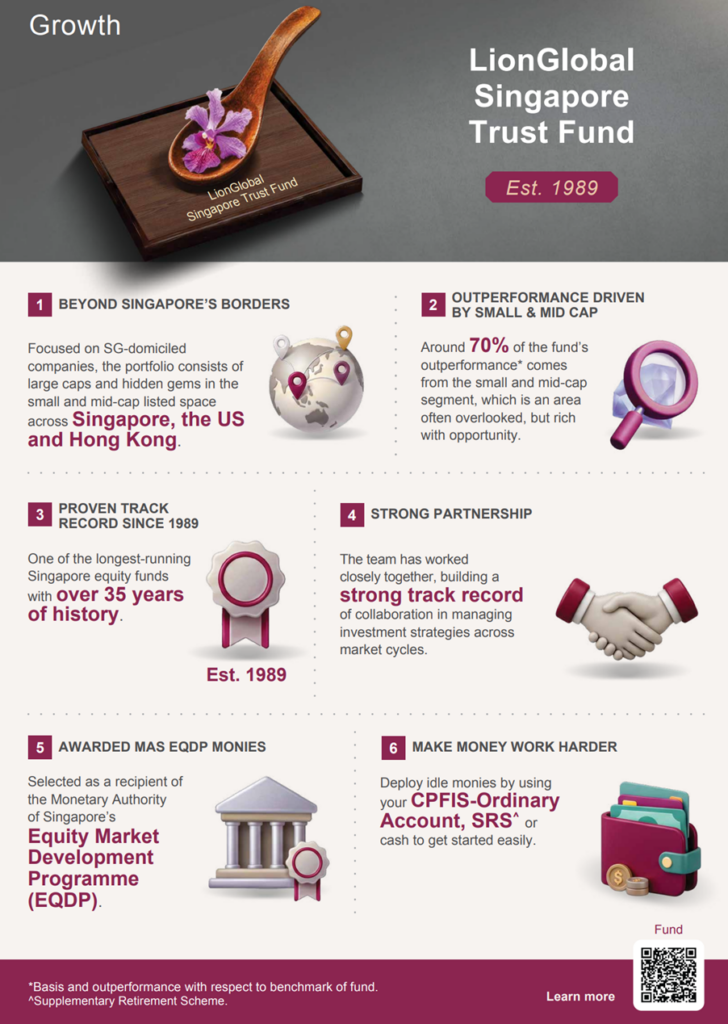
The LionGlobal Singapore Trust Fund is more differentiated.
It has operated since 1989 and invests meaningfully in smaller Singapore companies outside the STI.
In fact, it is the only existing fund to win the EQDP mandate while all other EQDP managers have to launch brand new funds.
Lion Global Investors says small and mid-cap stocks generated about 70% of the fund’s gross outperformance over the past ten years. That is where active management can add value.
With assets under management now exceeding S$1.4 billion as of 30 Jun 2026, the fund also has greater scale to pursue opportunities across the Singapore market.
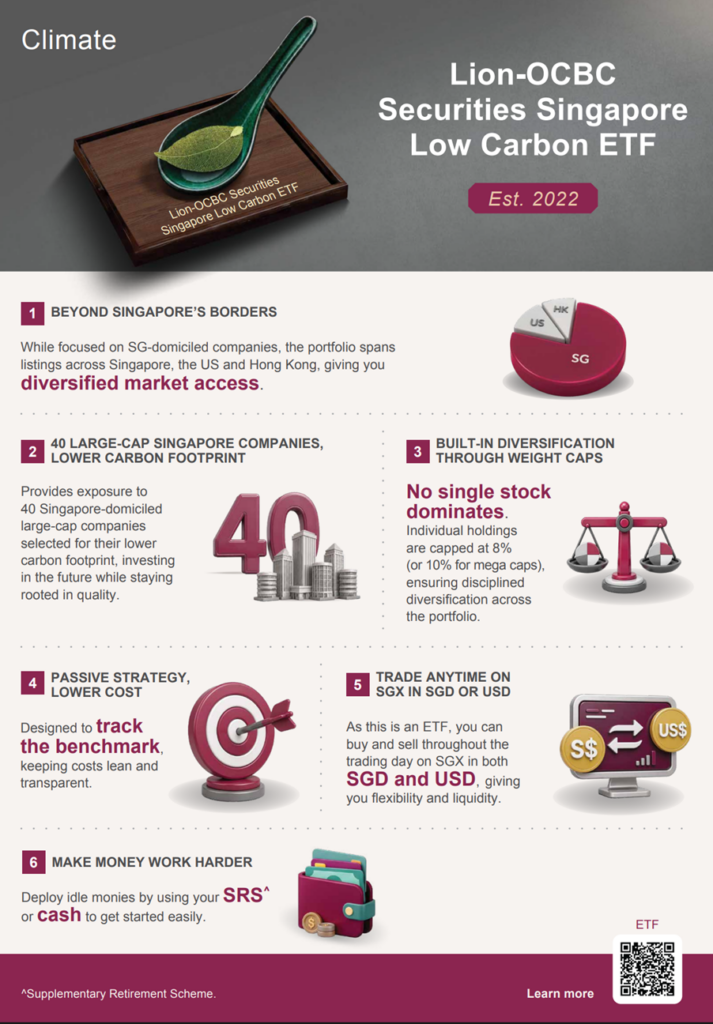
The Lion-OCBC Securities Singapore Low Carbon ETF is not simply the STI with a green label.
It holds 40 Singapore companies after applying fossil-fuel exclusions, carbon screens and individual stock caps.
It aims to replicate as closely as possible, before expenses, the performance of the iEdge-OCBC Singapore Low Carbon Select 40 Capped Index.
This produces meaningfully different sector and stock weights from the STI.
At a 0.45% expense ratio (Source: Lion Global Investors, FYE 31 December 2025), it makes sense for investors who specifically want lower-carbon Singapore exposure — not those simply looking for the cheapest STI tracker.
Besides the lower carbon exposure, this is also the top dividend-paying Singapore equities ETF according to SGX ETF Trading Summary as of 30 Jun 2026.
In short, these are three different strategies: dividend income, active small and mid-cap selection, and lower-carbon index exposure.
Investors can choose the strategy that best matches their objectives and preferred way of participating in Singapore’s growth story.
The gold fund – interesting product, interesting timing
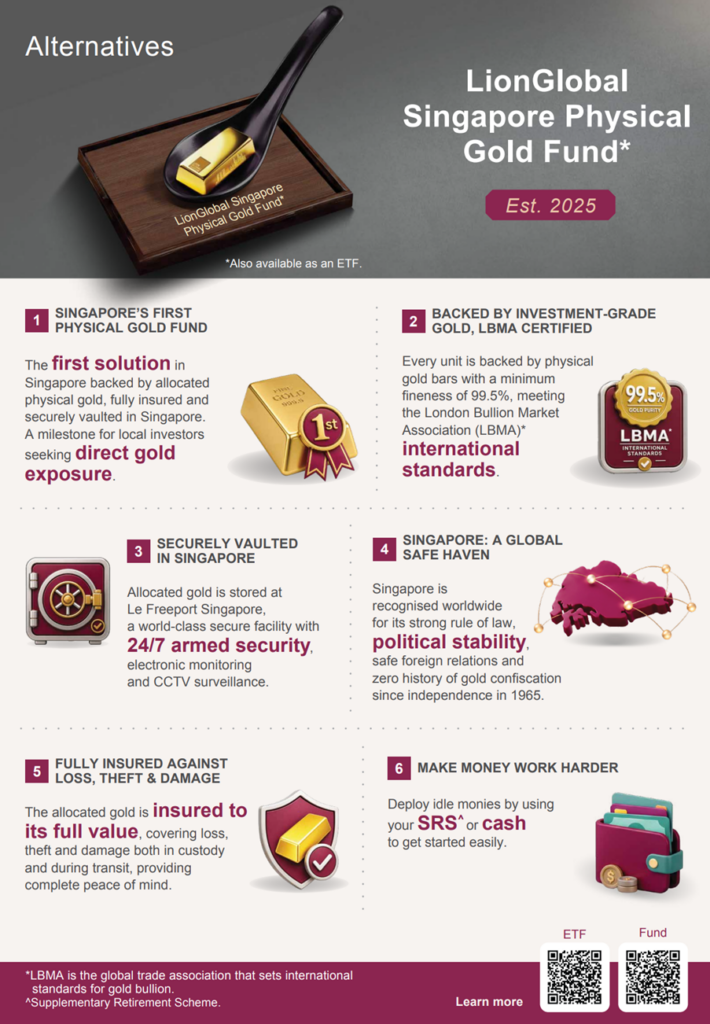
The most novel product in the suite is the LionGlobal Singapore Physical Gold Fund, Singapore’s first fund backed by physical gold that is insured and vaulted locally. The allocated gold is held at Le Freeport.
The ETF share class listed on SGX on 26 March 2026 under GLS for SGD trading and GLU for USD trading. We previously did a full review on the ETF here.
For Singapore investors, it offers a convenient way to own gold without using a US-listed ETF or storing physical bars themselves.
The harder question is timing.
Gold has fallen from its January record of about US$5,586 to around US$4,000—more than 25% below its peak. It also recorded its worst quarter since 2013 in the three months to June (Source: Reuters, 1 July 2026).
The long-term demand story, however, remains intact.
The PBoC added around 10 tonnes in June, its largest monthly purchase since October 2023 and its 20th consecutive month of reported buying (Source: World Gold Council, 2 July 2026).
By the end of 2025, gold accounted for 27% of global official reserves, overtaking US Treasuries at 22%. This shift was driven mainly by the roughly 60% increase in gold prices, which raised the value of existing holdings, although continued central-bank purchases also contributed (Source: European Central Bank report, 2 June 2026).
The better conclusion is that gold is becoming a more important reserve asset, rather than replacing the US dollar entirely.
The strategic case for holding some gold has therefore not disappeared, and today’s entry price is materially lower. The technical trend appears tempered, and gold can be volatile despite its safe-haven reputation.
Investors who want exposure could buy gradually rather than commit everything at once—or wait for the price trend to stabilise before taking a larger position.
Gold arguably still very much deserves a place as a portfolio diversifier, but the size and timing of that position matter.
Looking beyond the bank rally
Singapore’s banks have driven a significant part of the STI’s recent gains. However, the three equity strategies within the LionGlobal Signature Singapore Suite do not simply replicate that bank-heavy exposure.
The LionGlobal Singapore Dividend Equity Fund, LionGlobal Singapore Trust Fund and Lion-OCBC Securities Singapore Low Carbon ETF all had a lower combined weighting in DBS, OCBC and UOB than the STI (based on available portfolio data and STI constituent data as at July 2026; portfolio holdings and weightings are subject to change).
This gives each strategy a different mix of return drivers.
The LionGlobal Singapore Dividend Equity Fund focuses on dividend-paying companies, while the LionGlobal Singapore Trust Fund includes opportunities among less widely covered small- and mid-cap companies. The Lion-OCBC Securities Low Carbon ETF takes a different approach by tracking a rules-based index with lower bank concentration.
Together, the three funds offer different ways to participate in Singapore equities without simply recreating the STI’s composition. This may be particularly relevant for investors who already own the banks directly or through an STI-tracking fund, as it allows them to gain exposure to other parts of the market rather than adding more of what they already hold.
So who is the LionGlobal Signature Singapore Suite Funds actually for?
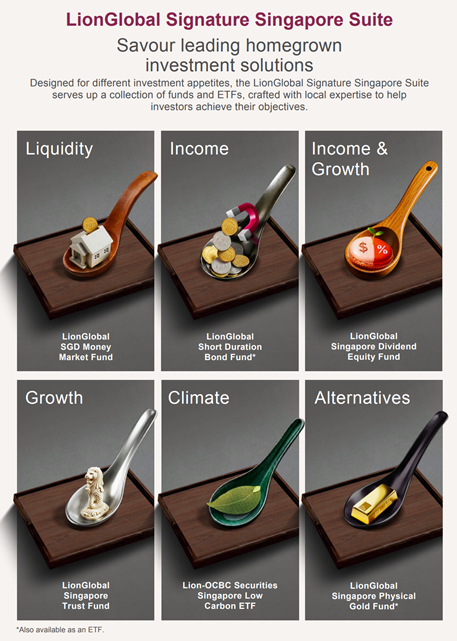
In summary, the suite is best suited to investors seeking a convenient, locally managed way to build exposure across cash, bonds, Singapore equities and gold.
Here’s how each sleeve can be used within a portfolio:
LionGlobal SGD Money Market Fund – a convenient place to park cash if you do not want to manage T-bill applications and maturities. The convenience and daily liquidity are the product.
LionGlobal Short Duration Bond Fund – the strongest proposition in the suite on track record, and the CPFIS-OA/SA and SRS eligibility gives investors a managed alternative with diversified bond exposure and regular distributions. It is also available as an ETF.
The equity funds: LionGlobal Singapore Trust Fund and LionGlobal Singapore Dividend Equity Fund – straightforward ways to participate in Singapore’s structural story, but note that the market is already near record highs. Averaging in may be more sensible than investing everything at once. Investors who own Singapore banks directly should also check for portfolio overlap. LionGlobal Singapore Trust Fund is available via CPFIS-OA and SRS.
Lion-OCBC Securities Singapore Low Carbon ETF – for investors who specifically want a carbon-screened Singapore portfolio.
LionGlobal Singapore Physical Gold Fund – the most differentiated product in the suite, offering locally vaulted and insured physical gold exposure. A better entry price than 6 months ago, while the trend remains tempered. May be prudent to build the position gradually rather than committing large amounts at once. It is also available as an ETF.
The suite works best as a menu rather than an all-or-nothing portfolio.
Investors can select the individual sleeves that fill gaps in their existing holdings.
How should investors approach position sizing?
The right approach likely depends on what you already own.
If you are starting from scratch, the LionGlobal Signature Singapore Suite offers a coherent way to build exposure across liquidity, income, growth and portfolio protection. Each fund serves a distinct purpose, while the suite brings these different exposures together within one locally managed range.
For investors with an existing Singapore portfolio, the suite can be used selectively to fill gaps.
The Money Market Fund can simplify cash management; the Short Duration Bond Fund provides diversified, actively managed income; the equity funds can broaden exposure beyond directly held banks and REITs; and the Physical Gold Fund offers locally vaulted gold without the practical burden of storing bullion.
The suite therefore does not have to be an all-or-nothing allocation.
It can serve as a complete starting portfolio or as a modular toolkit alongside existing holdings.
Following Singapore equities’ strong performance, it may still be wise to build the equity allocation gradually. This allows investors to participate in the longer-term structural story while retaining flexibility if better entry opportunities emerge.
The key is to define the role each fund should play, size each allocation accordingly, and avoid unnecessary overlap.
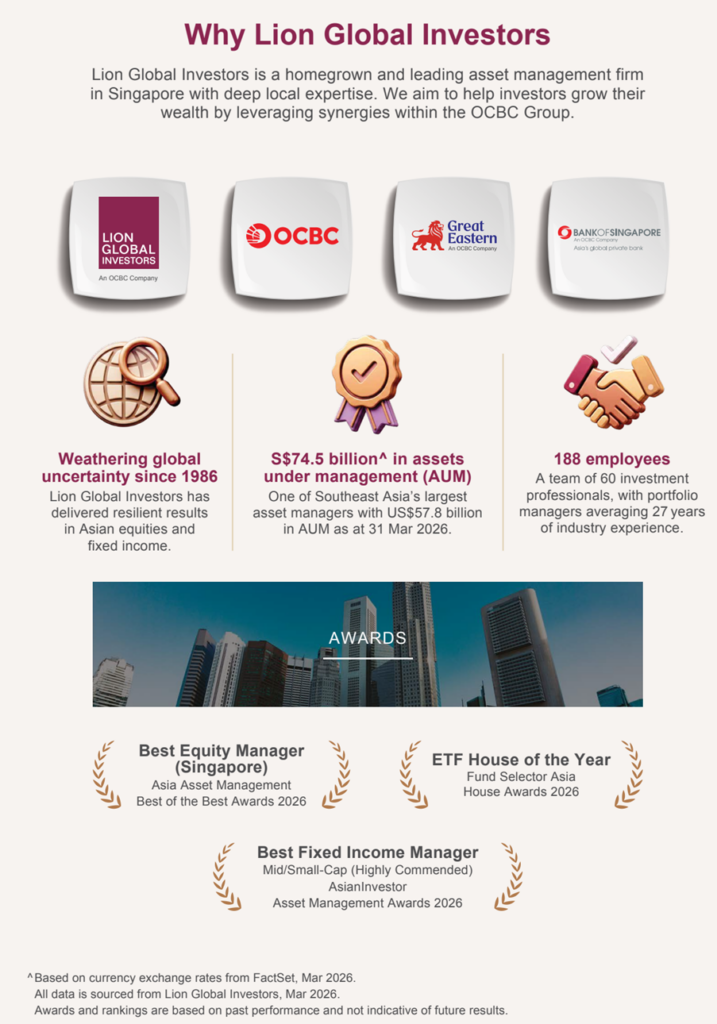
There is also value in the manager behind the suite. Lion Global Investors is a home-grown asset manager that has invested in Singapore for more than three decades. That local perspective is particularly relevant in a concentrated market such as Singapore, where understanding the differences between sectors and looking beyond the headline index can materially shape portfolio construction.
In this regard, backed by Lion Global Investors’ local investment expertise, the Signature Singapore Suite offers investors several ways to gain exposure to Singapore while managing liquidity, income and equity risk within the same range.
Ultimately, the right mix will depend on each investor’s objectives and existing portfolio. What are your thoughts on the suite? Share your thoughts in the comments below.
Click here to find out more about LionGlobal Signature Singapore Suite.
Funds are available from the following partners: OCBC, Bank of Singapore, Great Eastern, Singlife, Grow with SInglife, DollarDex, POEMS, iFAST Financial, Moomoo, Etiqa, FSM Global and Standard Chartered.
ETFs are available from your brokers.
Source: Lion Global Investors Ltd / Morningstar / Bloomberg, date 30 Jun 2026
Disclaimer – Financial Horse
This is a sponsored advertisement. We may receive fees, commissions or other benefits in connection with the sponsorship, remuneration or commercial arrangements concerning the products and/or services mentioned. Such arrangements may influence the content or presentation of information. The Financial Horse is not licensed or authorised to provide financial advice and/or financial services in Singapore.
The content here is for informational purposes only and should NOT be taken as legal, business, tax, or investment advice. It does NOT constitute an offer or solicitation to purchase any investment or a recommendation to buy or sell a security. In fact, the content is not directed to any investor or potential investor and may not be used to evaluate or make any investment. Do note that this is not financial advice. If you are in doubt as to the action you should take, please consult your stock broker or financial advisor.
Disclaimer – Lion Global Investors Limited
Past performance shown is limited to the stated period and is not the fund’s full performance history. Please refer to the latest factsheet and prospectus before making any investment decision.
Past performance is not necessarily indicative of future performance. Returns based on single pricing. Dividends are reinvested net of all charges payable upon reinvestment and in respective share class currency terms. Past performance data include Maximum Initial Charge for the respective share classes (where applicable), which may or may not be charged to investors.
This advertisement or publication has not been reviewed by the Monetary Authority of Singapore (the “MAS”). It is for information only, and is not a recommendation, offer or solicitation for the purchase or sale of any capital markets products or investments and does not have regard to your specific investment objectives, financial situation, tax position or needs. You should read the prospectus and Product Highlights Sheet of the relevant fund/ETF which are available and may be obtained from Lion Global Investors Limited (“LGI”) or any of its distributors and appointed Participating Dealers (“PDs”), for further details including the risk factors and consider if a fund/ETF is suitable for you and seek such advice from a financial adviser if necessary, before deciding whether to invest in the fund/ETF. Applications for units in our funds must be made on forms accompanying the prospectus.
Investments in our funds/ETF are not obligations of, deposits in, guaranteed or insured by LGI or any of its affiliates and are subject to investment risks including the possible loss of the principal amount invested. The performance of a fund/ETF is not guaranteed and the value of units in a fund/ETF and the income accruing to the units, if any, may rise or fall. Past performance, payout yields and payments as well as any predictions, projections, or forecasts are not necessarily indicative of the future or likely performance, payout yields and payments of a fund/ETF. Any extraordinary performance may be due to exceptional circumstances which may not be sustainable. Dividend distributions, which may be either out of income and/or capital, are not guaranteed and subject to LGI’s discretion. Any such dividend distributions will reduce the available capital for reinvestment and may result in an immediate decrease in the net asset value of the fund/ETF. Any references to specific securities are for illustration purposes and are not to be considered as recommendations to buy or sell the securities. It should not be assumed that investment in such specific securities will be profitable. There can be no assurance that any of the allocations or holdings presented will remain in the fund/ETF at the time this information is presented. Any information (which includes opinions, estimates, graphs, charts, formulae or devices) is subject to change or correction at any time without notice and is not to be relied on as advice. You are advised to conduct your own independent assessment and investigation of the relevance, accuracy, adequacy and reliability of any information or contained herein and seek professional advice on them. No warranty is given and no liability is accepted for any loss arising directly or indirectly as a result of you acting on such information. The fund/ETF may, where permitted by the prospectus, invest in financial derivative instruments for hedging purposes or for the purpose of efficient portfolio management. LGI, its related companies, their directors and/or employees may hold units of a fund/ETF and be engaged in purchasing or selling units of a fund/ETF for themselves or their clients.
©2026 Lion Global Investors® Limited (UEN/Registration No. 198601745D). All rights reserved. This publication is issued in Singapore by LGI. LGI is a Singapore incorporated company and is not related to any corporation or trading entity that is domiciled in Europe or the United States (other than entities owned by its holding companies).
For all Exchange-Traded Funds managed by Lion Global Investors Limited (“LGI”):
Please refer to the Prospectus for further details. The units of the ETF are listed and traded on the Singapore Exchange (“SGX”), and may be traded at prices different from their net asset value, suspended from trading, or delisted. Such listing does not guarantee a liquid market for the units. You cannot purchase or redeem listed units in the Fund directly with the manager of the Fund, but you may, subject to specific conditions, do so on the SGX or through the PDs.
For LionGlobal Singapore Trust Fund, LionGlobal Singapore Dividend Equity Fund and Lion-OCBC Securities Singapore Low Carbon ETF:
The Fund’s net asset value may have higher volatility as a result of its narrower investment focus on a limited geographical market, when compared to funds investing in global or wider regional markets.
For LionGlobal Short Duration Bond Fund (Listed and Unlisted Share Class)
The LionGlobal Short Duration Bond Fund (the “Fund”) is not like a typical unit trust offered to the public in Singapore. The Fund comprises both classes of units listed and traded on the Singapore Exchange (“SGX-ST”) and classes of units which are neither listed on the SGX-ST nor any other stock exchange.
The Fund may invest in Tier 1 and Tier 2 capital instruments that carry elevated risks, including potential write-down, conversion to equity, suspended coupons and loss of capital.
The Fund is an actively managed fund.
Please refer to Prospectus for discussion of certain factors to be considered in connection with an investment in the listed units of the Fund on the SGX-ST.
For LionGlobal Singapore Physical Gold Fund (Unlisted and Listed Share Class)
The LionGlobal New Wealth Series II – LionGlobal Singapore Physical Gold Fund (the “Fund”) is not like a typical unit trust offered to the public in Singapore. The Fund comprises both classes of units listed and traded on the Singapore Exchange (“SGX-ST”) and classes of units which are neither listed on the SGX-ST nor any other stock exchange. The LionGlobal New Wealth Series II – LionGlobal Singapore Physical Gold Fund (the “Fund”) is not like a typical unit trust offered to the public in Singapore. The Fund comprises both classes of units listed and traded on the Singapore Exchange (“SGX-ST”) and classes of units which are neither listed on the SGX-ST nor any other stock exchange.
An investment in a precious metals fund carries risks of a different nature from other types of collective investment schemes which invest in transferable securities and a precious metals fund may not be suitable for persons who are adverse to such risks.
An investment in a precious metals fund is not intended to be a complete investment programme for any investor. As a prospective investor, you should carefully consider whether an investment in a precious metals fund is suitable for you, taking into account, your investment objectives, risk appetite and the potential price movements of precious metals. You are responsible for your own investment choices.
The Fund’s net asset value may have higher volatility due to its narrower investment focus (primarily in Gold (as defined in the prospectus)), when compared to funds with more diversified portfolios.
Please refer to Prospectus for discussion of certain factors to be considered in connection with an investment in the listed units of the Fund on the SGX-ST.
Disclaimer – ICE Benchmark Administration Limited
THE LBMA GOLD PRICE, WHICH IS ADMINISTERED AND PUBLISHED BY ICE BENCHMARK ADMINISTRATION LIMITED (IBA), SERVES AS, OR AS PART OF, AN INPUT OR UNDERLYING REFERENCE FOR LIONGLOBAL SINGAPORE PHYSICAL GOLD FUND.
LBMA GOLD PRICE IS A TRADE MARK OF PRECIOUS METALS PRICES LIMITED, AND IS LICENSED TO IBA AS THE ADMINISTRATOR OF THE LBMA GOLD PRICE. ICE BENCHMARK ADMINSTRATION IS A TRADE MARK OF IBA AND/OR ITS AFFILIATES. THE LBMA GOLD PRICE AM, AND THE TRADE MARKS LBMA GOLD PRICE AND ICE BENCHMARK ADMINISTRATION, ARE USED BY LION GLOBAL INVESTORS LIMITED WITH PERMISSION UNDER LICENCE BY IBA.
IBA AND ITS AFFILIATES MAKE NO CLAIM, PREDICATION, WARRANTY OR REPRESENTATION WHATSOEVER, EXPRESS OR IMPLIED, AS TO THE RESULTS TO BE OBTAINED FROM ANY USE OF THE LBMA GOLD PRICE, OR THE APPROPRIATENESS OR SUITABILITY OF THE LBMA GOLD PRICE FOR ANY PARTICULAR PURPOSE TO WHICH IT MIGHT BE PUT, INCLUDING WITH RESPECT TO LIONGLOBAL SINGAPORE PHYSICAL GOLD FUND. TO THE FULLEST EXTENT PERMITTED BY APPLICABLE LAW, ALL IMPLIED TERMS, CONDITIONS AND WARRANTIES, INCLUDING, WITHOUT LIMITATION, AS TO QUALITY, MERCHANTABILITY, FITNESS FOR PURPOSE, TITLE OR NON-INFRINGEMENT, IN RELATION TO THE LBMA GOLD PRICE, ARE HEREBY EXCLUDED AND NONE OF IBA OR ANY OF ITS AFFILIATES WILL BE LIABLE IN CONTRACT OR TORT (INCLUDING NEGLIGENCE), FOR BREACH OF STATUTORY DUTY OR NUISANCE, FOR MISREPRESENTATION, OR UNDER ANTITRUST LAWS OR OTHERWISE, IN RESPECT OF ANY INACCURACIES, ERRORS, OMISSIONS, DELAYS, FAILURES, CESSATIONS OR CHANGES (MATERIAL OR OTHERWISE) IN THE LBMA GOLD PRICE, OR FOR ANY DAMAGE, EXPENSE OR OTHER LOSS (WHETHER DIRECT OR INDIRECT) YOU MAY SUFFER ARISING OUT OF OR IN CONNECTION WITH THE LBMA GOLD PRICE OR ANY RELIANCE YOU MAY PLACE UPON IT.
Disclaimer – Singapore Exchange Limited
The units in the Lion-OCBC Securities Singapore Low Carbon ETF are not in any way sponsored, endorsed, sold or promoted by the Singapore Exchange Limited (“SGX”) and/or its affiliates and SGX and its affiliates make no warranty or representation whatsoever, expressly or impliedly, either as to the results to be obtained from the use of the iEdge-OCBC Singapore Low Carbon Select 40 Capped Index and/or the figure at which the iEdge-OCBC Singapore Low Carbon Select 40 Capped Index stands at any particular time on any particular day or otherwise. The iEdge-OCBC Singapore Low Carbon Select 40 Capped Index is administrated, calculated and published by SGX. SGX shall not be liable (whether in negligence or otherwise) to any person for any error in the Lion-OCBC Securities Singapore Low Carbon ETF and the iEdge-OCBC Singapore Low Carbon Select 40 Capped Index and shall not be under any obligation to advise any person of any error therein.
OCBC is a registered trade mark of Oversea-Chinese Banking Corporation Limited and is used under licence. Save for the foregoing, all intellectual property rights in the iEdge-OCBC Singapore Low Carbon Select 40 Capped Index vest in SGX. The iEdge-OCBC Singapore Low Carbon Select 40 Capped Index is used by Lion Global Investors Limited under licence.
is this a sponsored post?