A higher salary or a bigger investment portfolio? Which will build more wealth?
Should more time go towards improving professional skills and earning a promotion?
Or should that time be spent researching investments and building a portfolio?
Let’s unpack this question.

This article was written by a Financial Horse Contributor.
Salary and investments perform different jobs
A salary is an active wealth engine.
It depends on continued work, relevant skills and the ability to earn.
A portfolio is a financial wealth engine.
It depends on accumulated capital, time, investment returns and risk control.
Most households begin with plenty of human capital but little financial capital.
Over time, employment income is converted into savings. Those savings are invested and become financial capital.
Eventually, the portfolio may grow large enough to support part—or all—of the household’s spending.
The transition looks like this:
Skills → income → savings → investments → financial independence
Skipping any part of this chain creates problems.
A high salary without savings produces little lasting wealth.
Regular investing without sufficient income may produce progress, but slowly.
A large portfolio without sensible risk management can be lost.
The objective is to strengthen the entire chain.
A salary only creates wealth when part of it is retained
Salary is not wealth.
It is cash flow.
The portion that remains after taxes, mandatory contributions and spending can become wealth.
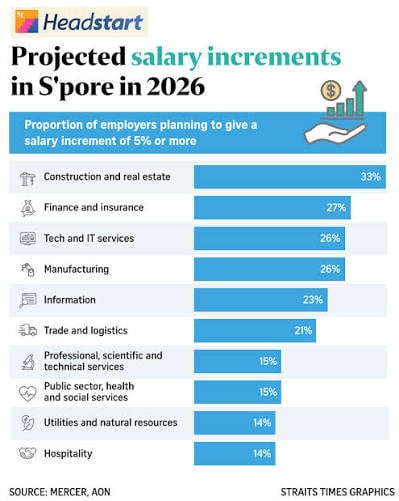
This distinction matters because salary and lifestyle often rise together.
A promotion may lead to a larger home, more expensive holidays, a new car and higher recurring expenses.
The employee earns more but remains equally dependent on the next paycheque.
The practical benefit of a salary increase therefore depends on the additional amount saved:
Additional wealth-building capacity = increase in take-home income − increase in spending
An employee whose take-home income rises by S$15,000 but whose spending rises by S$12,000 has created only S$3,000 of additional annual investment capacity.
Another employee may receive the same raise, keep spending broadly stable and invest most of the difference.
The salary outcome is identical.
The wealth outcome is not.
The portfolio converts temporary income into permanent capital
A salary stops when employment stops.
Money already invested can continue to generate returns without requiring additional working hours.
That is the central purpose of building a portfolio.
It converts part of today’s employment income into an asset that can support future spending.
But the portfolio should not become a second full-time job.
For most working adults, the core investment process can be relatively simple:
- Maintain sufficient emergency liquidity
- Invest a fixed amount regularly
- Use diversified, reasonably priced investments
- Keep costs under control
- Rebalance periodically
- Avoid taking risks that could permanently impair the financial plan
The investor does not need to choose between building a career and watching the portfolio every day.
A sound portfolio should allow attention to remain on work, family and life.
The balance changes as financial capital grows
Career development tends to produce the greatest financial impact when the portfolio is still small.
A professional with S$30,000 invested is unlikely to transform the financial position by finding an extra 1% of annual investment return.
That extra return represents only S$300 in the first year.
A useful course, salary negotiation or job move may increase annual income by several thousand dollars.
But this does not mean investing should be postponed.
Starting early establishes the savings habit and gives each contribution more time to compound.
The sensible early-career approach is usually:
Focus heavily on income growth while investing consistently in the background.
As the portfolio grows, the relationship changes.
A 1% decision on a S$1 million portfolio is worth S$10,000.
At that point, fees, asset allocation, tax treatment and large investment mistakes become financially significant.
Career income still matters.
But the investor should spend more time protecting and allocating accumulated capital.
A useful way to measure the transition
Compare annual portfolio growth with new annual contributions.
The rough crossover point is:
Portfolio crossover = annual investment contribution ÷ assumed long-term return
An investor contributing S$30,000 a year and using an illustrative 5% return assumption reaches the crossover at:
S$30,000 ÷ 5% = S$600,000
At S$600,000, a 5% portfolio return equals the S$30,000 annual contribution.
This is not a forecast.
Investment returns are volatile, and a portfolio can decline sharply in any given year.
The calculation is simply a way to understand which engine currently has more financial weight.
Below the crossover, income and contributions usually drive progress.
Above it, portfolio decisions begin to have a larger effect.
Even then, both engines remain useful.
The practical approach for an early-career employee
An early-career employee may have limited savings but substantial future earning potential.
The priority is to build a strong foundation.
Career actions
- Develop skills that are valued across multiple employers
- Ask what is required for the next role before promotion season
- Track measurable contributions at work
- Negotiate compensation using market evidence
- Build professional relationships before they are needed
- Avoid becoming dependent on one company-specific skill
Investment actions
- Establish an emergency fund
- Start a regular monthly investment
- Use a simple, diversified core portfolio
- Avoid spending excessive time trading a small account
- Increase contributions whenever income rises
Singapore’s MoneySense guidance suggests maintaining at least three to six months of expenses as emergency funds, adjusted for individual circumstances.
This buffer supports both sides of the plan.
It reduces the need to sell investments during a job loss and provides time to search for a suitable role instead of accepting the first available offer.
The practical approach for a mid-career household
Mid-career is where the balance becomes more complicated.
Income may be higher, but so are the financial commitments.
The household may be servicing a mortgage, raising children, supporting parents and planning for retirement at the same time.
The objective is no longer to maximise salary or portfolio returns independently.
It is to build resilience.
Career actions
- Maintain employability outside the current company
- Protect health and avoid an unsustainable workload
- Build a cash buffer appropriate for family obligations
- Develop more than one marketable area of expertise
- Review whether employer shares have become too large
Investment actions
- Separate near-term family expenses from long-term investments
- Increase contributions after salary increments
- Review insurance and major liabilities
- Diversify beyond the employer and domestic industry
- Measure property exposure as part of the portfolio
- Keep leverage manageable
A mid-career professional should not sacrifice every career opportunity for portfolio research.
But it is equally risky to focus exclusively on career progression while ignoring accumulated savings.
This is the stage when both engines need active maintenance.
A higher salary should produce a higher savings floor
One practical technique is to decide in advance how salary increases will be divided.
For example, part of every raise can be committed to:
- Higher investment contributions
- Additional CPF or eligible retirement saving
- Mortgage reduction
- Family goals
- Lifestyle improvements
The exact split will depend on circumstances.
A household with expensive debt may prioritise repayment.
A household with an adequate portfolio but limited quality time may reasonably spend more on convenience or experiences.
The principle is not to save every dollar.
It is to prevent the entire raise from disappearing into recurring expenses without a deliberate decision.
Once a new recurring expense is added, it becomes part of the income the household must replace before achieving financial independence.
Singapore property can dominate the household portfolio
For many Singapore investors, the family home is the largest asset.
This exposure should not be ignored simply because the property is not inside the brokerage account.
A household may own:
- A home worth S$1.2 million
- A S$300,000 investment portfolio
- S$250,000 in CPF
- S$100,000 in cash
- An outstanding S$400,000 housing loan
Net property equity is approximately:
S$1.2 million − S$400,000 = S$800,000
The property is therefore much larger than the financial portfolio.
That may be perfectly reasonable.
The home provides shelter and removes the need to pay rent elsewhere.
But it also creates concentration in one physical asset, one location and the Singapore property market.
Property is also illiquid.
It cannot fund daily spending unless the household rents out part of it, borrows against it, sells it or moves to a less expensive home.
This is why property should be counted as an asset without automatically treating its full value as available investment capital.
CPF used for property remains part of the picture
Where CPF savings have been used to purchase a home, the principal withdrawn and accrued interest generally need to be refunded to CPF when the property is sold.
The refund remains the owner’s money.
It moves from property back into CPF, but it may not be received as immediately spendable cash.
This affects retirement planning.
A household should distinguish between:
- Property market value
- Net property equity after the mortgage
- Cash likely to be received after a sale
- Amounts returning to CPF
- Cost of replacement housing
The home may contribute meaningfully to retirement.
But that contribution requires a practical monetisation plan rather than a broad assumption that the property can always be sold.
CPF supports the portfolio but does not replace liquidity
CPF balances form part of household wealth.
They can support housing, healthcare and retirement.
But they should not be treated like emergency cash.
A working adult may therefore need three separate financial pools:
- Liquid cash for emergencies and near-term spending
- CPF and retirement resources for long-term security
- Investments for growth and future income
The pools can complement one another without performing the same job.
Investing through CPFIS also carries an opportunity cost because the invested amount no longer earns the interest it would have received inside CPF.
CPF Board advises members to consider risk tolerance, investment knowledge, costs and the ability to outperform the applicable CPF interest. CPF Board The mere availability of CPFIS does not mean every CPF dollar should be invested.
Employment and investments should not depend on the same outcome
A person working for a bank may also receive employer shares and hold a portfolio dominated by Singapore financial stocks.
A technology employee may own employer shares, individual technology companies and several technology ETFs.
An entrepreneur may have most of both human and financial capital tied to one business.
These situations are common.
They are also more concentrated than they initially appear.
If employment already depends on one industry, the investment portfolio can provide diversification by reducing exposure to that same industry.
This does not require immediately selling every employer share.
It means setting a sensible maximum exposure and reducing the position gradually where appropriate.
The practical approach for a senior professional
A senior professional may have a high salary, substantial portfolio and limited time.
At this stage, constantly searching for the next investment idea may add less value than protecting what has already been built.
Career actions
- Decide whether the next promotion is worth the additional demands
- Protect health and career longevity
- Reduce dependence on bonuses for recurring spending
- Convert variable compensation into financial assets
- Create options for consulting, part-time work or a lower-intensity role
Investment actions
- Simplify overlapping holdings
- Reduce excessive employer-share exposure
- Review fees across the entire portfolio
- Maintain sufficient liquidity
- Establish a clear rebalancing process
- Prepare for a future reduction in employment income
The objective is not necessarily to maximise salary.
It is to convert peak earning years into durable financial independence.
The practical approach near retirement
Near retirement, the portfolio becomes more important because fewer years of employment income remain.
But career income can still be valuable.
Even a few years of part-time or lower-intensity work may:
- Reduce withdrawals from the portfolio
- Allow investments more time to compound
- Provide structure and professional engagement
- Increase flexibility during a weak market
- Reduce pressure to chase investment yield
The decision does not need to be full-time work or complete retirement.
A gradual transition may offer a better balance.
The portfolio should also be reorganised around spending needs rather than maximum growth.
Practical priorities include:
- Ring-fencing near-term expenses
- Reviewing mortgage obligations
- Estimating CPF LIFE and other recurring income
- Planning SRS and investment withdrawals
- Reducing positions that could threaten retirement
- Deciding whether property will be retained or monetised
The career remains useful.
But the portfolio must increasingly be able to perform without it.
Do not optimise only for money
A higher salary can come with longer hours, more stress and less control over time.
A bigger portfolio can require taking more investment risk than the household can tolerate.
Neither outcome is automatically better.
A promotion producing S$30,000 of additional income may be worthwhile if the workload remains sustainable.
The same promotion may be a poor trade if it creates burnout, damages health or eliminates time with family.
Similarly, pursuing an additional 1% of portfolio return may be worthwhile if it comes from reducing fees.
It may not be worthwhile if it requires leverage, concentration or constant trading.
Financial decisions should be assessed using risk, effort and sustainability—not just the headline return.
5 numbers worth tracking
A practical annual review does not need to be complicated.
Track 5 numbers.
1. Savings rate
Annual savings ÷ take-home income
This shows how effectively employment income is being converted into wealth.
2. Annual investment contribution
This measures the actual amount added to financial capital each year.
3. Investable assets
Exclude the family home unless there is a genuine plan to monetise it.
This indicates how much capital can support future spending.
4. Financial runway
Liquid assets ÷ annual household expenses
This shows how long the household could operate without employment income.
5. Concentration
Measure exposure to:
- One employer
- One industry
- Singapore property
- Singapore equities
- One currency
- One large investment position
Together, these numbers reveal whether salary and portfolio are becoming stronger or merely larger.
A realistic wealth-building system
For most working households, the practical system is straightforward.
Every month
- Save automatically
- Invest automatically
- Maintain the emergency fund
- Avoid unnecessary trading
Every year
- Review salary and market value
- Select one or two valuable career skills to develop
- Increase investments after a raise
- Review property and mortgage exposure
- Rebalance major portfolio concentrations
- Check progress towards financial goals
After a major life event
Review the full plan after:
- A new job
- A large promotion
- Buying a home
- Having a child
- Starting a business
- Receiving an inheritance
- Approaching retirement
The right allocation of effort changes when life changes.
It was always both …
A higher salary and a bigger portfolio are not rival strategies.
They are different stages of the same wealth-building process.
The career creates income.
Spending discipline creates the surplus.
The portfolio converts that surplus into long-term capital.
And the capital eventually creates career flexibility.
A bigger portfolio may allow someone to reject an unhealthy job, take a sabbatical or accept a more meaningful role with lower pay.
A better career may produce the income required to build that portfolio faster.
This is the feedback loop that matters.
The practical objective is not to choose salary over investments—or investments over salary.
It is to:
- Keep career skills relevant
- Earn sustainably
- Save deliberately
- Invest consistently
- Diversify career and financial risks
- Shift attention as financial capital grows
Early in the journey, career development may deserve more attention.
Later, portfolio management and capital protection may become more important.
But throughout the process, both engines should continue working.
The most useful question is therefore not:
“Should the focus be on earning or investing?”
It is:
“What is the most practical improvement that can be made to each engine this year?”