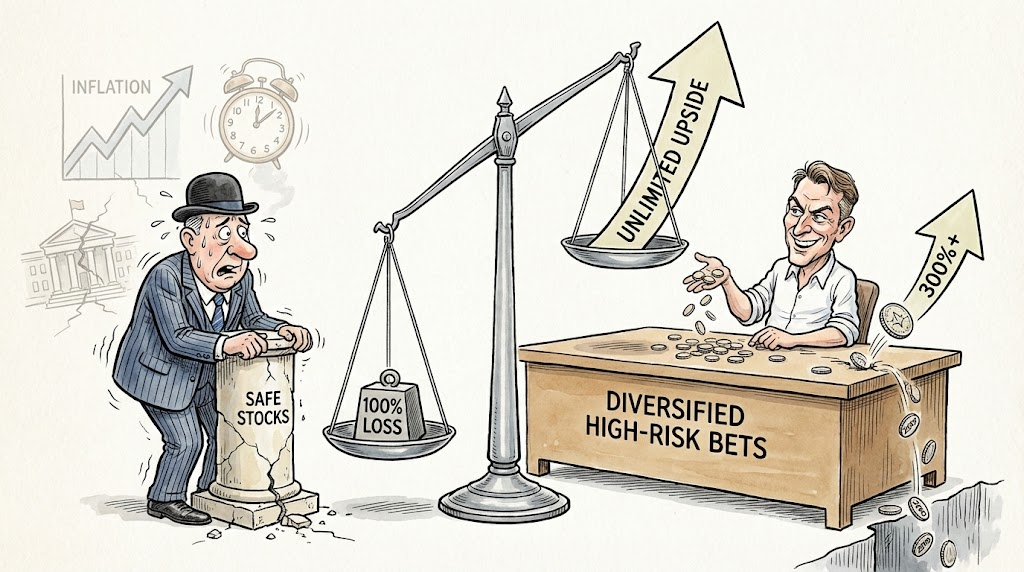
There is something deeply seductive about the all-in investor.
One idea. One massive bet. No hedging. No compromise.
If it works, the investor looks like a genius.
If it fails, nobody remembers the careful analysis behind the decision. They only remember that everything was lost.
So why do otherwise intelligent investors risk it all?
And when does high conviction become plain recklessness?
The short answer is simple.
An investor can have absolute conviction in an investment without putting the entire portfolio into it.
The quality of an investment determines whether it deserves to be owned.
The range of possible outcomes determines how much should be owned.
These are two separate decisions.
This article was written by a Financial Horse Contributor.

Why going all-in feels so attractive
The appeal is easy to understand.
If an investor has found a genuinely exceptional opportunity, diversification can appear to dilute the best idea.
Why put money into the tenth-best idea when the best idea offers far greater upside?
This logic is not entirely wrong.
A concentrated position will move the needle if the analysis is correct. A 100% gain on a 2% position adds only 2% to the portfolio.
The same gain on a 50% position adds 50%.
Concentration is how insight is converted into meaningful wealth.
But it also turns mistakes into permanent damage.
The emotional attraction goes deeper than the arithmetic.
An oversized position gives the investor a clear identity. The investor becomes the person who saw what everyone else missed.
Every piece of good news confirms the thesis.
Every criticism feels personal.
And every decline becomes an opportunity to prove conviction by buying more.
At that point, the investment is no longer just part of a portfolio. It has become part of the investor’s ego.
That is usually where the trouble starts.
Conviction is not certainty
Investing decisions are made under uncertainty.
An investor can conduct excellent research, understand the business and correctly identify its long-term potential.
The investment can still lose money.
Management may execute poorly. Financing may disappear. Regulation may change. A competitor may introduce a better product.
Or the long-term thesis may be correct, but already reflected in the price.
This is why the word “certain” should raise alarm bells.
Certainty is not an investment thesis.
It often means the investor has stopped looking for evidence that could prove the thesis wrong.
Conviction can justify a larger position.
It should never eliminate respect for uncertainty.
The mathematics of risking it all
The danger becomes clearer when the recovery mathematics are laid out.
| Loss | Gain required to recover |
|---|---|
| 20% | 25% |
| 50% | 100% |
| 80% | 400% |
| 90% | 900% |
The formula is:
Required recovery = 1 ÷ (1 − loss) − 1
Lose 50%, and the remaining capital must double.
Lose 80%, and it must rise fivefold just to return to the starting point.
This is why avoiding ruin matters more than maximising the upside from any single idea.
Consider a Singapore investor with a S$1 million portfolio.
If the entire portfolio is placed in one asset and that asset falls 80%, only S$200,000 remains.
If the same investment had been limited to 20% of the portfolio, an 80% collapse would cost S$160,000. The portfolio would retain S$840,000, assuming the other assets were unchanged.
The thesis failed in both cases.
But only one investor still has most of the capital—and the emotional capacity—to make the next decision.
That difference is survival.
And survival is what allows compounding to work.
For Singapore investors, the portfolio is bigger than the brokerage account
A common mistake is to look only at shares and exchange-traded funds when measuring concentration.
For a Singapore investor, the true household portfolio may also include:
- An HDB flat or private property
- CPF balances and future CPF LIFE income
- SRS investments
- Employment income and company shares
- Cash, fixed deposits and Singapore Savings Bonds
- Insurance policies with savings or investment components
- Overseas assets denominated in foreign currencies
These exposures can be heavily correlated.
A person working for a Singapore bank, receiving company shares and holding a portfolio dominated by local bank stocks may be far more concentrated than the brokerage statement suggests.
The same applies to someone whose home, investment property, job and equities are all tied to Singapore’s economic cycle.
CPF and property may provide valuable long-term resources. But they are not automatically available to meet an immediate margin call, medical bill or retrenchment-related cash need.
An investor can therefore look wealthy on paper and still face a liquidity problem.
Ring-fence the money that cannot be lost
Before considering a concentrated bet, near-term liabilities should be separated from investment capital.
Experts suggest keeping approximately three to six months of expenses as emergency cash. The appropriate amount may be higher for a household with dependants, irregular income or large loan commitments.
Money needed for the following should generally not depend on the price of a volatile asset:
- A home downpayment
- Renovation costs
- University fees
- Insurance premiums
- Taxes
- Medical expenses
- Near-term mortgage payments
- Daily household spending following a job loss
An investor expecting to buy an HDB flat within two years does not have a two-year investment horizon for that money.
Calling the position “long term” does not change when the cash will be needed.
A great investment can still be a terrible all-in bet
Investors often justify concentration by focusing exclusively on the upside.
“The addressable market is huge.”
“The founder is exceptional.”
“The technology will change the world.”
All these statements may be true.
But none explains whether the asset deserves an all-in allocation.
Three separate questions need to be answered.
First, are the fundamentals genuinely attractive?
Second, how much optimism is already priced in?
Third, what does the price trend say about how the market is processing new information?
A wonderful business bought at a price that assumes perfection can still produce poor returns.
A correct long-term thesis can also generate devastating short-term losses if the investor uses leverage or needs the money too early.
The more concentrated the position, the less room there is for valuation and timing errors.
“But it only takes one big winner”
This is another tempting argument.
If one successful investment can create generational wealth, why not maximise the opportunity?
Because the statement leaves out an important condition.
The investor must survive long enough to be right.
There is also a large dose of survivorship bias in how investment stories are told.
The investor who made one concentrated bet and became extraordinarily wealthy is celebrated.
The many investors who made similarly concentrated bets based on equally sincere conviction—and disappeared after the thesis failed—are rarely studied.
The winners write books and appear on TV.
The losers quietly return to work.
This does not mean concentrated investing is always wrong.
It means the visible success stories are not a complete dataset.
When can concentration make sense?
There is no universal maximum position size.
A 30% position may be reckless for one investor and manageable for another.
The difference depends on four variables.
1. Financial resilience
How much would life change if the investment went to zero?
If the position contains money required for housing, retirement or family expenses, the capacity for loss is low regardless of conviction.
A household with stable income, low liabilities and substantial assets elsewhere may have greater capacity for concentrated risk.
But capacity for loss is not the same as willingness to experience it.
2. Quality of the edge
What does the investor understand that the market does not?
An edge must be more than enthusiasm, social-media commentary or confidence borrowed from a famous investor.
It should come from better analysis, a longer time horizon or a superior understanding of the variables driving the outcome.
If the edge cannot be explained simply, it may not exist.
3. Shape of the downside
Is the downside genuinely bounded?
A profitable company with net cash and durable demand has a different risk profile from an indebted company dependent on favourable capital markets.
An unleveraged asset can fall sharply.
A leveraged position can be forcibly closed before the thesis has time to recover.
Combining concentration with leverage is especially dangerous because the investor loses control over the holding period.
4. Ability to change course
What evidence would invalidate the thesis?
A concentrated investor must be more willing—not less willing—to admit a mistake.
If every piece of negative information can be explained away, there is no investment framework.
There is only belief.
A practical position-sizing formula
Instead of asking, “How confident is the investor?”, start with a harder question:
How much of the portfolio can be lost if the thesis is wrong?
Then estimate a severe but plausible decline in the asset.
The indicative formula is:
Maximum position size = acceptable portfolio loss ÷ assumed asset decline
Suppose a household has S$500,000 of genuinely investable capital after ring-fencing emergency and near-term funds.
It can tolerate an 8% portfolio loss from the idea.
The asset is assumed to be capable of falling 60% in a severe downside scenario.
The maximum indicative position would be:
8% ÷ 60% = 13.3%
That works out to approximately:
13.3% × S$500,000 = S$66,667
This is not a guarantee that the loss will be capped at S$40,000.
The asset could fall further. Liquidity could disappear. Other holdings might decline at the same time.
But the formula forces the position to be sized from the downside instead of the hoped-for upside.
That is a much healthier starting point.

CPF money requires a higher hurdle
CPF savings are primarily intended for housing, healthcare and retirement.
Investing through CPFIS means giving up the interest that the invested CPF balance would otherwise earn.
CPF Board’s guidance is to consider whether the investor has the risk tolerance, time and expertise to outperform the relevant risk-free CPF interest after fees. CPF Board also makes clear that inclusion under CPFIS does not mean a product is risk-free or endorsed by the Board.
This creates a higher hurdle for an all-in decision.
A concentrated cash investment may reduce liquid wealth.
A concentrated CPFIS investment can damage retirement resources while sacrificing the alternative CPF return.
Money intended for an upcoming home purchase should be treated even more cautiously. CPF Board specifically notes that volatile CPFIS investments may be unsuitable where OA savings will be needed for a home within the next few years.
SRS should not be treated as emergency capital
SRS provides tax relief for eligible contributions, while investment returns accumulate tax-free before withdrawal.
But the money is intended for retirement.
Eligible withdrawals can generally be spread over a ten-year penalty-free withdrawal period from the prescribed retirement age. Only 50% of qualifying retirement withdrawals is taxable, while premature withdrawals may attract tax and a 5% penalty in most circumstances.
That makes SRS a poor substitute for an emergency fund.
It also means a concentrated SRS position should be assessed against the retirement objective of the account—not merely its potential upside.
Avoid stacking concentration, leverage and currency risk
A Singapore investor buying one US stock may be taking three risks at once:
- Company-specific risk
- US-dollar exposure against Singapore-dollar liabilities
- Financing risk if margin is used
Currency exposure is not automatically bad.
But it should be recognised.
An investment can rise in its home currency while producing a much smaller SGD return if the foreign currency weakens.
Leverage makes the position more dangerous.
Contracts for difference involve margin requirements, financing costs and the possibility of forced liquidation. CFD losses can exceed the initial margin and that investors may need to meet margin calls at very short notice.
A Customer Knowledge Assessment does not make the investment suitable. It only assesses whether the investor has the relevant knowledge and experience to understand a Specified Investment Product.
Should an investor average down?
An all-in investor often begins with a large position and becomes even more concentrated as the price falls.
The explanation is usually that the investment has become cheaper.
But a lower price alone does not improve the thesis.
The market may be wrong.
Or the decline may reflect information the original analysis missed.
A useful discipline is to separate a broad market sell-off from a company-specific downtrend.
If the entire market is falling while the long-term earnings engine remains intact, averaging down may make sense.
If the asset is underperforming because its fundamentals are deteriorating, adding merely because the price is lower can turn an error into a disaster.
Before adding, answer five questions:
- Has intrinsic value changed?
- Is the original thesis still intact?
- What new evidence has emerged?
- Is the decline market-wide or asset-specific?
- Would the position be initiated today if it were not already owned?
The entry price is history.
It should not determine whether an investment deserves fresh capital today.
A Singapore investor’s pre-trade checklist
Before making a high-conviction investment, check the following:
- Emergency cash: Are at least three to six months of household expenses ring-fenced?
- Near-term liabilities: Is money for housing, education, taxes and major family expenses excluded?
- Full exposure: Does the calculation include property, CPF, SRS, employer shares and employment income?
- Risk budget: What percentage of total investable wealth can be lost without changing the household’s financial plan?
- Stress case: What happens if the asset falls 60%, 80% or becomes temporarily untradeable?
- Currency: Are the household’s liabilities in SGD while the investment is in another currency?
- Leverage: Can the position be forcibly liquidated through a margin call?
- Custody: Who legally holds the assets, and which regulator oversees that entity?
- Invalidation: What specific evidence would prove the thesis wrong?
- Exit plan: Will the position be reduced because of valuation, deteriorating fundamentals, a broken trend or a change in personal circumstances?
If these questions cannot be answered, the investor is not ready to go all-in.
The investor may not even be ready to take a normal-sized position.
High conviction without financial ruin
The best investors are not simply those willing to make bold bets.
They know which risks they are taking, how much they stand to lose and what would prove them wrong.
Concentration can create wealth.
But concentration without risk control can destroy the capital, confidence and time required to recover.
Long story short, the objective is not to avoid every loss.
It is to avoid a loss that removes the investor from the game.
Because in investing, being right eventually is not enough.
The investor must still be solvent when eventually arrives.
Would any investment justify placing more than half of a household’s genuinely investable wealth into a single position?