When Mapletree Industrial Trust (MIT) bought the huge data centre portfolio in 2021, I shared back then that I was not a fan.
The US market is brutally competitive – I just didn’t see the competitive advantage a Singapore REIT had in buying 50% exposure to US data centres.
Real estate is a local business, you just don’t have the expertise to compete with the locals over a longer time period.
So back in 2021 I sold my entire position in MIT, and in hindsight I’m glad I did.
But quite a few of you have asked me about MIT again of late.
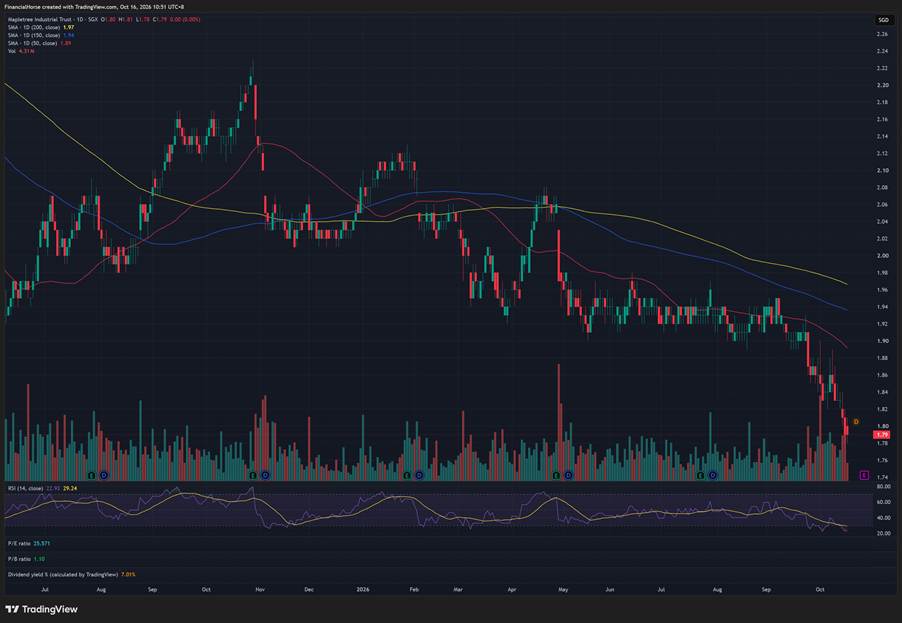
MIT is now 47% below its 2020 high, at a 52-week low, and it pays a 7% dividend yield.
This is a REIT where more than half the assets are data centres.
Keppel DC REIT just paid S$1.37 billion for 2 data centres in Tokyo, Equinix just reported its second-highest bookings ever, and everybody wants data centre exposure.
And yet MIT keeps going down.
So… at 7% dividend yield, is it finally a good buy?
Price action of Mapletree Industrial Trust
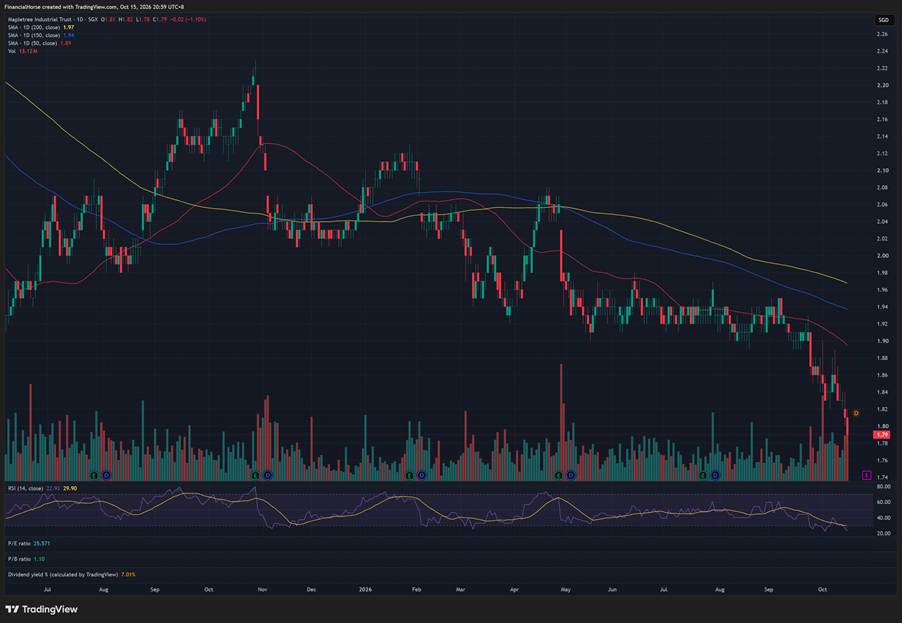
Here’s the chart for reference.
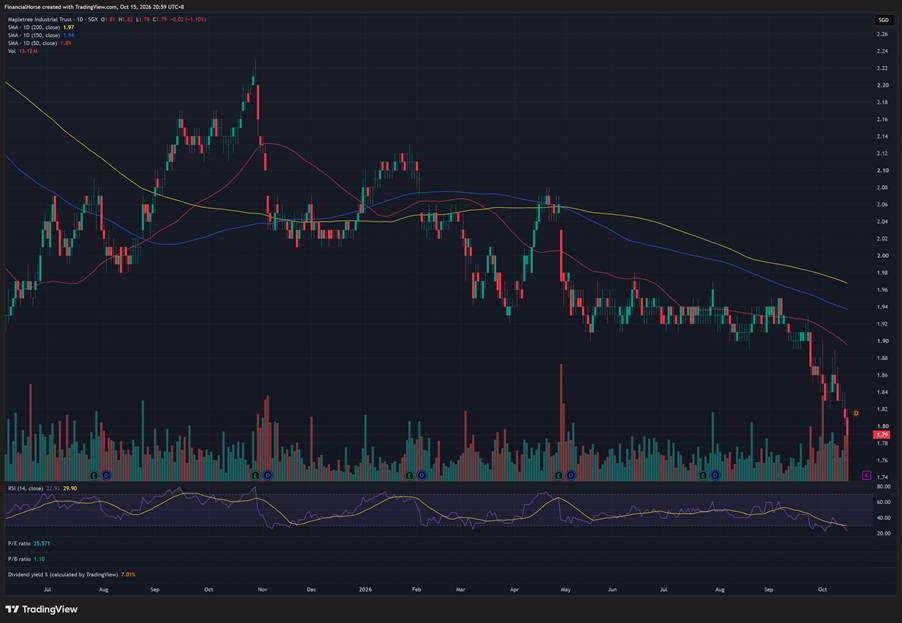
Whatever way you want to spin it – it’s a falling knife.
Down 14% this year, every bounce gets sold, and it closed at S$1.79 on 15 Oct.
Mapletree Industrial Trust pays the same DPU as 2020 – at half the price
Now here’s the part that surprised me when I ran the numbers.
The trailing 12-month DPU is 12.55 cents.
That is exactly what MIT paid in FY20/21 – the year the unit price peaked at S$3.35.
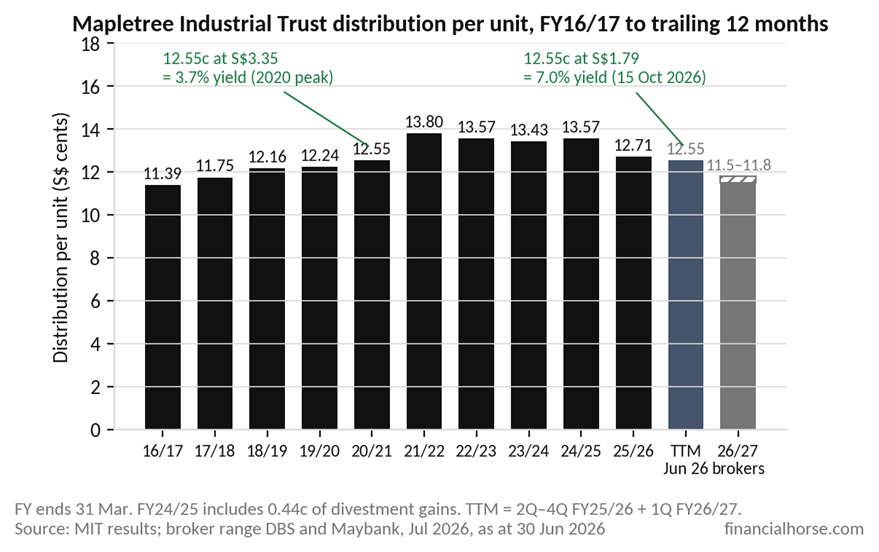
Same DPU, half the price.
That’s just ridiculous.
In plain English – in 2020 investors were happy to own MIT at a 3.7% yield, and today they want 7%.
Sure, the DPU has come down from the FY21/22 peak, and analysts have it dropping to 11.5–11.8 cents this year.
But that’s a 15% drop in DPU, against a 47% drop in price.
So… what is going on?
This is from MIT’s own 1Q results in July:
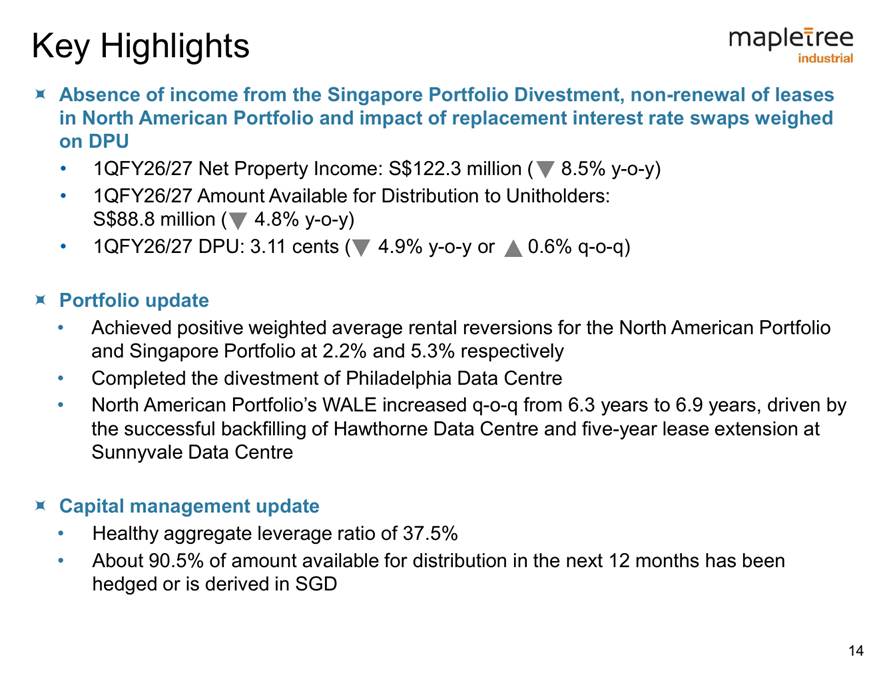
In a nutshell, DPU is down 4.9%, and the 3 reasons are right there on the slide:
- the Singapore divestment
- US tenants not renewing
- interest rate swaps rolling off
The first one is a one-off.
The other 2 are worth discussing further.
Half of it is interest rates
Part of the answer is simply interest rates, which have hit every REIT this year.
The Fed hiked in September for the first time since 2023, the US 10-year is above 5%, and S-REITs as a whole are down about 10% in 2026 while the STI is up 17%.
I covered this in the Ascendas REIT article so I won’t repeat it here.
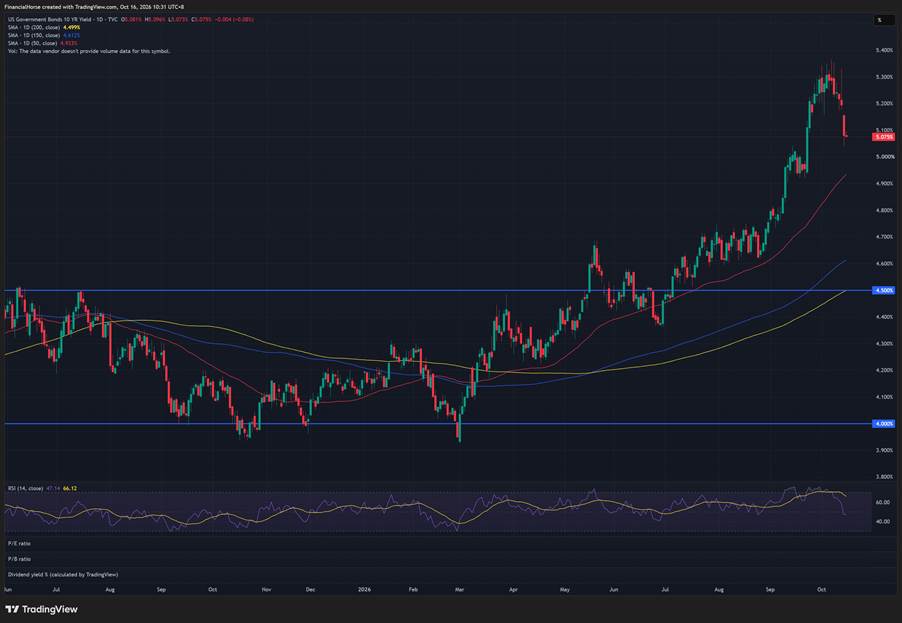
But what’s interesting for MIT is that even the data centre REITs with the “right” assets are at 52-week lows.
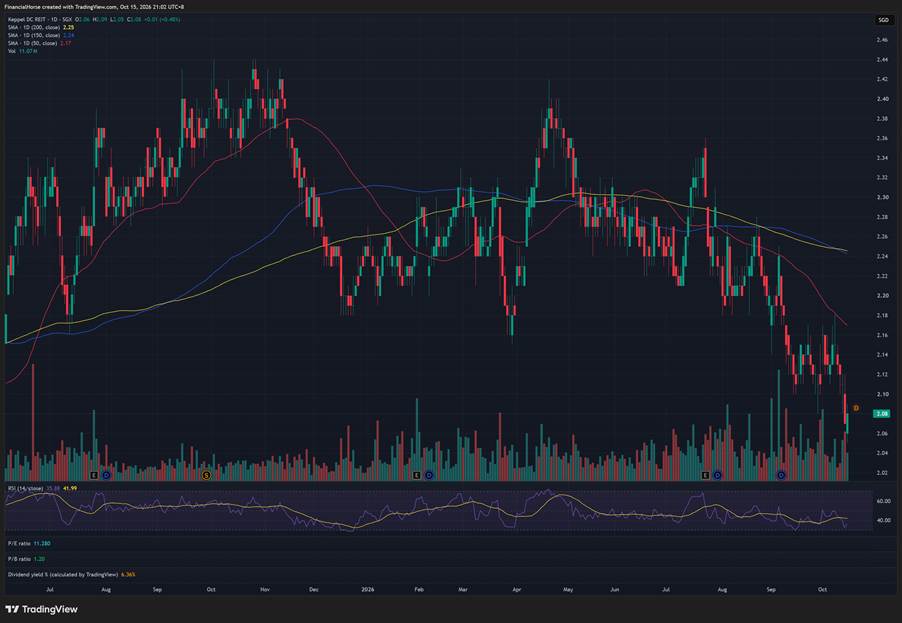
Keppel DC REIT is at S$2.07 with DPU up 11% this year – 52-week low, same as Digital Core REIT and NTT DC REIT.
So maybe a third to a half of MIT’s fall this year is the sector selling off.
The rest is MIT’s own problem.
And you can actually see this in the price action – the Singapore 10-year yield has come down about 20 basis points since late September, and MIT just kept making new lows.
Why the AI data centre boom is not helping Mapletree Industrial Trust
Reasoning from first principles – what does an AI data centre actually need?
Power, basically.
A single rack of Nvidia’s latest chips pulls about 120 kilowatts and needs liquid cooling.
A data centre built in the 2010s for enterprise tenants was designed for maybe 5–10 kilowatts a rack, cooled by air.
And an AI training campus is 100 megawatts to a gigawatt – the sites MIT has disclosed are 1.8 megawatts, 3 megawatts and 6 megawatts.
Then there’s location – the AI money is going to Northern Virginia, Dallas, Atlanta and Phoenix, where CBRE has vacancy at 1.4% and 7.5 gigawatts under construction.
Now look at what MIT actually bought.
In 2017, 14 data centres from Carter Validus – 97% leased, 6.7-year leases, core-and-shell on triple-net terms.
In 2019, 13 from Digital Realty – 10 of them powered shells at a 6.6% cap rate, plus 3 hyperscale sites in Ashburn at 6.0%.
In 2021, another 29 from Sila Realty for US$1.32 billion – 88% leased, 32 tenants.
Here’s how the data centre portfolio looks today:
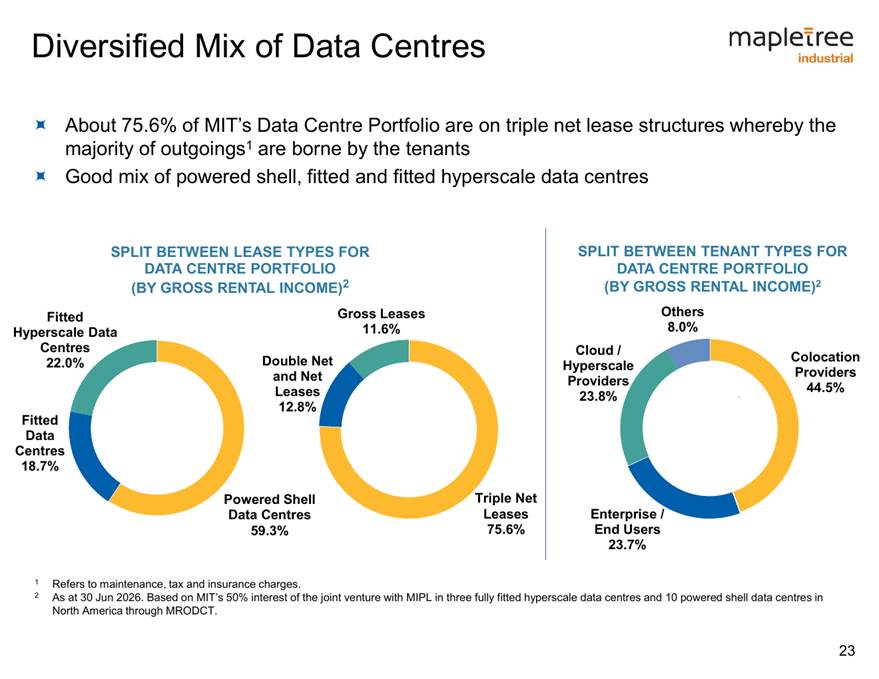
59% powered shell, and a quarter of the tenants are enterprise end-users – the banks and telcos that ran their own servers in the 2010s.
In plain English – MIT bought bond-like leases on older data centres in secondary US markets.
Great for income, but these buildings were never going to get the AI upside.
And to give credit where credit is due, management has been pretty honest about this.
Per the REIT’s own investor relations, the assets are “generally lower-power” and “not designed for AI computing workloads”.
At this year’s AGM the line was that “cloud adoption had accelerated faster than anticipated” – which I suppose is a polite way of saying that enterprise tenants are moving their servers to Amazon and Microsoft, and not renewing.
Here’s the occupancy of the US data centres by quarter – not pretty:
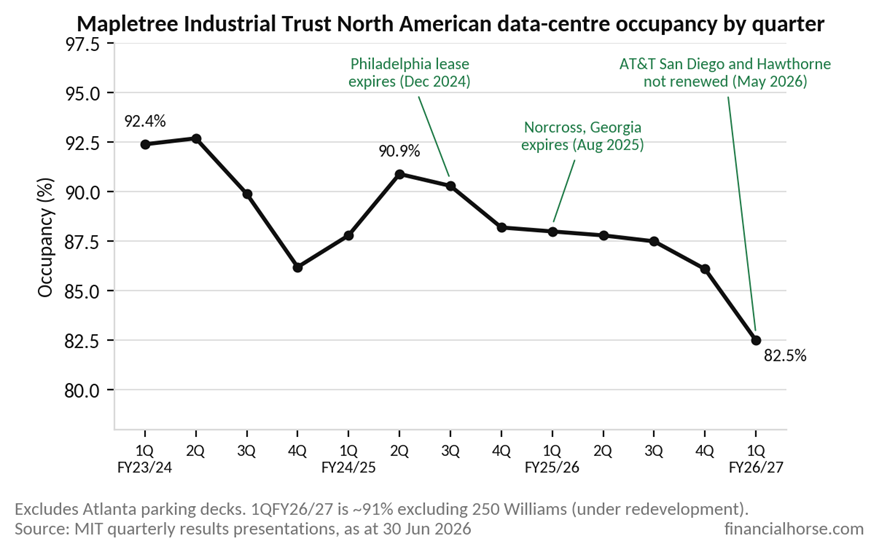
Down every single quarter for 2 years – from 92% to 82.5%.
AT&T walked away from San Diego in May, and that alone was 2.5% of MIT’s rental income.
And about 4.7% of this year’s income is already confirmed as not renewing.
The Philadelphia example
Philadelphia is the clearest example of the problem.
The tenant left in December 2024.
The building only had 3 megawatts of power, and to get more MIT would have needed a new substation, more land, and years of capex – with no tenant signed.
So they sold it.
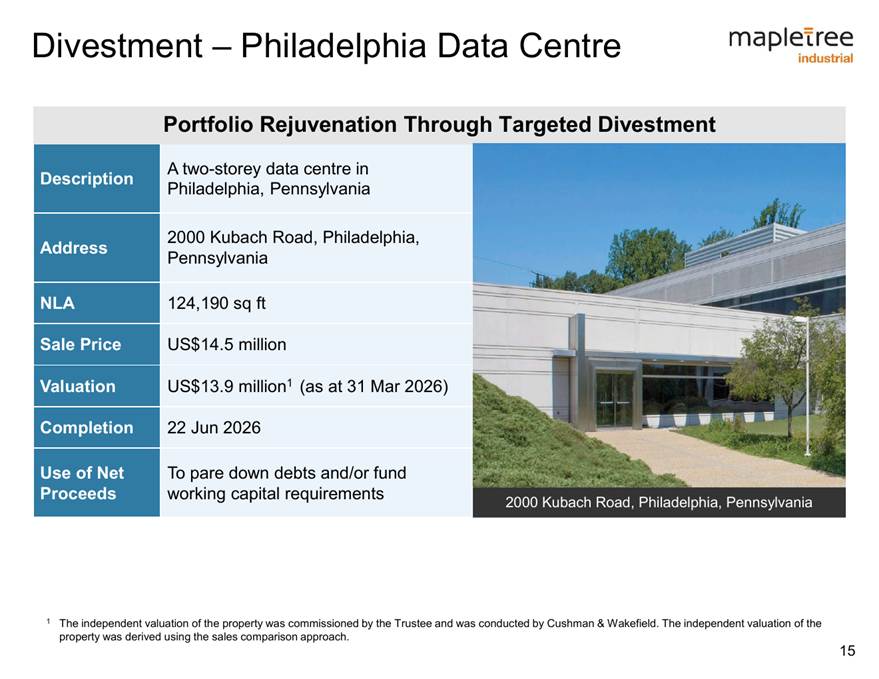
US$14.5 million for 124,000 square feet of data centre.
In March 2023 the same building was valued at US$38.5 million – and the valuation halved the year the tenant left.
Even the “good news” tells you something – Hawthorne in Los Angeles was backfilled in May, by an aerospace company on a 10-year lease.
So MIT found a tenant, but not a data centre tenant.
It is not that the buildings cannot be converted
To be fair to MIT, retrofitting the cooling is actually not that expensive – about US$2 million per megawatt, versus US$11 million per megawatt for a new build.
The problem is not the building, it’s the power at the site, and the years it takes to get more.
You would have heard all the news that because of power constraints in the US, the challenge building data centres now is in securing the power required to run them.
Which is why management is now selling 22 of the 54 US data centres, rather than upgrading them.
I said as much last month when I left MIT out of my top 5 dividend stocks – “they just couldn’t convert them into AI data centres cost effectively”.
Never miss a post! Follow Financial Horse on WhatsApp or Telegram — one tap, and every new article reaches you the moment it’s published.
What is priced in at S$1.79?
Here’s how MIT compares with the other big REITs as at 15 Oct 2026:
| REIT | Price | Trailing yield | Price / book | Gearing |
| Mapletree Industrial Trust | S$1.79 | 7.0% | 1.10x | 37.5% |
| Keppel DC REIT | S$2.07 | 5.0% | 1.21x | 35.3% |
| CapitaLand Ascendas REIT | S$2.16 | 7.0% | 0.94x | 39.0% |
| Mapletree Logistics Trust | S$1.08 | 6.7% | 0.86x | 44.3% |
| CICT | S$2.21 | 5.2% | 1.03x | 38.6% |
Which is unbelievable that even after the sell-off, MIT trades at such a high Price/Book.
What this suggest is that the market has written off the yield, but hasn’t written off the book value yet.
Which suggests there could be further downside if the market narrative starts to shift on the book value.
Which brings us to the 3 things that decide the next 12 months.
One – the sale of 22 US data centres.
MIT has appointed JLL to sell 22 of its 54 US data centres, with a book value of about US$1.07 billion for MIT’s share.
No guide price, they’re open to selling piecemeal, and MIT’s own words are that there is “no certainty or assurance that any transaction will materialise”.
DBS has run the numbers – if everything sells at book, DPU drops about 3% and gearing falls from 37.5% to 24%.
That’s a 6.8% yield on a REIT with hardly any debt, which is a very different investment from what you’re buying today.
If it sells 15–20% below book, the NAV takes a hit, but at least the overhang is gone.
And in that scenario – you know what I think MIT could be a great buy in that scenario.
But if the data centres don’t sell, or if they sell for a poor price, then it’s a very different story.
Two – the interest rate hedges.
MIT’s own balance sheet slide says it plainly:
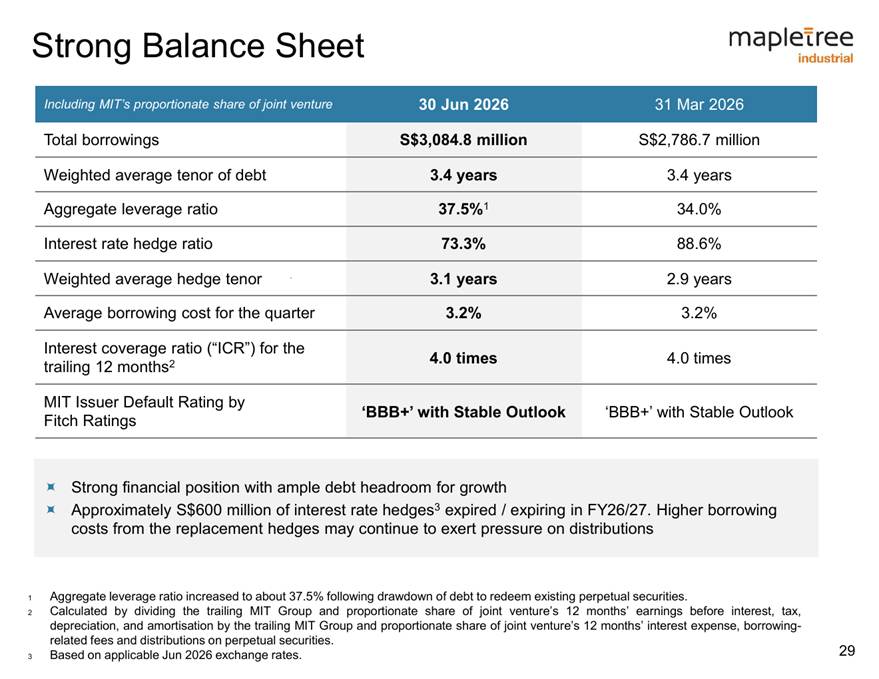
About S$600 million of interest rate hedges expiring this financial year, and the hedge ratio has already dropped from 89% to 73%.
Maybank has the cost of debt going from 3.2% to 3.5%, and every 50 basis points on the unhedged debt is about 0.12 cents of DPU.
That’s a huge overhang.
Three – the half of the REIT that is fine.
Here’s the portfolio overview from the same deck:
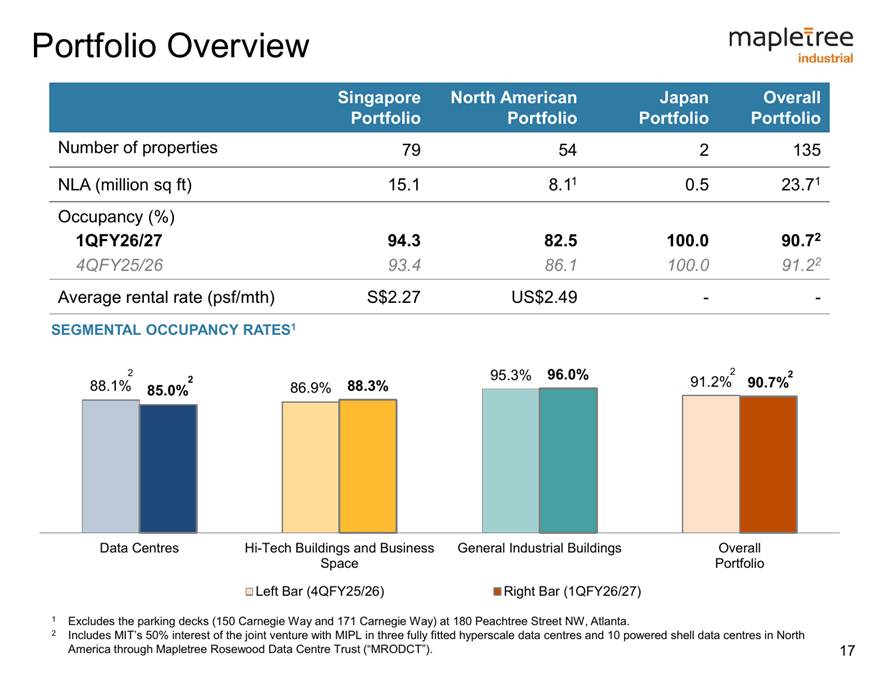
Singapore is 46% of the assets, 94% occupied, and rents are still going up 5% on renewal.
Japan is 100% leased on a 13.5-year lease.
Nobody is worried about the Singapore half.
Which again goes back to what I said above.
If indeed MIT sells the data centres and gets a good price for it.
You know what then suddenly this REIT looks very different.
It’s like MPACT if you take out the underperforming Hong Kong assets – I would buy it in a heartbeat.
Bull / base / bear at S$1.79
Keeping this simple – at S$1.79, I see 3 ways the next 2–3 years could play out:
Bull – the US sale clears close to book, gearing drops to the mid-20s, and the Fed stops hiking. A 7% yielder that just paid down its debt gets re-rated back toward a 6% yield. Total return maybe around +25–35%, including distributions. Possibly more in an upside scenario.
Base – the sale happens piecemeal and below book, DPU settles at 11.5–12 cents, and the unit price goes sideways while you collect the yield. Total return maybe around +15–20%, including distributions – which is basically the yield.
Bear – the sale stalls, the hedges reprice, more enterprise tenants leave, and the valuers do to the US portfolio what they did to Philadelphia. DPU heads to 11 cents and NAV gets marked down below today’s price. Total return probably flat to negative, including distributions. Possibly worse in the true bear case.
There’s 2 ways of seeing this.
Either the market is right, and MIT’s US portfolio is worth a lot less than book – in which case 1.1x book is not cheap at all.
Or the market is wrong, a buyer pays close to book, and this is a 7% yielder that just de-levered.
I mean… nobody actually knows what those 22 buildings are worth until someone writes a cheque.
And that’s really the whole question here.
Keppel DC REIT vs Mapletree Industrial Trust – which is the better data centre play?
The obvious follow-up – if I wanted data centre exposure, why not just buy Keppel DC REIT at a 52-week low instead?
At a 6%ish dividend yield?
Now I did say last month that Keppel DC REIT has its own legacy data centres, and the same power and cooling problem applies to those.
But the difference shows up in the numbers.
Keppel DC REIT’s rents went up 10% on renewal in the first half (51% in the first quarter), DPU is up 11%, and its latest buy is 2 brand-new Tokyo data centres, 100% leased to investment-grade tenants on 8-year leases.
MIT’s US rents went up 2%, DPU is down 5%, and it’s a seller.
In plain English – Keppel DC REIT’s data centres are where the demand is, and MIT’s are not.
You pay for that of course – 5.0% yield at 1.21x book, versus 7% at 1.10x.
But if I wanted a data centre play, I’d rather pay up for the one where rents are going up, than buy the 7% yield on the one where tenants are leaving.
What I’m doing with my money
I don’t own MIT today, so for me this is a will-I-buy question, not a sell-or-hold one.
If you ask me, it comes down to 2 factors.
One – REITs as a whole are a falling knife right now, and like I said in the Ascendas article, I don’t see a meaningful bottom until long-term interest rates top out.
MIT making new lows while Singapore 10-year yields come down tells you it’s not just about interest rates either.
Two – structurally, MIT is not well placed.
The data centre boom is real, but it’s happening in 100-megawatt campuses in Northern Virginia and Tokyo, not in 3-megawatt enterprise shells in Philadelphia.
A 7% yield doesn’t fix that.
This is a structural problem.
I know my own bias is to average into losers because they look cheap, and this is exactly the kind of chart that tempts me.
So I’m not going to be a hero here.
I think the key thing I want to see to change my mind – is what they do with the data centres.
If they sell the bulk of that US data centre portfolio, at a decent price.
And this suddenly becomes a predominantly Singapore industrial portfolio – boy the market is going to rerate the heck out of this REIT.
And then it gets very interesting again.
Whatever the case, MIT’s results are coming out on 27 Oct, and hopefully we have some updates on the US sales.
I’ll update my views on MIT after the 27 Oct results on FH Premium.
Love to hear what you think!
This article was written on 16 Oct 2026. It will not be updated going forward.
My live views on Mapletree Industrial Trust — including the price at which I would buy — are updated weekly on FH Premium, alongside my full watchlist and personal portfolio.
Join the FH mailing list and new articles land straight in your inbox:
Also on WhatsApp, Telegram and Facebook.