Okay so a reader wrote in recently asking if I could do a piece on the CPF LIFE Standard Plan vs the Escalating Plan.
I figured it was a good one to do, because this is a decision every one of us makes at 65, and for the most part you don’t get to change your mind after.
I wrote about deferring CPF LIFE to 70 a while back, so I won’t repeat that here – this is the other decision you make at 65.
Before we get into it, one thing that I think reframes the whole debate.
The CPF LIFE premium is the same whichever plan you pick, and MOM has confirmed in Parliament that the interest rate and mortality assumptions behind the payouts are the same for both plans too.
In plain English – the Escalating Plan doesn’t pay you less money. It pays you the same money, just spread out differently.
So it really needs to be a personal decision, based on your personal circumstances.
Let’s get into it.
What the two plans actually pay
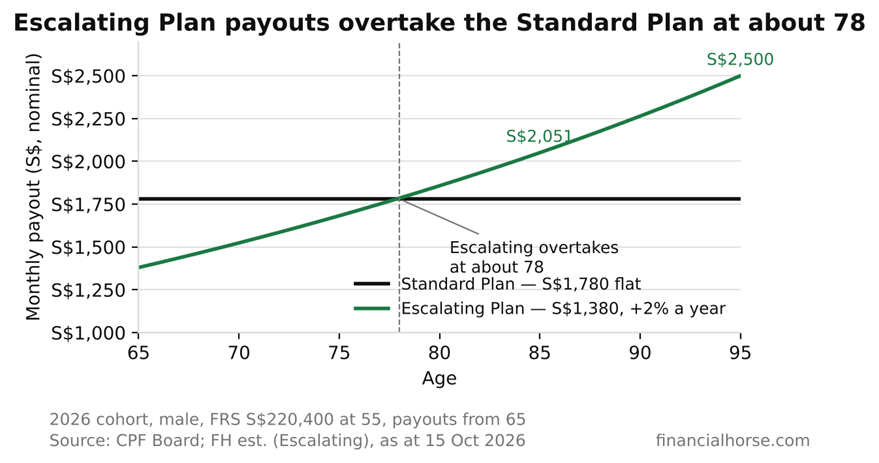
Let’s use CPF’s own example – a guy who hits the 2026 Full Retirement Sum of S$220,400 at 55, and starts payouts at 65.
On the Standard Plan, he gets about S$1,780 a month, for life.
On the Escalating Plan, the same guy starts at about S$1,380 a month.
I should say this S$1,380 is my own estimate, because interestingly CPF does not publish the Escalating Plan figure anywhere on their website. You have to run the payout estimator to get your own number, and where I got it from.
From there the payout goes up 2% every year, on the anniversary of your first payout, for as long as you live.
Working out the rough numbers:
| Standard Plan | Escalating Plan | |
| Payout at 65 | S$1,780 | ~S$1,380 |
| Payout at 75 | S$1,780 | ~S$1,680 |
| Payout at 85 | S$1,780 | ~S$2,050 |
| Payout at 95 | S$1,780 | ~S$2,500 |
| Bequest | Premium less payouts received | Premium less payouts received |
| Default if you make no choice | Yes – Standard, starting at 70 | No |
A couple of things to note.
The 2% is a fixed 2%. It is not pegged to actual inflation, and it doesn’t stop at any age.
The bequest works the same way under both plans – whatever premium hasn’t been paid back to you goes to your family.
And if you don’t make a choice at all, CPF just puts you on the Standard Plan at 70.
Here’s the chart for reference.
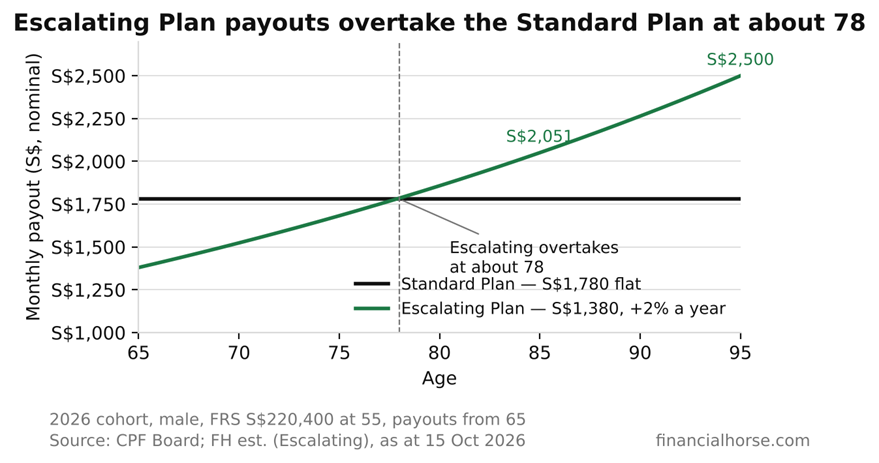
So you can see – the Escalating Plan pays you about S$400 a month less for the first 13 years or so, and then it pays you more than the Standard Plan for the rest of your life.
There is also a Basic Plan, which pays less than both and keeps more money in your RA.
I’ll just say that I don’t think it’s the right answer for *most* people – the RA runs down somewhere around 90, so the “bigger bequest” argument is not as strong as it sounds – and leave it at that.
The break-even age – and why I think it’s the wrong number
Every article you read on this topic lands on a break-even age, so let’s get that out of the way first.
On a monthly basis, the Escalating Plan overtakes the Standard Plan at about 78.
On a total basis – if you add up every payout you’ve received since 65 – the Escalating Plan only pulls ahead at about 91.
That 91 is the number that gets quoted a lot, and I think it’s why most of the commentary out there leans Standard – you need to live past 90 to come out ahead.
Now let’s look at the odds.
CPF’s own numbers are that about 1 in 2 Singaporeans aged 65 today will live past 85, and about 1 in 3 past 90.
If you split it by gender, the life tables say 27% of men and 42% of women make it to 90.
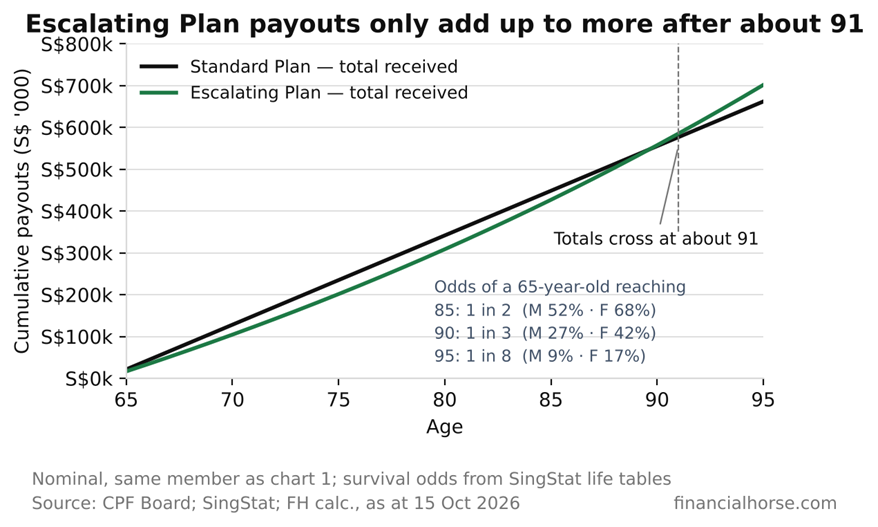
So if you just go by total dollars received, the Standard Plan “wins” for roughly 3 in 4 men, and for women it’s closer to a coin flip.
Sounds pretty decisive right?
The problem is what this comparison assumes.
It assumes that a dollar you receive at 90 is worth the same as a dollar you receive at 65.
And you know what – it isn’t.
The same two plans in today’s dollars
So let’s run the numbers again, this time with 2% inflation.
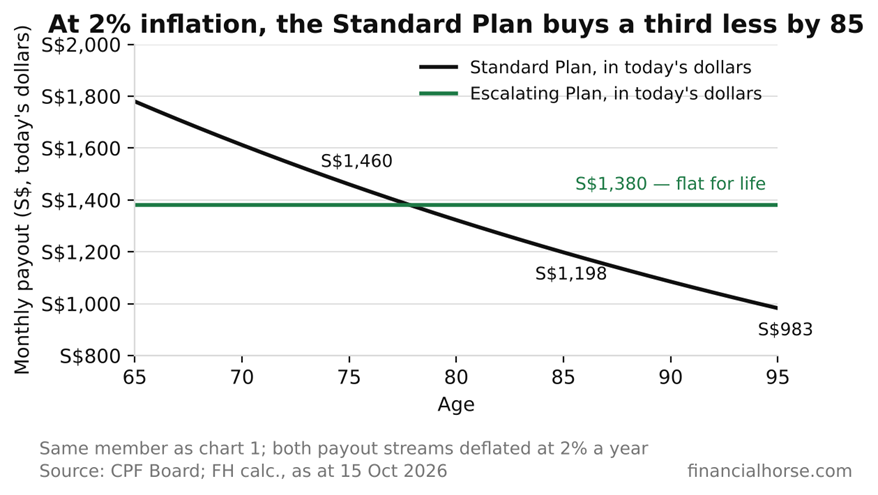
The Standard Plan’s S$1,780 buys you about S$1,460 of today’s goods at 75.
By 85 it’s about S$1,200.
By 95 it’s under S$1,000.
The Escalating Plan, by design, buys you the same S$1,380 of today’s goods every single year for the rest of your life.
Now is 2% the right number to use for inflation?
I mean the kopi o kosong that I buy during lunch used to cost me 2 bucks, and it just went up to 2.25.
That’s not 2% inflation, albeit anecdotally.
That said if you look at Singapore’s history, headline inflation has compounded at about 1.7% a year over the past 10 years and the past 30 years, and about 2.1% over the past 20 years.
The latest print for August was 2.3%, and MAS is forecasting 1.5–2.5% for 2026.
So from a data driven perspective, 2% is roughly the long-run number – a bit generous for the past decade, a bit light for the 2 decades before that.
I suppose the better way to see it, is that the 2% is more of a floor, to build in a certain level of inflation hedge.
If we get a stretch of 3% inflation, both plans lose purchasing power. The Escalating Plan just loses it 2 points a year slower.
Does spending really fall as you get older?
To be fair, the best argument for the Standard Plan is not the break-even age.
It’s that you spend more at 68 than you do at 88.
You’re young and energetic, and in good health, so you factor in the travel, the eating out, the grandkids – so it makes sense to front-load the payouts.
And the US data broadly supports that – real spending in retirement falls by around 1% a year in the research most financial planners rely on.
The thing is, the Singapore data doesn’t say that.
CPF did a Retirement and Health Study that tracked retirees from 65 to 85, and found that non-healthcare spending actually went up about 3.2% a year in nominal terms – about 1.2% a year faster than inflation.
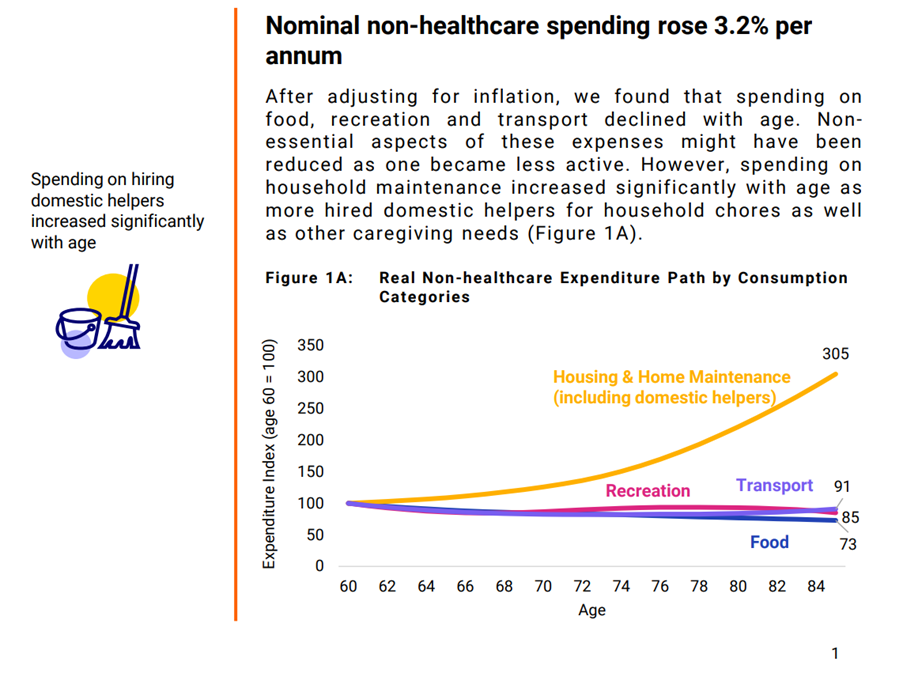
Food and transport went down, as you would expect.
But domestic helpers and housing went up by more than enough to offset that.
And bear in mind that excludes healthcare, which is the one cost that always shows up late.
Healthcare inflation has run about half a point above headline inflation for decades. Nursing home fees have roughly doubled since 2018 to about S$4,900 a month. And CareShield Life payouts are now being raised 4% a year for 2026 to 2030 just to keep up.
In plain English – the costs that show up at 80 and 85 are exactly the ones going up the fastest. So I would be careful about building a retirement plan on the assumption that you’ll spend less when you’re old.
Sure, you probably travel less at 85.
But you do need to factor in costs like helpers and healthcare.
Never miss a post! Follow Financial Horse on WhatsApp or Telegram — one tap, and every new article reaches you the moment it’s published.
Can’t I just take the Standard Plan and invest the difference?
This is the sharpest objection I can think of, so let’s run it.
Say you take the Standard Plan, spend S$1,380 a month rising 2% a year (which is exactly what the Escalating Plan would have paid you), and bank the difference.
The difference starts at S$400 a month and shrinks to zero by 78. After that you’re drawing the pool down to cover the shortfall.
If the pool earns nothing, it runs out at about 90.
If it earns the Savings Bond rate – 2.45% on the November issue – it lasts to about 93.
At 4%, it lasts past 95.
So on paper the DIY version actually works, for a disciplined person who lives to a normal age.
I see 2 problems with it.
One – the pool has no longevity pooling. The 1 in 8 who make it to 95 are exactly the people the Escalating Plan was built for, which would be superior vs DIY.
Two – you need to actually bank S$400 a month for 13 years and not touch it. I mean frankly, most people can’t, and the CPF data above suggests most people don’t.
If you want “both”, I think there are 2 better ways to do it.
Defer the Escalating Plan instead. Every year you wait lifts the starting payout by up to 7%. So if you start the Escalating Plan at 69 instead of 65, you get roughly the Standard Plan’s S$1,780 to begin with – and it goes up from there. Run it on the estimator for your own balance.
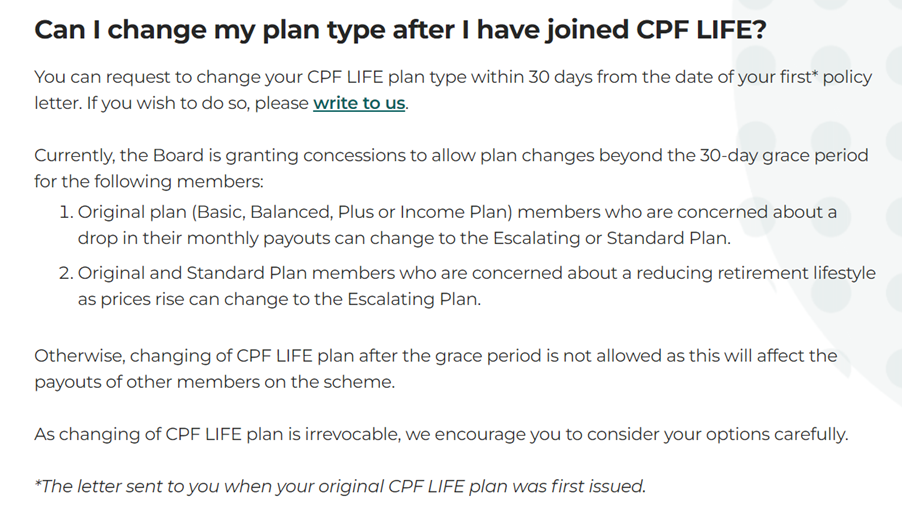
Use the one-way door. Technically you get 30 days from your first policy letter to change plans. But CPF is currently allowing Standard Plan members to switch to the Escalating Plan after that window as well, if they are “concerned about a reducing retirement lifestyle as prices rise”. The switch is irrevocable, there is no door going the other way, and it’s an exception rather than a rule so I wouldn’t rely on it. But as things stand, the Standard Plan keeps an option open that the Escalating Plan doesn’t.
There’s 2 ways to see the whole thing.
Either inflation averages 2% for the next 25 years, and both plans deliver what they promised.
Or inflation runs hotter than that, and only one of the two plans was built for it.
Either way, the 2% escalation is pretty cheap insurance – because you’re not actually paying for it. You’re just taking the same money a bit later.
Which brings us to the million dollar question – which plan would I pick?
The way I see it, it depends on what CPF LIFE is to you.
If CPF LIFE is most of your retirement income – if the payout basically is the budget – I would take the Escalating Plan, and defer it if you can fund the bridge. A payout that is the budget has to hold its value, and the one cost you cannot cut at 85 (healthcare) is the one going up the fastest.
If CPF LIFE is just the floor under a portfolio that already has inflation protection built in – stocks, REITs, maybe a rental property – then I think the Standard Plan is perfectly defensible.
Your stocks and property do the escalating, CPF does the guaranteeing, and you keep the one-way switch in your back pocket if prices really run.
For women, I would lean Escalating on the odds alone – 42% make it to 90, vs 27% of men.
For what it’s worth, if I were 65 today, I would take the Escalating Plan – and I would may defer it to 69 than take the Standard Plan at 65, because given the choice, I would rather have S$1,780 that goes up every year than S$1,780 that doesn’t.
But touch wood lah…
What would change my mind?
If CPF ever changes the 2% step, or widens the gap between the two starting payouts, then the numbers above need to be redone.
So that’s how I’m thinking about the CPF LIFE plans today.
Love to hear what you think!
This article was written on 16 Oct 2026. It will not be updated going forward.
How my own portfolio is actually positioned – with weekly updates on what I buy and sell – is shared on FH Premium, alongside my full stock watchlist and the prices at which I would buy.
Join the FH mailing list and new articles land straight in your inbox:
Also on WhatsApp, Telegram and Facebook.