The price action in the Singapore banks this week was… not pretty.
OCBC is down 10% from Tuesday’s high, UOB 8%, DBS 6% – and on Thursday the STI had its worst day since April 2025.
A month ago I wrote that OCBC was not cheap at S$32, despite being a shareholder.
Well, it’s S$29 today.
So… buy the dip, or is more downside coming?
How much did DBS, OCBC and UOB fall this week?
The numbers below are as at Thursday’s close (8 Oct 2026):
| Wed 7 Oct | Thu 8 Oct | 2 days | From 52-week high | |
| DBS | −1.4% | −4.7% | −6.0% | −6.6% |
| OCBC | −5.9% | −4.3% | −9.9% | −11.0% |
| UOB | −2.9% | −5.2% | −7.9% | −10.9% |
| STI | −1.6% | −3.5% | −5.1% | −6.7% |
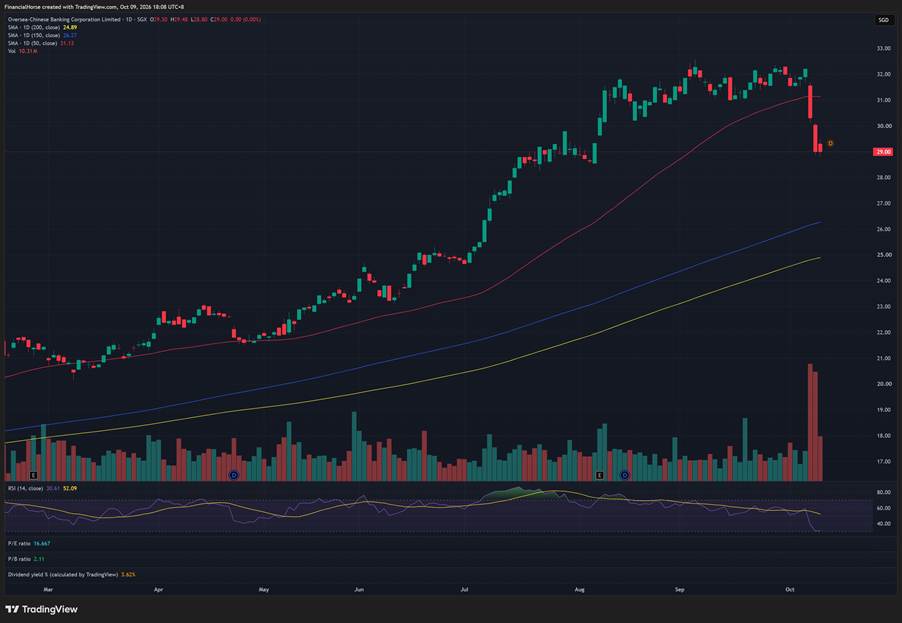
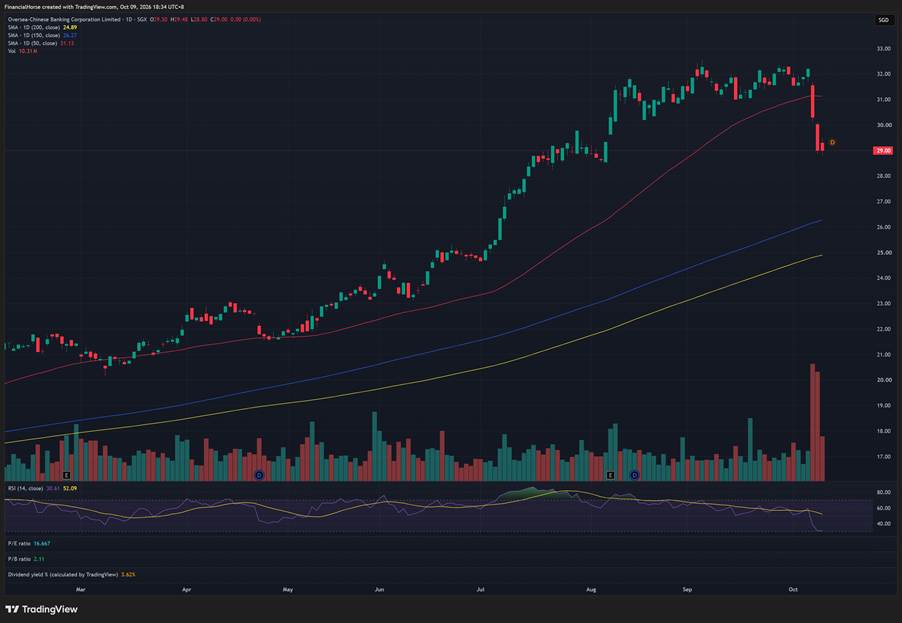
Here’s the chart of OCBC for reference.
Note how the Wed and Thurs decline was on very high volume – which is not a good sign.
Two other things stand out.
The first is that Mon and Tues were up days – the STI actually rose 1.2% over the first 2 sessions.
The whole move happened in 2 sessions on Wed and Thurs.
The second is that OCBC went first and fell the most, while DBS only joined the sell-off on Thursday.
It wasn’t just the banks
On Thursday, Keppel fell 4.8%, ST Engineering 4.7%, SGX 3.1%, Hongkong Land 2.7% – and SIA, Singtel and CapitaLand Integrated Commercial Trust all closed down as well.
Of the large caps, Jardine Matheson was the only one that finished the day up.
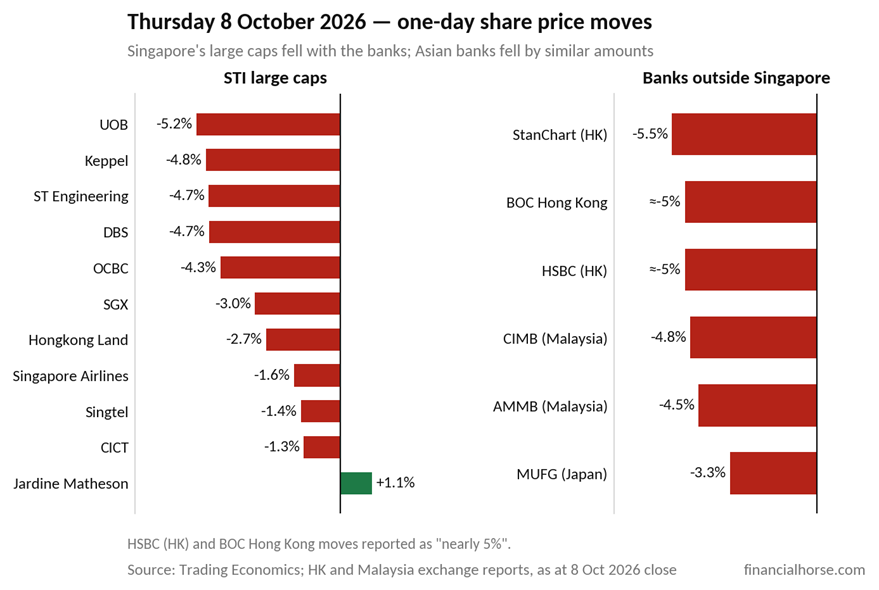
So yes, the banks led – but the whole STI index got sold.
And it wasn’t just Singapore either.
HSBC and Standard Chartered fell about 5% in Hong Kong on Thursday, Bank of China (Hong Kong) about the same, and in Malaysia CIMB fell 4.8% and AMMB 4.5%.
European banks were down 3.4% on Wednesday, and the 2-day drop into Thursday was their worst since March.
In plain English – this was a bank sell-off across Asia and Europe, and in Singapore it dragged the whole index down because the 3 banks are roughly half of the STI.
What drove the sell-off?
Let’s start with the immediate catalyst.
On Wednesday morning, Citi cut OCBC to Sell with a S$27.50 target.
Their argument, very simply, is that:
- 3Q earnings will be flat year on year
- the capital ratio is slipping
- the P/E has expanded 46% this year (the most of the 3 banks)
- OCBC’s dividend yield is now the thinnest cushion over bond yields.
OCBC fell 5.9% that day on more than 3 times its normal volume – roughly S$8 billion of market value gone in a session.
Then on Thursday, JPMorgan published a note on Southeast Asian banks saying the 3Q “surprise is likely skewed negative”, and told clients to trim bank exposure.
That note didn’t just hit Singapore – it downgraded CIMB and AMMB in Malaysia the same day, which is why they fell as much as DBS and UOB did.
But c’mon let’s be realistic.
A broker note does not take S$8 billion off a bank market cap in a morning.
The rating downgrade was the catalyst, but it was not the underlying reason.
Under the surface, someone was already waiting to sell, and they were merely waiting for an excuse to pull the trigger.
An excuse that came on Wed.
Was it a positioning unwind?
My first instinct this week when I saw the price action was that this was a positioning unwind.
Too many people crowded into the same trade, the trade went up too far, and a downgrade was all it took to trigger the selling.
The problem though – is that the data doesn’t really back up this theory.
Institutions were net sellers of DBS for the whole of 2026 – more than S$1 billion net sold by end-August – and they were net sellers of all 3 banks in August.
In the last weeks of September however, they were actually net buyers of financials.
And there was no index rebalancing this week, no ex-dividend date, no block trade, no sovereign selling that I could find.
And on Thursday, nothing got bought – REITs, Keppel and ST Engineering fell too, so this wasn’t money rotating out of banks into something else.
If it’s a fund flow issue, then it was institutions just flat-out reducing risk exposure to Singapore.
Never miss a post! Follow Financial Horse on WhatsApp or Telegram — one tap, and every new article reaches you the moment it’s published.
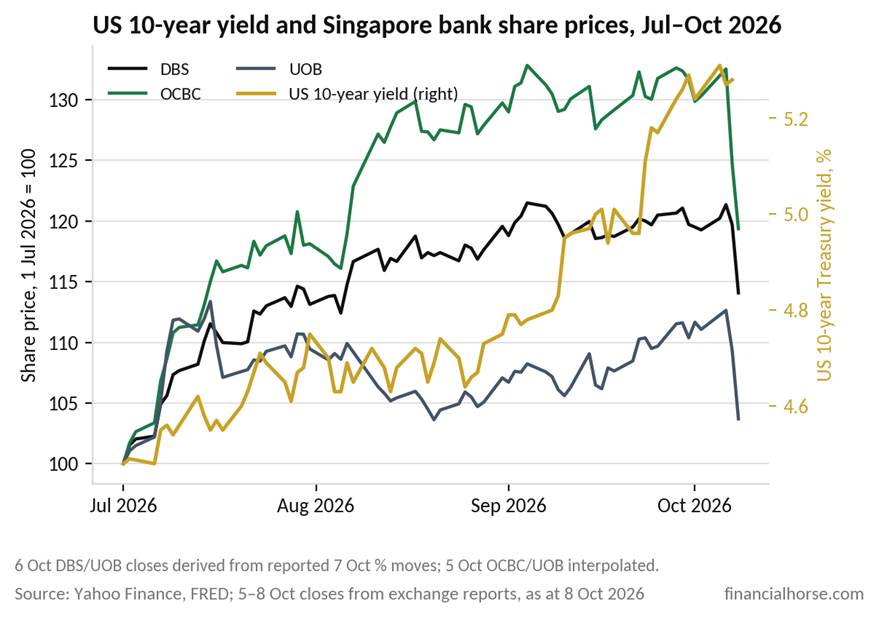
The real reason – rising long term interest rates is causing a valuation reset?
Now this is my theory, and for obvious reasons I could be wrong so take it with a pinch of salt.
But zoom out and look outside Singapore.
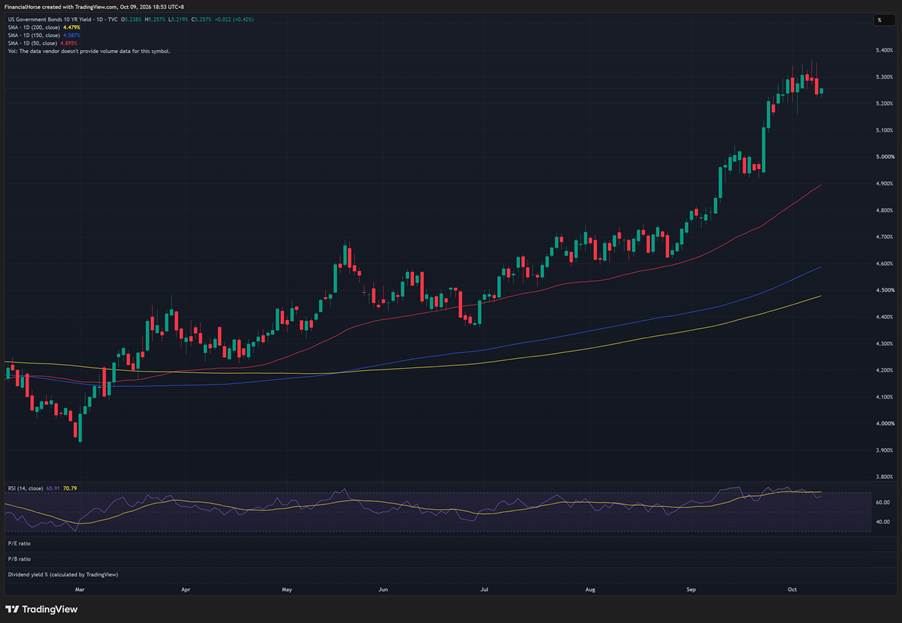
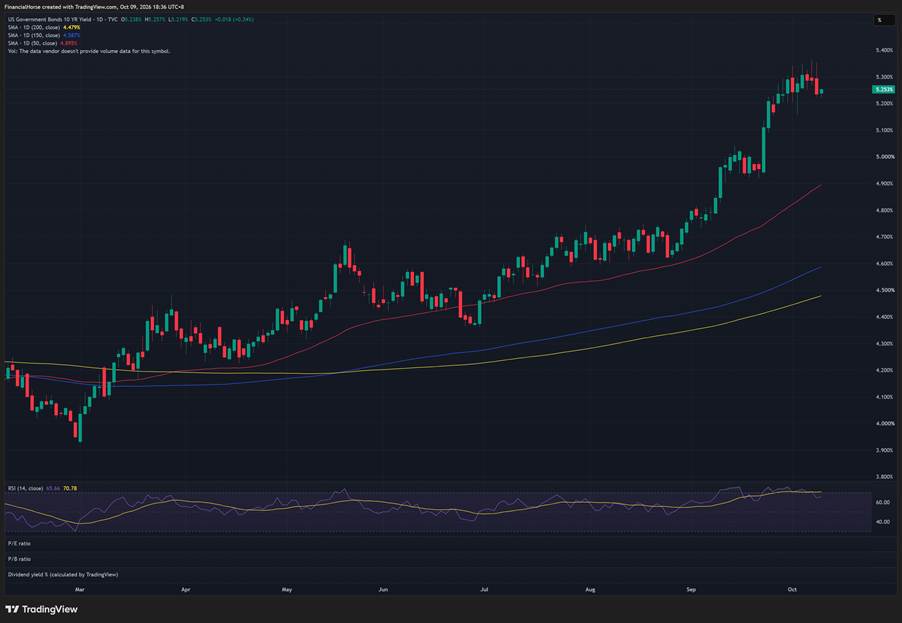
The US 10-year Treasury yield touched 5.36% on Wednesday – the highest since 2002.
The 30-year UK gilt is at 6%.
Brent crude is back above US$105.
And the Fed, which hiked in September, released minutes on Wednesday showing most officials want one more hike before year end.
So yes, nothing happened to the banks’ earnings this week.
What changed is the broader macro environment.
When a US government bond pays you 5.3% a year for 10 years – the price the world is willing to pay for a dollar of bank earnings is just not the same.
You can see this in the US, where the bank index is down about 10% from its August peak.
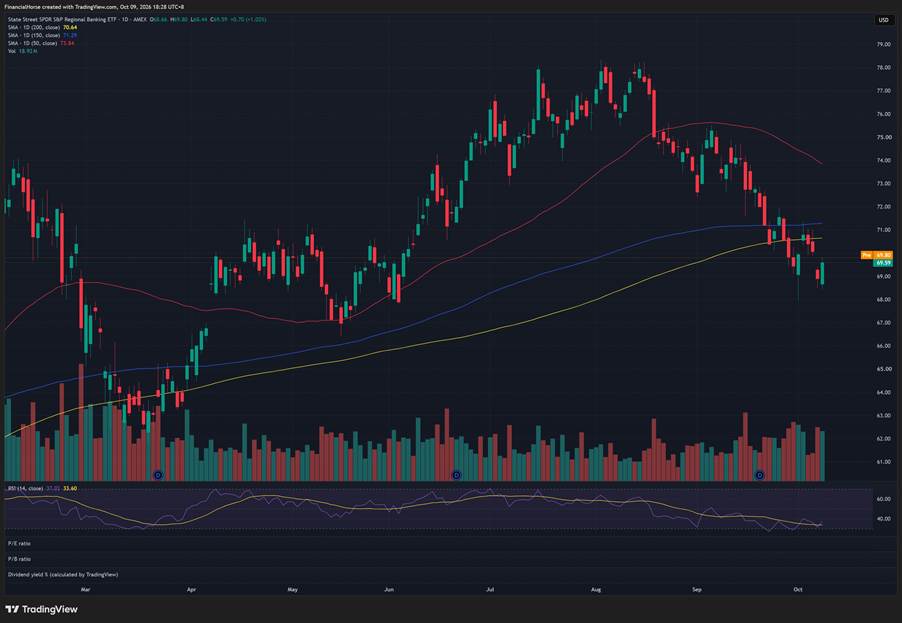
If I am right.
Then this isn’t really an OCBC story, nor is it a Singapore story.
It was a global re-pricing of banks, which has been playing out in the US for a while now, this week it finally reached Singapore.
BUT – Why did Singapore banks fall the most?
Couple of reasons why Singapore banks are more vulnerable to a sell off.
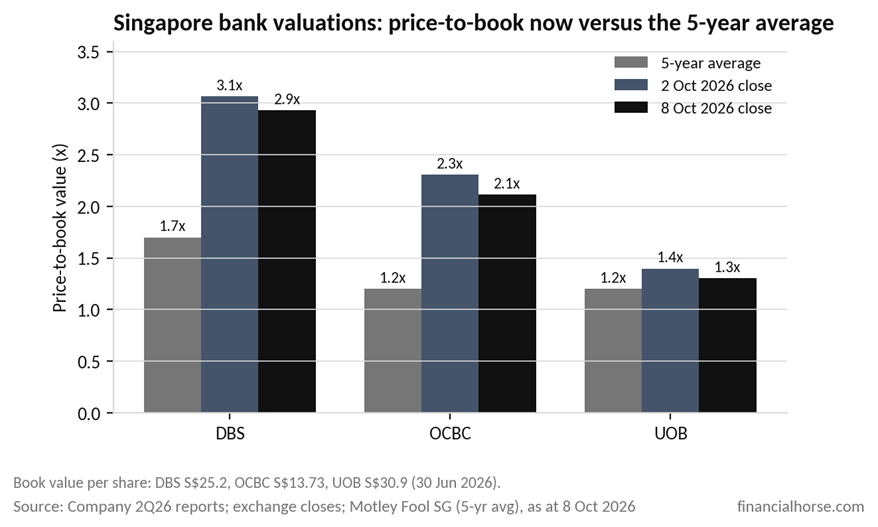
One – we had the most expensive banks in the region.
At last Friday’s close, DBS was trading close to 3 times book value, OCBC about 2.3 times, and UOB about 1.4 times.
The 5-year averages are 1.7 times, 1.2 times and 1.2 times.
At those kinds of multiples, the maths is brutal.
If investors demand just half a percentage point more return for holding a bank – which is roughly what a 5% Treasury does – fair value at 3 times book drops by close to 10%.
Coincidentally which is about the extent of this week’s move.
Two – Singapore rates are decoupled from US rates.
The usual argument is that higher interest rates are good for banks.
But Singapore rates have not gone up.
3-month SORA is 1.23%, and the 10-year Singapore government bond yields 2.48% – both basically unchanged this week.
So the banks don’t get the benefit of higher rates on their loan book.
What they get is the cost side – fixed-deposit rates creeping up, bond portfolios marked down against a 5.3% Treasury, and a 4% dividend yield that now has to compete with a 5.3% risk-free yield in US dollars.
In plain English – only the bad half of “higher rates” reaches Singapore.
Three – OCBC had the most to give back after a huge 2026 rally.
OCBC’s P/E went from about 12 times at the start of the year to about 18 times before the sell-off.
Its 2Q profit was up 22% – but a good chunk of that came from Great Eastern’s investment income, which management itself called volatile, and wealth fees that it said were already moderating in July.
Its capital ratio is sitting right at its 14% target, and the S$2.5 billion capital return programme ends this year.
In plain English, after the huge 2026 runup, OCBC was looking somewhat expensive – and vulnerable to a sell-off.
What happens next for DBS, OCBC and UOB?
But that’s all done and dusted.
What’s key to understand – is what happens next.
And to me it depends on 2 factors.
The biggest one is long-term interest rates.
I wrote a full macro piece for FH Premium readers this week on the US 10 year yield.
Long and short is that if the US 10-year stays above 5%, I don’t think the sell-off is finished.
Whereas if long rates peak soon, then I could well see a nice rally into Christmas and perhaps even some more in 2027.
And what drives long term interest rates – it all goes back to Iran.
If Strait of Hormuz opens tomorrow then I think we’re all good.
If Strait of Hormuz stays shut into mid 2027, boy things are going to get rough.
The second is 3Q results in early November.
Citi and JPMorgan are now bearish on bank earnings – calling for margin compression, and trading and wealth income normalising from a very strong first half.
On the flip side – RHB raised its forecasts for OCBC and UOB, and Jefferies calls this a valuation reset, not a fundamentals problem.
Who is right?
The next round of bank earnings results will tell us, and we’ll know in early Nov.
If bank earnings stay strong, I could see a recovery from current levels.
What would I do – buy the dip, or more downside coming?
Which brings us to the million dollar question.
Do I buy this dip?
Or do I take profit in my positions to guard against further downside.
Full disclosure – I hold meaningful exposure to OCBC and UOB, with OCBC the bigger of the 2.
So yeah this week definitely hurt.
But that said in September, I looked at OCBC and wrote that OCBC was not cheap at S$32.
So I can’t claim to be surprised by this week either.
I know my own 2 biases here.
I sell winners too early – so I am not going to panic-sell OCBC into a 2-day drop when nothing has changed in the business.
And I average into losers – so I am also not going to buy the dip just because the stock is 10% cheaper than it was on Tuesday.
By that logic, the best move may be to do absolutely nothing, for now.
What would change my mind?
Well if long-term interest rates top out and start coming down, or the banks 3Q earnings show the margin and the fee income holding up, and the stocks go back into an uptrend.
In those scenarios I might add, but then again OCBC at $30ish is not exactly a steal, so I’ll still need to think about it.
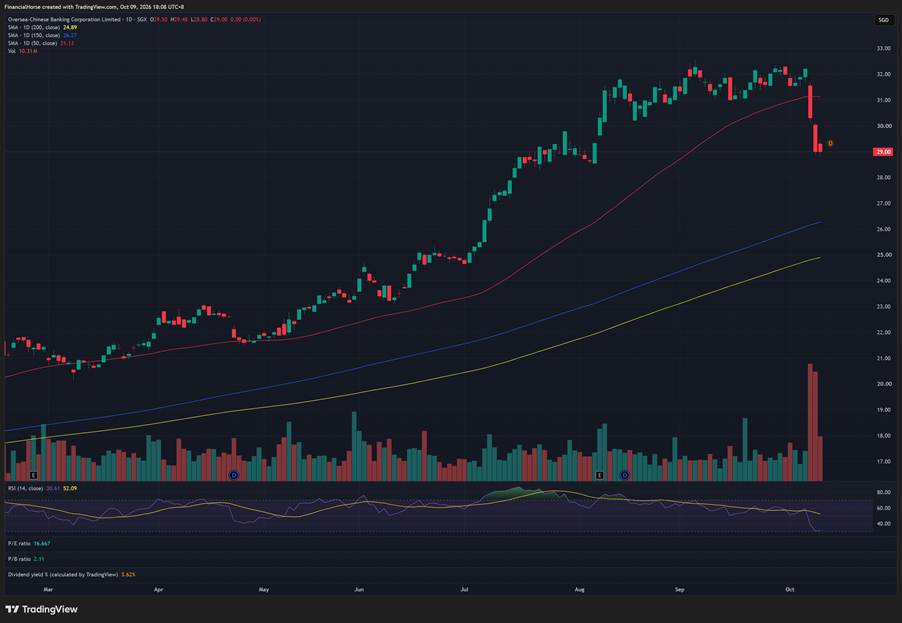
Whereas on the flip side if interest rates stay high, and OCBC’s price action starts to break key technical levels – then I get really worried and I may look at taking profit.
That being said, markets move quickly, and if the facts change I’ll change my mind.
Love to hear what you think!
This article was written on 8 Oct 2026. It will not be updated going forward.
How my own portfolio is actually positioned — with weekly updates on what I buy and sell — is shared on FH Premium, alongside my full stock watchlist and the prices at which I would buy.
Join the FH mailing list and new articles land straight in your inbox:
Also on WhatsApp, Telegram and Facebook.