Okay so quite a few of you have asked me whether the cash picture has changed, now that long-term interest rates are spiking.
Back in August I wrote that T-bills paid just 1.56%, and that the honest answer for cash was to accept a small real loss.
6 weeks later, the US 10-year yield has touched 5.36% – the highest since 2002.
The 6-month T-bill has jumped to 1.90%, and the November Singapore Savings Bond pays 2.45% – the best issue this year.
All while S-REITs, which pay 6.6%, are down close to 10% in 2026 while the STI is up more than 20%.
So… if I had S$100,000 of cash to park today – T-bills, bonds, or REITs?
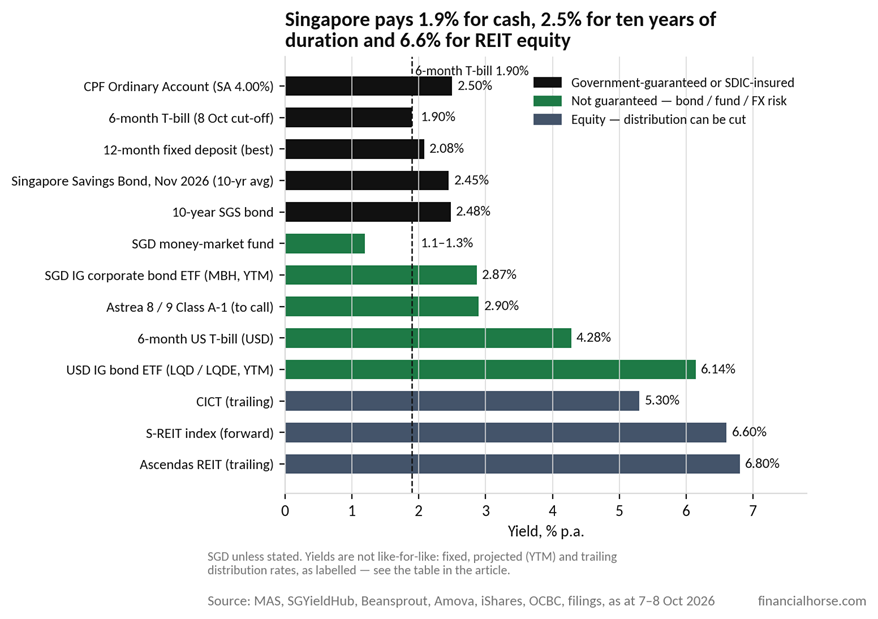
The short answer – cash options compared
To sum it up.
Bonds finally pay 3% in SGD and 6% in USD, but almost all of that is payment for interest-rate risk, not a free lunch. If interest rates continue going up, you’ll be sitting on a mark to market loss.
And S-REITs at 6.6% are the one thing on this list that is cheap against its own history – but they are equity, not cash. As the past few months have shown, you can suffer capital losses with REITs.
Here’s the various options compared:
| Instrument | Yield today (as at) | Yield type | Capital protected / SDIC | Getting your money back | The risk you are taking |
| CPF OA / SA | 2.50% / 4.00% (Oct–Dec 2026) | Guaranteed | Government | Locked until 55 | None – except you cannot get it out |
| 6-month T-bill | 1.90% (8 Oct cut-off) | Fixed at auction | Government, no cap | 6 months, tradeable | Reinvesting at a lower rate |
| 12-month fixed deposit (best) | 2.05–2.08% (7 Oct) | Fixed | SDIC up to S$100k | 12 months, penalty to break | None |
| Singapore Savings Bond (Nov 2026) | 1.67% year 1, 2.45% 10-yr average | Fixed step-up | Government, S$200k cap | Redeem at par any month | None |
| SGD money-market fund | 1.1–1.3% (Aug–Sep) | Floating, not guaranteed | No SDIC | 1–2 days | Fund gating in a rush for the exit |
| 10-year SGS bond | 2.48% (7 Oct) | Fixed if held to 2036 | Government | Tradeable, price moves | Duration – almost 9% loss per +1% in yields |
| SGD IG corporate bond ETF (MBH) | 2.87% yield to maturity (31 Aug) | Projected | No | Tradeable | 5.8 years of duration + credit |
| Astrea 8 / 9 Class A-1 bonds | ~2.9% to call (8 Oct price) | Fixed if called on time | No (PE cash flows, rated AA) | Tradeable, thin | Call gets pushed out |
| USD T-bill / USD fixed deposit | 4.2–4.6% (7 Oct) | Fixed | US government / bank – no SDIC on foreign currency | 3–12 months | Currency – the SGD is up 1% in 3 months |
| USD IG bond ETF (LQD / LQDE) | 6.1% yield to maturity (6 Oct) | Projected | No | Tradeable | 7.5 years of duration + currency + credit |
| S-REIT ETF (Lion-Phillip / CSOP) | 5.8–6.3% trailing (8 Oct) | Distribution, can be cut | No | Tradeable | Equity – fell 11% in 2022 |
| CICT / Ascendas REIT | 5.3% / 6.8% trailing (7 Oct) | Distribution, can be cut | No | Tradeable | Equity + single-name risk |
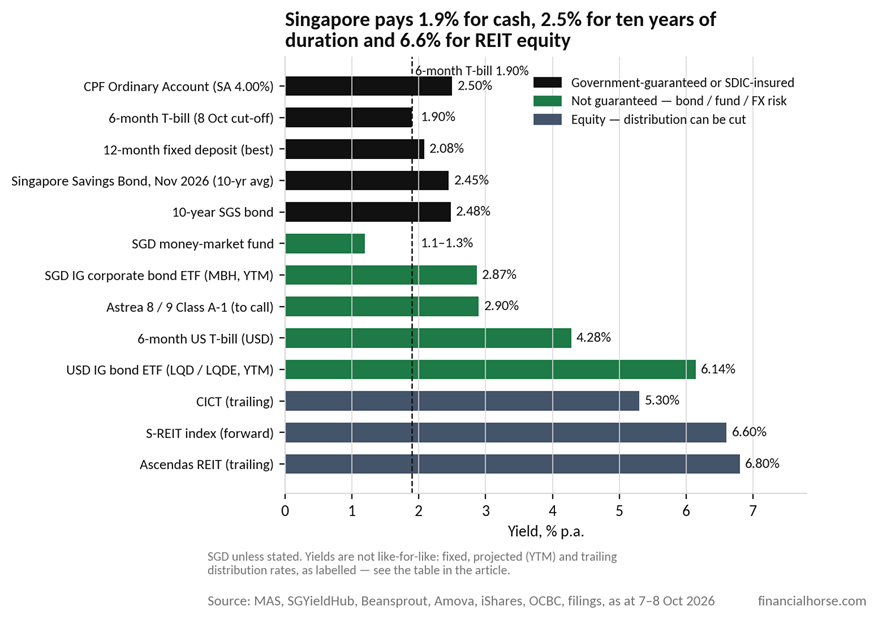
Here’s the chart for reference.
Bucket 1 – T-bills at 1.90%, fixed deposits at 2.05%, Singapore Savings Bonds at 2.45%
3 things have changed since August.
One – the 6-month T-bill ladder now pays 1.90%, up from 1.36% in February and 1.56% when I last wrote.
But the best 6-month fixed deposit now pays more, at 2.05%.
Two – the SSB is the quiet winner.
The November issue pays 1.67% in year 1, stepping up to 3.08% in year 10, for a 2.45% average – up from 2.06% in August.
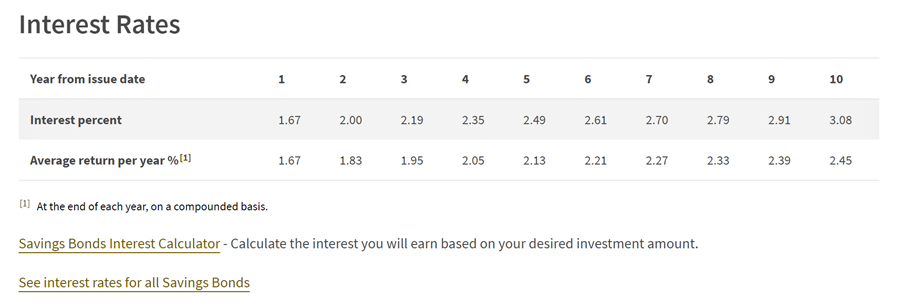
Redeem at par any month, S$200,000 cap per person, and the October issue was undersubscribed – so allotment is not the problem it was in 2023.
Here’s how 2026 has gone for both:
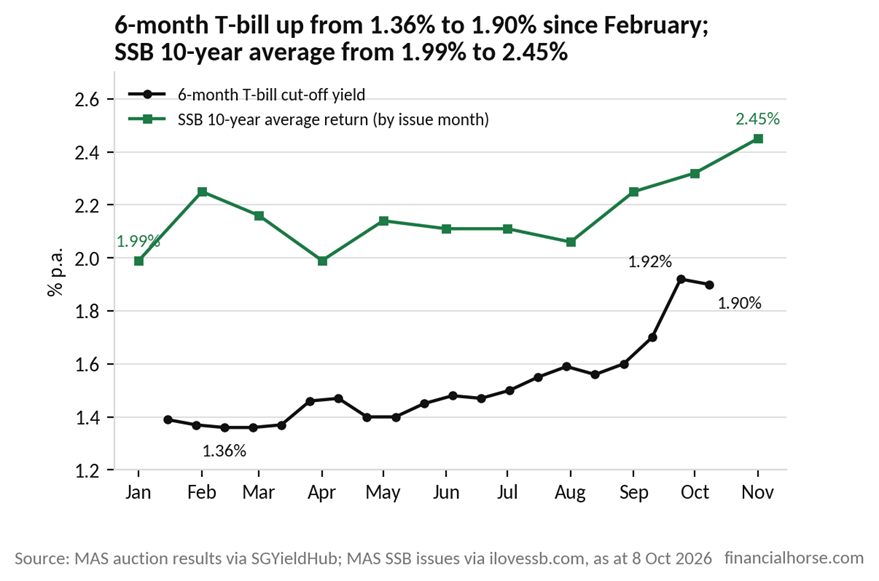
The T-bill has gone up at almost every auction since April, and the SSB average has gone from 1.99% in January to 2.45% in November.
Three – the cash-management apps have fallen behind.
SGD money-market funds pay 1.1–1.3% today, so the plain T-bill beats them by 60–70 basis points – which does not happen often.
And CPF is still CPF – OA at 2.50% and SA at 4.00% remain the only guaranteed returns above inflation, one-way door and all.
Never miss a post! Follow Financial Horse on WhatsApp or Telegram — one tap, and every new article reaches you the moment it’s published.
Bucket 2 – bonds finally pay 3% in SGD and 6% in USD. What’s the catch?
Singapore-dollar investment-grade bonds now pay about 3% – the SGD corporate bond ETF (MBH) has a 2.87% yield to maturity, and the Astrea 8 and 9 Class A-1 bonds yield about 2.9% to their call dates.
In US dollars it is better still – the big investment-grade ETFs (LQD, or the Irish-domiciled LQDE) yield 6.1%, and a plain 6-month US T-bill pays 4.28%.
There are 3 catches – the first is duration.
The SGD government bond ETF (A35) is down about 3% this year, and MBH carries 5.8 years of duration – which means another 1% rise in yields costs you close to 6% of your capital.
The second is that you are not being paid for credit risk at all.
US investment-grade spreads are 83 basis points – within 10 basis points of this year’s low, and tight by any historical standard.
Which is why LQD is down more than 4% this year with no credit event anywhere – the entire loss is interest rates.
The third catch is the currency.
A 4.2% US T-bill hedged back into Singapore dollars costs roughly 3% a year to hedge – the gap between US and Singapore short rates – which leaves you with about the same as a Singapore T-bill.
Unhedged, the US dollar has fallen 1% against the SGD in the past 3 months alone, which is a quarter of your yield gone.
The honest middle is short-duration investment grade – 1–3 year USD paper yields 5.3–5.6% and is flat this year, and the SGD short-duration bond funds yield 2.5–2.8% gross and are flat too.
In plain English – buying 7 to 10 years of bond duration today is a bet that long-term interest rates have peaked.
Either that or you have no problem to hold to maturity to ride out any mark to market loss.
If that’s you, then bonds are pretty interesting.
But no doubt this is not risk free, so unlike Bucket 1 you do need to accept some level of risk here.
Bucket 3 – S-REITs at 6.6%: a bond proxy that isn’t a bond
And then we have the most risky bucket on this list.
But also the highest yield.
REITs.
A REIT is equity style risk – the 6.6% dividend yield can be cut, and the price can fall 20% while you wait for it, which is exactly what happened in 2022.
And not all REITs are equal, so unless you buy an index, you do need to spend some time picking.
That’s the downside.
The upside on the other hand.
Is that the S-REIT index today yields 6.6% against a 10-year average of 6.1%.
That is about 4 percentage points over the 10-year SGS, versus a long-run average of about 3.8 points, and the sector trades at 0.85x book versus a 10-year average of 0.96x.
The big names sit within a few percent of their 52-week lows – CICT at 5.3%, Ascendas REIT at 6.8%, Mapletree Logistics at 6.6%.
With about 75% of the sector’s debt hedged, every 1% rise in borrowing costs takes roughly 3% off distributions – not 30%.
In plain English – REITs are cheap, very cheap.
REIT prices have not fallen because the rental income fell, they have fallen because risk free interest rate rose.
That said in 2022 the 10-year SGS peaked in October at 3.63%, and the REITs did not bottom until late 2023.
The long end turns first, and the REITs follow with a lag – so the thing to watch is the 10-year yield, not the REITs.
And has the 10 year yield peaked today?
Who knows.
Where I would park S$100,000 of cash today
Which brings us to the million dollar question.
Assume the S$100,000 is cash I have already decided not to put in stocks
I would broadly split them as follows:
Emergency cash
High-yield savings account or the front of the T-bill ladder – accept the small real loss against 2.2% core inflation, that is the price of liquidity.
6–12 month money
The 6-month T-bill ladder at 1.90%, or the 2.05% fixed deposit if I cannot be bothered with fortnightly auctions.
Multi-year money
The November SSB at 2.45%, up to the cap. Then CPF for the tranche I am happy to lock away.
Yield-seeking risk money
To be clear this is not cash, and this is money at risk.
If I were to deploy some cash here today, I think the REITs look interesting.
Sure they may continue to go down short term and its definitely a falling knife.
But I’m willing to wager that at some point in the next 2 – 3 years I’ll probably be able to exit these REITs flat or up, in which case all the yield is just profit.
But hey I could be wrong though.
Love to hear what you think!
The views above are as at 9 Oct 2026, and markets move quickly.
My latest macro views, what I’m doing with my own money this week, and what would change my mind, are shared on FH Premium.
Join the FH mailing list and new articles land straight in your inbox:
Also on WhatsApp, Telegram and Facebook.