Okay so a reader wrote in recently asking me to take a look at Daiwa House Logistics Trust (DHLU) – is it a good risk-reward, given the exposure to Japan and Vietnam logistics?
And I get it.
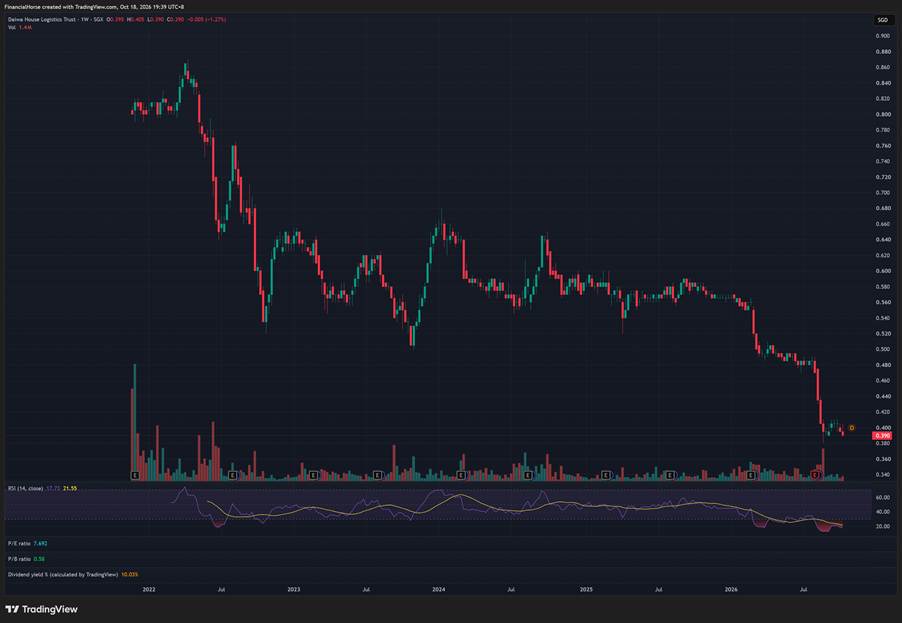
The unit closed at S$0.39 on Friday, which is 51% below the S$0.80 IPO price, and as far as I can tell the lowest it has ever traded.
At that price it pays a 10% trailing dividend yield, and trades at 0.62x book.
That’s pretty crazy numbers.
But I also remember taking a speculative position in Eagle Hospitality Trust and losing all my money.
So… is this a good risk-reward, and will I buy?
It’s a fairly detailed piece, so if you want to skip the analysis you can jump straight to the conclusion and what I’m doing at the end.
Price Action is terrible
Here’s the chart for reference.
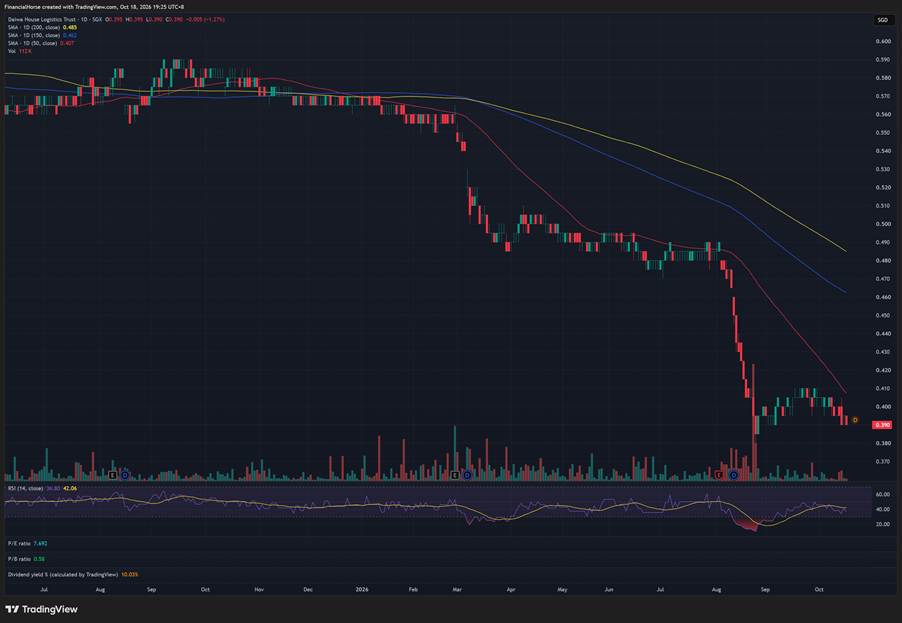
Just a falling knife, all the way from IPO.
For the record, I reviewed this REIT at IPO back in November 2021 and flagged the yen, the small sponsor stake and the leverage.
Personally I applied for the IPO, got no allocation, and never bought it after that.
Five years on, every one of those risks has played out.
This is an FH Premium article written a few weeks back that I am releasing to all readers. For more articles like this, my full personal portfolio and stock watch, do check out FH Premium!
First, this is not a Japan and Vietnam REIT
Let me get this out of the way first, because the way the question was framed is slightly off.
Vietnam is 1 property.
A cold-storage warehouse outside Ho Chi Minh City, bought from the sponsor in 2024 at an 8.3% yield, with a single tenant on a 20-year lease.
Good asset, but it’s 3% of the portfolio by value and about 6% of net property income.
The other 18 properties are in Japan, and 97% of what this REIT earns is in yen.
In plain English – you are buying Japanese warehouses, with a yen income stream, paid out to you in Singapore dollars.
So the real question is a lot simpler than Japan vs Vietnam.
Do I want a 10% yield that is paid in yen?
What you actually own at S$0.39
Here’s the key highlights slide from the 1H 2026 results:
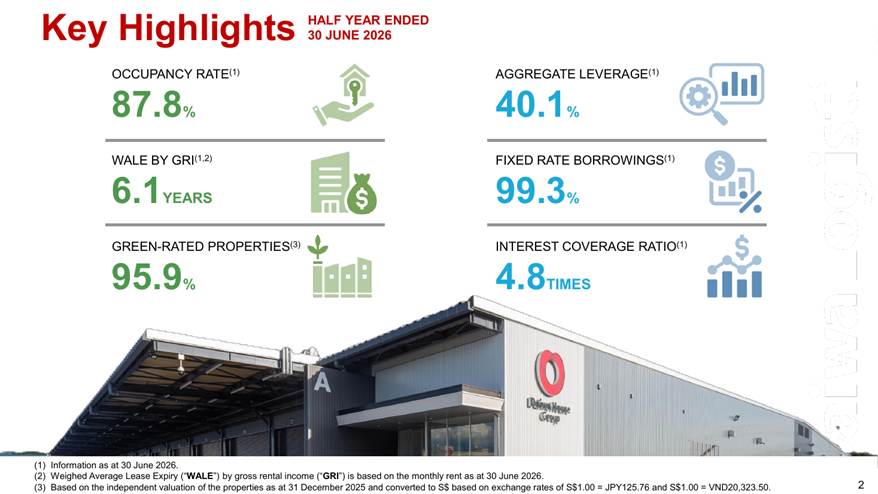
40% gearing, 99% fixed rate debt, 4.8 times interest cover – nothing alarming on the surface.
The 87.8% occupancy is the number that stands out though, which I’ll come back to later.
Here’s the full portfolio for reference:
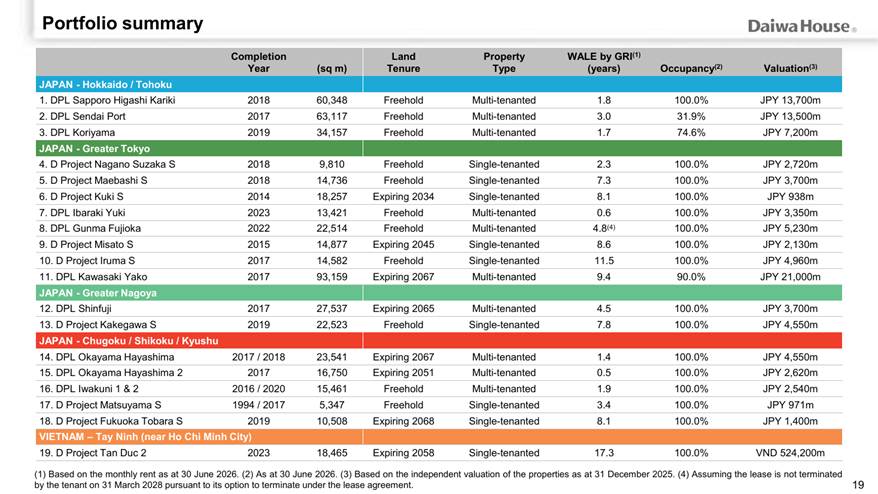
A couple of things to note.
About 45% of the portfolio is “Greater Tokyo” by the manager’s definition, but most of that is Gunma, Nagano, Ibaraki – the outer prefectures.
The only true Tokyo-area asset is DPL Kawasaki Yako, which at ¥21 billion is 21% of the whole REIT on its own.
Another third is in Hokkaido and Tohoku, and that’s where the vacancy is – Sendai Port at 32%, Koriyama at 75%.
The reason the portfolio looks like this is that the sponsor’s best Japanese assets go to its own Tokyo-listed REIT and private funds first, and DHLU is fourth in the queue.
The buildings themselves are fine though – average age under 7 years, 96% green-rated, and 80% of the tenants are 3PL operators like Mitsubishi Shokuhin, Suntory Logistics and Nippon Express.
And the sponsor is Daiwa House Industry, which is an AA-rated company with a ¥3 trillion market cap and about 13.5% of the units.
So this is not a dodgy sponsor with dodgy buildings.
At S$0.39 the numbers are: NAV of S$0.63 (so 0.62x book), trailing DPU of 3.91 cents (10% yield), market cap of about S$274 million.
The problem is what has happened to the income.
The DPU has fallen for 6 straight half-years
This is the problem in a nutshell:
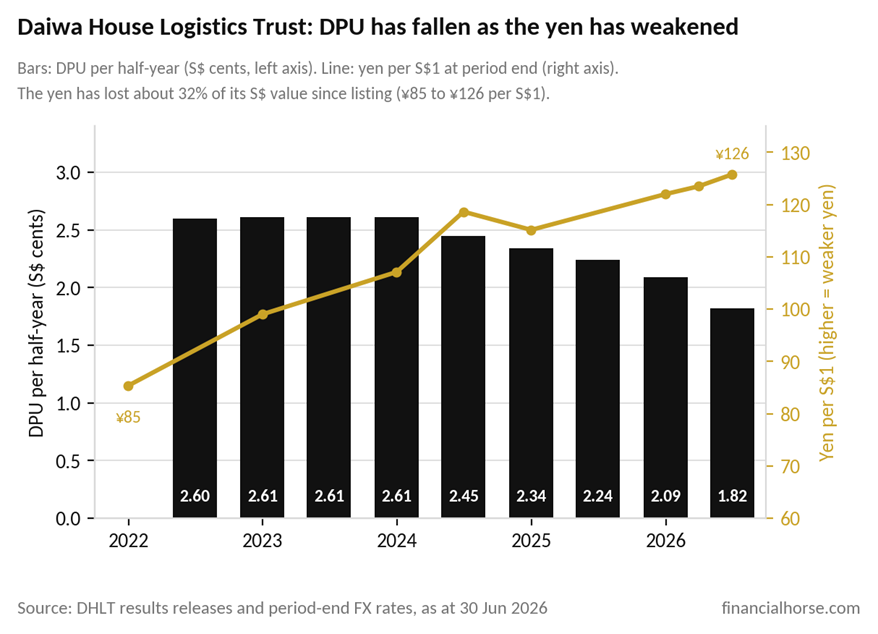
DPU peaked at 2.61 cents a half in 2023, and the latest half was 1.82 cents.
That’s a 30% drop in the distribution in 3 years.
And over the same period the yen has gone from ¥85 to ¥126 per Singapore dollar, which is a 32% loss in value.
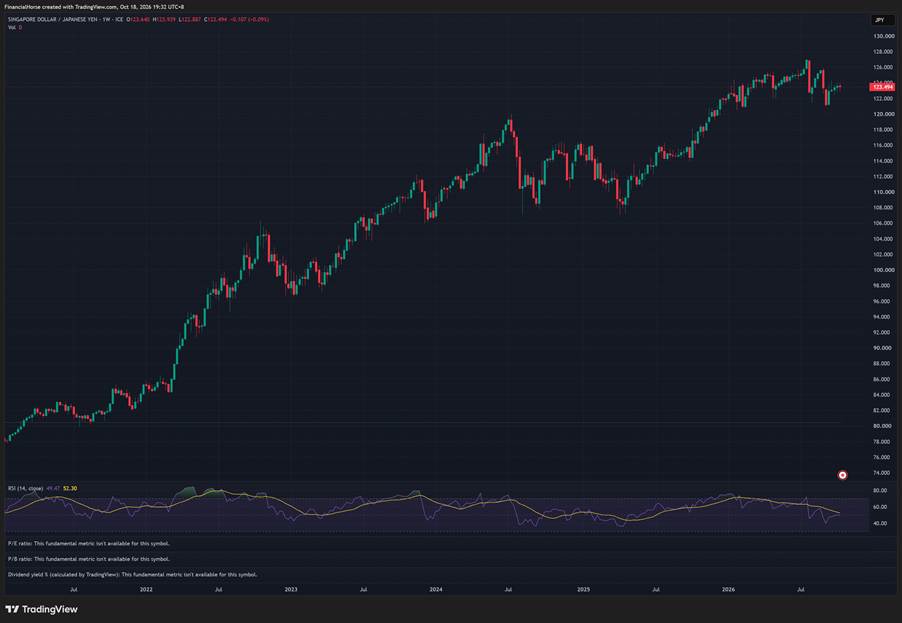
Not a coincidence.
So where exactly did the DPU go?
The trust doesn’t publish a bridge, so I ran the numbers myself:
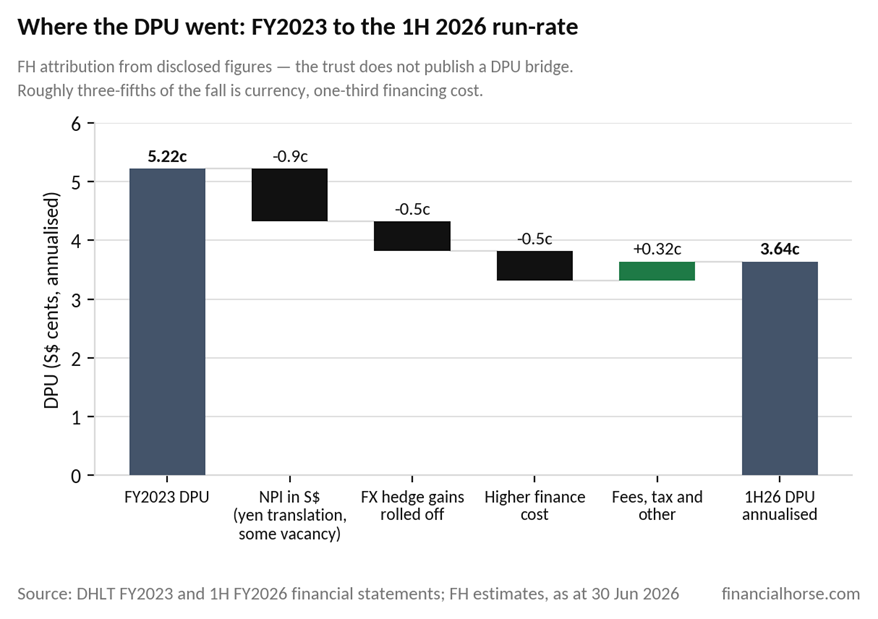
Roughly 60% of the decline is currency – the yen translation of the rental income, plus the FX hedges rolling off.
About 30% is financing, because the all-in cost of debt has gone from 0.99% to 2.05% as the BOJ started hiking.
Vacancy is the smallest piece, although it’s the one that is growing.
The hedges are why the DPU looked so stable in 2022 and 2023 while the yen was already falling – at IPO the distributions were hedged a year forward at the old rates, and those hedges delivered S$3.8 million of gains in FY2023.
In 1H 2026, the same line was S$0.2 million.
In plain English – the currency hedge is gone, and from here on any yen depreciation flows straight into the DPU with at most a one-year lag.
To be fair to the manager, the properties themselves held up for the first 3 years – net property income in yen actually grew in 2023 and 2024.
But that has now turned too:
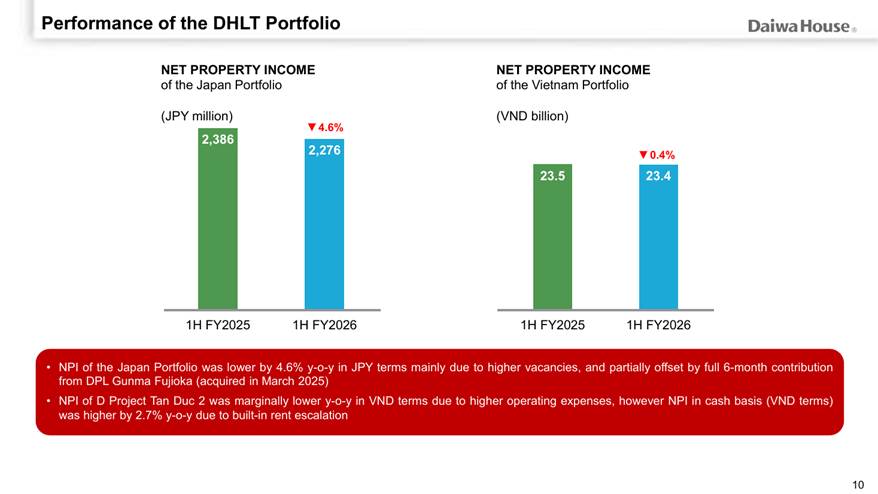
Japan NPI down 4.6% in yen terms, and the slide says why – vacancies.
So now the yen and the buildings are both leaking at the same time.
Here’s the occupancy slide:
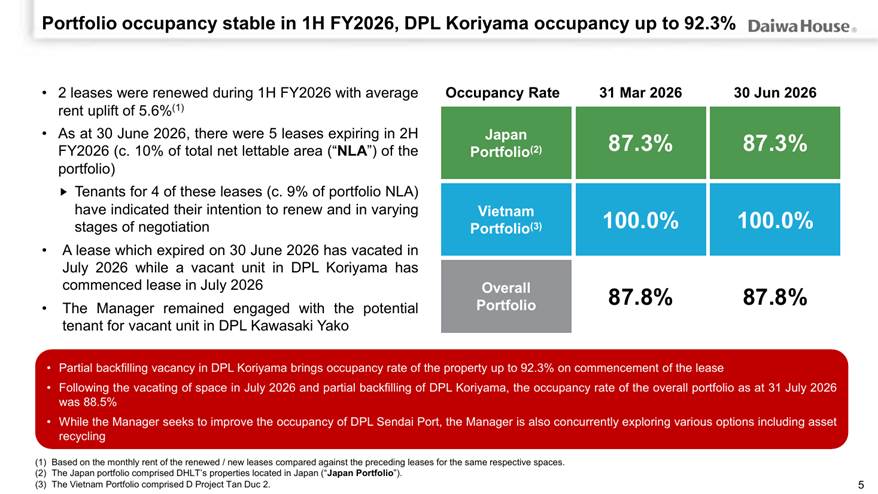
The occupancy problem has a name, and it’s DPL Sendai Port.
It’s the third-largest asset in the portfolio at about 13% of value, and it’s 32% occupied, because a big tenant left in 2025 and the floor plates are too large for the local market.
Management has ruled out an asset enhancement on cost, and is “exploring various options including asset recycling”.
Which is a polite way of saying they’re trying to sell it.
The 4 things that decide the next 12 months
If you ask me, it comes down to 4 things, and I’ll take them in order of importance.
One – the yen.
This is the big one, and nobody can forecast it.
The BOJ has hiked 3 times in the past 10 months to 1.25%, and in theory that should help the yen.
In practice the yen has kept weakening anyway, because the new government is running a loose fiscal policy and the 10-year JGB just hit a record 3.0%.
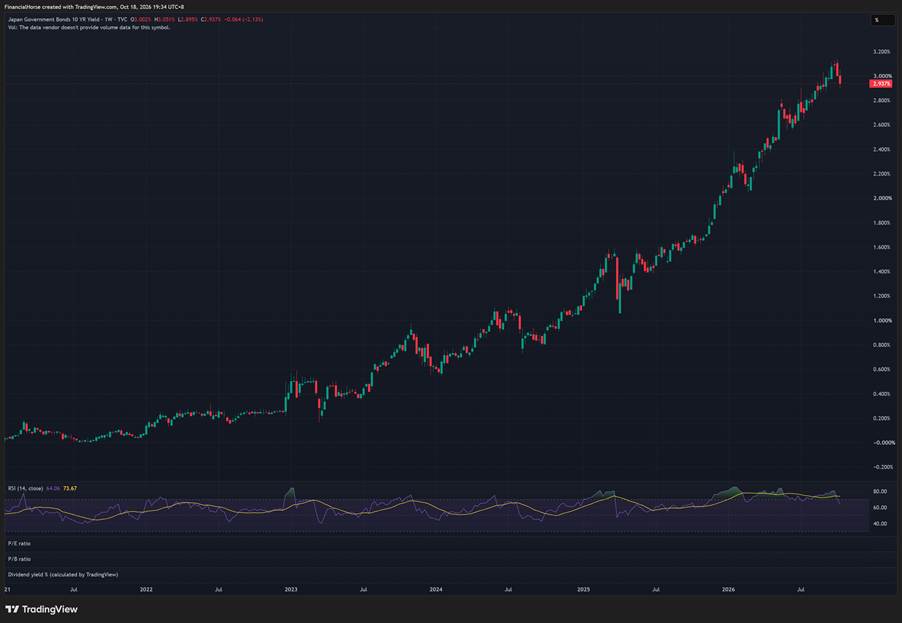
So in 2026 DHLU got the worst of both worlds – higher yen interest rates on its debt, and no yen recovery on its income.
And this is management’s own read – note the line that “JPY weakness is expected to persist”:
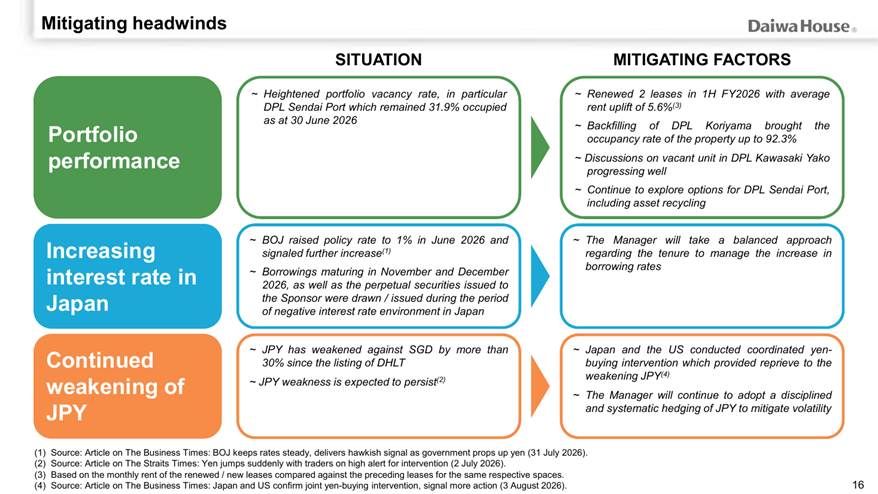
When the manager itself is telling you the currency is going to keep going against the REIT, I take that seriously.
Two – the refinancing in November and December.
Here’s the debt maturity profile:
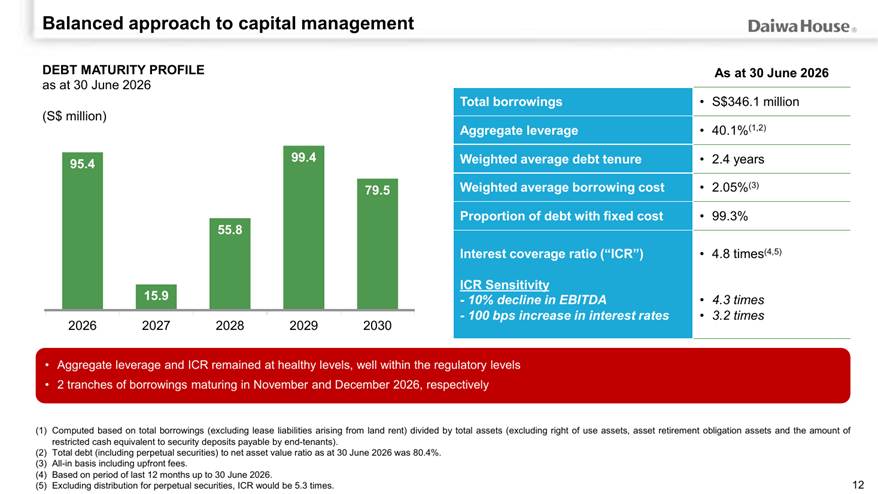
About S$95 million, or 27% of the borrowings, matures in the next 2 months – loans written back when Japan had negative interest rates, which management has said plainly will refinance at higher rates.
Their own sensitivity is that a 1.5 percentage point step-up on that tranche cuts DPU by about 4%.
On top of that, the ¥3 billion of perpetual securities held by the sponsor reset on 26 November – at a rate nobody has disclosed yet.
Three – the December revaluation.
The Japanese portfolio hasn’t been revalued since December 2025.
But the 10-year JGB is now at 2.9%, against a Tokyo Bay logistics cap rate of about 3.65%.
That’s a 70 basis point spread, which is very thin, and the Tokyo-listed logistics REITs already trade at 0.7–0.9x NAV because the market doesn’t believe those cap rates hold.
If the valuers move cap rates up even 25–50 basis points in December, that’s a 5–12% hit to asset values on a 40% geared book, and gearing goes to the mid-40s.
Still within the 50% limit – but at 0.62x book, any equity raise would be very painful for existing unitholders.
Four – Sendai Port and the 2027 lease expiries.
About 11% of rent expires in the rest of 2026, and another 19% in 2027.
Reversions have been positive though – up 5.6% in 1H 2026, and up 11% for FY2025.
And the Japan logistics market as a whole is actually improving – Tokyo vacancy is down to 7.8% from an 11.1% peak, rents are rising, and new supply in Tokyo in 2027 is a third of what it was in 2025.
The problem is that DHLU’s weak spots are in regional Japan, where the tenant pool is a lot smaller.
So the asset class is fine.
It’s the specific buildings, and the specific currency, that are the problem.
What is priced in at 0.62x book?
Here’s how the market values DHLU against the alternatives:
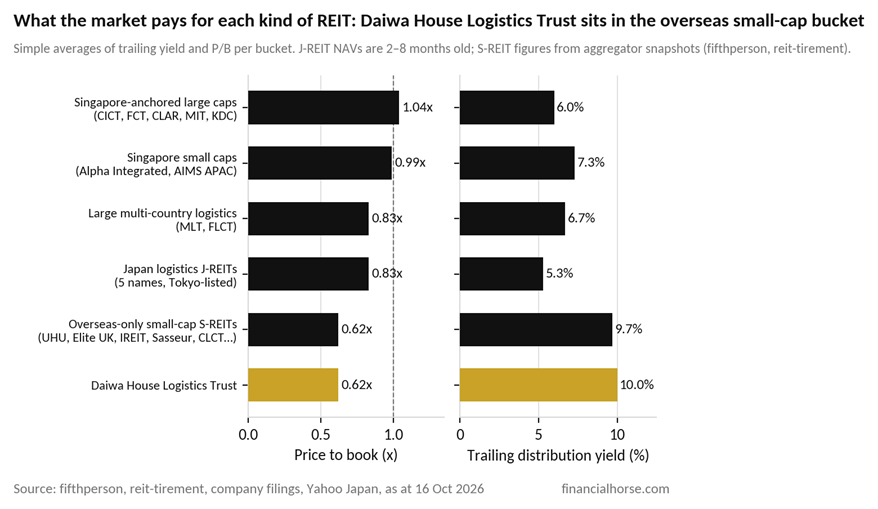
DHLU is priced exactly like the other overseas-only small cap S-REITs – United Hampshire, Elite UK, Sasseur, CapitaLand China Trust – at roughly 0.6x book and a 10% yield.
It is not priced like Mapletree Logistics Trust, which owns the same kind of Japanese warehouses and trades at 0.86x, and not like the Singapore small caps either, which trade close to book.
So the discount is not about size – it’s the discount the market puts on any S-REIT that earns in a foreign currency and has no Singapore anchor – plus a 32%-occupied building and a refinancing in 6 weeks.
Now here’s the part I find interesting.
Even Japan’s own logistics REITs trade at 0.7–0.9x NAV, and Daiwa House’s own Tokyo-listed REIT is at 0.68x.
In plain English – nobody is paying book value for Japanese warehouses right now, not even in Japan.
So yes 0.62x is cheap, but it’s cheap against a book value that the market has stopped believing in globally.
Never miss a post! Follow Financial Horse on WhatsApp or Telegram — one tap, and every new article reaches you the moment it’s published.
The flip side though, is the yield.
At S$0.39, even if the DPU falls another 10% to around 3.3 cents after the refinancing, you’re still collecting about 8.5%.
The catch is capital gains / losses – you just don’t know where the price of the REIT will go.
If the DPU settles at 3.3 cents and the market still demands 10%, the unit is worth about S$0.33 – and 2 years of distributions roughly cover that gap, so you break even.
For a real loss, the DPU has to keep falling at the pace of the last 3 years – another 30% – or the market has to decide this is a distressed REIT and push it toward the 0.2x where the US office REITs sit.
The second has historically only happened to S-REITs where the sponsor failed, the master lessee defaulted or the accounts stopped coming – Eagle Hospitality, EC World, Dasin – and none of those was a Japanese logistics REIT with an AA-rated sponsor.
FX has been a drag on every overseas S-REIT, but it has never been the thing that killed one – and that’s the strongest argument for DHLU.
That you just keep collecting the juicy yield, and hope to exit breakeven at current prices sometime in the next few years.
The counterargument is just as real though.
Nobody has taken an overseas-only small cap S-REIT private at a premium in the past 2 years that I can find, and Daiwa House already has a Tokyo-listed REIT where its Japanese assets naturally belong.
Price could well stay depressed for a very long time, who knows.
What has to go right for Daiwa House Logistics Trust
For DHLU to work from S$0.39, 3 things need to go right at the same time.
One – the yen stops falling. It doesn’t need to rise, it just needs to stop.
Two – the November refinancing lands within management’s own 4% sensitivity, and the December valuation holds roughly where it is.
Three – Sendai Port gets leased, or sold somewhere near book.
If all 3 happen, the DPU stabilises in the mid-3-cent range, the yield does the work, and the unit probably drifts back toward where MLT and FLCT trade – which is a decent re-rating on top of a 9–10% yield.
If none of them happen, you get a DPU in the low 3s, gearing in the mid-40s, an equity raise at a discount, and the unit joins the 0.4–0.5x club.
If some of them happen, it depends – but the yen is the one that carries the other 2, because a weaker yen shrinks both the income after refinancing and the Sendai sale proceeds in S$ terms.
And that’s the asymmetry here – the bear case only needs the yen to keep doing what it has done for 5 years, while the bull case needs it to stop.
Bottom line – there’s 2 ways of seeing this.
Either the yen is near its bottom, in which case I think there could be real opportunity here.
Or the yen has further to fall, in which case you’re being paid 10% to hold a shrinking distribution, and 0.62x book doesn’t protect you in a market that continues to sell-off.
What I’m doing with my money
Which brings us to the million dollar question.
I don’t hold DHLU, and I never have.
But I’ll be upfront – having done the work above, I do find this REIT interesting, for 2 reasons.
The first is the Japan exposure itself – the logistics market is improving, the buildings are young, and a 10% yield on Japanese real estate is not something I see very often.
The second is the sponsor – Daiwa House is about as solid as Japanese sponsors come – it holds the perps, it has injected assets below valuation, and it’s not the kind of sponsor that walks away from a listed vehicle.
The wildcard as I shared above – is the Yen.
Frankly the Yen can go anywhere from here, and it is not an easy call.
Whatever the case though, I still find this REIT a falling knife – and my own rules say I don’t buy falling knives – I wait for the price to stop falling and go back into an uptrend first.
That being said, at this price, all we need is a small catalyst – the Yen to stabilise / strengthen, long term yields to drop, and it could trigger a massive rerating in the REIT.
Love to hear what you think!
This is an FH Premium article written a few weeks back that I am releasing to all readers. For more articles like this, my full personal portfolio and stock watch, do check out FH Premium!