So in an article earlier this month, some of you guys pointed out that I didn’t actually share how I would invest $1 million in this market.
On reflection, you guys were right – and my sincere apologies for the misleading title.
So I figured, let’s do a proper piece that tackles the topic head-on.
Assuming I have no investments today.
And you gave me $1 million to invest as I deem fit.
How would I invest the $1 million today?
How I would invest $1 million today – amid higher interest rates and the Iran war
Let’s get right into it.
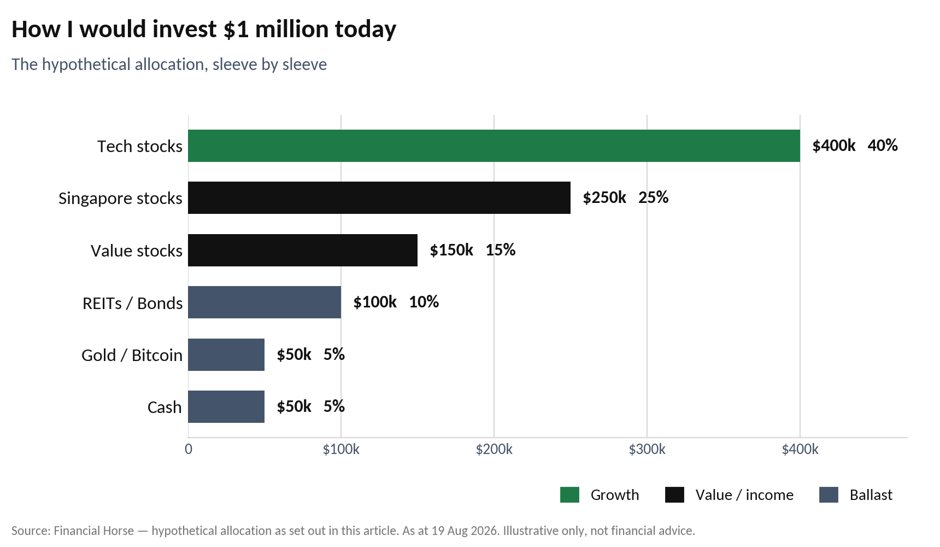
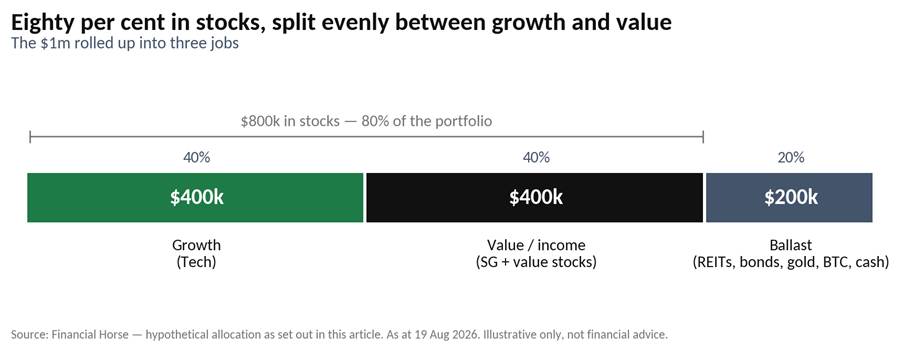
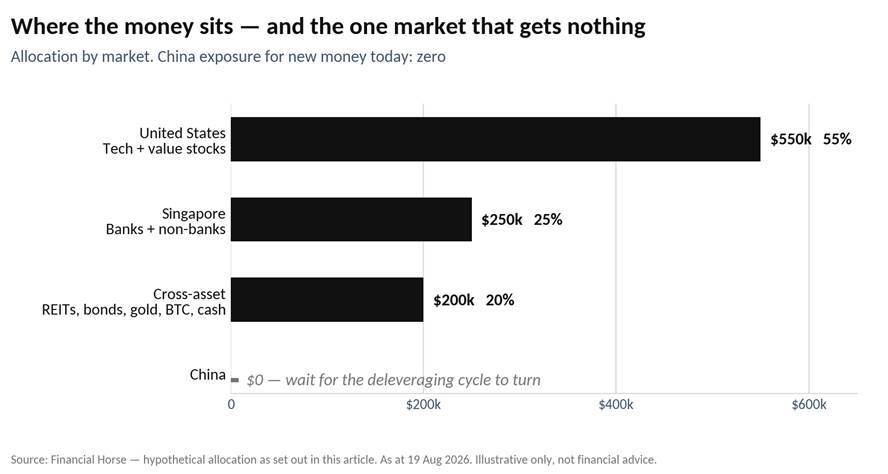
Here’s the hypothetical asset allocation I would use:
- $400k – Tech stocks
- $250k – Singapore stocks
- $150k – Value stocks
- $100k – REITs / Bonds
- $50k – Gold / Bitcoin
- $50k – Cash
Let’s walk through the thought process for each.
$400k in tech stocks
For what it’s worth, when I refer to tech stocks, I mean a loose collection of three sectors:
- AI stocks
- MAG7 stocks
- Non-AI tech / software stocks
This is why the sector is the largest at $400k: frankly, it is a collection of three different sectors that form the growth portfolio.
Hypothetically, with $400k, I would probably allocate $150k–$200k to AI, then split the rest equally between MAG7 and non-AI.
Let’s talk more about each of the three categories.
AI stocks
So I wrote a fairly lengthy article for FH Premium subscribers earlier this week setting out my views on AI (and MAG7).
Bottom line – even after the recent sell-off, AI stocks have still been by far the strongest performers in 2026.
If you had no exposure to AI in 2026, your portfolio would very likely have underperformed.
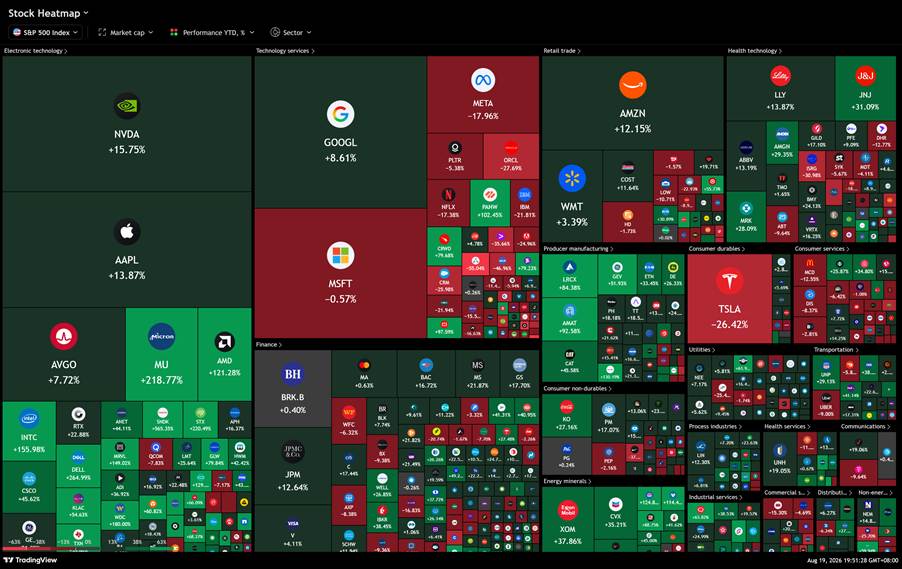
The better question is this: after a huge rally in AI stocks in 2026, followed by a meaningful sell-off, does the risk-reward today favour holding AI stocks or not holding them?
If you ask me, this is one of those areas where I still want some exposure, but I want to manage risk very carefully.
My personal view is that we are still early in the AI capex buildout.
When you have a technology as transformative as AI, there is no way this capex cycle ends in three years.
Companies are going to be pouring hundreds of billions into AI for the next few years (or more).
But the dot-com bubble is a cautionary tale: a technology can revolutionise the world (the internet did go on to change it), and yet, as an investor, you can still lose money on the stocks.
At the end of the day, these are investments for me.
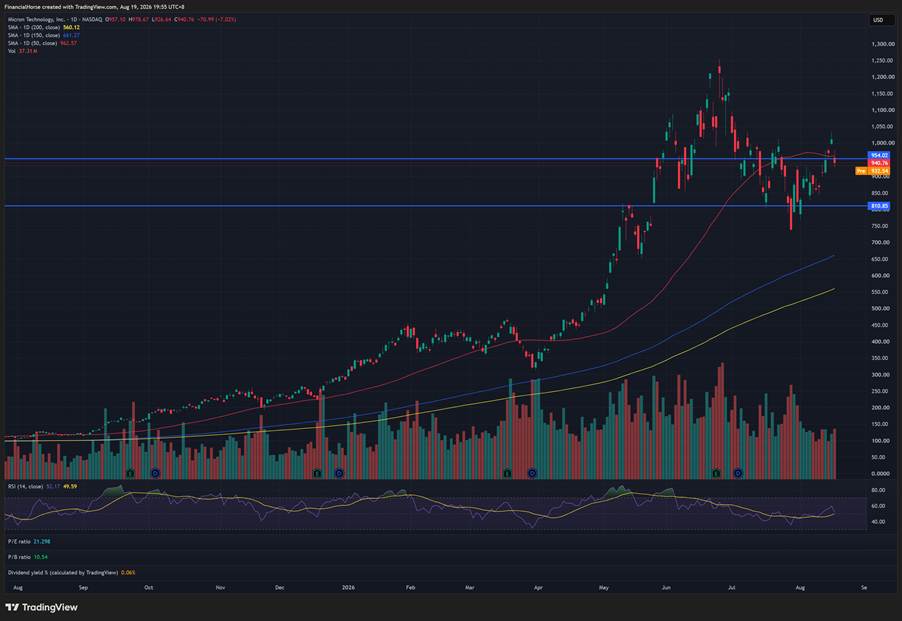
I will hold a broad basket of AI stocks, but if the price action breaks below key levels, I will sell them to manage risk.
MAG7 stocks
I’ve been thinking a lot about this lately.
With AI commoditising thinking itself, where does the competitive advantage for companies lie going forward?
And you know what – stupid as it may sound – it suddenly occurred to me that a competitive advantage in this new world is capital.
Or in plain English – money.
Spending on AI data centres runs into hundreds of billions of dollars a year; very few companies outside nation-states can afford that kind of spending.
Except for the MAG7.
The MAG7 have strong underlying businesses that generate a ton of cash flow.
They can pour that cash flow into the buildout of data centres.
In a compute-constrained world where AI models may eventually become commoditised, that is a competitive advantage not to be underestimated.
The fact that companies with massive cash flow such as Google are resorting to equity financing and pausing share buybacks tells you how much money is required for this buildout.
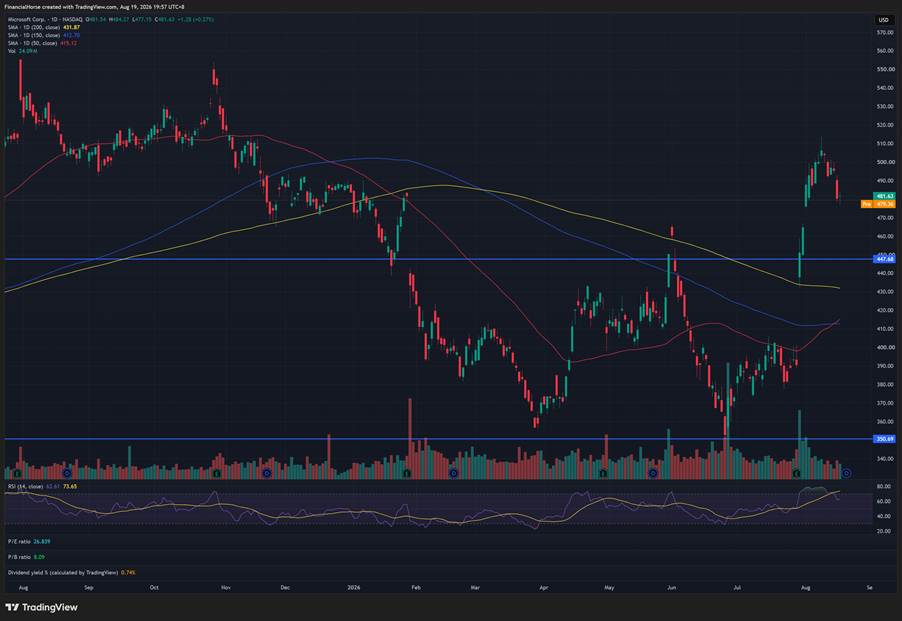
Personally, I like Amazon, Meta and Microsoft, but frankly you could make a case for any of the MAG7.
SpaceX is another interesting one to watch too.
With Elon Musk at the helm, the company is taking its Starlink cash flow and IPO proceeds and pouring them into AI.
I would definitely not rule them out of the race.
Non-AI stocks
With all the investor attention on AI, there are actually a lot of opportunities outside the sector.
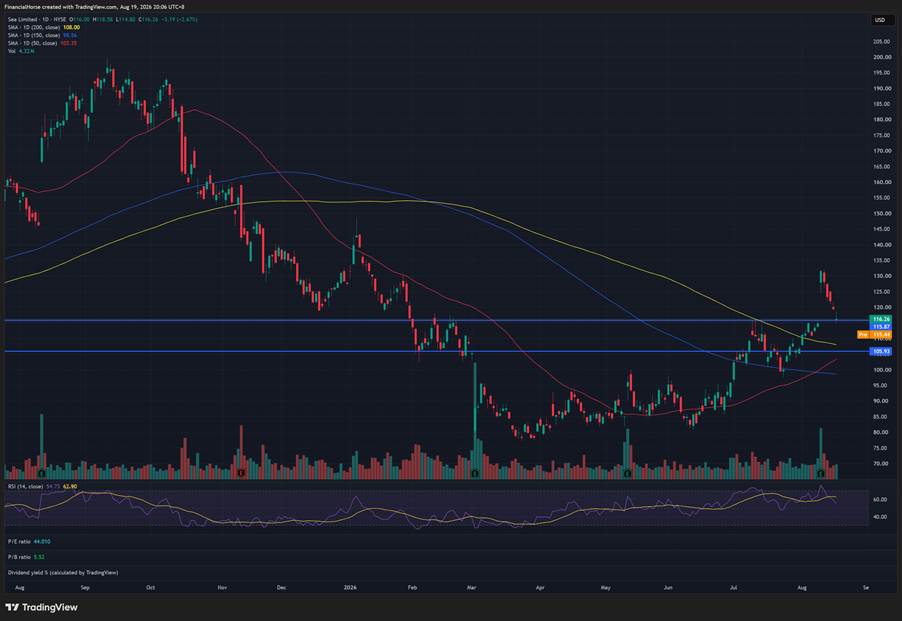
Take something closer to home, like Sea, for example.
The stock has been quietly forming a base in the $80s and has recently broken out to new highs above the 200-day moving average.
At one point, it was up almost 50% from its lows.
Sea is just one example and you can see the names I am monitoring on FH Premium, but you get my point.
The benefit of this sector is that valuations are reasonable, earnings growth is decent and, even if the AI bubble bursts, the sector should be largely immune.
There’s a lot to like about that.
So that forms the 400k in growth stocks – and then we go on to value stocks.
Which I would broadly allocate into a mix of Singapore stocks, and global value stocks.
Never miss a post! Follow Financial Horse by subscribing or following us on your favorite platform:
Subscribe to our mailing list for exclusive content straight to your inbox:
$250k in Singapore stocks
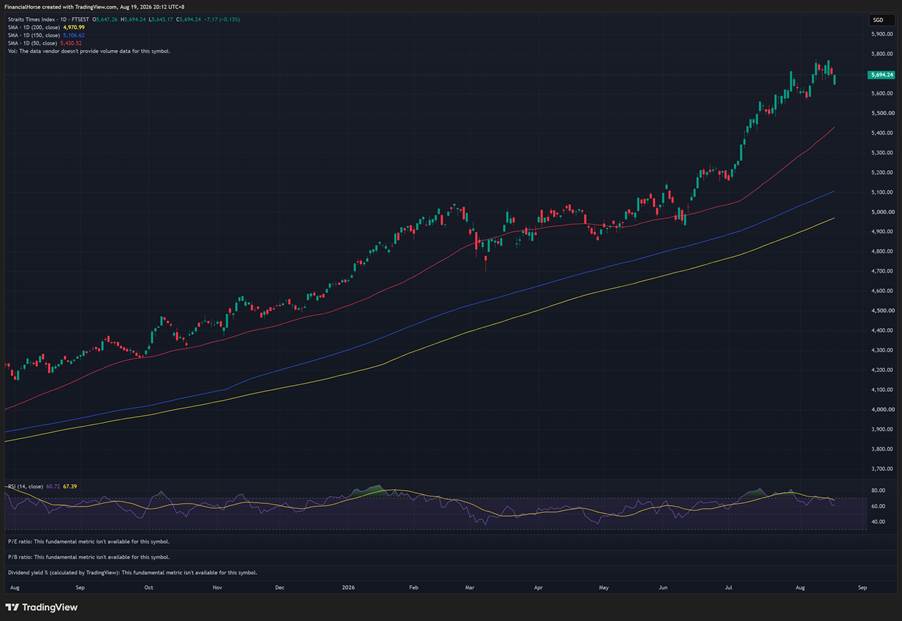
I mean at the end of the day, as a Singapore investor, we cannot not invest in Singapore stocks.
And you know what – when the STI looks like that, you would be a fool not to run exposure to Singapore stocks.
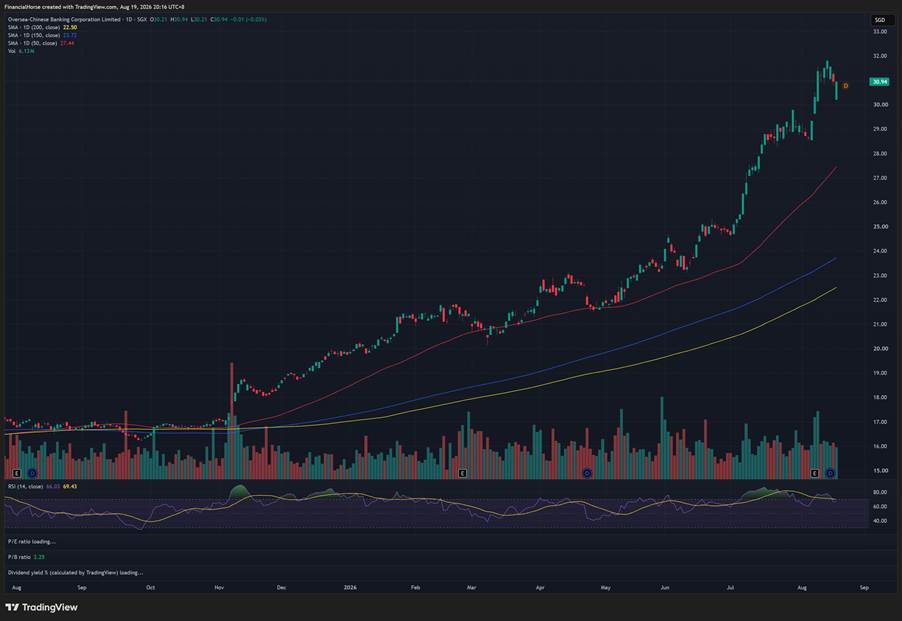
The problem with Singapore stocks is that, at these prices, I don’t find the Singapore banks cheap at all – in fact, I find them expensive.
But then if you run no allocation to Singapore bank stocks, the portfolio also doesn’t seem right.
With that in mind, here is how I would allocate the $250k to this sector.
I would probably put about half into the bank stocks.
And the other half into a broad mix of non-bank stocks (this comes down to stock-picking; perhaps names like SATS, Keppel, ST Engineering and SGX – see my full views on FH Premium).
That’s probably how I would approach this.
$150k in value stocks
I actually find a lot of great opportunities outside of Singapore as well.
Names like Visa and Mastercard, for example, look interesting to me.
As with non-AI software stocks, the benefit of this sector is that, because all the hot money has poured into AI, valuations here are reasonable and many of these stocks are showing earnings growth.
The big problem was that many of them were still trending down. But over the past few months, as money has rotated out of AI, that has changed.
That makes this a good time to deploy cash into this area, in my view.
That said, this does go into stock picking territory.
The “ballast” of the portfolio
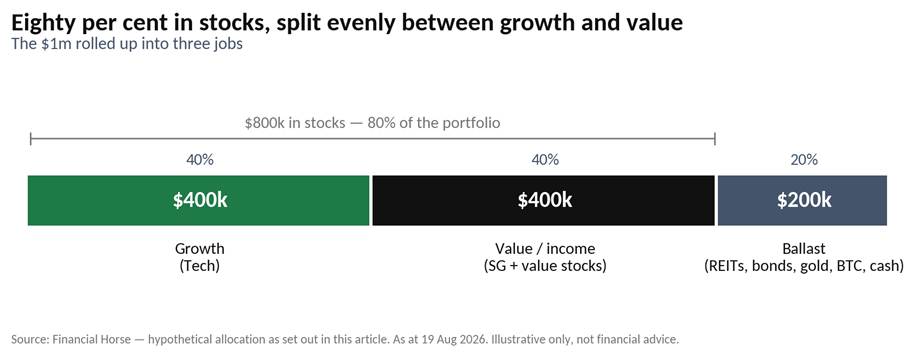
That leaves $200k, with the core $800k split about evenly between growth and value stocks.
I figured the rest of the portfolio should be in some kind of ballast that provides stability.
Hence, the rest is broadly split among REITs, bonds, gold, Bitcoin and cash.
$100k in REITs / bonds
With US 10-year yields rising to 4.6%, the REIT index is as ugly as it gets, sitting close to the lows reached during the Iran war.
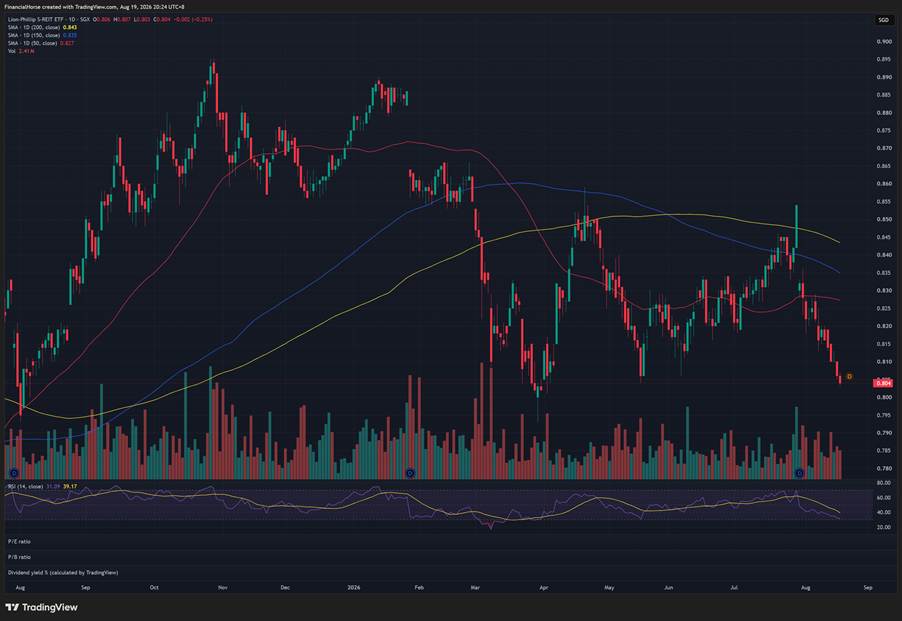
At these prices, you could get a 5%–6% yield on a broadly diversified REIT or bond portfolio.
Is that amazing? Probably not.
Is that a good counterbalance to the $800k invested in a stock portfolio? Probably.
The goal of this area of the portfolio is not to double your money; it is to allow you to take risk on the rest of the portfolio.
If this area of the portfolio just holds its value and delivers a good return above inflation, frankly it has already done its job.
The true returns should come from the 800k invested in stocks, not from this 200k.
$50k in gold / Bitcoin
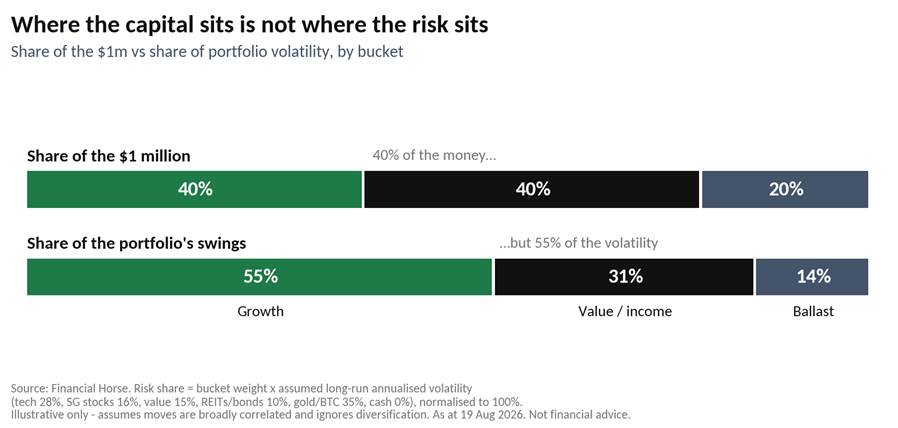
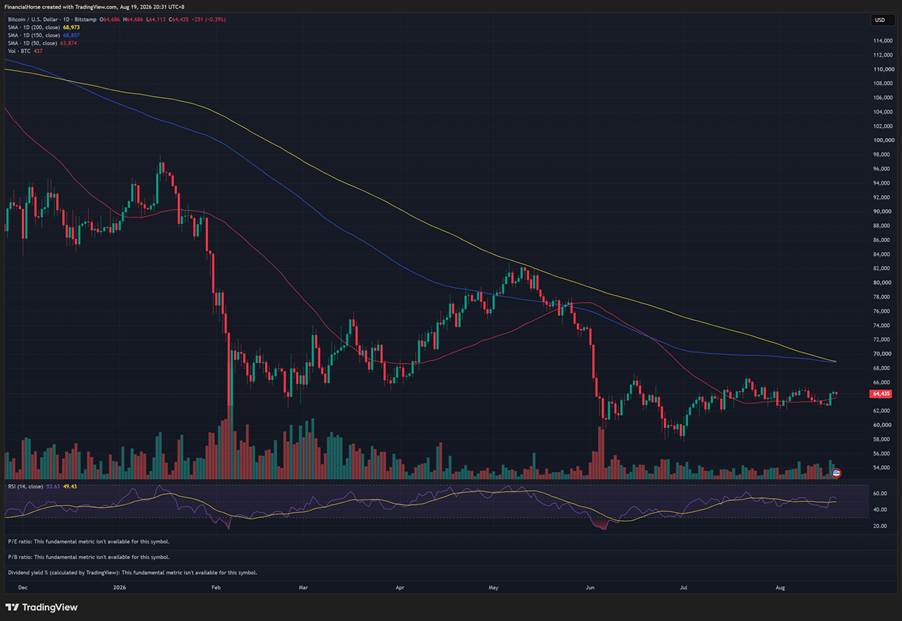
Of the two, Bitcoin is clearly the riskier asset, and you could rightly argue that it probably belongs under the stock portfolio above.
If you ask me, I think there is a role for both in a broadly diversified portfolio.
But I mean don’t kid yourself into thinking that Bitcoin is a low-risk store of value.
If you want something safe, gold is probably the better choice.
If you can take on more risk and volatility though, I would be willing to wager that over a medium- to long-term horizon, Bitcoin probably delivers superior returns – provided you can stomach the downside.
And if you hold Bitcoin, you may actually need to increase the allocation to REITs / bonds / cash to counterbalance the volatility.
So… allocate accordingly.
$50k in cash
Finally – $50k in cash.
This one is pretty self-explanatory.
If the market takes a dive, you need cash to average in, and you need cash to pay bills.
This one should be adjusted based on personal risk appetite.
If you need more cash for living expenses, up the allocation accordingly.
Why no China stocks?
I guess a notable exception from this asset allocation is China.
Now I love China, and I hold a small allocation to Chinese stocks.
But objectively – for new money today?
You cannot get away from the fact that the Chinese economy is still struggling to get out of the real estate deleveraging cycle.
And China stocks are still in a broad downtrend.
If and when the cycle turns, I agree that China stocks can deliver strong returns.
But in my experience as an investor, you should be cautious when an economy is going through structural deleveraging like that.
It’s best not to front-run the turn.
Just be patient and wait for the deleveraging to play out.
When the stocks enter a new uptrend, then you buy.
Sure, you may miss a 20%–30% rally off the bottom.
But it’s still better than buying early and being stuck in a position that goes nowhere for years.
How I would invest $1 million today – amid higher interest rates and the Iran war
So there you have it!
How I would invest $1 million today.
Now I deliberately kept this piece high-level and focused on asset allocation, without going into too much discussion of which individual stocks to buy.
The way I see it, if you want to invest your money, you should at least think carefully about which stocks offer good risk-reward in this market.
For those who are keen, I track a broad portfolio of US, Singapore and China stocks on my watchlist, setting out what I like and the prices at which I would buy them – all shared on FH Premium.
My full personal portfolio, with weekly updates on what I buy and sell, is also shared on FH Premium.
Broadly agree, except at current levels, I would buy BABA instead of SPACEX
Nice article. How would you recommend building exposure in a basket of AI stocks that excludes the Mag 7?
I just wrote a FH Premium article on this. I think the key is to look at it from first principles – what sectors will do well, and where it is not already priced in. Some areas of semicon like TSMC or NVDA for example stand out.