Okay so quite a few of you have asked me about Keppel Infrastructure Trust (KIT).
And I understand why — the unit price is up more than 30% from its June 2025 low, yet it still offers a 7.6% trailing yield.
I bought KIT in the low 40s in 2023, so to be fair this investment has done very well for me.
Including distributions, I’ve made almost 50-60% on my investment over a 3 year period, working out to almost a 20% annualised return.
Well this month, I decided to finally take profit in this business trust.
In this article, I wanted to discuss:
• What did the 1H2026 results actually show?
• Is that 7.6% distribution really funded by cash flow?
• Would I buy, hold or sell Keppel Infrastructure Trust?
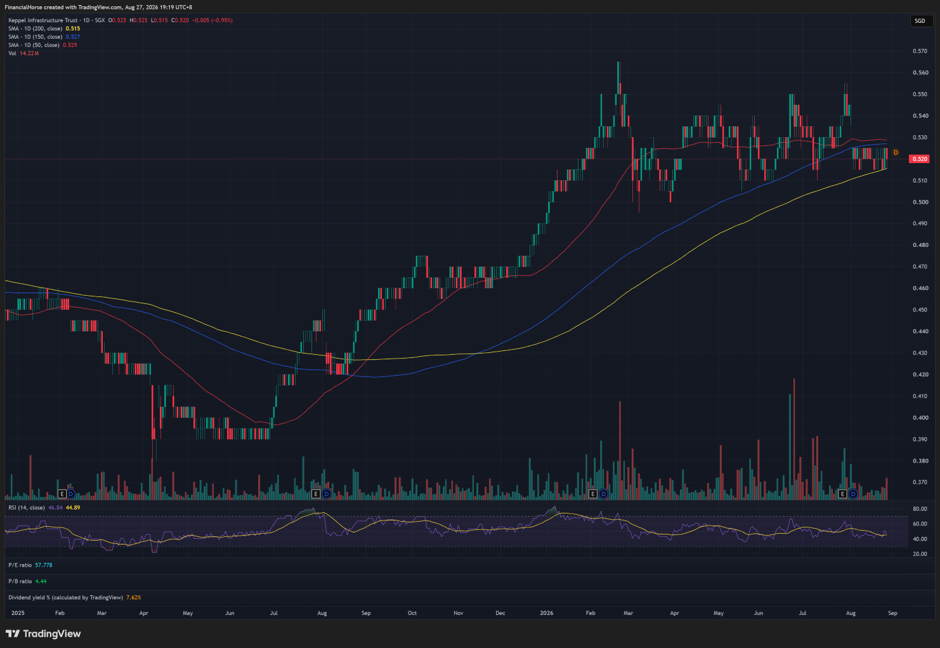
Price action of Keppel Infrastructure Trust
Here’s the chart for reference.
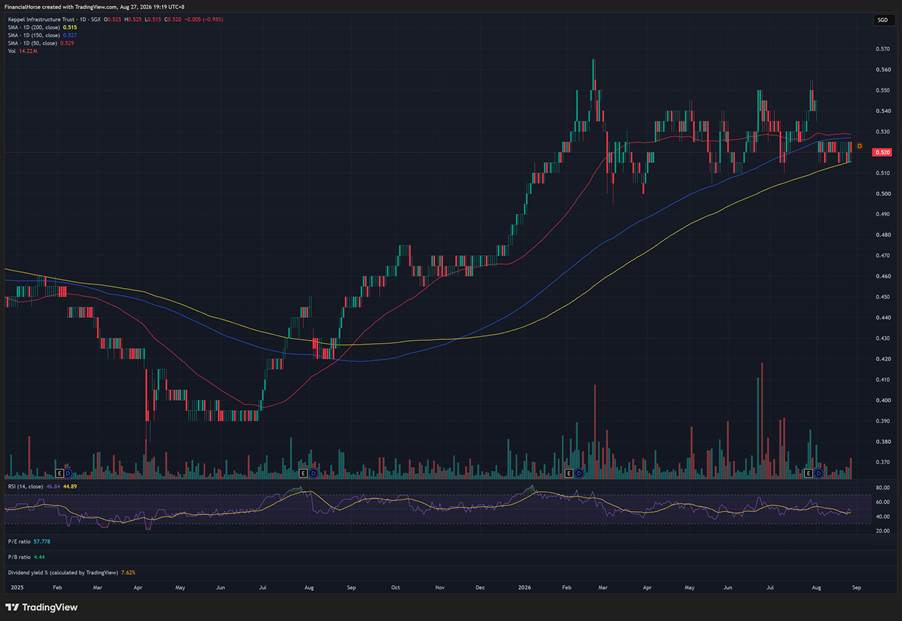
I started a position in KIT in 2023 at the low S$0.40s, when it was paying a 7-8% yield.
And I’ve held it ever since.
If I include the 8% yearly distribution plus capital gains, actually I’m up almost 50-60% on this investment.
That’s almost a 15-20% annualised return.
So I’ve actually done pretty well on this investment, considering this is a yield play.
The 1H 2026 financial results for Keppel Infrastructure Trust
On the surface, the 28 July 2026 results were fine.
DPU came in at 1.99 cents for the half, up 1.0% year on year, while distributable income was S$101.1 million.
Excluding last year’s one-off divestment gains, distributable income rose 1.2%.
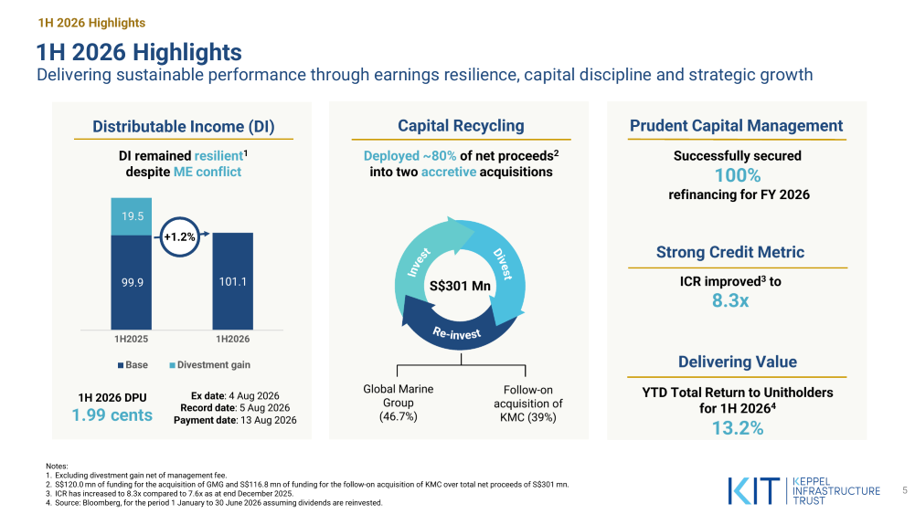
KIT’s own chart shows the point: the S$19.5 million blue block on the 1H2025 bar is the divestment gain. Strip it out and the two half-years are S$99.9 million against S$101.1 million — the +1.2% the trust reports. Source: slide 5, KIT 1H 2026 Financial Results presentation, 28 July 2026.
There were some soft spots underneath: City Energy took a S$5.4 million hit from fuel costs it couldn’t pass through quickly enough, the Korean waste business is still losing money, and the German offshore wind asset will see its tariff step down from October 2026.
But the real story was the balance sheet.
Net gearing went from 38.7% in December 2025 to 41.9% in March 2026 and 44.2% in June 2026.
That’s a 5.5-percentage-point jump in 6 months — driven mainly by the S$125.6 million purchase of an additional 39% of Keppel Merlimau Cogen, funded using internal funds and borrowings.
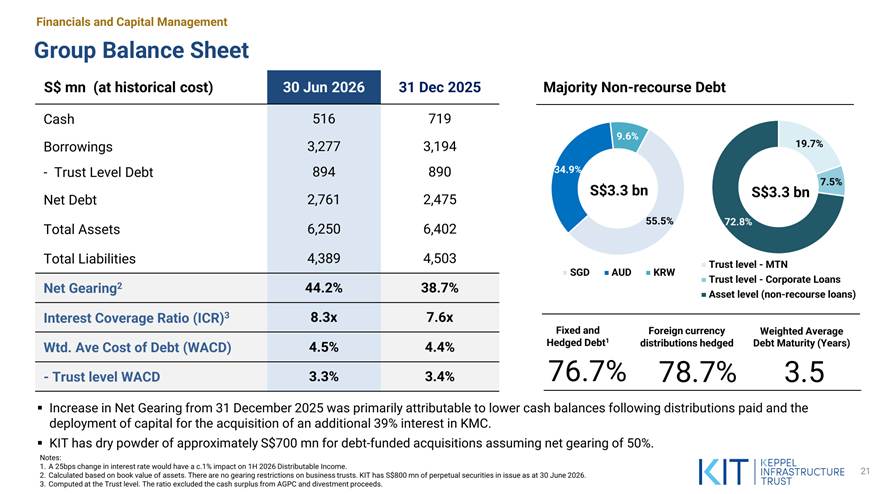
In plain English: the operating business grew 1% in the half, while the debt grew much faster.
Net gearing at 44.2% — and what KIT does when gearing gets here (historically)
This is the part where it gets interesting.
KIT is a business trust, so it does not face the same regulatory gearing limit as an S-REIT — the main constraint is management’s own target, with a stated ceiling of 50%.
And here’s the fundraising track record for Keppel Infrastructure Trust:
| Year | Amount raised | Issue price | What it funded |
| 2015 | S$525m | S$0.505–S$0.550 | Keppel Merlimau Cogen (51%) |
| 2019 | S$501m | S$0.441 | Repay Ixom acquisition debt |
| 2023 | S$300m | S$0.467 | Repay acquisition bridge loans — gearing had hit 42.5% |
| 2024 | S$200m (+ S$200m of perpetual securities at 4.9%) | S$0.438 | Ventura bus acquisition |
Four equity raises in 10 years, and the pattern is consistent: a debt-funded acquisition comes first, and equity follows.
The 2023 raise came when gearing hit 42.5%.
Today, gearing is 44.2% — higher than the level that preceded that raise — and the acquisition treadmill hasn’t stopped, with a second German solar deal announced earlier in August.
And that’s before counting roughly S$800 million of perpetual securities, which are treated as equity rather than debt and therefore do not appear in that 44.2% figure.
So another equity fundraise is a possibility in the months / years ahead.
But balance sheet is decent
That said – to give credit where credit is due, KIT has a pretty decent balance sheet.
Interest coverage is a healthy 8.3 times, the FY2026 refinancing is complete, and KIT has S$304 million of undrawn credit lines.
So there is no insolvency risk here.
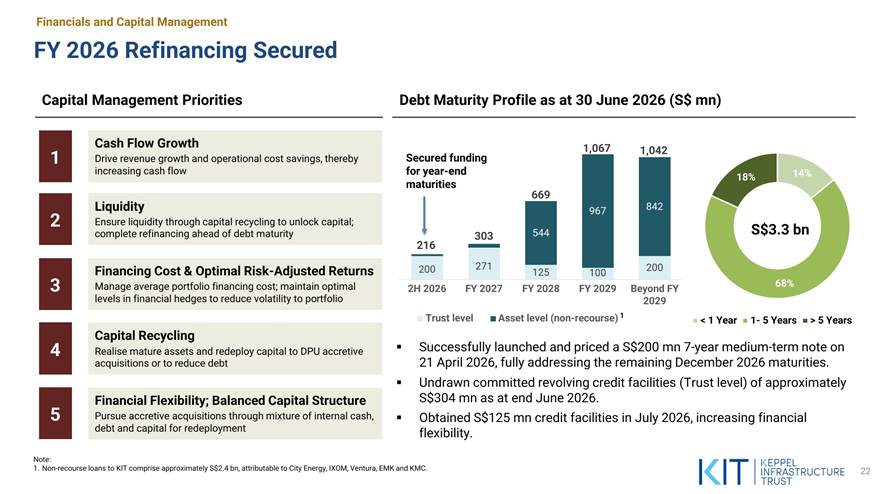
The near-term maturity wall is light — S$216 million due in 2H2026 and S$303 million in FY2027 against S$304 million of undrawn facilities — with the bulk of the S$3.3 billion falling FY2029 and beyond. Source: slide 22, KIT 1H 2026 Financial Results presentation, 28 July 2026.
And to be fair to KIT, the past raises were priced close to market and diluted existing holders by around 5% each time — not disaster.
But the track record of equity fundraising, and the current leverage ratios, suggest that investors should at least consider the possibility of a potential equity fundraise going forward.
Business trusts can distribute more than accounting profit
REIT distributions are generally tied to income, whereas a business trust can distribute from operating cash flow even when accounting profit is low — or absent.
That’s not a loophole; it’s part of the structure, and KIT’s own website says exactly this:
The investing public of business trusts reaps benefits in the form of distributions. Business trusts are allowed to pay distributions to investors out of operating cashflow. This is unlike companies, which can only pay dividends out of accounting profits.
Looking at the financial results of KIT:
| Year | Distributions paid | Profit attributable to unitholders |
| FY2022 | S$191m | S$0.9m |
| FY2024 | S$203m | S$28m |
| FY2025 | S$196m | S$93m |
The payout has run ahead of accounting profit the past few years.
Part of the gap is accounting: depreciation on concession assets is added back before distributions are calculated.
But several of KIT’s Singapore concessions are finite-life assets that return to the government when their concessions end — Ulu Pandan in 2027, and Senoko and SingSpring in 2028.
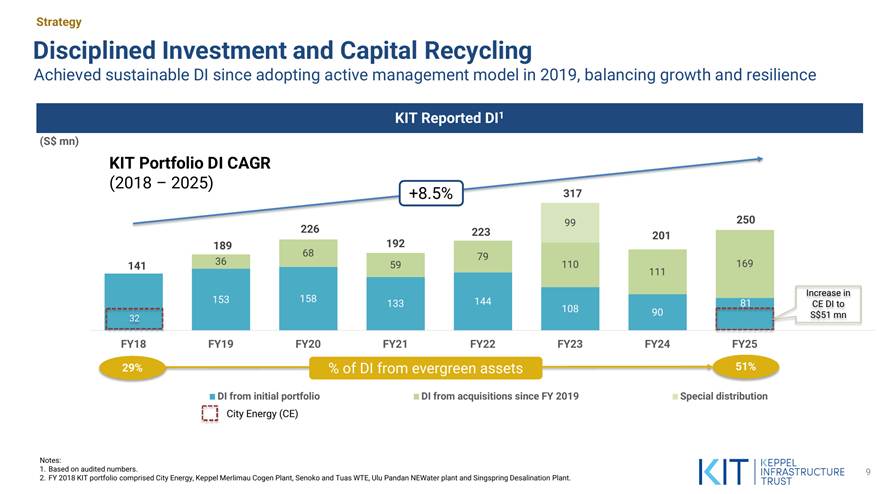
In previous articles on KIT that I wrote, a lot of you have pointed out to me that for Business Trusts where the underlying assets have a short remaining tenure, some of the distributions are in effect coming out of “capital”.
Never miss a post! Follow Financial Horse on WhatsApp or Telegram — one tap, and every new article reaches you the moment it’s published.
The distribution is running ahead of the cash
Now layer on the most recent numbers.
In 1H2026, KIT paid S$121.1 million in distributions against S$101.1 million of distributable income.
The S$20 million difference came from unitholders’ funds.
FY2025 tells a similar story: of the 3.94 cents DPU, about 0.8 cents — roughly a fifth of the payout — came from one-off divestment gains.
So historically, the distribution payout does run ahead of the underlying cash flow generated by the business.
There’s nothing wrong with this – this is perfectly allowed being a business trust.
It’s just something to note, given the frequent equity fundraise track record whenever gearing reaches a certain level.
To be fair – the DPU has not been cut in 10 years and the underlying income is still growing modestly.
So if you ask me, I don’t think the dividend yield is at risk, it’s more the gearing / equity fundraise issue that troubles me.
What’s priced in at S$0.52?
So is 7.6% dividend yield enough to compensate investors for the risk?
Here’s how the yield compares with the alternatives as of late August 2026:
| Instrument | Yield |
| KIT | ~7.6% |
| MPACT | ~6.2% |
| CapitaLand Ascendas REIT | ~6.1% |
| NetLink Trust | ~5.6% |
| 10-year SGS | 2.36% |
| 6-month T-bill | 1.56% |
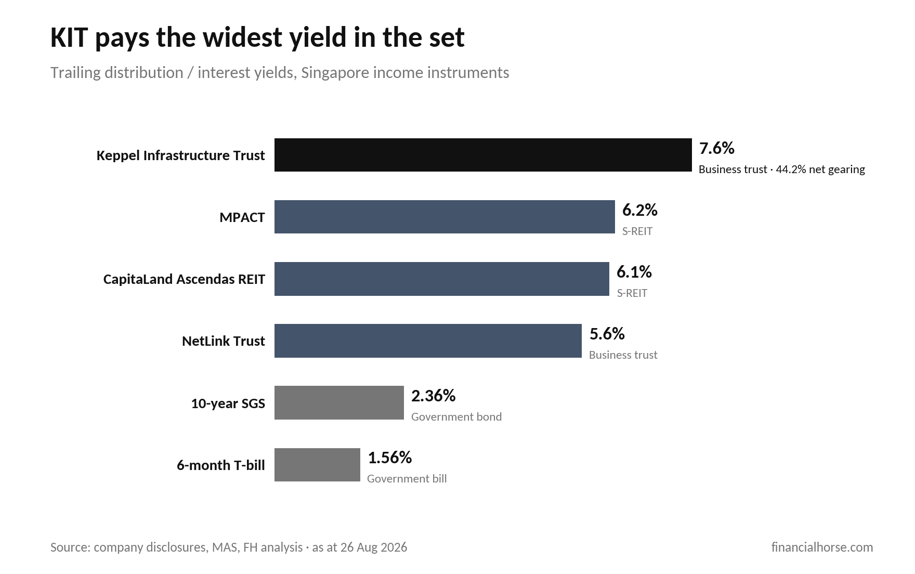
KIT pays the widest yield in the set — about 1.5 percentage points more than a blue-chip REIT.
But then you do have to factor in the points above – the 44.2% gearing, the finite-life concessions and the fundraising history.
Is that adequate compensation for the risk?
If you ask me, I would say the market is not obviously mispricing KIT — it is pricing the risks above.
At roughly 9 times cash earnings, I’ll probably say Keppel Infrastructure Trust is fairly valued here.
Risk-reward — buy, hold or sell?
Which brings us to the million-dollar question.
Keeping this simple — at S$0.52, I see three ways the next 3 years or so could play out:
Bull — the new assets deliver, gearing comes down without a raise, and the market rewards KIT with a higher multiple. Total return maybe around +60 – 70%, including distributions.
That said KIT has traded at roughly the same valuation for years, so at 44% gearing this is probably the optimistic bull case.
Base — business as usual. DPU inches up 1% a year, the unit price stays flat, and you collect the distributions. Total return maybe around +20 – 30%, including distributions — about 8% a year, which is essentially the yield.
Bear — KIT announces another equity raise, diluting the unit price and DPU. Based on the past raises, the damage is real but not catastrophic — total return is probably flat to negative after you include the distributions.
Is that attractive risk reward?
I mean… it really goes back to the individual investor.
In the bull case definitely you make good money.
But in the bear case it’s unknown downside.
Again if you ask me, I think KIT is just fairly valued here.
What I did with my money
Full disclosure, after holding my KIT position for around 3 years, I decided to finally take profit in this business trust.
It was always a small position for me so this was not a dramatic portfolio move – it’s not like KIT was 20% of my portfolio or anything.
But the way I saw it, KIT’s gearing was getting to the kind of levels where historically an equity fundraise usually followed.
And at these prices, I’m getting a good return on my original investment, and I can deploy the funds elsewhere (you can see what I’m buying on FH Premium).
I know my own bias is to sell winners too early, and I asked myself that question before selling.
But this wasn’t profit-taking on an uptrend — gearing had crossed the level that preceded the last raise, and that was the line I’d drawn in advance.
And also share price has been mostly flat since the start of 2026.
For what it’s worth, KIT’s past equity fundraises have historically offered decent entry points.
So if they do an equity fundraise, that could be a good point for me to look at this business trust again.
But hey that’s just me, I would love to hear what you think!
This article was written on 27 Aug 2026. It will not be updated going forward.
My live views on Keppel Infrastructure Trust — including the price at which I would buy back in — are updated weekly on FH Premium, alongside my full watchlist and personal portfolio.
Join the FH mailing list and new articles land straight in your inbox:
Also on WhatsApp, Telegram and Facebook.