Healthcare has three powerful structural tailwinds.
The global population is ageing.
Medical innovation is expanding what can be diagnosed and treated.
And artificial intelligence is beginning to change drug discovery, medical imaging and clinical workflows.
The World Health Organization expects one in six people globally to be aged 60 or older by 2030. By 2050, that population is projected to reach 2.1 billion.
That should increase demand for medicines, diagnostics, surgery and healthcare services.
But growing demand does not automatically produce good investment returns.
A company still needs effective products, regulatory approval, manufacturing capacity, reimbursement and a defensible market position.
And investors still need to pay a sensible price.
The following ten stocks provide exposure to different parts of the healthcare value chain. They are not ranked from best to worst, and they are not ten automatic buys.

This article was written by a Financial Horse Contributor.
The content here is for informational purposes only and should NOT be taken as legal, business, tax, or investment advice. It does NOT constitute an offer or solicitation to purchase any investment or a recommendation to buy or sell a security. In fact, the content is not directed to any investor or potential investor and may not be used to evaluate or make any investment. Do note that this is not financial advice. If you are in doubt as to the action you should take, please consult your stock broker or financial advisor.
The 10 healthcare stocks to watch…
| Company | Listing | Main exposure | Key risk |
|---|---|---|---|
| Eli Lilly | NYSE: LLY | Obesity and diabetes | High expectations |
| Novo Nordisk | NYSE: NVO; Copenhagen: NOVO-B | Obesity and diabetes | Competition and pricing |
| Johnson & Johnson | NYSE: JNJ | Medicines and medical technology | Patents and legal liabilities |
| AstraZeneca | NYSE/LSE/STO: AZN | Oncology and rare diseases | Pipeline execution |
| Roche | SIX: ROG; OTCQX: RHHBY | Medicines and diagnostics | Currency and pipeline risk |
| Intuitive Surgical | Nasdaq: ISRG | Robotic-assisted surgery | Valuation and competition |
| Abbott Laboratories | NYSE: ABT | Devices, diagnostics and nutrition | Product execution |
| GE HealthCare | Nasdaq: GEHC | Imaging and healthcare AI | Hospital spending |
| Thermo Fisher Scientific | NYSE: TMO | Life-science tools and services | Research-spending cycles |
| UnitedHealth Group | NYSE: UNH | Insurance, care delivery and data | Regulation and medical costs |
1. Eli Lilly: The metabolic-disease leader
Eli Lilly is one of the most direct ways to gain exposure to the obesity and diabetes treatment market.
Second-quarter 2026 revenue increased 48% to US$23.0 billion, driven primarily by Mounjaro and Zepbound. Lilly raised full-year revenue guidance to between US$85 billion and US$87 billion. Eli Lilly
Its pipeline also includes next-generation metabolic treatments such as retatrutide and the oral drug orforglipron.
The risk is expectations.
The market already recognises Lilly’s growth. Manufacturing, pricing or clinical disappointments could hurt the stock even if the business remains strong.
2. Novo Nordisk: Strong franchise, tougher competition
Novo Nordisk remains a global leader in diabetes and obesity care through Ozempic, Wegovy and Rybelsus.
Adjusted second-quarter 2026 sales grew 7% at constant exchange rates. However, the full-year adjusted sales outlook remained between a 6% decline and flat growth. Novo Nordisk
Its CagriSema candidate achieved substantial weight loss but failed to demonstrate non-inferiority to Lilly’s tirzepatide in the REDEFINE 4 trial. Novo Nordisk
Novo retains global scale, manufacturing expertise and a strong brand.
But the investment case now depends on defending market share and restoring growth.
3. Johnson & Johnson: Diversification in one stock
Johnson & Johnson combines Innovative Medicine with MedTech.
Second-quarter 2026 sales rose 6.6% to US$25.3 billion. Innovative Medicine contributed US$16.4 billion, while MedTech generated US$8.9 billion. Johnson & Johnson
The company offers exposure to oncology, immunology, neuroscience, cardiovascular devices and surgery.
This reduces dependence on one treatment area.
But diversification also means slower growth than a successful pure-play company. Patent erosion and legal liabilities remain important risks.
4. AstraZeneca: A broad oncology pipeline
AstraZeneca has leading positions in oncology, rare diseases and chronic conditions.
Tagrisso generated approximately US$1.9 billion of second-quarter 2026 revenue, representing 6% growth.
The company listed 183 pipeline projects in July 2026, including 21 new molecular entities in late-stage development. AstraZeneca
Ageing supports long-term demand for cancer and chronic-disease treatments.
But a large pipeline does not guarantee successful medicines. Clinical failures, regulatory delays and competition remain part of the investment case.
5. Roche: Medicines plus diagnostics
Roche combines a global pharmaceutical business with a major diagnostics platform.
First-half 2026 sales increased 6% at constant exchange rates. Pharmaceutical sales grew 6%, while diagnostics grew 3%. Roche
This combination provides exposure to precision medicine.
Roche can develop both the treatment and, in some cases, the diagnostic technology used to identify suitable patients.
Its diagnostics business may also benefit from digital pathology and AI-assisted analysis.
The main risks are pipeline execution, slower diagnostics growth and currency translation into Swiss francs.
6. Intuitive Surgical: The robotic-surgery platform
Intuitive Surgical pioneered robotic-assisted surgery through its da Vinci system.
Combined da Vinci and Ion procedure volumes grew approximately 16% in the second quarter of 2026. The da Vinci installed base reached 11,710 systems, up 12% from a year earlier. Intuitive Surgical
The business earns recurring revenue from instruments, accessories and servicing as procedures are performed.
Ageing populations should require more surgical care.
But hospitals have limited capital budgets, competition is increasing and strong growth expectations may already be reflected in the valuation.
7. Abbott Laboratories: Chronic care and medical devices
Abbott operates across medical devices, diagnostics, nutrition and established pharmaceuticals.
Second-quarter 2026 sales reached US$12.6 billion. Abbott reaffirmed comparable sales growth guidance of 6.5% to 7.5% and raised adjusted earnings guidance. Abbott
Its products include continuous glucose monitors, cardiac devices, diagnostics and adult nutrition.
That provides broad exposure to chronic disease and ageing without relying on one medicine.
Competition in glucose monitoring and cardiovascular devices remains the main risk.
8. GE HealthCare: Direct exposure to healthcare AI
GE HealthCare provides medical imaging, ultrasound, patient monitoring, diagnostics and healthcare software.
Second-quarter 2026 revenue grew 5.7%, while orders rose 11.1%. Backlog reached US$23.9 billion. GE HealthCare
The company also reported 115 AI-enabled medical-device authorisations on the FDA’s list ahead of HIMSS 2026. GE HealthCare
AI may help clinicians analyse images, automate measurements and manage growing workloads.
But regulatory approval is not the same as profitable adoption. Hospitals must see enough clinical or financial value to pay for the technology.
9. Thermo Fisher Scientific: The picks-and-shovels provider
Thermo Fisher supplies instruments, laboratory products and services to pharmaceutical, biotechnology and diagnostic companies.
Second-quarter 2026 revenue rose 10% to US$12.0 billion, including 5% organic growth. Adjusted earnings per share increased 13%. Thermo Fisher Scientific
Thermo Fisher does not need to identify the next successful drug.
It can benefit by supplying many companies attempting to develop one.
The risk is cyclicality. Biotechnology funding, research budgets and laboratory capital spending can weaken.
10. UnitedHealth Group: Scale with greater complexity
UnitedHealth combines UnitedHealthcare with Optum’s pharmacy, care-delivery and health-services operations.
Second-quarter 2026 revenue reached US$112.0 billion, with US$8.0 billion of operating earnings. Management raised its full-year adjusted earnings outlook. UnitedHealth Group
Ageing should increase demand for insurance, care delivery and pharmacy services.
But UnitedHealth is the most complicated and politically sensitive company on this list.
Medical costs, government reimbursement, regulation, litigation and data privacy all require close monitoring.
It is better viewed as a complex execution case than a simple demographic winner.
AI is an enabler—not the entire thesis
Healthcare AI covers several different activities.
Pharmaceutical companies can use AI to identify drug targets and analyse clinical data.
Diagnostics and imaging companies can use it to interpret scans and pathology.
Healthcare providers can use it to improve administration and care management.
Life-science suppliers can provide the instruments and data required to develop these systems.
But AI does not remove the need for clinical evidence, regulatory approval or paying customers.
GE HealthCare and Roche provide relatively direct exposure through imaging and diagnostics.
For companies such as Lilly and AstraZeneca, AI is more likely to improve research productivity than become a separate revenue stream.
The investment case must still work without an AI label.
What about healthcare ETFs and indexes?
Selecting individual healthcare companies requires specialist knowledge.
Investors need to understand patents, clinical trials, regulation, reimbursement and product safety.
A healthcare ETF provides a simpler alternative by spreading the investment across multiple companies.
But the index methodology matters.
Some healthcare indexes are US-only. Others invest globally. Some focus on large established companies, while thematic indexes may hold smaller biotechnology and medical-technology businesses.
Broad healthcare ETF choices
Fund information is based on data available in August 2026 and should be verified before investing.
| ETF | Exposure | Holdings | Expense ratio |
| Health Care Select Sector SPDR Fund (XLV) | Large US healthcare companies | 60 | 0.08% |
| Vanguard Health Care ETF (VHT) | Broad US healthcare market | 429 | 0.09% |
| iShares Global Healthcare ETF (IXJ) | Global healthcare companies | 110 | 0.38% |
| iShares U.S. Medical Devices ETF (IHI) | US medical-device companies | Varies | 0.37% |
| iShares MSCI World Health Care Sector Advanced UCITS ETF | Developed-market healthcare | 112 | 0.18% |
| iShares Healthcare Innovation UCITS ETF (HEAL) | Global healthcare innovators | 203 | 0.40% |
Official fund information: XLV, VHT, IXJ, IHI, World Health Care UCITS ETF, HEAL.
Which index fits which objective?
XLV: Large US leaders
XLV owns healthcare companies from the S&P 500.
It is inexpensive and liquid but does not provide exposure to smaller US companies or major foreign businesses such as Roche and Novo Nordisk.
VHT: Broader US exposure
VHT includes large-, mid- and small-cap US healthcare stocks.
It offers broader industry coverage than XLV while remaining entirely US-focused.
IXJ or a World Health Care UCITS ETF: Global exposure
These funds include major healthcare companies outside the United States.
This matters because medical innovation is global.
A global fund may be more suitable for investors who do not want their healthcare allocation dominated by US companies.
IHI: Medical devices
IHI targets medical-device manufacturers and distributors.
It provides more direct exposure to robotic surgery, cardiovascular devices, diabetes monitoring and medical equipment.
It is narrower and should not be treated as a broad healthcare portfolio.
HEAL: Higher-risk innovation
HEAL invests in companies associated with emerging medical treatments and technologies.
It offers broader thematic exposure but may hold less profitable and more speculative companies.
Company-count diversification does not eliminate thematic risk.
An ETF does not eliminate valuation risk
Most healthcare indexes weight companies by market value.
As a company’s share price rises, its index weight generally increases.
An ETF may therefore allocate the most money to companies after they have already performed strongly.
Capped indexes reduce extreme concentration but do not guarantee an attractive entry price.
ETF investors should still examine:
- Largest holdings
- Pharmaceutical versus device exposure
- Country concentration
- Aggregate valuation
- Fees
- Index-rebalancing rules
Diversification reduces the damage from one company failure.
It does not protect against overpaying for the whole sector.
Check existing portfolio overlap
Investors who already own an S&P 500, MSCI World or FTSE All-World fund already have healthcare exposure.
Adding a healthcare ETF increases the sector above its market weight.
That may be intentional.
But it is a sector bet, not additional broad-market diversification.
There may also be substantial overlap between a healthcare ETF and the ten stocks in this article.
A practical core–satellite approach
Investors do not need to choose between an ETF and ten individual stocks.
A middle ground is possible.
Core
Use a broad healthcare ETF for diversified sector exposure.
The ETF reduces dependence on one product, clinical trial or management team.
Satellite
Add a small number of individual stocks where there is a clear view that the company offers better risk-reward than the index.
Each position should have:
- A clear investment thesis
- A valuation range
- A maximum position size
- An invalidation trigger
- Limited unintended overlap with the ETF
This avoids having to identify ten winners.
It also prevents one stock from determining the entire healthcare allocation.
Which healthcare exposure offers the best risk-reward?
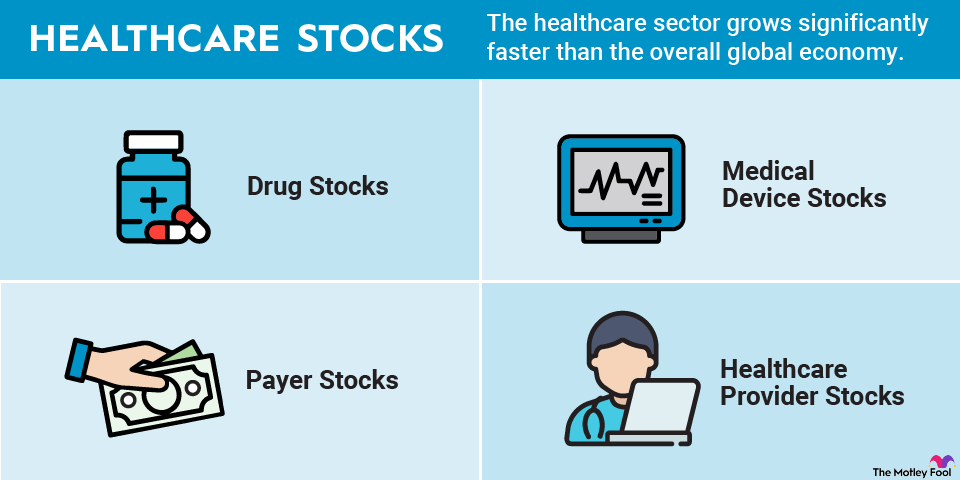
Investors who do not want to analyse individual companies can use a broad healthcare ETF.
Those with stronger conviction can adopt a core–satellite approach: an ETF for the core, with a small number of selected stocks around it.
Ageing expands the market.
Innovation determines which products succeed.
AI may improve how those products are discovered and delivered.
But the investment return will still depend on what the investor pays—and what the business eventually earns.
Which part of healthcare offers the best risk-reward today: medicines, medical devices, research tools or a broad healthcare index?
Disclaimer: The content here is for informational purposes only and should NOT be taken as legal, business, tax, or investment advice. It does NOT constitute an offer or solicitation to purchase any investment or a recommendation to buy or sell a security. In fact, the content is not directed to any investor or potential investor and may not be used to evaluate or make any investment. Do note that this is not financial advice. If you are in doubt as to the action you should take, please consult your stock broker or financial advisor.