Quite a few of you have asked me about this since the 4% rule article.
Say you retire with S$2 million spread across cash, an SRS account, CPF and a brokerage account full of stocks.
Which pot should you draw down first?
Most people never plan this. They spend whatever feels most liquid and leave the SRS untouched “to compound tax-deferred” — because that is what many American retirement guides say to do.
But on a S$400,000 SRS account, that instinct could cost you S$21,150 in tax.
In this article, I’ll cover:
- Which of the four pots IRAS taxes when you withdraw
- How to withdraw S$400,000 from SRS at 0% tax
- A worked example: the same S$2 million, two withdrawal orders, S$21,150 apart

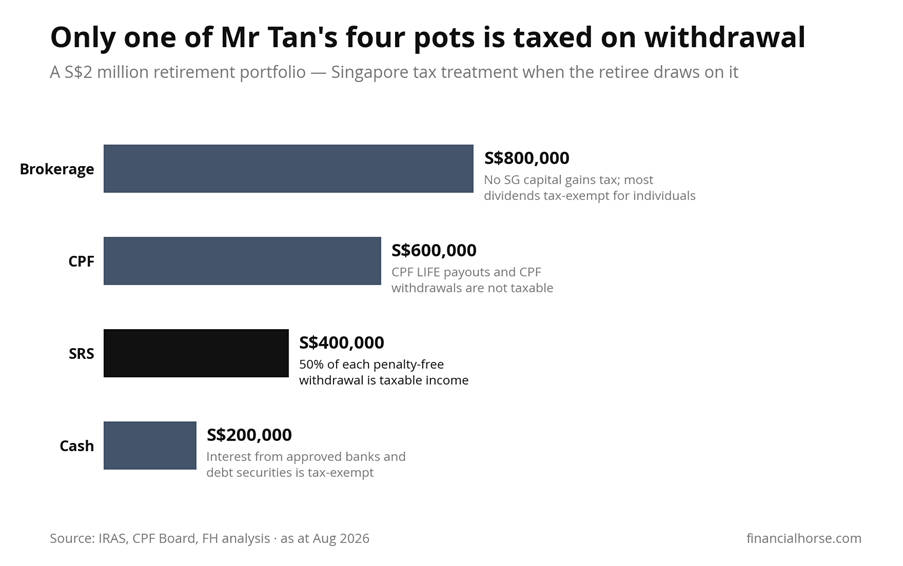
Which of your four pots does IRAS actually tax?
Let’s reason from first principles.
Before deciding the order, you need to know the tax cost of drawing from each pot.
| Pot | Tax when you withdraw | What it earns today |
| Cash (savings, FDs, T-bills, SSBs) | None for a typical individual investor — most interest from approved banks and debt securities is tax-exempt | ~1.5–2.0% (six-month T-bill cut-off yield: 1.56% on 13 Aug 2026; best FDs: ~2.0%) |
| CPF | None — CPF LIFE payouts and CPF withdrawals are not taxable | 4.0% in the RA (floor extended to 31 Dec 2026); 2.5% in the OA |
| Brokerage | Generally none for a long-term individual investor — Singapore does not tax capital gains, and most dividends received by individuals are tax-exempt | Market returns, less costs such as foreign withholding tax |
| SRS | 50% of each penalty-free retirement withdrawal is taxable income | Whatever you invested it in |
Three of the four pots are generally tax-free when a typical retiree draws from them.
In plain English, you can sell S$500,000 of stocks held as personal investments and generally pay no Singapore capital gains tax.
The main leak in a brokerage account is foreign withholding tax — for example, 30% on dividends from US-listed ETFs versus 15% for many Irish-domiciled ETFs. But that leak applies regardless of which account you draw from first, so it does not change today’s question.
This is why the standard American playbook — draw down the taxable account first and leave tax-deferred accounts to compound — translates poorly to Singapore.
In the US, that order can work because dividends, interest and realised gains in a taxable account may generate tax along the way.
For a typical long-term investor in Singapore, they generally do not.
Meanwhile, the SRS pot you save for last can create a large tax bill if you withdraw too much in one year.
So the withdrawal-order question becomes much simpler:
How do you get money out of SRS at the lowest possible tax rate?
The SRS rules in four lines
Singapore had S$23.88 billion of cumulative SRS contributions across 516,376 accounts as at December 2025, so this is not a niche problem.
Here are the IRAS rules that matter:
- Withdraw before your prescribed retirement age and, in most cases, 100% of the withdrawal is taxable and a 5% penalty applies.
- Withdraw at or after that age and only 50% is taxable, with no penalty.
- Your prescribed retirement age is the statutory retirement age when you made your first SRS contribution. It is locked in for life. The statutory retirement age rose to 64 on 1 July 2026 — which is why I told you to put S$1 into SRS before 1 July.
- You have a ten-year withdrawal period starting from your first penalty-free withdrawal. Any balance left at the end is deemed withdrawn, with 50% subject to tax.
Now for the math.
The first S$20,000 of chargeable income in Singapore is taxed at 0%.
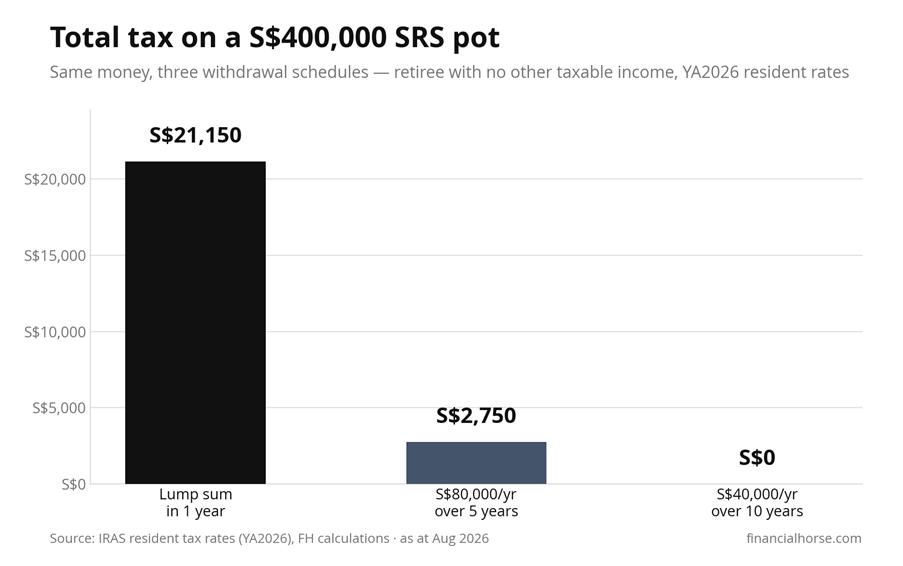
So if you withdraw S$40,000 a year from SRS and have no other taxable income, only S$20,000 counts as taxable income. Your tax bill is S$0.
Do that for ten years and you can withdraw S$400,000 from SRS without paying income tax, assuming the account does not grow beyond the amounts withdrawn.
But here is the part many people miss.
That S$40,000-a-year capacity is use-it-or-lose-it. The 0% band does not roll over.
Once your ten-year withdrawal period starts, skipping a year leaves fewer opportunities to spread the balance across low tax brackets. Meanwhile, any investment growth may increase the amount you eventually need to withdraw.
So what can getting the order wrong actually cost?
The same S$2 million, two withdrawal orders
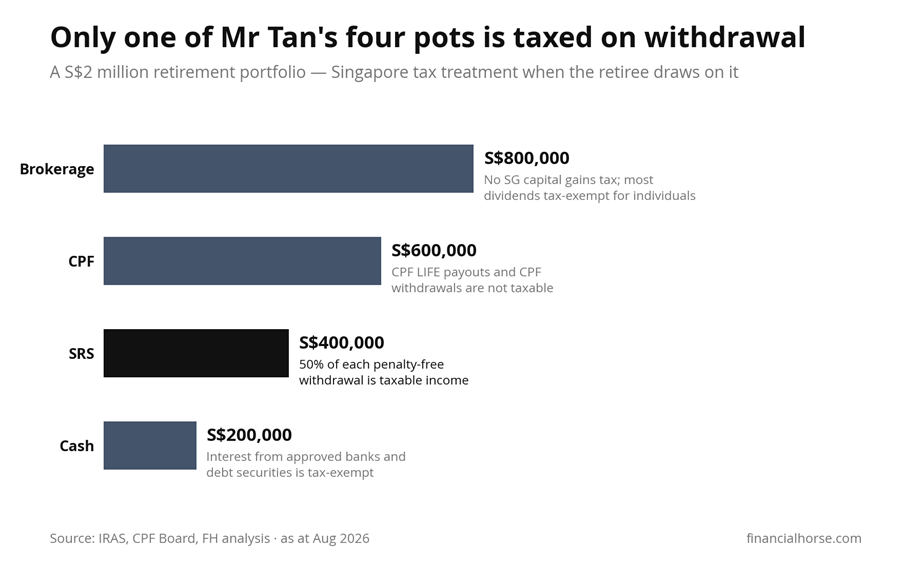
Meet Mr Tan. He is 63, retiring this year and spending S$80,000 a year. His S$2 million portfolio is split as follows:
- Cash: S$200,000
- SRS: S$400,000
- CPF: S$600,000 — including S$220,400 in his RA and about S$380,000 in his OA
- Brokerage: S$800,000
He made his first SRS contribution in 2010, when the statutory retirement age was 62. That is therefore his prescribed retirement age, and his penalty-free withdrawal period can begin now.
To isolate the effect of withdrawal timing, assume for this comparison that the SRS balance does not change through investment gains or losses. I will return to growth below.
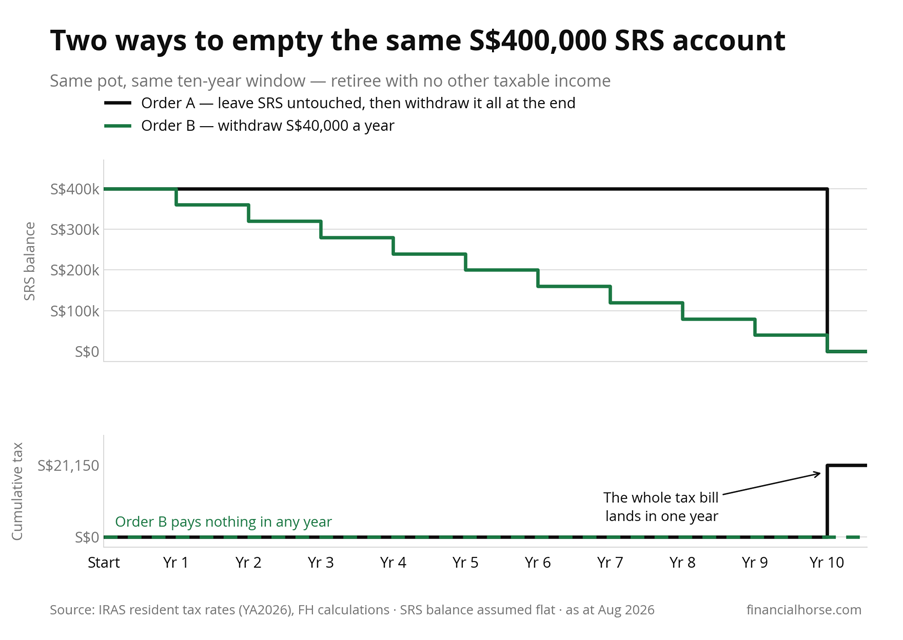
Order A — the American instinct. Mr Tan spends his cash first. From 65, he sells down his brokerage account alongside his CPF LIFE payouts. He leaves the SRS untouched and withdraws the full S$400,000 near the end of the ten-year period.
Half the lump sum — S$200,000 — is taxable in a single year, reaching the 18% tax bracket.
Tax bill: S$21,150.
Order B — the Singapore approach. Mr Tan withdraws S$40,000 a year from SRS and funds the remaining S$40,000 of annual spending from cash, then the OA and then the brokerage account. CPF LIFE starts at 65 as before. His SRS account is empty by the end of the ten-year period.
With no other taxable income, only S$20,000 of each annual SRS withdrawal is taxable.
Tax bill: S$0.
Same S$2 million. Same S$80,000 of annual spending. Same four pots.
The only change is the SRS withdrawal schedule — and one version pays IRAS S$21,150 more.
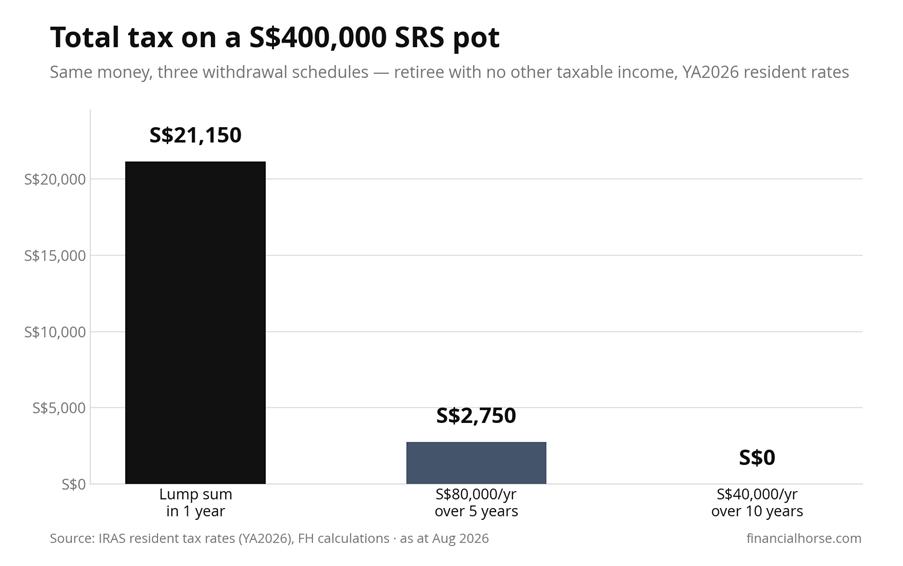
The number scales with the account. On a S$550,000 SRS balance, the difference between a lump sum and ten equal annual withdrawals is about S$34,000. On S$700,000, it is about S$47,000.
One important caveat: if your SRS investments keep growing during the ten-year period, fixed S$40,000 withdrawals will not fully empty the account.
For example, if Mr Tan’s SRS earns a steady 4% and he withdraws S$40,000 at the start of each year, a balance of roughly S$92,000 remains at the end. Half of that deemed withdrawal is taxable, producing a tax bill of about S$1,000 if he has no other taxable income.
That is still much less than taking the entire growing balance as a lump sum. But the practical answer is to review the account each year and adjust the withdrawal amount as the balance changes.
Never miss a post! Follow Financial Horse by subscribing or following us on your favorite platform:
Subscribe to our mailing list for exclusive content straight to your inbox:
Where does CPF fit? It is not a tax lever
CPF barely featured in the example because CPF LIFE payouts and CPF withdrawals are not taxable, regardless of your withdrawal order.
CPF therefore does not change the tax calculation. Its place in the sequence depends more on returns, liquidity and longevity protection.
The RA is one of the strongest risk-free assets available to a Singapore retiree: a 4% interest-rate floor until at least the end of 2026, tax-free and insulated from market sequence risk.
So I would generally preserve the RA. Ideally, it is not “drained” at all. It forms the longevity floor in the bridge-and-floor framework from the 4% rule article.
The OA is different. Since the Special Account closed for members aged 55 and above in January 2025, savings above the applicable RA transfer amount may sit in the OA, earning 2.5% and remaining withdrawable on demand.
In practical terms, that makes the OA similar to a government-backed, on-demand account paying 2.5%. In a simple tax-aware drawdown order, it may come after lower-yielding cash and before higher-expected-return investments.
Whether to defer CPF LIFE payouts to 70 is a separate decision. Payouts can rise by up to 7% for each year of deferral, but that is a longevity-insurance trade-off rather than a tax strategy. It deserves its own article — let me know if there is interest.
What changes the order?
Four situations can materially change the answer.
You are still working. Your salary may already use the lower tax brackets, so a S$40,000 SRS withdrawal could be taxed at your marginal rate. The ten-year period starts only when you make your first penalty-free withdrawal, not when you reach your prescribed retirement age. You can therefore wait and begin withdrawals after you stop working.
You have rental or other taxable income. This income uses the lower tax brackets before your SRS withdrawal does. Plan using your net taxable rental income after allowable expenses, not your gross rent.
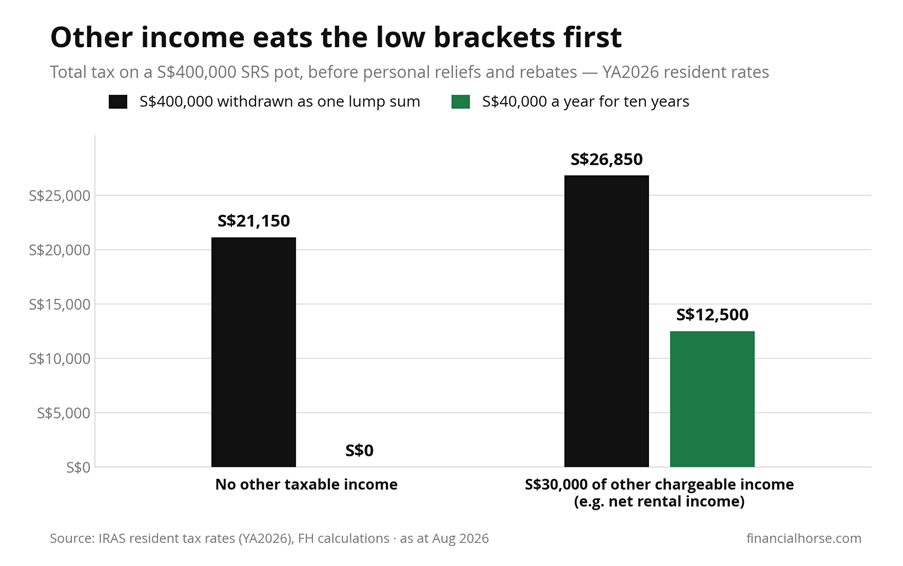
For example, if you have S$30,000 of other chargeable income each year and withdraw S$40,000 annually from SRS, your total chargeable income is S$50,000. At current resident rates, that produces S$1,250 of tax a year, or S$12,500 over ten years, before personal reliefs and rebates. A S$400,000 lump-sum SRS withdrawal in a year with S$30,000 of other chargeable income would produce S$26,850 of tax.
Your SRS balance is much larger than S$400,000. You may not be able to withdraw it all within the 0% band, but the next tax brackets are still relatively low. Ten annual withdrawals of S$55,000 from a S$550,000 account would generate about S$1,500 of total tax if you have no other taxable income — an effective rate of about 0.3% of the SRS withdrawals. SRS funds used to buy a life annuity are also outside the ten-year deemed-withdrawal rule, with 50% of each payout taxable when received.
You die with money still in SRS. The remaining balance is treated as withdrawn on death. There is no 5% penalty, and up to S$400,000 may be exempt from tax, adjusted for certain earlier penalty-free withdrawals. Of any remaining amount, 50% is taxable. The rest of your brokerage estate is a separate issue, which I covered in the brokerage account article.
One more thing: you do not necessarily have to sell your investments to use this strategy.
Qualifying SRS withdrawals can be made in kind. You may be able to transfer S$40,000 worth of shares from SRS to your personal brokerage account, remain invested and still have the transfer count as that year’s withdrawal. Check the process and fees with your SRS operator.
So what is the right order?
Long story short, the tax-aware Singapore answer can be the opposite of the standard American answer: draw down SRS gradually once you have stopped earning significant taxable income, while preserving the tax-free flexibility of your brokerage account.
For someone with no other taxable income and a S$400,000 SRS balance, the default order I would consider is:
- Withdraw from SRS gradually during the ten-year period. Target the lowest available tax brackets and review the balance each year.
- Use lower-yielding cash for spending. Check that your cash is earning a competitive rate.
- Then consider the OA. It currently earns 2.5% and is available on demand.
- Use the brokerage account according to your asset-allocation and rebalancing plan. There is generally no Singapore capital gains tax reason to sell sooner, but portfolio risk and sequence risk still matter.
- Preserve the RA and CPF LIFE as the longevity floor. Ideally, do not treat them as pots to drain.
This is a tax-aware default, not a universal liquidation rule. The exact sequence must still respect your asset allocation, market risk, liquidity needs, other taxable income and estate plan.
That is how I am thinking about the withdrawal order today.
Love to hear what you think though!
If you are already drawing down your retirement portfolio, what order are you using? And did you plan your SRS exit before or after you stopped working?
This article was written on 20 Aug 2026. It will not be updated going forward.
My latest macro views, as well as my full stock watch and personal portfolio, are shared on FH Premium.
Good article! Quick clarification: isn’t 20K the threshold for tax free income? Curious to understand how the 40K a year amount was derived?
withdraw 40k/year, 50% of total withdrawal is taxable so 20k.
20k is lands within the tax free bracket, anything more you will be subjected to the next tax bracket.
SRS withdrawals are taxed at 50%
SRS is taxed at 50%
Thanks for the article, but it’s too general.
TLDR: drawdown SRS first.
If 400k, that’s a problem I’m glad to have!
Also, assuming you drawdown to maximize tax savings: where should you put the money instead?
The idea with SRS is you are deferring tax payments, interest free. The savings are recorded at time of contribution.
If it grows beyond tax free withdrawal, that’s fantastic!
Good article. Just 3 points:
1. Considering that most healthy people here can expect to live to more than 85, and many will live into their 90s, deferring the CPF withdrawals to age 70 can be a great way to go, and I plan to do that myself. It will make a huge difference to my payouts. For somebody with the maximum CFP Life Premium (“Enhanced Retirement Sum”) it will mean a very generous payout after reaching the age 70 that goes on until you die.
2. Once we start withdrawing from the SRS (my understanding is) we need to take it all out within 10 years. I’ve managed (even conservatively investing), to achieve an average CAGR of 6.5% on mine. If that continues I’ll be able to withdraw about S$73K p.a. over 10 years, and still only pay a few hundred dollars in tax.
3. Don’t forget US Estate Tax on any shares you hold there as a non-US person (for tax purposes) if the balance of the holdings is over US$60K. It’s not a flat rate, and it increases progressively, starting at 18% on the first US$10,000 above the tax free threshold, and rises to a whopping 40% on anything over US$1 million.
Fully buy-in to your analysis, and interested on another article on whether to defer CPF LIFE payouts.
i don’t consider SRS in the sequence, as most likely SRS are invested just like the brokerage, and like you mentioned in the article, you can transfer instead of selling the equities. SRS is just part of the pool of Brokerage and you need a different strategy to move out SRS investment. I agree that the sequence depends more on returns, liquidity and longevity protection
Thabks for the article. Always very keen to read your pieces. What’s your thoughts about bucket strategy in retirement? How many buckets, or should it just be 60/40 (or 70/30) instead and is there a better strategy?
Would be much appreciated if you would write on this topic as well.
OK – will see if i can write on this.
OK will do
If you have more money, e.g. $600k in SRS, how would you withdraw the money to minimise the tax one has to pay?
“Jonathan Lloyd August 23, 2026 At 11:57 am
Good article. Just 3 points:
1. Considering that most healthy people here can expect to live to more than 85, and many will live into their 90s,…”
This is a flawed statement. Most people will live till the life expectancy, that is for 2025 male: 81.8, female: 86. This is what statistics means.