In case you missed it — Singapore headline inflation just came in at 2.2%.
That is the highest reading since August 2024.
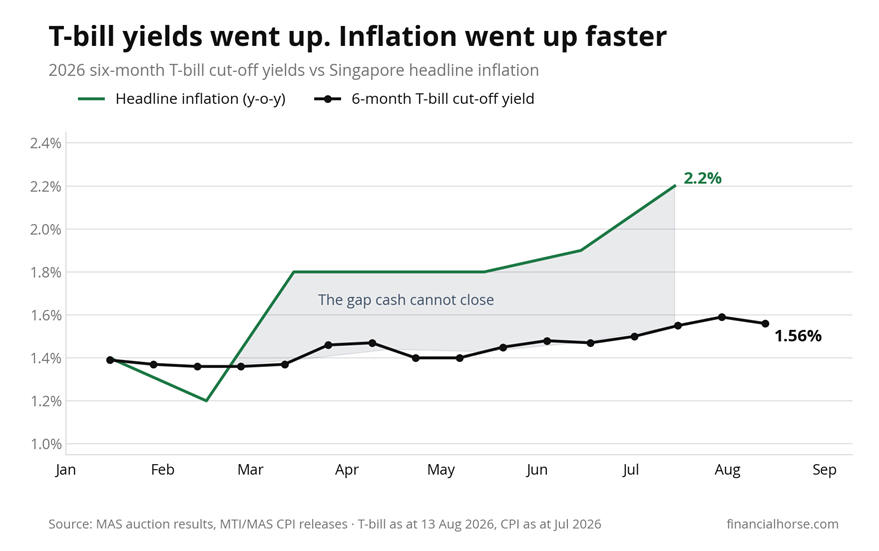
At the same time, the latest completed 6-month T-bill auction paid just 1.56%.
In plain English, almost every conventional place to park cash in Singapore now offers a headline yield below the current inflation rate.
So in this article, I wanted to cover 3 questions:
- Why is inflation back?
- Which cash instruments still offer a yield above inflation, if any?
- Where would I park cash today?
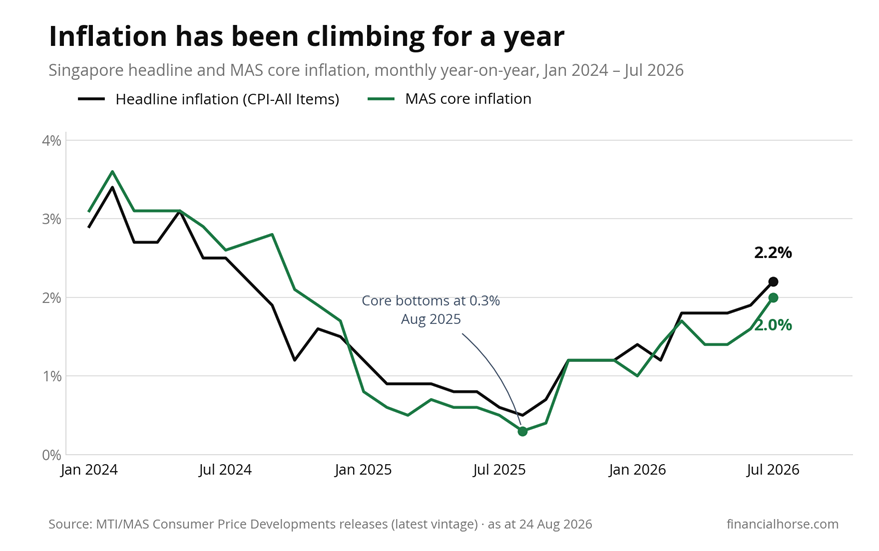
Inflation is back — core jumped from 1.6% to 2.0% in a single month
The numbers first, from the MAS-MTI release published this week.
Core inflation jumped from 1.6% to 2.0% year-on-year in July.
Headline inflation rose from 1.9% to 2.2%.
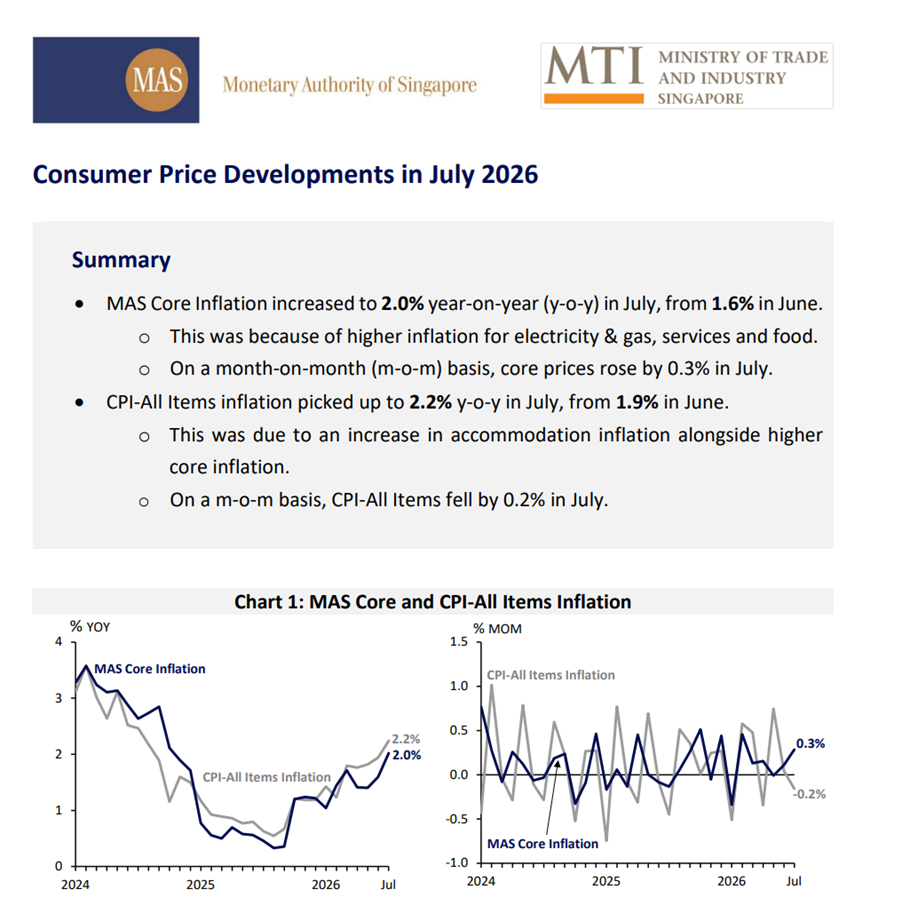
Here’s the chart for reference.
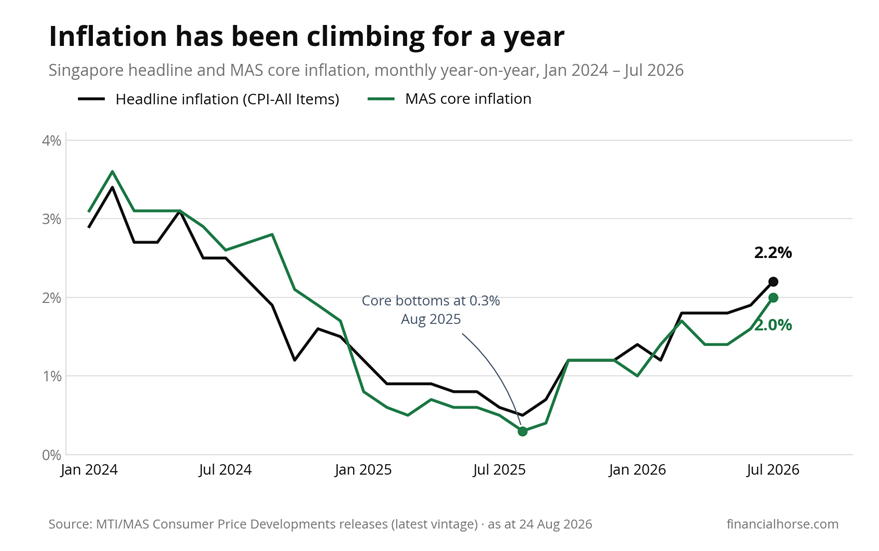
You can see that this is not just a one-month move.
Core inflation bottomed at 0.3% in August 2025 and has been rising broadly since.
July made that trend impossible to ignore.
The single biggest culprit — the electricity bill
Look at the category breakdown and one line jumps out.
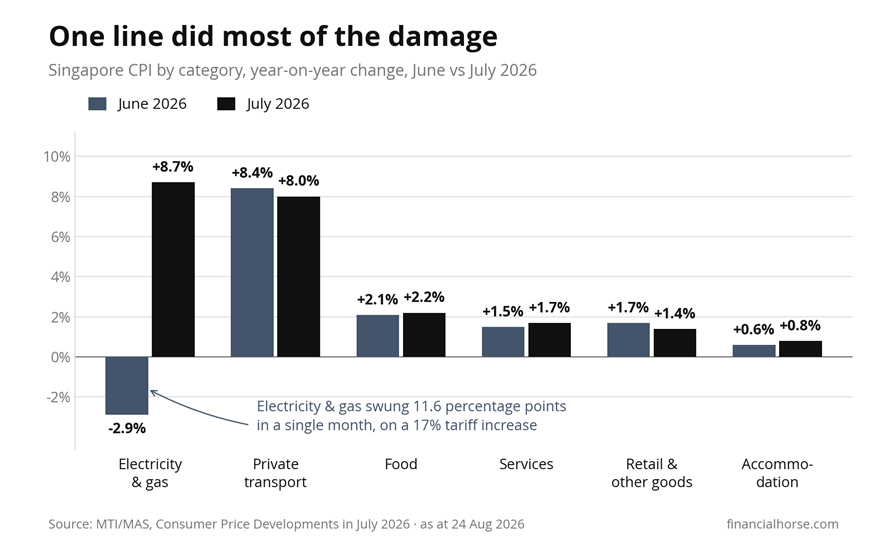
Electricity & gas inflation swung from −2.9% to +8.7% in a single month.
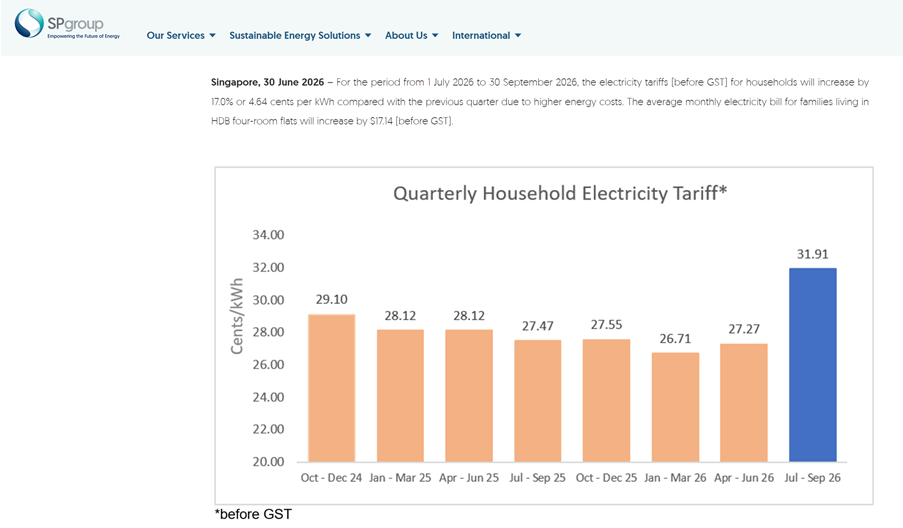
The reason is simple — the regulated household electricity tariff jumped 17% in July, adding about S$17 a month to the average four-room HDB bill before GST.
And here’s the part most people miss.
Each quarter’s energy-cost component is based on average natural gas prices from the first two and a half months of the previous quarter. July’s tariff therefore reflects the period from April to mid-June, when global fuel prices were very high because of the Middle East conflict.
In plain English, your July electricity bill reflects an earlier fuel-price shock, arriving with a lag.
That cuts both ways.
If global fuel prices ease, the Q4 tariff may fall and this component could fade. SP Group has explicitly flagged that possibility.
So don’t mechanically extrapolate July’s 8.7% — but don’t dismiss it either, because services, food and accommodation inflation also edged up.
Will inflation stay higher? MAS thinks the risks are to the upside
MAS and MTI kept their full-year 2026 forecasts at 1.5–2.5% for both core and headline inflation.
But two lines in the release deserve attention.
First, core inflation is “expected to remain elevated into 2027”, before moderating more clearly from around mid-2027.
Second, “the risks to the inflation outlook remain tilted to the upside” — including renewed energy disruptions, worse weather and demand spillovers from the global IT investment boom.
MAS is not just talking. It tightened monetary policy twice this year, in April and July, by increasing the rate of appreciation of the S$NEER policy band to lean against imported inflation.
That said, there is one important caveat to the 2.2% figure.
About a fifth of the CPI basket reflects imputed rent on owner-occupied homes — a cost that does not represent a cash payment for most owner-occupiers.
Your household’s actual inflation rate can therefore differ materially from the headline figure, depending on what you spend money on.
The problem — almost nothing in cash beats 2.2% anymore
Now compare that 2.2% with what common cash instruments pay today.
The table below uses a snapshot real-rate gap: the nominal annualised yield versus July’s 2.2% year-on-year headline inflation rate.
| Instrument | Nominal (as of) | Snapshot real-rate gap | Capital/rate certainty |
| 6-month T-bill | 1.56% (13 Aug cut-off) | −0.6% | SG government; hold to maturity |
| 1-year T-bill | 1.68% (23 Jul cut-off) | −0.5% | SG government; hold to maturity |
| SSB Sep-26, year 1 | 1.52% | −0.7% | SG government |
| SSB Sep-26, 10-year average | 2.25% | ~0.0% | SG government |
| Best fixed deposit (promo) | ~1.78% (20 Aug) | −0.4% | SDIC-insured up to S$100,000 per depositor per scheme member |
| Money market funds | 1.3–1.6% (Jul) | −0.6% to −0.9% | No — yield floats and capital is not guaranteed |
| CPF OA | 2.50% | +0.29% | Current statutory floor rate |
| CPF SA/MA/RA | 4.00% | +1.76% | Current floor rate |
The takeaway is simple.
Every liquid instrument in the table offers a nominal yield below the current headline inflation rate.
Only CPF’s base rates sit clearly above 2.2%. The September SSB’s 10-year average roughly matches it, although that comparison mixes a 10-year average interest rate with a one-year inflation reading.
Two nuances before anyone panics.
Bonus-rate savings accounts such as OCBC 360 and DBS Multiplier can still beat inflation at their advertised maximum rates. But those rates require combinations of salary crediting, card spending and other conditions, and usually apply only up to specified balance caps. Compare the effective blended rate you can actually earn, not the headline maximum.
And if you use core inflation of 2.0% instead of headline inflation, each real-rate gap improves by about 0.2 percentage points. The picture becomes less negative, but most signs do not flip.
Never miss a post! Follow Financial Horse on WhatsApp or Telegram — one tap, and every new article reaches you the moment it’s published.
Which brings us to the million-dollar question: where should you park cash now?
My framework is to split cash into 3 buckets, because no single instrument does all three jobs well.
Bucket 1 — emergency cash (3–6 months of expenses).
This money’s job is to be there, not to beat inflation.
Keep the first layer in an accessible savings account, ideally one whose bonus conditions you already meet naturally. A money market fund can hold a secondary layer if its redemption timing and lack of capital guarantee work for you.
I would not rely on a T-bill for money that may be needed immediately: there is no early redemption, so you generally need to hold it to maturity or try to sell it in the secondary market.
A negative snapshot real yield on an emergency fund is annoying, but it is not a problem worth solving by sacrificing liquidity.
Bucket 2 — cash you will not need for 6–12 months.
Here, a 6-month T-bill ladder remains reasonable, even with a negative snapshot real-rate gap.
The attraction is sovereign credit quality, a short commitment period and staggered reinvestment dates. T-bill cut-offs have risen from 1.36% in February to 1.56% at the latest completed auction, although the most recent result was down from 1.59% in late July.
A ladder does not guarantee higher rates. It simply reduces the risk of locking the entire sum at one point in time.
A 12-month fixed deposit at around 1.7% locks in today’s rate. A T-bill ladder gives you another chance to reprice in 6 months. If yields fall, the fixed deposit wins; if they rise, the ladder adapts sooner.
For money I genuinely will not need during the term, I would lean towards the ladder for that flexibility.
Bucket 3 — cash that can sit for years.
This is where SSBs and CPF become more relevant.
The September SSB’s 10-year average return of 2.25% roughly matches inflation today. Its structure is useful in an uncertain rate environment: the interest rate steps up to 2.82% by year 10, while investors can submit a monthly redemption request at par, subject to the redemption cycle and transaction fee.
The SSB is not inflation-linked, so it does not guarantee a positive real return. But it offers a rare combination of a fixed long-term rate, Singapore Government backing and an exit at par.
Then there is CPF, currently paying 2.5% in the OA and 4% in the SA, MA and RA. Those are the only base rates in this comparison that sit clearly above current headline inflation.
The catch is real: CPF money remains subject to CPF usage and withdrawal rules. This only makes sense for cash that you are genuinely willing to commit for housing, healthcare or retirement purposes, as applicable.
Two practical angles are worth knowing:
- If you previously used OA money for a property, a voluntary housing refund can restore cash to your CPF accounts, mainly the OA depending on your circumstances. Refunded OA savings can be reused for CPF-approved purposes, including housing, subject to the applicable rules. But make sure you retain enough cash for daily expenses and emergencies first.
- Buying T-bills with OA funds no longer makes sense on yield alone. At 1.56% versus the OA’s 2.5% floor — before accounting for lost CPF interest around the auction and maturity dates — leaving the money in OA has the higher guaranteed nominal rate.
Long story short — keep emergency money liquid, use a T-bill ladder for cash you can commit for 6–12 months, and consider SSBs or CPF only for money that can sit longer and where their access rules fit your needs.
And if inflation stays higher into 2027 — banks, REITs, bonds?
One step further, and to be clear — this is my inference, not MAS’s forecast.
Persistently higher inflation could keep Singapore yields higher than they would otherwise be. But Singapore interest rates are not set directly by MAS; they are also influenced by US rates, domestic liquidity and expectations for the Singapore dollar.
For the banks, firmer SORA could provide some relief.
All 3 local banks reported year-on-year net interest margin compression in Q2: DBS at 1.87%, OCBC at 1.70% and UOB at 1.74%. UOB management has said SORA “appears to be bottoming”.
If SORA stabilises or rises, that could support margins. But the impact on each bank will still depend on deposit costs, loan growth, asset repricing and credit quality.
For longer-duration bonds, renewed inflation would generally be a headwind because higher yields push existing bond prices down. The 10-year SGS yield was about 2.30% on 26 August.
For REITs, higher-for-longer rates could delay part of the refinancing tailwind. S-REITs lagged the STI in the first half of 2026, although the impact varies by leverage, hedging profile, refinancing schedule and asset quality.
There is a full article in that if readers are keen — let me know in the comments and I’ll write one.
In summary
Headline inflation is back at 2.2%, while most conventional cash instruments pay around 1.5–1.8%. MAS and MTI say the risks to the inflation outlook remain tilted to the upside.
The instruments have not changed, but the trade-offs have.
Keep emergency money liquid. Use short-duration instruments for cash you can commit. Consider SSBs and CPF only where the longer holding period and access rules fit your needs.
The views above are as at 27 Aug 2026, and markets move quickly.
My latest macro views, what I’m doing with my own money this week, and what would change my mind, are shared on FH Premium.
Join the FH mailing list and new articles land straight in your inbox:
Also on WhatsApp, Telegram and Facebook.
Which bank is offering 1.78% interest rate now? Dont think it was included in the article. Thank you.
Bank of China
Will be great to hear about your views on S-REITS and the overall rate issues. Esp since after your previous analysis on the local Banks.
OK will write on this