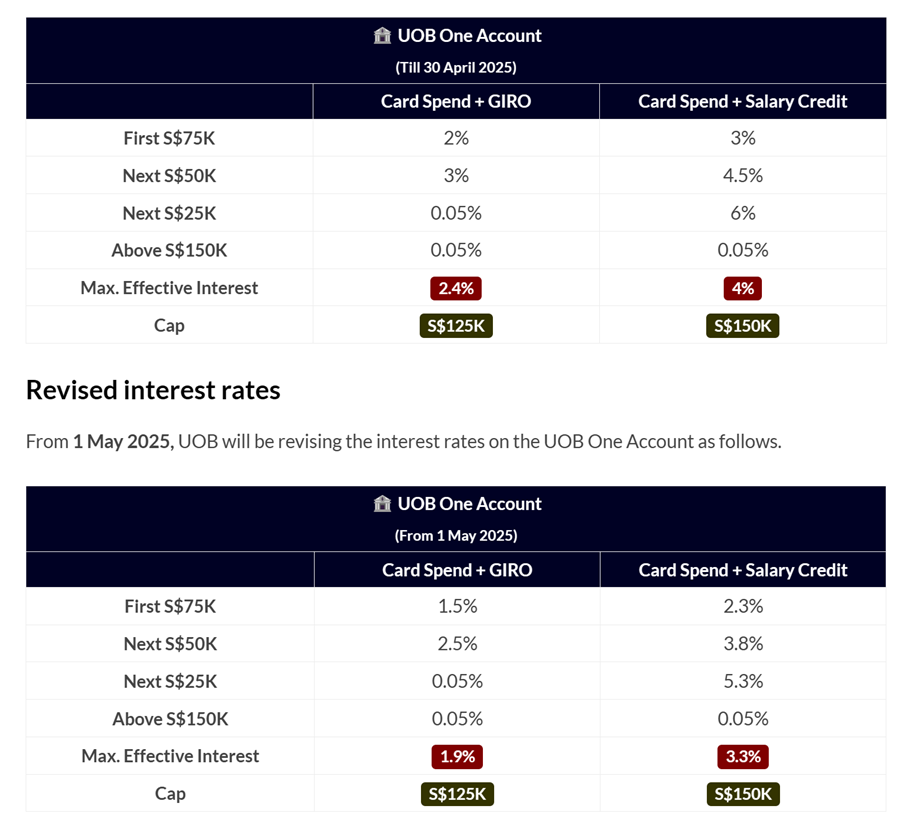
As you would know, UOB announced a drop in interest rates to their UOB One account recently (to 3.3% on $150,000, down from 4.0%).
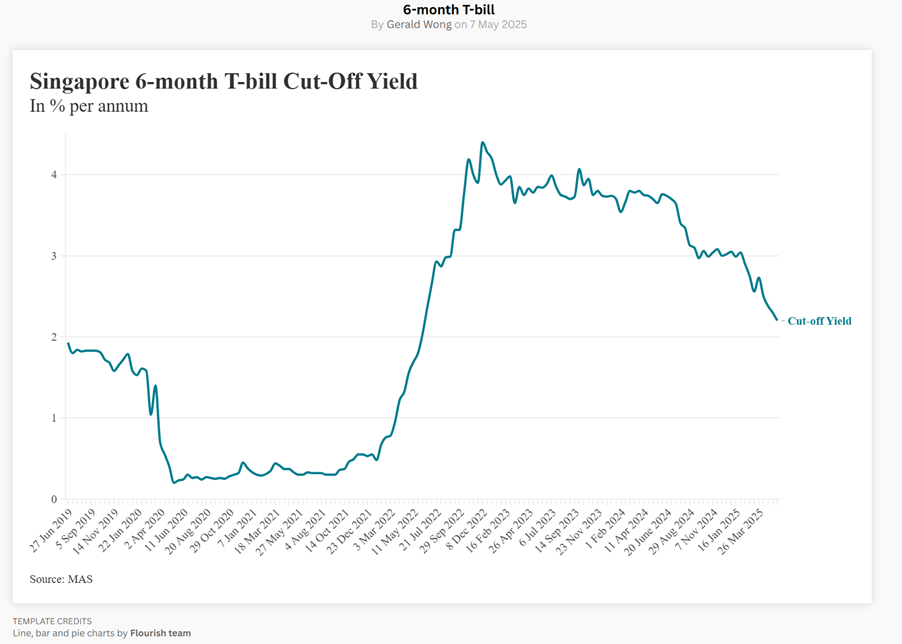
While the latest 6-month T-Bills yields fell to 2.20%.
With interest rates going down across the board, and plenty of volatility across stock markets globally.
I wanted to relook at the best places to park cash today.
Couple of points I wanted to discuss:
- What are the Top Fixed Deposit Rates in Singapore today (May 2025)?
- What are the alternatives to Fixed Deposit? T-Bills a better buy?
- Where would I put my cash today?
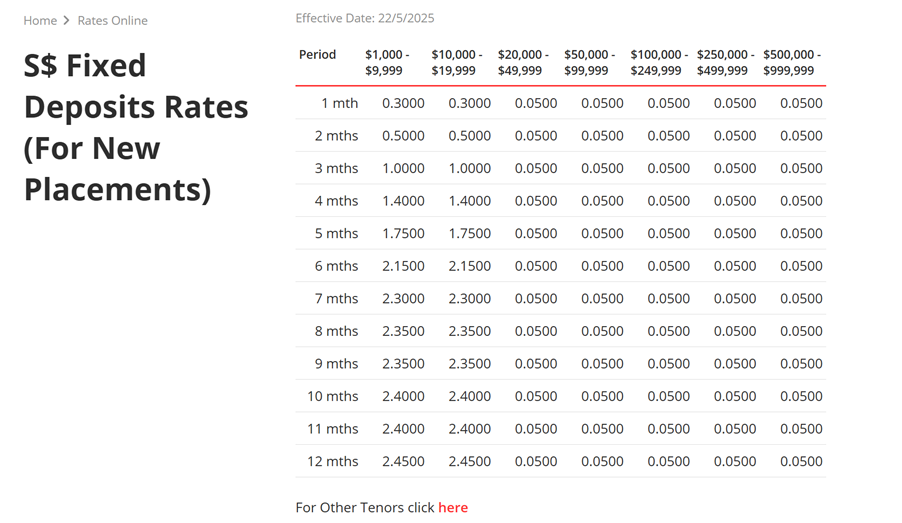
Top Fixed Deposit Rates in Singapore offer 2.45% yield (May 2025)
The full table is further below in the article, but I’ve summarised the best interest rates for the 3-, 6- and 12-month tenures below.
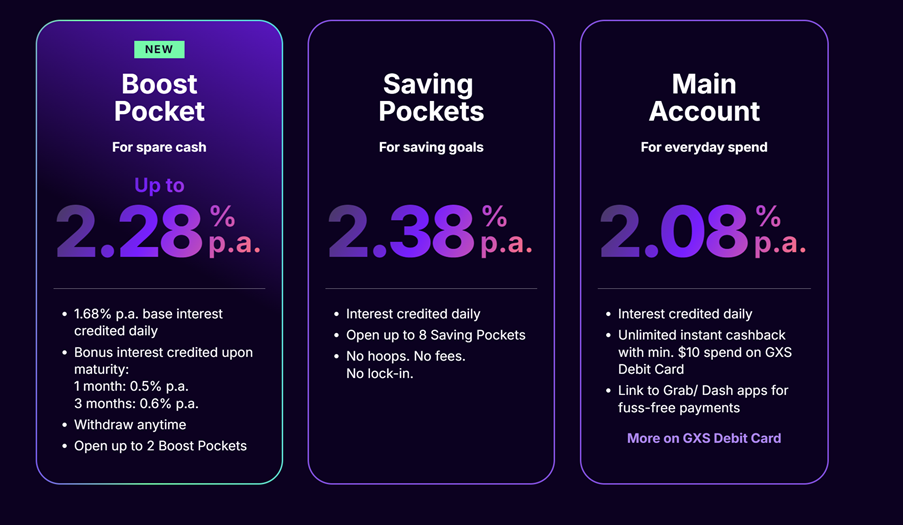
You’re looking at 2.28% for 3 months and 2.35% for the 6 months tenure.
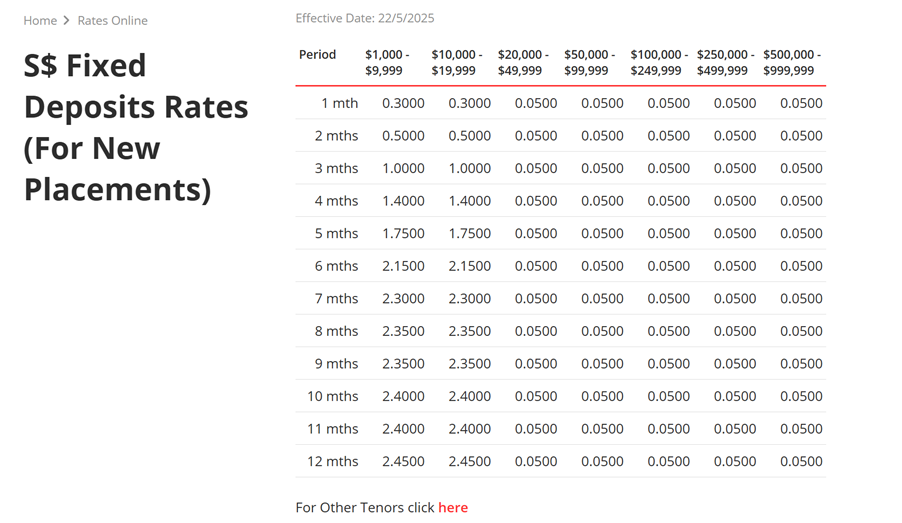
And 2.45% for the 12 months tenure (which very interestingly – is offered by DBS Bank).
| Tenure | Best fixed deposit interest rate (May 2025) | Bank |
| 3 months | 2.28% | GXS Bank |
| 6 months | 2.35% | State Bank of India |
| 12 months | 2.45% | DBS/POSB Bank |
GXS Bank:
DBS Bank:
Best Fixed Deposit Rates yield 2.30% if you deposit with Syfe Cash+ (to access institutional fixed deposit rates)
The rates above are assuming that you deposit with the bank directly as a retail customer.
Another way to do it is to use Syfe Cash+ Guaranteed.
The way this works is that you park the cash with Syfe, who will then deposit the cash into an institutional fixed deposit account.
This allows you access to institutional fixed deposit rates.
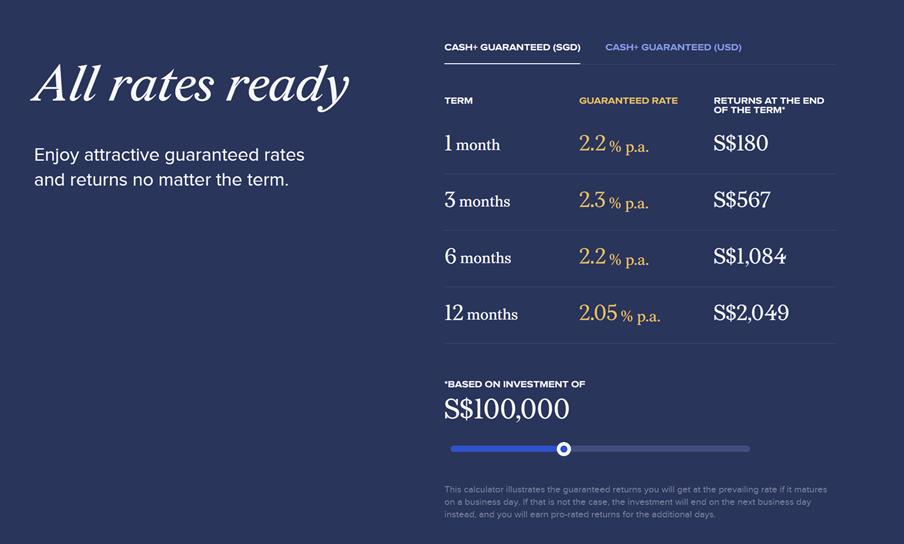
These are the latest interest rates from Syfe Cash+ below:
- 3 months – 2.30%
- 6 months – 2.20%
- 12 months – 2.05%
Note that Syfe Cash+ is not SDIC insured, but given that the underlying is fixed deposits risk should be on the low side (but not risk free).
That being said if you compare with the fixed deposit rates above – you’re probably better off just sticking with the plain vanilla fixed deposit.
6-month T-Bills yields drop to 2.20% – Will T-Bills yields continue to drop?
Meanwhile, 6-month T-Bill yields continue to drop, coming in at 2.20% at the latest auction:

You can see this charted below, T-Bills yields have been steadily declining since the peak in mid 2022:
Comparing interest rates for T-Bills vs Fixed Deposits vs Syfe Cash+ Guaranteed across all tenures (May 2025)
I’ve tabulated the interest rates for the 3 cash options below, as well as with money market funds.
You can see how with the recent drop in T-Bills yields – actually fixed deposits are a pretty attractive option once again.
| 3 months | 6 months | 12 months | Risk Free | |
| T-Bills yields | NA | 2.20% | 2.08% | Yes |
| Fixed Deposit (direct to bank) | 2.28% | 2.35% | 2.45% | Yes (if below $100,000 SDIC limit) |
| Syfe Cash+ Guaranteed (Institutional Fixed Deposit Rates) | 2.30% | 2.20% | 2.05% | No |
| Money Market Funds | ~2.8% | No | ||
In fact viewed this way the 2.45% offered by DBS Bank looks like an outlier and pretty much a no brainer.
The only downside is that the maximum you can put in is $19,999:
Best Fixed Deposit Rates yield 2.45% – if you deposit directly with the bank (as of May 2025)
The full list of Fixed Deposit rates is set out below (bold being the most attractive for each tenure).
After the table I’ll share my views on:
- What are the alternatives to T-Bills and Fixed Deposit?
- Where would I put my cash today?
| Bank | Interest rate per annum | Tenure | Minimum amount |
| DBS/POSB | 2.45% | 12 months | S$1,000 (max S$19,999) |
| 2.35% | 9 months | S$1,000 (max S$19,999) | |
| 2.15% | 6 months | S$1,000 (max S$19,999) | |
| SBI | 2.35% | 6 months | S$50,000 |
| 2.25% | 12 months | S$50,000 | |
| GXS Bank | 2.28% | 3 months | S$100 |
| Bank of China | 2.25% (mobile new placement) | 3 months | S$500 |
| 2.20% (mobile new placement) | 6 months | S$500 | |
| 2.15% (mobile new placement) | 9/12 months | S$500 | |
| ICBC | 2.15% (mobile placement) | 3 months | S$500 |
| 2.10% (mobile placement) | 6/9 months | S$500 | |
| 2.05% (mobile placement) | 12 months | S$500 | |
| CIMB | 2.20% | 3 months | S$1,000 |
| 2.10% | 6 months | S$1,000 | |
| 1.90% | 9/12 months | S$1,000 | |
| Hong Leong Finance | 2.00% (mobile placement) | 7 months | S$5,000 |
| 1.80% (mobile placement) | 10 months | S$5,000 | |
| 1.75% (mobile placement) | 13 months | S$5,000 | |
| Maybank | 2.05% (mobile placement) | 6 months | S$20,000 |
| 1.90% (mobile placement) | 9 months | S$20,000 | |
| 1.85% (mobile placement) | 12 months | S$20,000 | |
| RHB | 2.00% (mobile placement) | 3/6 months | S$20,000 |
| 2.00% (mobile placement) | 12 months | S$20,000 | |
| Citibank | 2.00% | 3 months | S$50,000 (Max S$3 Million) |
| 2.00% | 6 months | S$50,000 (Max S$3 Million) | |
| UOB | 2.00% | 6 months | S$10,000 (fresh funds) |
| 1.70% | 10 months | S$10,000 (fresh funds) | |
| Standard Chartered | 2.00% | 5 months | S$25,000 (fresh funds) |
| 1.50% | 15 months | No minimum | |
| 1.10% | 12 months | No minimum | |
| 1.05% | 9 months | No minimum | |
| OCBC | 1.90% (mobile placement) | 9 months | S$30,000 |
| 1.85% (mobile placement) | 12 months | S$30,000 | |
| HSBC | 1.55% | 3 months | S$30,000 |
| 1.50% | 6 months | S$30,000 | |
| 1.35% | 12 months | S$30,000 |
What are the alternatives to T-Bills and Fixed Deposit?
Let me outline the key alternatives to T-Bills and Fixed Deposits below.
Follow Financial Horse to avoid missing any post!
High Yield Savings Accounts – UOB One, DBS Multiplier, OCBC 360 etc
Interest rates for high yield savings accounts have been revised down of late.
UOB One has dropped interest rates
Just this week – UOB one announced a drop in their interest rates.
There’s a nice table from Milelion summarising the changes – effective interest rate on $150,000 has now fallen from 4% to 3.3%:
That said, if you can fulfil the criteria without too much trouble.
I still think it’s worth it, as the 3.3% is still higher than other options like fixed deposits, money market funds, or T-Bills.
That said, if you find it too much of a hassle, or don’t want to put the full $150,000 in, then just use the other options on this list.
Money market fund instruments (like MariInvest)
Alternatively there is MariInvest which is a money market fund that pays about 2.8% over the past 30 days for me.
This has definitely dropped, before it was 3.0% just a few weeks back.
There is some investor discretion required here as unlike T-Bills, money market funds are not risk free.
Singapore Savings Bonds are an acceptable alternative too
Interest rates on the latest Singapore Savings Bonds below.
You’re looking at 2.20% for the first 3 years, stepping up to 2.56% over 10 years.
I don’t think this is amazing, but you can see that it’s still comparable to the other fixed deposit style options above.

PIMCO GIS Income Fund via Maribank
For more duration, you can consider buying a bond fund.
One example is the PIMCO GIS Income Fund, that you can access via Maribank.
It’s known as Mari Invest Income, and is by invitation only for now.
I wrote a detailed review so do check it out if you are keen.
Bottom line is that these bond funds are quite a complex instrument, and not for everyone.
Because if interest rates go up, you can suffer mark to market capital losses.
And there is no way to hold to maturity as the bond fund will automatically reinvest proceeds.
So effectively there is some timing element involved here, in that you want to buy the fund when yields are high, and sell when yields are low, and if you do it the other way around you could see mark to market capital losses.
Best used only if you have a mid to longer term investment horizon.

Where would I put my cash today?
Personally I haven’t really touched fixed deposits or T-Bills in a while, and most of the new funds I have are mostly parked in money market funds (I do have T-Bills, Fixed Deposit, and Singapore Savings Bonds purchased previously at higher yields).
After today’s roundup of the options for yield, I don’t see much that would change my mind.
MariInvest yields about 2.8% for now, and yes no doubt that will drop over time, but as long as the yield is decent I’m happy to park some spare funds there for now.
Given the current market volatility, I also like keeping the liquidity on hand as I may choose to deploy the funds into the market any time.
But that’s just me – and I would love to hear what you guys think!
Where are you parking your cash for yield today?
This post is written on 23 May 2025 and will not be updated going forward. My latest views on markets, my Stock watchlist and full Personal Portfolio, are shared on FH Premium.
With the proclaimed “US bond crisis” coming, will the risk outweigh the benefits by putting the spare cash into bond funds?
I don’t see it as an all or nothing. I can have T-Bills, money market funds, fixed deposits, and also bond funds in my portfolio. And vary the allocation based on risk appetite.
Hi FH,
PIMCO GIS Income Fund is primarily design to payout monthly, even at the expense of corroding the NAV.
Rough estimated numbers as below for easy reference.
Please correct me if my thoughts are wrong.
Expense ratio = 1.45% is on the high side but I guess the Pimco name is worth that much.
Current yield based on price = 6.60%
But the bond can only earn enough to pay you 4.40% so the remaining 2.20% is paid out from capital which is your own money. Paying back to you slowly over time so you feel good about your monthly income/dividend.
Eventually, when you sell the fund, you will very likely need to suffer some sort of capital loss which means your effective monthly yield is likely only 4.40% abouts.
Several years ago, the current payout amount was increased in order for the bond fund to look appealing compared to the rest of the market.
Easier for banks or distributors to market the product.
A high monthly yield is very attractive as a selling point.
If the Fed cut rates back to 3% ish, then the bond managers will be able to reduce the payout amount from the capital and so the yield will likely drop back to 4%ish.
While a Fed cut will help to boost the NAV, a reduction or total halt from paying out of capital (which is good for investors) will having limited upside to the NAV.
If the Fed cut back to below 1% then NAV will ballooned.
In short, the fund is designed to pay out of capital if needed in order to offer high yield as compared to their competitors but alot of investors who invested into the fund are unaware and may not like this.
Would love to hear your thoughts on this, thank you.
That’s a very long comment with quite a few points that you raised. Generally speaking some points you raised are correct, but some points are overstated, and I think your conclusion is not fully supported by the facts.
Some key points below:
1. Yes, part of the monthly cheque is ROC, so if you spend the income you are slowly eating into your invested capital. In early 2025 the ROC share was 35-45 % of each payment, not the majority of it.
2. The fund still earns a healthy gross yield (~6.8 % YTM) and has historically delivered positive total returns, but the juicy headline yield over-states “true” income by ~1-3 %-pts after fees.
3. Fee level matters. If you can access the 0.55 % Institutional share class (eg. via Endowus), the gap between earned income and payout narrows materially.
4. Rate cuts would probably push the distribution lower and NAV higher, but the magnitude is difficult to pin down; duration is modest.
Bottom line: Your note catches the key risk (ROC disguised as income) but over-simplifies the mechanics and uses outdated numbers. A more realistic sustainable yield, net of fees and without eating into capital, is likely in the 4.5-5.5 % range based on today’s portfolio metrics.
Hi FH,
Thank you for your kind reply and for sharing your thoughts.
I see you as someone with far more experience in this area so i am looking to learn from your sharing.
Would you kindly share more details about my outdated numbers and the part of my conclusion that is not based on facts.
A few weeks ago, i invested $20k into the Pimco Bond Fund.
Price at $8.27 per unit, giving me 2418.38 units
Monthly payout is $0.04547
$0.04547 x 12 mths divided by $8.27 = 6.60% yield per year
On Friday, 30 May 2025, I received my monthly payout from Moo Moo but not from Tiger. Not sure why Tiger is slower but both platforms charge zero fee for buying and selling.
I got my numbers from the Pimco website
https://www.pimco.com/sg/en/investments/gis/income-fund/e-sgd-hedged-income
From their excel sheet under the “Distributions” tab, it records and show all the payouts and percentage that comes from capital.
Example payout from capital starts from 29/06/2017, the payout amount was $0.03403 and it was 67.40% from capital.
Based on their website
As of 30/04/2025,
Estimated Gross Yield To Maturity 6.71%
Annualized Distribution Yield 6.55%
Current Yield 4.63%
Current yield is a security’s annual income (interest or dividends) divided by its current price.
Pls correct me if i understand this wrongly.
Current yield is 4.63% based on the price on 30 April 2025
Based on the Excel sheet, the monthly payout for 30 April 2025, the ROC is 31.88%.
This leads me to the conclusion, ballpark number, that for my 6.60% yield, 4.40% is my real yield while 2.20% is ROC or my own money.
Seeking your kind sharing, thank you and wish you a pleasant weekend.
Based on what you’re sharing, you’re probably looking at 4%+ yield based on your buy in price, assuming nothing material changes.