Okay so quite a few of you have asked me for my views on the Singapore bank results.
And what a results week it was.
DBS and OCBC both reported record quarterly profits, and both stocks hit fresh all-time highs.
UOB reported a 10% rise in profits — and the stock fell almost 5%.
So… with the earnings result and price move, which is the best Singapore bank to buy today?
In this article, I’ll cover:
- What the Q2 results actually said about each of the 3 banks
- Whether the dividends still hold up at today’s prices
- Which bank (if any) I would buy today
The scorecard — 3 banks, 3 very different quarters
Let’s start with the numbers.
All 3 banks reported Q2 2026 results in the same week (DBS on 6 August, OCBC and UOB on 7 August).
The key numbers are summarised below:
| DBS | OCBC | UOB | |
| Q2 2026 net profit | S$3.08b (record) | S$2.22b (record) | S$1.48b |
| Growth (y-o-y) | +9% | +22% | +10% |
| Q2 NIM | 1.87% | 1.70% | 1.74% |
| Wealth fees (y-o-y) | +42% | +45% | +16%* |
| Credit costs (Q2) | 16bps | 14bps | 28bps |
| NPL ratio | 1.0% | 0.9% | 1.6% |
| ROE | 17.5% (1H) | 13.7% (1H) | 11.7% (Q2) |
*UOB: 1H wealth income growth.
And here’s how the market reacted:
- OCBC (candles) — up 60% in 2026, the clear leader, record high above S$31
- DBS (red) — up 33%, record high above S$76
- UOB (blue) — up 18%, the laggard, and down almost 5% after results to ~S$42
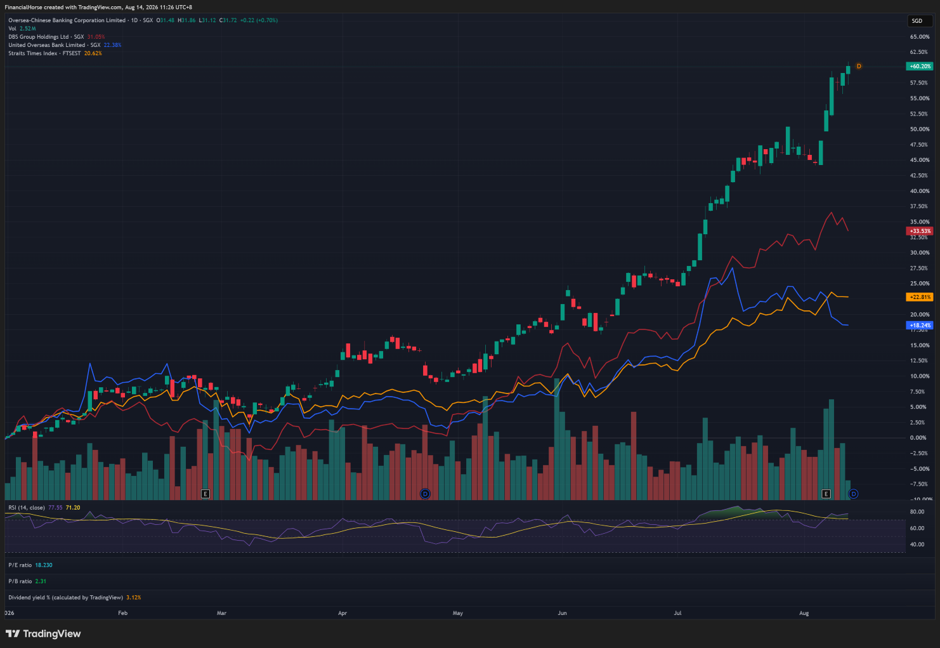
You can see the market has already made up its mind about who won earnings week.
For transparency before we go further — my biggest bank position is OCBC, followed by a smaller position in UOB, and I do not hold DBS today.
So while I was right about OCBC so far, I have been wrong about UOB – let’s see if that may change going forward.
But first let’s look at the earnings for each of the 3 banks.
DBS — the wealth machine, priced at 3x book
DBS delivered its strongest quarter ever.
Net profit of S$3.08 billion, up 9%, with quarterly income crossing S$6 billion for the first time.
The star of the show was wealth management — fees up a whopping 42% year on year, with assets under management crossing S$500 billion for the first time.
This matters because it is exactly what the bull case needed: net interest income fell 2% on lower rates, and wealth fees more than filled the gap.
Management also raised guidance — full-year income is now expected to exceed 2025, with non-interest income growing mid-teens.
ROE came in at 17.5% for the first half.
There is very little to criticise in this set of results.
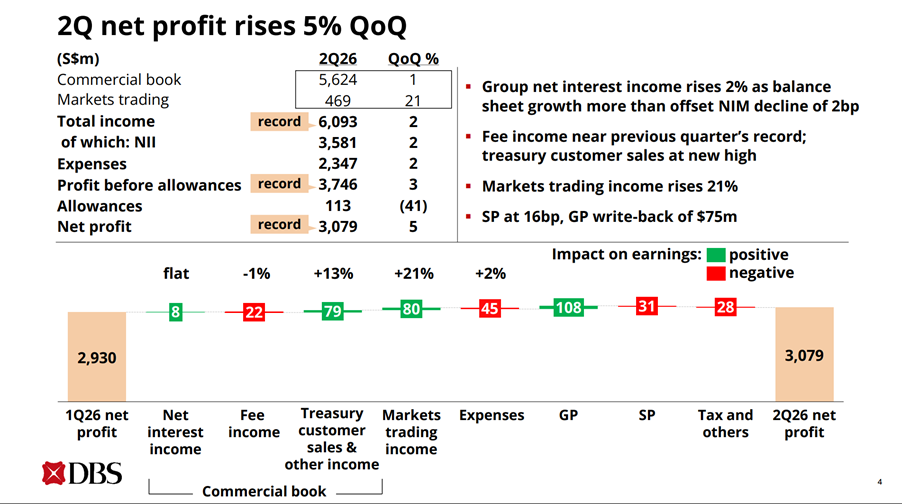
The problem is the price.
At roughly 18x forward earnings and 3.0x book value, DBS trades at close to double its own historical valuation range.
In plain English — you are paying a record price for a bank earning record profits, which means the record needs to keep getting better from here.
OCBC — the blowout quarter
OCBC’s Q2 was the standout of the three.
Net profit of S$2.22 billion, up 22% — the first time OCBC has ever crossed S$2 billion in a quarter, and a double-digit beat of consensus.
Non-interest income rose 51%, wealth fees hit a record, and Great Eastern’s insurance income jumped 68%.
Loans grew 11%, and the interim dividend was raised 15% to 47 cents.
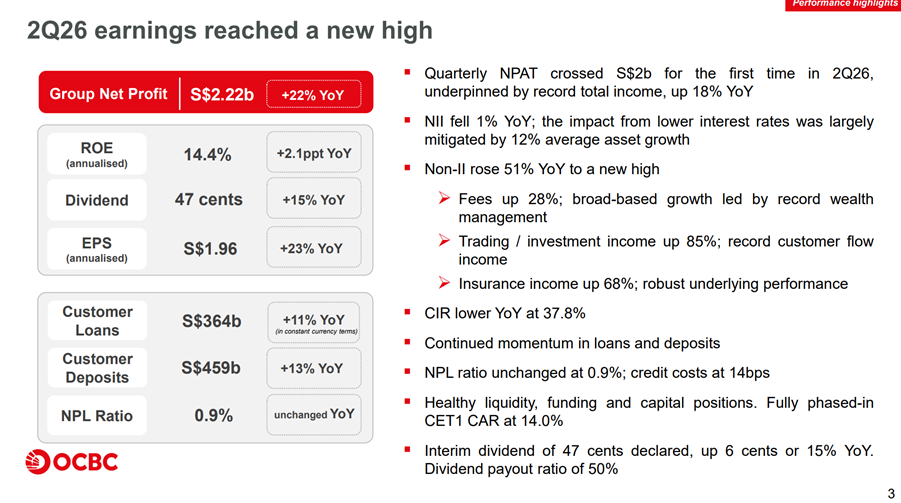
That said, two honest caveats.
First, trading income of S$695 million (up 85%) did a lot of the heavy lifting — and trading income is not the kind of income you want to pay a premium multiple for.
Second, OCBC now runs the lowest NIM of the 3 banks at 1.70%, and its capital ratio stepped down this quarter on the back of 11% loan growth — growth management itself says was partly M&A-driven and will moderate in the second half.
Long story short — an exceptional quarter, but the headline +22% flatters the underlying engine, which looks closer to mid-single-digit compounding once the trading windfall normalises.
At ~17x earnings and ~2.2x book (against a ~1.2x historical average), the market is well aware of how good this quarter was.
UOB — the odd one out
Then there’s UOB.
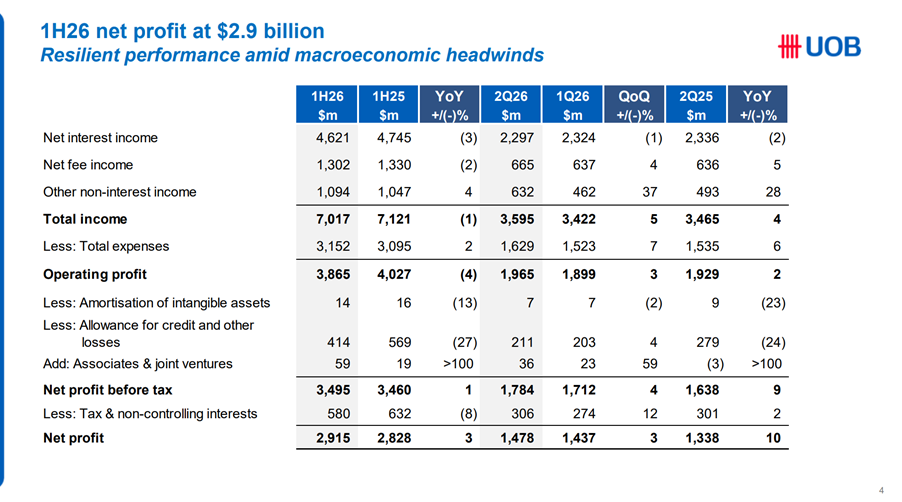
On the surface, the results looked fine — net profit up 10% to S$1.48 billion, record wealth fees, interim dividend raised to 88 cents.
So why did the stock fall almost 5%?
If you ask me, it comes down to 3 things.
One — margins. Q2 NIM came in at 1.74%, below the bank’s own 1.75%–1.80% full-year guidance floor.
Two — fees. Management cut fee income guidance from high-single-digit growth to low-single-digit growth, citing delayed investment banking deals and pressure on card fees.
Three — and this is the big one — asset quality. The NPL ratio rose from 1.5% to 1.6%, and the Greater China NPL ratio jumped from 3.5% to 4.8%, driven by a Hong Kong commercial real estate account.
A lot of readers have pointed this out to me over the years — UOB is simply not delivering at the level of DBS or OCBC today.
I think that is broadly correct, and this quarter did not change the story.
To be fair, the market knows it too — UOB trades at ~11.7x forward earnings and ~1.5x book, by far the cheapest of the three.
And there were real positives buried in the report: ASEAN-4 wealth income up 30%, the S$2 billion buyback 40% done, and the sale of UOB Asset Management to Allianz (with a ~S$330 million gain to come) showing management is serious about recycling capital.
Cheap, but cheap for a reason — for now.
Has the NIM squeeze finally ended?
Now zoom out, because the macro backdrop quietly turned this quarter.
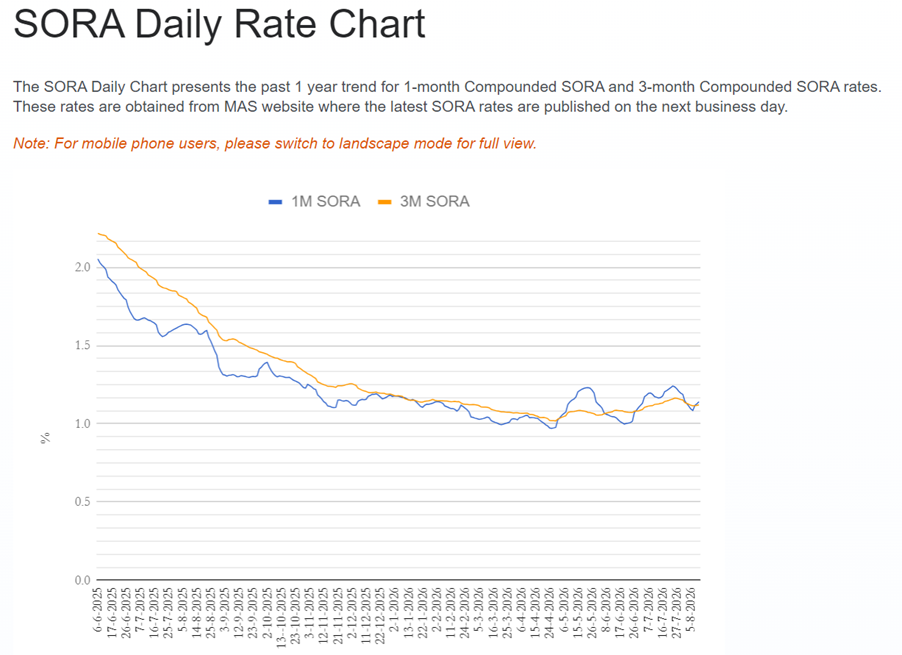
The story of the past 18 months was falling rates squeezing bank margins — 3-month SORA fell about 2.6 percentage points from its peak.
That squeeze looks like it is ending.
3-month SORA has stopped falling, and has actually ticked up for 2 consecutive months to around 1.1%.
MAS surprised markets by tightening policy in July on the back of stronger growth and sticky inflation.
And in the US, the Warsh Fed has shifted from cutting rates to openly signalling that the next move could be a hike.
In plain English — the single biggest headwind for Singapore bank earnings may be turning into a tailwind, for the first time since 2024.
If rates hold here or rise, the NIM pressure that dominated every results call since 2025 starts to fade — and the wealth management engines all 3 banks built during the squeeze get to compound on top of stabilising margins.
That’s the bull case for the sector, and it is a respectable one.
Never miss a post! Follow Financial Horse by subscribing or following us on your favorite platform:
Subscribe to our mailing list for exclusive content straight to your inbox:
The dividends at today’s prices
But here’s the thing about buying banks for dividends at all-time highs — the yield you get depends entirely on the price you pay.
The dividends are summarised below (at 12–13 August prices):
| Bank | Estimated 2026 dividends | Price | Yield |
| DBS | S$3.24 (66c/qtr ordinary + 15c/qtr capital return) | ~S$76.50 | ~4.2% |
| OCBC | ~94c ordinary (+ potential ~18c special in early 2027) | ~S$31.45 | ~3.0% (~3.6% incl. special) |
| UOB | ~S$1.76 | ~S$42.00 | ~4.2% |
Two things stand out.
First, DBS and UOB pay you about 4.2% to wait — respectable, but well below the 5–6% yields these same banks offered before the 2025–26 re-rating.
Second, OCBC — the best performer — now carries the lowest yield, at ~3.0% on ordinary dividends. After a 54% run, the dividend simply hasn’t kept up with the share price.
Sustainability is not the issue — payout ratios sit around 50%, capital ratios are strong, and all 3 banks have buybacks or capital-return programmes running.
The issue is that the market has already paid itself a big chunk of the future income through the price.
So what’s priced in at these valuations?
Here’s the chart for reference — ROE against price-to-book for the 3 banks:
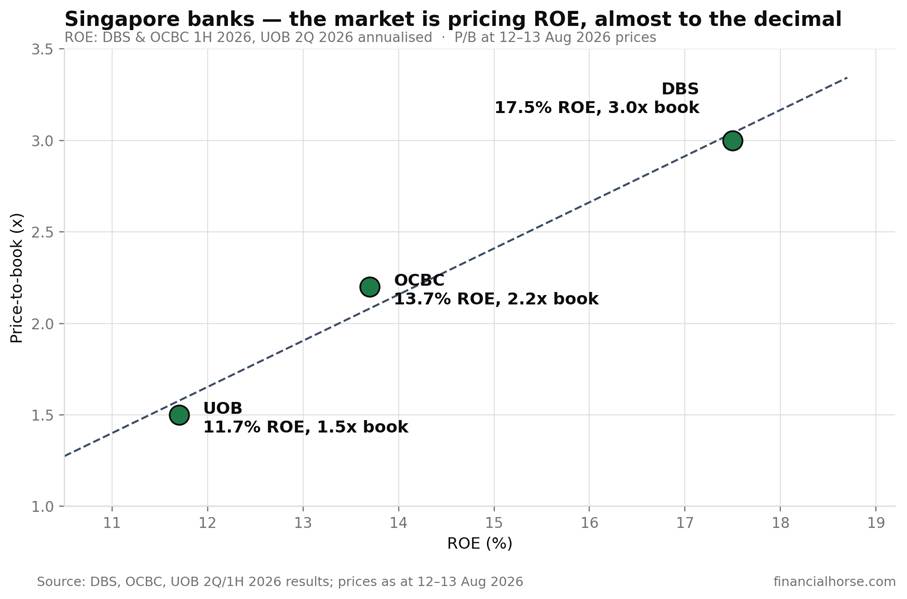
The market is being perfectly rational — the higher the ROE, the higher the multiple.
- DBS earns 17.5% and trades at 3.0x book.
- OCBC earns 13.7% and trades at 2.2x.
- UOB earns 11.7% and trades at 1.5x.
That matters because a bank earning a 12% ROE should not trade at the same valuation as one earning 17.5% — and it doesn’t.
In other words, none of the 3 banks is obviously mispriced against the other two.
The real question is whether the whole sector deserves these multiples — because all 3 banks now trade at roughly double their own historical price-to-book averages.
For these valuations to hold, margins need to have bottomed, wealth fees need to keep compounding, credit costs need to stay benign, and the capital returns need to keep flowing.
That is a lot of things going right at the same time — and it is more or less what the market is now pricing as the base case.
The future doesn’t need to be bad for these stocks to disappoint. It just needs to be normal.
Which brings us to the million dollar question
So — which bank is the better buy?
On the results alone, it is not close: OCBC delivered the best quarter, DBS the best franchise economics, UOB the most question marks.
The problem is that to a large extent – this has already been priced in.
And at today’s prices, here’s how I see it.
DBS is the best bank of the three, and the most expensive stock. At 3.0x book, even flawless execution on the raised guidance may only deliver modest returns from here. Quality is not the question; the entry price is.
OCBC has the best momentum — earnings, guidance upgrades and price action all pointing the same way. But after +54% this year you are paying up for a quarter flattered by trading income, on the lowest margin of the three.
UOB is the cheapest on every metric, and for now, cheap for a reason. Until Greater China credit stabilises and NIM gets back inside guidance, the discount is earned. But watch the next 2 quarters — if NPLs stabilise while the buyback keeps running, the re-rating case starts to write itself.
Long story short — earnings season confirmed these are 3 well-run banks in an improving macro backdrop, at prices that already assume exactly that.
If you forced me to pick one for a 3–5 year holding at today’s prices, I would lean OCBC for the earnings momentum and the diversified franchise – and to be fair OCBC is my largest bank position today I am somewhat biased.
But frankly, “lean” is doing a lot of work in that sentence, because at these valuations while I am letting my existing positions run, I am not keen to deploy significant amounts of new capital into the Singapore banks at these prices.
What I’m doing with my money
As shared above — OCBC is my biggest bank position, UOB a smaller one, and I hold no DBS.
After results, I am holding both positions and letting them run.
My bias historically has been to sell winners too early — and both positions are in strong uptrends with earnings still delivering, so I see no reason to cut a winning position just because it has gone up.
But I am reluctant to deploy new money at these valuations.
Singapore banks are already a meaningful part of my portfolio, and at roughly double historical price-to-book across the sector, the risk-reward for fresh capital is nothing like what it was in 2024–25.
Especially when I see a lot of great stock opportunities out there outside of the Singapore banks – both across tech and value stocks (see my full watchlist on FH Premium).
I can run all the valuation analysis I want, but the trend is powerful and the earnings keep beating — so the practical approach is to respect the uptrend with the positions I already have, while declining to chase it with new money.
What I’m watching from here:
- The trend — a decisive weekly break of the uptrend would have me trimming, not buying the dip
- UOB — NIM and Greater China NPLs over the next 2 quarters
- OCBC — whether fee and trading momentum carries into 2H
- DBS — whether the record multiple holds as the capital-return programme runs down through 2027
So that’s how I’m thinking about the Singapore banks today.
Love to hear what you think — OCBC is up 54% this year. Are you still adding at these prices, or taking profit?
This article was written on 14 Aug 2026. It will not be updated going forward.
My latest macro views, as well as my full stock watch and personal portfolio, are shared on FH Premium.

Great analysis as usual, balanced and practical. Thanks for this man.
Hi FH,
https://sgwealthbuilder.com/2026/09/04/dbs-shares-sgx-d05-made-history/
Previously, I talked up the possibility of DBS shares (SGX: D05) hitting the target price of $80. At the point of writing, it seems that DBS is destined to hit that milestone in a matter of days. Question now is what would be the next mountain to climb – $100 or $120? Thus far, no SGX stock has hit that audacious levels, so I can imagine investors laughing off this idea. But in life, never say never.
The interesting thing about DBS shares (SGX: D05) is that institutional funds have been net selling the stock while retail buyers have been buying. I have compiled the data based on the SGX Fund Flow Weekly Tracker. Note that the data below is just an estimate. There were some weeks in which DBS shares did not feature in the Top Ten Institutional or Retail Net Flows List. Hence, the data may not be 100% accurate.
https://sgwealthbuilder.com/2026/09/04/dbs-shares-sgx-d05-made-history/
Interesting point on instis selling but retail buying.